
The belief that “backup specialties make you look uncommitted” is wildly exaggerated—and sometimes flat-out wrong.
I know that probably clashes with the horror stories you’ve heard in the hallway: “Program directors talk! If they see you applied to two specialties you’re done.” Or the classic: “If you’re not 100% all‑in on one field, they can smell it and you won’t match anywhere.”
Let me say this as someone who thinks through every worst‑case scenario at 2 a.m.: yes, there are ways to screw this up. But the simple fact that you applied to more than one specialty? That alone is not the thing that’s going to sink you.
Let’s actually pick this apart, because the half‑truths are what make you anxious and irrationally scared to protect yourself.
The Core Fear: “If I Apply Widely, I’ll Look Fake Everywhere”
Here’s the nagging thought:
If you apply to, say, dermatology as your dream specialty but add internal medicine and maybe prelim surgery as backups, you imagine PDs sitting in a smoky back room comparing notes:
“Wow, look at this applicant. Applied to derm, IM, and anesthesia. Clearly uncommitted. Reject.”
Reality is much more boring. And more bureaucratic.
Most of the time:
- They don’t see your entire ERAS application list across specialties.
- They’re too busy dealing with their own pile of 1,000+ apps to play detective.
- They care way more about: does your story to them make sense? Does your file match what you’re telling them?
Your fear isn’t totally irrational though. There are situations where your strategy can make you look scattered or disingenuous. That’s what you actually need to manage—not the sheer act of having backups.
What Programs Actually See (And What They Don’t)
Let’s handle the surveillance paranoia part first.
Programs do not get an automatic report saying: “This applicant applied to 3 specialties, 76 total programs.” That’s not a thing.
What can reveal your backup strategy?
- Letters of recommendation not matching the specialty
- Personal statements that are generic or obviously repurposed
- Inconsistencies in how you talk about your career in interviews
- If you accidentally send a specialty‑specific letter to the wrong field (e.g., “X will be an outstanding plastic surgeon” in your family medicine app—yes, I’ve seen this happen)
The cross‑specialty intel usually comes from:
- You (voluntarily admitting it, sometimes unnecessarily)
- Shared faculty between departments who know you well
- Very small fields at the same institution where people literally talk (“Hey, did you interview that student who also applied to us?”)
So the risk is not: “I applied to 2 specialties, I’m doomed.”
The risk is: “I created a messy paper trail and now I look like I don’t know what I’m doing.”
Big difference.
The Real Question: How Competitive Are You Actually?
Let me be harsh for a second: the people who preach “never have a backup, it shows weakness” are usually:
- Already competitively positioned (top 10% of class, 260+ scores, research coming out their ears), or
- Speaking from memory of a less competitive era, or
- Just…overconfident and projecting that onto you
You’re not weak for asking, “What’s my actual risk here?”
You’re smart.
If your dream specialty is highly competitive—derm, ortho, ENT, plastics, neurosurgery, ophtho, urology, integrated vascular/CT—then “no backup” can easily become “no match.”
Here’s a rough (not perfect, but emotionally clarifying) comparison:
| Specialty | General Competitiveness* | Common Backup Strategy |
|---|---|---|
| Dermatology | Very High | IM, Transitional Year |
| Orthopedic Surg | Very High | General Surgery, Prelim Surgery |
| ENT | Very High | General Surgery, IM |
| Plastic Surgery | Very High | General Surgery, Prelim Surgery |
| Anesthesiology | Moderate-High | IM, Transitional Year |
| Internal Med | Moderate | Often *is* the backup |
*“Very High” = consistently high Step scores, strong research, limited spots, lots of unmatched each year.
Now ask yourself the brutal questions:
- Are your scores consistent with successful applicants in your dream specialty?
- Do you have at least some specialty‑specific letters/research?
- Did your school’s advisors say, “You should be fine,” or did they say, “You must apply broadly”?
If multiple realistic people in your life are saying, “Please have a safety net,” ignoring them because you’re scared of “looking uncommitted” is like refusing to wear a seatbelt because it might crease your shirt.
When Applying to a Backup Really Can Backfire
You’re not wrong that there are scenarios where backup applications can hurt you.
Here’s where it actually gets risky:
You only do half the work for both fields
Your derm apps are okay, your IM apps are weak, and you don’t look strong anywhere. PDs don’t think, “Wow, they’re broad and flexible.” They think, “This app is mediocre.”Your letters scream a different specialty
- Applying to EM with 3 glowing IM letters and no EM letter? Red flag.
- Applying to ortho with one ortho letter and three peds letters? Confusing.
You send the wrong document to the wrong specialty
The “I’ve always wanted to be a neurologist” personal statement that goes to anesthesia. The “future surgeon” LOR attached to psych. These are the unforced errors that create doubt about your judgment.You tell different stories in different rooms
When you tell one program, “I can’t imagine doing anything other than anesthesia,” and at another place you say, “I realized during fourth year that IM is where I belong”—and the faculty overlap—you can come off as disingenuous rather than evolving.You use a backup in a way that makes no coherent sense
Applying to derm and OB/GYN with literally no OB exposure, no letters, no explanation. That doesn’t read as “open‑minded.” It reads as “random” or “desperate.”
So yeah, there’s a way to look uncommitted. But it’s not because of the number of specialties. It’s because of inconsistency, sloppiness, and lack of narrative.
How to Apply to a Backup Without Looking Like a Flake
Let’s talk tactics. You can cover yourself and still look serious.
1. Decide Your Primary vs Secondary Early
You don’t have to advertise this to anyone, but in your head—and with your advisor—be very clear:
- “I’m primarily applying to ENT, with IM as a true backup.”
- “I’m all‑in on ortho, but I’m adding 10 prelim surgery spots for insurance.”
This mental clarity will keep you from creating a Frankenstein application.
2. Build a Coherent Story for Each Specialty
You don’t need some elaborate life‑changing narrative. You do need a believable through‑line.
Two questions you need to answer cleanly in your own mind:
- Why this specialty? (for each one you’re applying to)
- Why would it make sense—based on my experiences—that I’m interested in it?
Example: You’re applying to EM and IM.
For EM:
- EM shifts, EM research, you like acute care, fast decisions, procedures, undifferentiated complaints.
For IM:
- You like longitudinal care, complex multi‑problem patients, teaching, critical thinking on the wards.
The key is: both stories should draw from real things you’ve done. Not vague “I like problem solving and teamwork” copy‑paste clichés.
3. Use Specialty‑Specific Personal Statements
Yes, it’s extra work. Sorry.
You absolutely should not use the same generic personal statement for every field.
At minimum:
- One solid statement tailored to your main specialty.
- One clear, genuine statement for your backup field that doesn’t sound last‑minute or resentful.
Please don’t write: “Although my ultimate interest has been dermatology, I would also be happy in internal medicine.” That just screams: “You are my consolation prize.”
4. Match Your Letters to Your Story
If you’re dual‑applying, your letters need to reflect that someone in that field actually knows you.
Something like:
- 2 letters from your primary specialty
- 1–2 from your backup specialty
- 1 from a core clerkship or research mentor depending on the field
Don’t make your backup apps entirely staffed by letters from another specialty. That looks like you didn’t really care enough.
5. Don’t Overshare Strategically in Interviews
You don’t need to lie. But you also don’t have to hand them ammunition.
If an IM program asks: “Are you applying to other specialties?” the safest honest but contained answer is something like:
“I explored [primary specialty] very seriously and have a strong interest there, but I realized I’d be genuinely happy in internal medicine as well. I’m applying to both because I could see a fulfilling long‑term career in either field. What specifically draws me here is [specific aspects of their program].”
That’s different from panic‑rambling:
“I mean, yeah, I applied to EM too because I was scared of not matching and my advisor said I should…”
You’re allowed to sound thoughtful, not terrified.
When You Probably Should Have a Backup Specialty
Let’s be uncomfortably honest. You should at least seriously consider a backup if:
- Your Step scores are significantly below the mean for your dream field
- You have no research in a very research‑heavy specialty (derm, ENT, plastics, etc.)
- You’re at a school with limited home support for that specialty
- Multiple advisors independently say, “I’d feel more comfortable if you applied more broadly”
Also: risk tolerance matters. If the idea of not matching at all would absolutely wreck you—and you already know your stats are borderline—it’s rational to give yourself an off‑ramp.
Here’s a simple mental model:
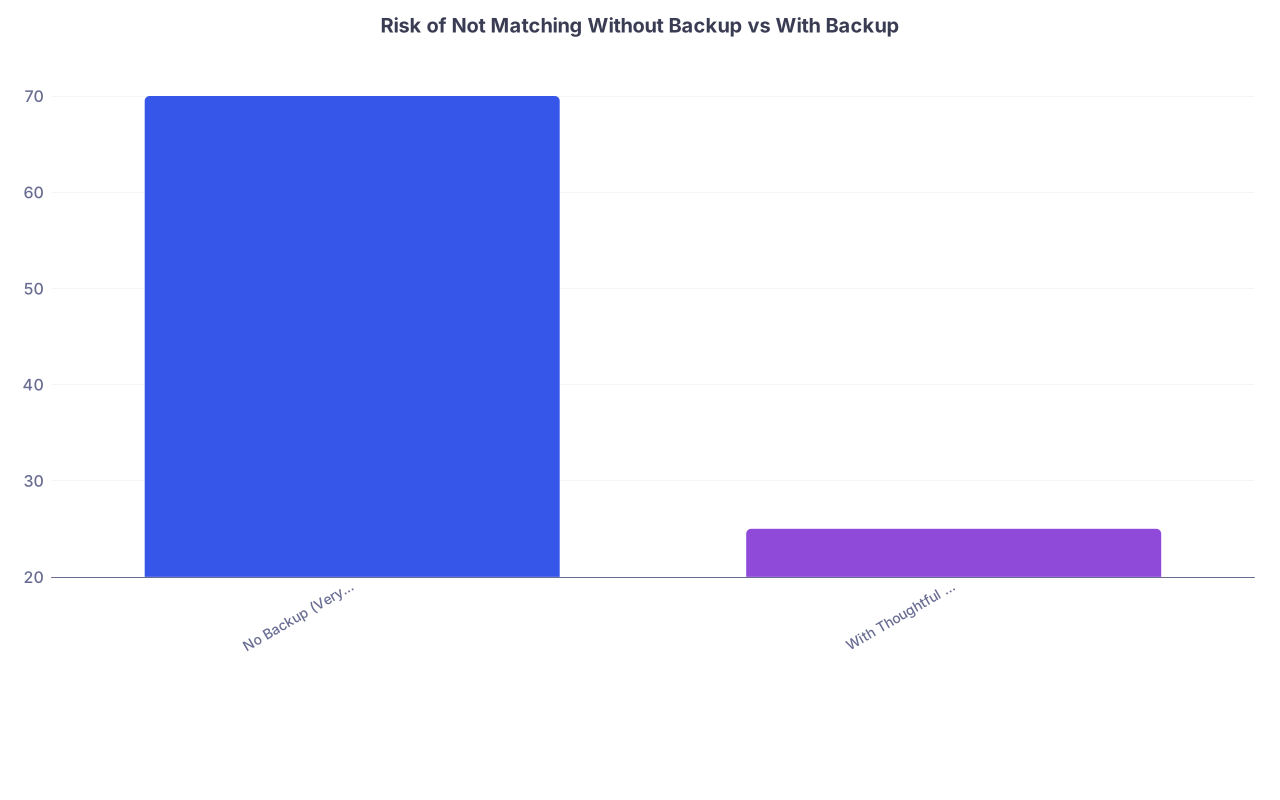
| Category | Value |
|---|---|
| No Backup (Very Competitive Field) | 70 |
| With Thoughtful Backup | 25 |
No, those numbers aren’t exact. But that’s the emotional truth: for many borderline applicants in ultra‑competitive fields, the risk of not matching anywhere drops dramatically when they apply smartly to a backup.
The One Thing You Can’t Do: Pretend the Risk Isn’t Real
You know what actually keeps people from matching?
Not “looking uncommitted.”
It’s:
- Underrating how competitive their dream field really is
- Refusing to run the numbers honestly
- Ignoring feedback because “someone from my school matched last year with worse scores”
- Hoping the universe rewards “passion” while everyone else brought both passion and realistic planning
You’re not weak or disloyal for wanting a net under your tightrope. You’re a person who doesn’t want to be scrambling for a SOAP position at 3 p.m. on Match Week Monday, refreshing your email while your classmates are posting “I matched!” screenshots.
And I say that as someone who absolutely loses sleep over that exact scenario.
How to Keep Your Sanity While Applying Widely
Last part, because the anxiety isn’t just logistical. It’s emotional.
A few things to hold onto:
Programs care about whether you’ll work hard and fit in.
If your app is coherent, your story makes sense, you interview decently, and your letters are fine, they’re not going to reject you purely because you liked two different ways of practicing medicine.Your interests can evolve without being fake.
Liking two specialties doesn’t make you uncommitted. It makes you a human being who liked more than one kind of work.You’re allowed to prioritize matching over optics.
You know what looks worse than “uncommitted”? Being unmatched because you were trying to look perfectly committed to a field that didn’t pick you.
The Bottom Line
Here’s what actually matters:
- Applying to a backup specialty does not automatically make you look uncommitted. Sloppy, inconsistent applications do.
- You’re safer—and often smarter—protecting yourself with a well‑planned backup than gambling everything on a long‑shot field.
- The key is coherence: clear story, specialty‑specific statements and letters, and not treating backup programs like they’re obviously second class when you talk to them.
If you can do those three things, you’re not “sabotaging” yourself by applying widely. You’re just refusing to let fear of looking uncommitted push you into the much worse fear: not matching at all.