
The nightmare isn’t failing. It’s succeeding…in the wrong specialty.
You’re not scared you won’t match. You’re scared you will match and then wake up PGY-3 thinking, “I picked wrong, and now I’m trapped.”
Let’s say it out loud so your brain stops whispering it at 2 a.m:
“I love two competitive specialties. What if I choose the wrong one and ruin my career?”
You’re not the only one. I’ve watched people spiral over IM vs derm, ortho vs neurosurg, EM vs anesthesia, plastics vs ENT, gas vs cards, you name it. Same pattern: overthinking, Reddit doomscrolling, stalking PD quotes from 2015 like they’re scripture, making pros/cons lists that somehow make you more confused.
I’m going to walk through this the way I wish someone had done for me: blunt, specific, and with the actual worst-case scenarios on the table. Not the sugar-coated brochure version.
First: The “Wrong Specialty” Fear Is Overpowered
Here’s the harsh truth:
You are giving this decision way more power than it actually has.
I know that sounds insane because it feels like the fork in the road. But think of the people you’ve actually met in residency and beyond. How many of them are truly, deeply, “I hate my life, I picked the wrong specialty and I can never escape” level miserable?
Not “tired.” Not “burned out this month.” I mean existentially wrong.
I’ve met a few. Very few. And almost every time, it wasn’t:
- “I loved ortho and loved neurosurg and simply picked the slightly wrong one.”
It was:
- “I chose based on prestige / pressure / money / one attending’s opinion, and I ignored all the red flags about lifestyle / values / what I actually like doing day-to-day.”
In other words, the real disaster isn’t choosing between two specialties you truly love.
It’s choosing something you like on paper but hate in real life.
That’s not you. You’re in the rare situation where you’d probably be happy in either lane and your brain is trying to turn that into a horror movie.
Two Competitive Loves: Why This Is Mentally Brutal
Here’s why this feels uniquely awful:
Both are hard to match.
You can’t just “apply to both” easily without:- Watering down your application
- Confusing PDs
- Looking unfocused
Both have strong cultures/identities.
Ortho, derm, ENT, plastics, rad onc, urology, neurosurg, ophthalmology, etc. They’re tribes. Once you’re in, people assume you always wanted that tribe and nothing else.Your brain thinks it’s permanent.
It’s screaming:- “If I pick wrong, I’ll never get out.”
- “If I switch, programs will judge me.”
- “I’ll be behind, poor, and unemployable.”
Picture yourself as a PGY-2 in one of them. What’s your mental movie?
- Are you jealous of the other specialty?
- Or are you doing procedures / clinics / reading / call in your chosen field and not thinking about the other one at all because you’re busy and mostly okay?
Most people who pick between two things they genuinely like? They adapt. Their identity slowly attaches to the thing they actually do every day. The “what if” doesn’t vanish, but it gets quieter.
Your anxiety is loud now because the choice is abstract. Once it becomes concrete, life fills in around it.
Worst-Case Scenarios: Let’s Actually Spell Them Out
You’re a catastrophizer. So let’s catastrophize accurately, not vaguely.
Scenario A: You Pick Specialty 1, and It’s… Fine (Not Amazing)
You match into, say, ENT instead of plastics. Or cards instead of anesthesia. Or derm instead of rheum. Whatever.
You realize:
- You like the work
- You like most of the people
- Occasionally you wonder, “Would I have liked [other specialty] more?”
This is not a tragedy. This is 90% of adults in any career. They don’t all walk around thinking they’re in their one, perfect, bespoke calling. They’re in a decent match and make the most of it.
You can nuance your path within that:
- Pick certain fellowships
- Carve out a niche
- Shift toward more procedure-heavy vs clinic-heavy practice, or vice versa
- Change practice setting: academic vs community, big city vs rural
This is probably what actually happens to most people.
Scenario B: You Pick Specialty 1, and Halfway Through You Think, “I Screwed Up”
This is the one that wakes you up at 3 a.m.
You’re PGY-2. You’re exhausted. The honeymoon’s over. The other specialty suddenly looks like paradise.
What then?
Here’s what actually happens in the real world, not in Reddit mythology:
- Residents do switch specialties. Not every day, but regularly enough that PDs are not shocked when it happens.
- It’s way easier to switch from a competitive specialty to a less competitive one (neurosurg → anesthesia, ortho → FM, derm → psych, etc.).
- Switching between two equally competitive ones is harder but not impossible. It usually requires:
- A PD who doesn’t hate you
- A clear, honest story (“I discovered I really missed X type of patient / work”)
- Some hustle: networking, away rotations (if allowed), maybe a research year or prelim/transitional year in the new field
Is it clean? No. You might:
- Lose a year or two
- Take a pay hit temporarily
- Move cities again
- Explain your story multiple times
But this “I’ll be stuck in a prison for 40 years” narrative? That’s the part that’s a lie. Residency is structured, but the rest of your life is not a locked track.
Scenario C: You Don’t Match the One You REALLY Wanted
Another fear hiding under this:
“What if I commit to one, don’t match, and then I’ve nuked my chances at the other one too?”
This is real. If you go all-in on, say, derm and don’t dual-apply, and then you don’t match, it hurts. Badly. I’ve seen people spiral for months.
But then… they pivot.
Common routes:
- Reapply with a research year
- Enter a prelim year (surg/medicine/transitional) and then try again
- Pivot into the second specialty you loved anyway, sometimes with a stronger story because you’ve got more clinical time and maturity
Your brain treats “not matching this cycle” as equivalent to “career destroyed.” It’s not. It’s “career delayed and rerouted.” It sucks. It’s survivable.
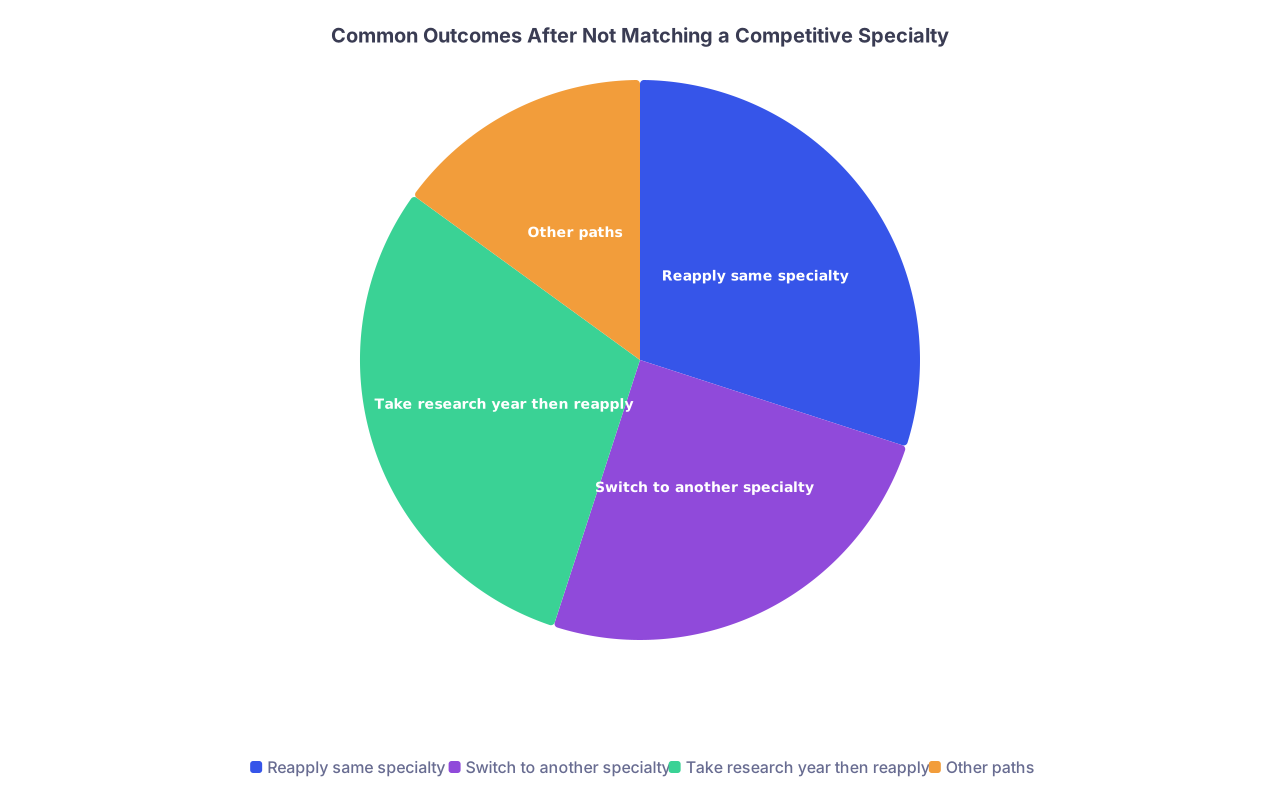
| Category | Value |
|---|---|
| Reapply same specialty | 30 |
| Switch to another specialty | 25 |
| Take research year then reapply | 30 |
| Other paths | 15 |
The Boring, Unsexy Truth About Limiting Regret
If you strip away prestige and fear, here’s what actually drives long-term satisfaction:
- The daily work: clinic vs OR vs procedures vs ICU vs reading images vs doing scopes.
- The people: Which personality type do you tolerate best at 3 a.m.?
- The schedule pattern: shift work? home call? Q4 28-hour calls? clinic-heavy?
- Your tolerance for training length and delayed gratification.
If you’re stuck between two loves, start interrogating the boring details, not the branding.
Ask yourself:
- On a random Tuesday, what am I physically doing in each specialty?
- Who am I talking to? Families? Surgeons? Hospitalists? Referring docs?
- How much of my day is hands-on vs computer vs talking?
- If I’m dead tired, which kind of tired would I rather feel: OR tired, clinic tired, ICU tired, call-room tired, or neck-pain-from-PACS tired?
You can absolutely be in love with the idea of a specialty but actually hate the daily grind of it. I’ve watched people realize this in real time on sub-I’s.
The “Can I Fix It Later?” Question (Switching, Fellowships, Hybrids)
Your brain wants to know: if I pick one now, how much wiggle room is there later?
More than you think, less than you wish.
Some real-world ways people “correct” course:
Internal medicine → cards / GI / pulm crit / heme-onc / rheum / endo
People go into IM partly because they’re interested in several of these and want time to decide. It’s flexible within IM.General surgery → surg onc / vascular / colorectal / trauma / MIS / plastics (rare, but seen)
People sometimes use gen surg as a base then narrow later.Pediatrics → peds cards / peds endo / peds EM / peds crit / neonatology
Again, base first, niche later.Anesthesia → crit care / pain / cardiac / peds
If you like physiology and procedures but aren’t sure where to land, anesthesia keeps some doors open.
Then there are harder pivots:
- EM → anesthesia
- Surgery → radiology
- Path → radiology (or vice versa)
- Neurology → psych
These all happen. Not cleanly, but they do.
And yeah, there are some “hybrid lifestyles”:
- Interventional radiology vs vascular surgery
- Cards vs CT surgery dynamics
- EM + critical care
- Medicine + palliative care or addiction as a niche
No, they’re not perfect blends. But your future is more malleable than your anxiety will admit.
| Base Specialty | Flexibility for Later Shift |
|---|---|
| Internal Med | High |
| Pediatrics | High |
| General Surgery | Moderate |
| Anesthesia | Moderate |
| EM | Low-Moderate |
| Derm/Ortho/Neurosurg/ENT/Plastics | Low |
So What Should You Actually Do Right Now?
You’re probably looking for a hack. Some magic framework that will give you certainty. You’re not going to get certainty. You’re going to get “enough clarity to move.”
Here’s the most practical approach that doesn’t wreck your application:
1. Go All-In on One Specialty Publicly
Competitive fields want commitment. If you start sending weird signals (“I love ortho but also neurosurg and also maybe anesthesia?”), you just look unfocused.
So:
- Pick one to present as your main identity to faculty, letters, PDs.
- Pour your CV into that: research, mentors, sub-I’s, personal statement.
This is terrifying, I know. It feels like closing a door. But half-committing to both is how you actually increase your chances of ending up with neither.
2. Quietly, Seriously Test the Other One
While you’re building a coherent application narrative, you can still:
- Do an early elective in the other specialty
- Shadow a few days or a week
- Have brutally honest conversations with residents in both
- Ask attendings you trust, “Knowing me, do you see me in [X] or [Y]?”
But don’t just collect generic “follow your passion” fluff. Ask concrete questions:
- “What do you hate about this job?”
- “If you had to pick something else now, what would it be and why?”
- “What kind of resident is miserable in this field?”

3. Decide on a Backup Strategy Before Interview Season
If your top choice is super competitive (derm, plastics, ortho, ophtho, ENT, neurosurg, IR, rad onc), ask yourself:
- Am I willing to dual-apply (e.g., derm + IM, ENT + gen surg, ortho + prelim surg)?
- Or am I going single-specialty and accepting the risk of SOAP / reapply / research year?
There’s no universally right answer. Just don’t wait until Match Week to think about it for the first time.

| Step | Description |
|---|---|
| Step 1 | Love Two Competitive Fields |
| Step 2 | Commit to that field |
| Step 3 | Test both via electives and mentors |
| Step 4 | Choose one for primary app |
| Step 5 | Single apply and accept reapply risk |
| Step 6 | Dual apply with clear primary story |
| Step 7 | Is one clearly stronger fit? |
| Step 8 | Still torn by apps time? |
| Step 9 | Risk tolerance high? |
How Do You Live With the Uncertainty?
This is the part nobody explains. Not the logistics. The emotional hangover.
Here’s the uncomfortable truth: even after you match, you may still occasionally wonder about the road not taken. That doesn’t mean you chose wrong. It means you’re human.
You can handle that by:
Letting the decision be “right enough,” not perfect.
You’re choosing between two good options. This isn’t picking toxic vs healthy; it’s picking good vs also good.Focusing on being excellent where you land.
Being good at your job feels way better than being in your “perfect” specialty but constantly behind, checked out, or resentful.Remembering you’re allowed to change your mind later.
Not for free. Not easily. But you’re not trapped in amber.

A Quick Reality Check on “Competitive”
A lot of this fear is amplified because both specialties are “competitive,” which your brain translates to: rare, magical, uniquely precious doors that once closed can never open again.
Reality:
- Yes, the match odds are lower.
- Yes, you need a coherent, focused application.
- No, this doesn’t mean that choosing one competitive field over another is equivalent to burning the other forever.
People match competitive specialties as:
- Reapplicants
- Switchers
- Non-traditional applicants
The path gets windy, not erased.
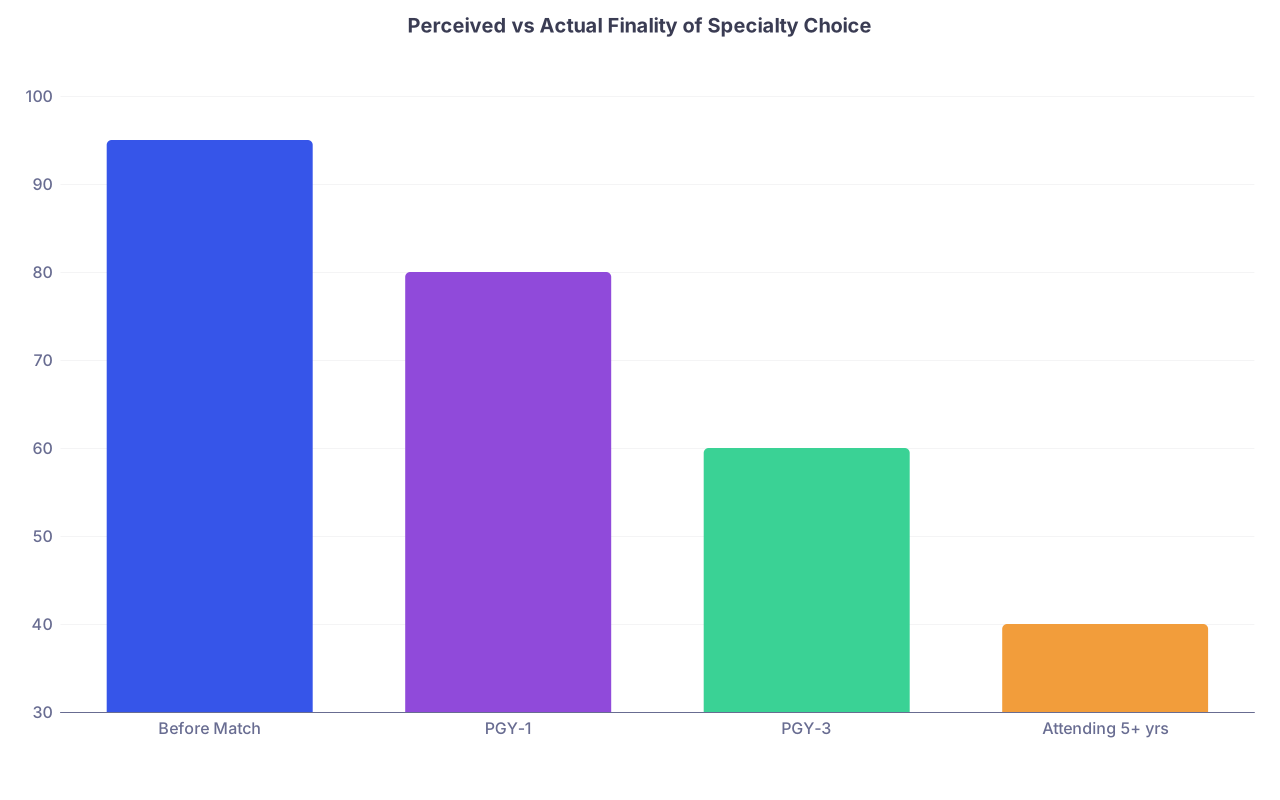
| Category | Value |
|---|---|
| Before Match | 95 |
| PGY-1 | 80 |
| PGY-3 | 60 |
| Attending 5+ yrs | 40 |
(Think of those numbers as “percentage of people who feel their choice is permanent,” not actual locked-in reality.)
FAQs
1. What if I genuinely love both equally and nothing is clearly better?
Then you stop waiting for a feeling of 100% certainty that isn’t coming. You pick based on:
- Day-to-day work you slightly prefer
- Training length and lifestyle you can tolerate
- Where your application is currently stronger (research, mentors, letters)
And then you commit to that decision like it was the plan all along. Indecision will do more damage than a “slightly off” choice between two good fits.
2. Is dual-applying to two competitive specialties a bad idea?
Usually, yes. Dual-applying to two ultra-competitive specialties (say plastics + ENT, or derm + ophtho) often makes you look unfocused and weak in both, unless there’s a very cohesive story and insane stats. A more realistic dual-apply is one competitive + one less competitive but related base (derm + IM, ENT + gen surg, ophtho + prelim medicine or surgery).
3. Will PDs think I’m flaky if I ever try to switch specialties later?
Some will. Many won’t. What they hate is confusion and BS. If you switch with:
- A clear, honest explanation
- Good evaluations in your original field
- Strong letters from your new area
then you look like someone who made a thoughtful correction, not a flake.
I’ve seen PDs be very supportive of residents switching out when it was clearly the right move for the person.
4. Should I just pick the one with better lifestyle or money to be “safe”?
If you’re really torn and both are equal in love, it’s reasonable to let lifestyle tilt the scale. But choosing a specialty you actively dislike just for lifestyle or money is one of the few reliably bad long-term moves. You can burn out in “lifestyle” specialties too if you hate the content of your work.
5. Is it true that once I match a highly specialized field (like neurosurg, ENT, plastics, derm), I’m stuck forever?
No. It’s harder to pivot because your skills are narrow and you’ve invested a ton of years, but people do leave for:
- Another clinical specialty (less common but real)
- Industry, med tech, pharma
- Admin, quality, consulting
- Non-clinical roles entirely
Your MD plus your training is still a powerful credential. You are not stuck in a single-room box.
6. What’s the single best thing I can do right now to reduce regret later?
Get brutally honest exposure. Not one rosy elective where the star attending shows you their best days. Multiple weeks, different attendings, nights, weekends if you can. Then write out—on paper—the parts you hate and the parts you love about each specialty. Your brain clings to the fantasy version. Force yourself to look at what the job actually is.
Key points to walk away with:
- Choosing between two specialties you genuinely like is not how people end up in catastrophic, soul-crushing mismatch; ignoring your own values and daily preferences is.
- Your choice isn’t as irreversible as your anxiety claims—corrections are possible, though not painless.
- You’ll never get perfect certainty; you’re aiming for “good enough, with eyes open,” then committing and building a life that makes that choice work.