
The dirty secret is this: most program directors can spot a “backup specialty” applicant in under 30 seconds—and they rarely reward it.
You think you’re being strategic. They think you’re hedging, unserious, and hoping they will be your safety net while you chase something more glamorous. And that framing colors everything they see in your file.
Let me walk you through how this really plays out behind closed doors, because what students think programs believe and what PDs actually say in rank meetings are not the same world.
The Two Kinds of Backup Applicants PDs See
Program directors do not use the phrase “backup applicant.” They use words like “flight risk,” “not committed,” or the more polite version: “I do not see this person as a future [insert specialty] physician.”
There are two main species.
The obvious hedge
This is the ortho applicant suddenly applying Internal Medicine in January. The plastics hopeful now throwing apps at General Surgery. The radiology-bound student tossing in Family Medicine “just in case.”Faculty will literally say in meetings:
- “This is a derm application in disguise.”
- “They’re only here because derm didn’t work out.” And that’s usually the end of the discussion.
The thoughtful pivot
This is the person who started out thinking about one specialty, did a serious re-evaluation, and pivoted early with clear evidence, letters, and a coherent story.Very different reception:
- “Started as ENT, but this is a legit IM applicant now.”
- “They figured it out late, but the letters are strong and this story tracks.”
The second group gets ranked. The first group gets filtered out or buried.
How PDs Actually Detect Backup Applicants
You’re not slick. The ERAS application gives you away in about six different ways.
Here’s how PDs and faculty read between the lines.
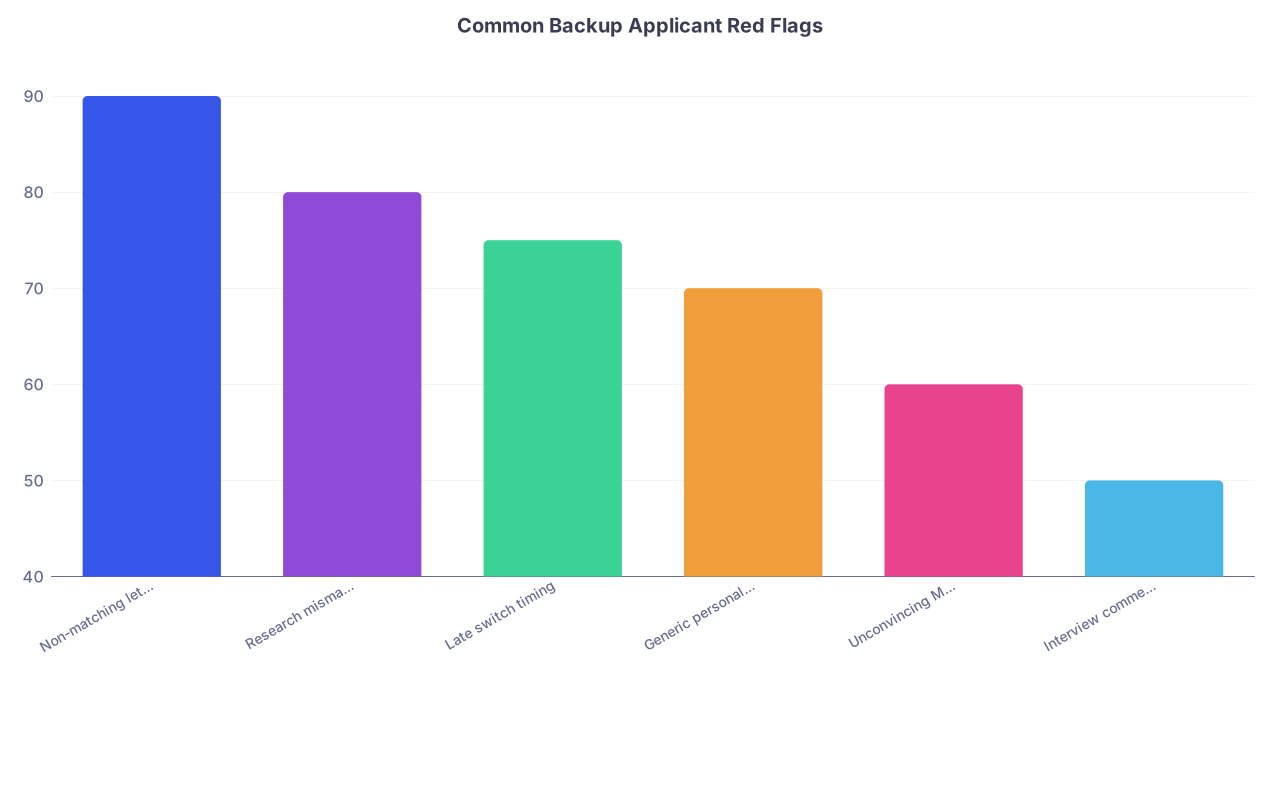
| Category | Value |
|---|---|
| Non-matching letters | 90 |
| Research mismatch | 80 |
| Late switch timing | 75 |
| Generic personal statement | 70 |
| Unconvincing MSPE | 60 |
| Interview comments | 50 |
1. Letters that don’t match the specialty
This is the biggest and most immediate tell.
I’ve sat in ranking meetings where a PD scrolls your ERAS, sees three letters from dermatology, one from medicine, and just says, “Next.”
They look for:
- At least two strong letters from core faculty in that specialty
- Ideally one from a sub-specialist at a recognizable program
- Language that clearly frames you as “this specialty” material
If your strongest letters are from another specialty, the conversation usually goes like this:
“Why are they applying to us with all these surgery letters?”
“Because surgery didn’t work out.”
“Then I don’t want to be their consolation prize.”
Brutal, but accurate.
2. Research that screams another field
If your CV is:
- 7 ortho publications
- 3 spine abstracts
- A first-author paper on ACL reconstruction
…and you’re now applying to PM&R with one weak rehab case report slapped on at the end?
Faculty notice. They talk.
It’s not that you can’t pivot. It’s that the pattern has to change in a believable way. If you’re selling “I’m passionate about IM,” but your entire scholarly identity is pediatric neurosurgery, they don’t believe you.
3. The timeline in your MSPE and rotations
Backup applicants usually pivot late and leave footprints:
- Fourth-year schedule stacked with one specialty, with their new specialty tacked on at the end
- No sub-I in the new field
- Very limited exposure before interview season
In committee, someone will scroll to your schedule and say:
- “They didn’t even do an acting internship in our field.”
- “They only did our rotation in December. That’s a safety move.”
If your school’s MSPE hints at you “exploring multiple specialties” or “still deciding late into fourth year,” that gets interpreted as: “couldn’t commit” or “shopping around until something stuck.”
4. The personal statement that tries to serve two masters
PDs pass around personal statements that are obviously copy-pasted from another specialty. I’ve seen them outright mocked in a room.
The classic backup PS mistakes:
- Vague language: “I enjoy procedures and longitudinal care and acute emergencies”
- No concrete story grounded in that specialty’s day-to-day
- Generic “I like teamwork and continuity” paragraphs that could apply to 15 fields
A PD once said, while reading an applicant’s statement out loud:
“This could be a personal statement for IM, FM, EM, or rads. Which means it’s not really for us.”
When your PS is trying too hard to keep other doors open, faculty can feel it. They don’t respect it.
5. Interview answers that betray your first love
This is where a lot of “backup” applicants destroy themselves.
Interview questions that expose you:
- “What other specialties were you considering?”
- “Why this specialty over [the one you spent two years researching in]?”
- “Tell me about your long-term career vision in this field.”
Bad answers:
- “I loved derm but realized I also like internal medicine.”
- “Surgery was great but I wanted more lifestyle.”
- “I’m still open to a lot of things but thought this would be a good fit.”
In faculty debrief:
- “Still sounds like they want surgery.”
- “They’re trying to sell lifestyle, not genuine interest.”
- “If they got a derm spot tomorrow, they’d take it.”
Once that seed is planted—“they’re a flight risk”—your rank position drops instantly, if you make the list at all.
How This Differs by Specialty Competitiveness
Not every specialty treats “backup” behavior the same. The more competitive the field, the more ruthless they are about commitment.
| Specialty Type | Tolerance for Apparent Backup | Typical PD Reaction |
|---|---|---|
| Hyper-competitive (Derm, Ortho, Plastics) | Very low | Immediate red flag |
| Competitive (EM, Anes, Radiology) | Low to moderate | Requires strong story |
| Mid (IM, Gen Surg, Psych) | Variable by program | Scrutinize commitment |
| Primary Care (FM, Peds) | Somewhat higher | Look for genuine interest |
Hyper-competitive fields: they do not want your half-hearted attempt
In derm, plastics, ortho, ENT, neurosurgery—if they suspect their field is your second choice, you’re done.
These PDs live in a market where they can be picky. They want people who would crawl through glass to do their specialty. If there’s even a faint hint that you’re using them as a hedge, someone else with similar metrics but clearer commitment will take your spot.
Competitive but slightly more flexible fields
Anesthesia, EM, radiology—they see a lot of borderline pivots:
- Surgery to Anesthesia
- IM to Radiology
- EM to Anesthesia
- Derm reject to IM
Here, the story matters more. If you can explain a believable evolution:
“I liked surgery, but realized I’m more drawn to perioperative physiology and critical care. I sought out an anesthesia rotation, did research, and found my fit.”
That gets discussed seriously.
If you say:
“Surgery lifestyle wasn’t for me, so I picked anesthesia,”
you get labeled as a lifestyle shopper, not a real convert.
IM, Psych, FM, Peds: not as desperate as you think
A lot of students treat IM, FM, and Peds as their “safe” options. PDs are very aware of this and have become more skeptical over the last decade, especially at university programs.
You’ll literally hear:
- “We are not your derm backup program.”
- “If they’re not going to build a career in IM, I’d rather use this spot on someone who will.”
Community programs with staffing needs may be more flexible, but academic IM or strong FM programs? They want people who chose them, not people who fell down to them.
The One Thing PDs Care About Most: Will You Actually Show Up?
Here’s the unspoken fear behind all this suspicion: PDs are terrified of unfilled spots and post-Match ghosts.
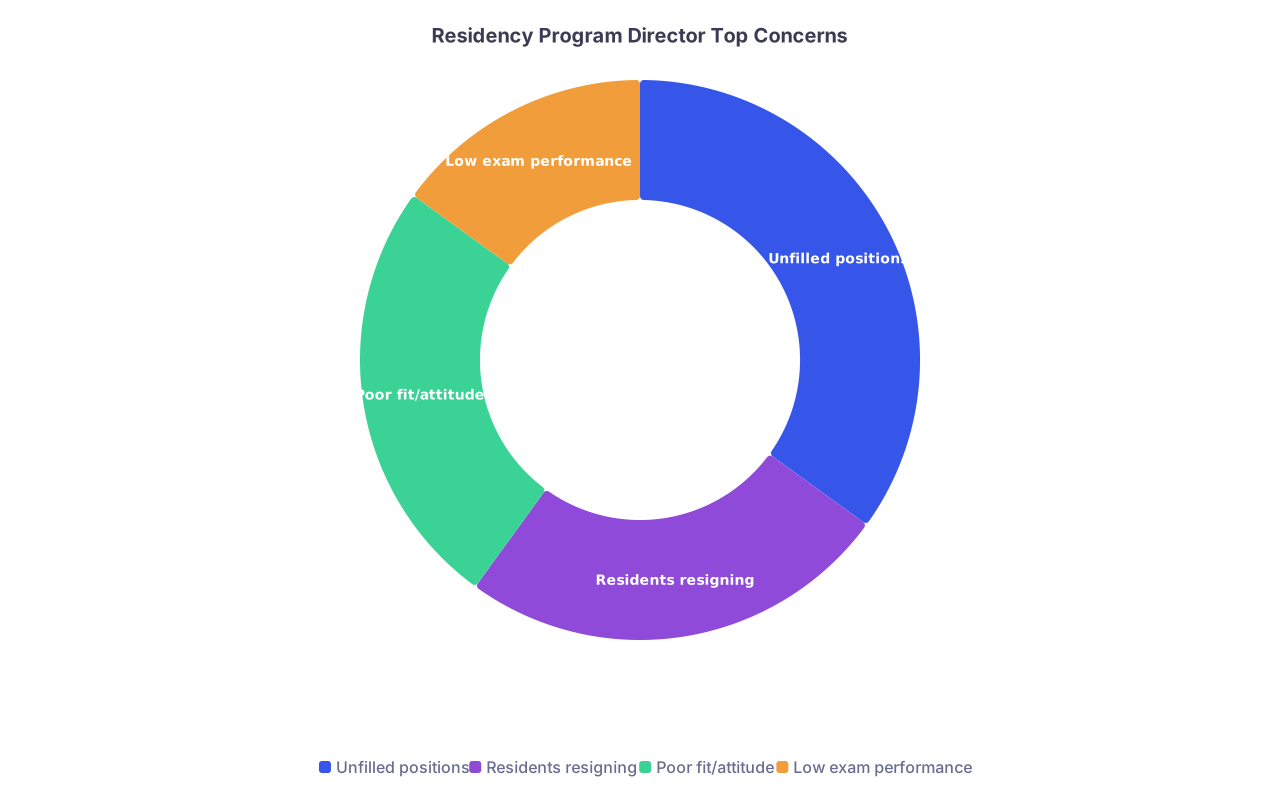
| Category | Value |
|---|---|
| Unfilled positions | 35 |
| Residents resigning | 25 |
| Poor fit/attitude | 25 |
| Low exam performance | 15 |
If they see you as a backup applicant, they imagine three scenarios:
You match somewhere else in the primary specialty you really wanted.
Translation: they just wasted an interview slot and maybe a rank slot.You match with them, spend PGY-1 depressed and disengaged, then try to transfer.
Translation: they have a hole in their call schedule and a headache.You match with them but never mentally buy in.
Translation: attitude problems, lower morale, and ultimately a drag on the program.
Direct quote from an IM PD I know:
“I will always favor the slightly weaker applicant who is clearly committed to internal medicine over the superstar who is obviously here as a backup. One will be my chief resident. The other will be gone in a year.”
That is the calculus. Potential chief vs potential flight risk.
How to Pivot Without Looking Like a Backup Applicant
Now for the part you actually need: how to not look like a hedge case if you’re making a late or realistic specialty change.
Step 1: Make the switch early enough to look intentional
If you’re still “deciding” in November of fourth year, PDs can see that right in your rotation schedule. The later the switch, the more suspicious they become.
If you’re going to pivot:
- Ideally do it by end of third year
- Get at least one sub-I in the new specialty
- Add a second rotation early fourth year, not in December as a panic move
If you’re already late: then you need brutal honesty and extremely tight narrative work to compensate.
Step 2: Fix your letters—this is non-negotiable
You need at least two letters that unequivocally frame you as “a future X specialist.” And they need to be from that specialty.
If that means:
- Asking that derm attending to write you a more general medicine letter instead of a derm-love letter
- Or intentionally not using a “big name” letter from another field because it will scream backup
Then do it. PDs would rather see three consistent, appropriate letters than a superstar endorsement in the wrong field.
Step 3: Align your story across PS, interview, and MSPE
Your narrative has to be consistent across all media:
- Personal Statement
- Interview answers
- Dean’s letter/MSPE
- Letters of recommendation (when they hint at your trajectory)
A convincing pivot story sounds like:
- “I went into med school thinking about X, but during third year I realized Y parts of patient care drew me more.”
- “I took concrete steps: rotations, mentorship, research, talking to residents in the field.”
- “Here’s what I’ve learned about this specialty that makes me actively choose it, not default into it.”
If your story is “my Step score limited my options,” that can be part of the internal truth, but it cannot be the whole external narrative. Programs don’t want to feel like your compromise.
Step 4: Stop trying to keep ten doors open
This is where anxious applicants sabotage themselves. They try to retain optionality all the way through January.
PDs can see it:
- Wishy-washy answers about long-term plans
- “I could see myself in a lot of things”
- Being evasive about where else you applied
You’re better off committing hard to the specialty you’re applying to—even if in your heart you’d still take derm or ortho if lightning struck. They can’t read your mind. They only see your application.
On interview day, your posture should be: “I am here because I want to train in this specialty, full stop.” Anything less reads as backup energy.
Step 5: Be strategic where you apply, not just how
Some specialties are absolutely flooded with backup applicants. Some programs in those specialties are used to being parachuted into by applicants with previous lives.
If you know your application screams prior commitment to another field:
- Target programs with a track record of accepting switchers
- Community and mid-tier academic programs often have more appetite for these stories
- Smaller or newer programs may be more open if you can convince them you’ll stay and build with them
Whereas if you aim only at elite university programs in a field you just switched into three months ago, they’ll simply choose one of the dozens of “day-one committed” candidates instead.
How Different Programs Talk About You in Rank Meetings
Let me paint three real-world scenarios. I’ve watched all of these happen.
Scenario 1: The transparent derm-to-IM backup
Applicant A:
- 260+ scores
- Five derm publications
- One weak IM rotation in October with a generic letter
- Personal statement: “I discovered my love for complex medical decision-making” (but nothing specific)
In the IM rank meeting:
Faculty 1: “This is basically a derm app.”
PD: “Agree. If he gets a derm prelim or maybe a second look, he’s gone.”
Faculty 2: “And we have ten equally strong IM-focused applicants.”
PD: “We can rank him, but I’m not putting him high. I want people who will be here.”
Result: ranked low, never reaches their spot because the program fills earlier.
Scenario 2: The late but believable switch
Applicant B:
- Originally set on surgery
- Step scores solid but not surgical superstar
- Did two IM sub-Is by September, got stellar IM letters
- Research: one quality QI project in IM plus some old surgery stuff
- PS and interviews: clear, thoughtful explanation of why they’re truly choosing IM
In committee:
PD: “They came to IM late, but this looks real.”
Faculty: “Letters are very strong. I could see them as a future chief.”
PD: “Rank in our top third.”
Result: matches there, becomes chief. I’ve seen this exact story twice.
Scenario 3: The quietly hedging EM-Anesthesia applicant
Applicant C:
- Mixed EM and Anesthesia letters
- Applied to both specialties
- On interview: “I like procedures, resuscitation, and flexibility. I could see myself in EM or anesthesia.”
- Avoids answering where else they interviewed.
In Anesthesia rank meeting:
Faculty: “I think they want EM more than us.”
PD: “Then I’m not putting them above people who clearly want anesthesia.”
In EM rank meeting:
Faculty: “They seem really into anesthesia too.”
PD: “We have EM die-hards we’d rather invest in.”
Result: ranked in the murky middle by both. Depending on the year, that person sometimes matches and is perpetually “the one who really wanted the other specialty,” or they slip, scramble, and end up somewhere they never even considered.
Bottom Line: What PDs Really Think
They’re not offended you once loved another specialty. They’re not naïve about how competitive the Match has become. Many of them switched paths themselves years ago.
What they do resent is feeling like:
- The consolation prize
- The hedge
- The field you settled for because your dream rejected you
If you look like you’re applying “just to have something,” they worry you’ll:
- Leave
- Underperform
- Poison the culture
So they protect their program.
If you demonstrate you’ve done the work to understand and truly choose their specialty—even after starting somewhere else—they’re surprisingly forgiving. They respect late maturity more than desperate hedging.

| Step | Description |
|---|---|
| Step 1 | Applicant with prior interest in another field |
| Step 2 | Seen as backup applicant |
| Step 3 | Seen as late but committed |
| Step 4 | Ranked low or not at all |
| Step 5 | Ranked competitively |
| Step 6 | Evidence of genuine pivot? |