Why Treating All Competitive Specialties the Same Is a Strategic Mistake
What actually happens if you build one “competitive specialty” application strategy and try to use it for dermatology, ortho, ENT, radiology, and anesthesia?
You quietly sabotage yourself. And you usually do not realize it until after Match Day.
Everyone throws around the phrase “competitive specialties” like it means one thing. It doesn’t. Lumping derm, ortho, ENT, plastics, radiology, EM, anesthesia, and urology into one bucket is one of the most common—and expensive—mistakes I see.
Let me be blunt:
“Strong applicant for anesthesia” does not automatically translate to “remotely viable for derm.”
“Solid for EM” does not mean “fine for ortho if I just add one more letter.”
If you treat them all the same, you end up:
- Over-preparing for the wrong things
- Under-preparing for the right things
- And misreading your chances so badly that your rank list becomes a trap
Let’s walk through where people go wrong and how to avoid being that cautionary tale.
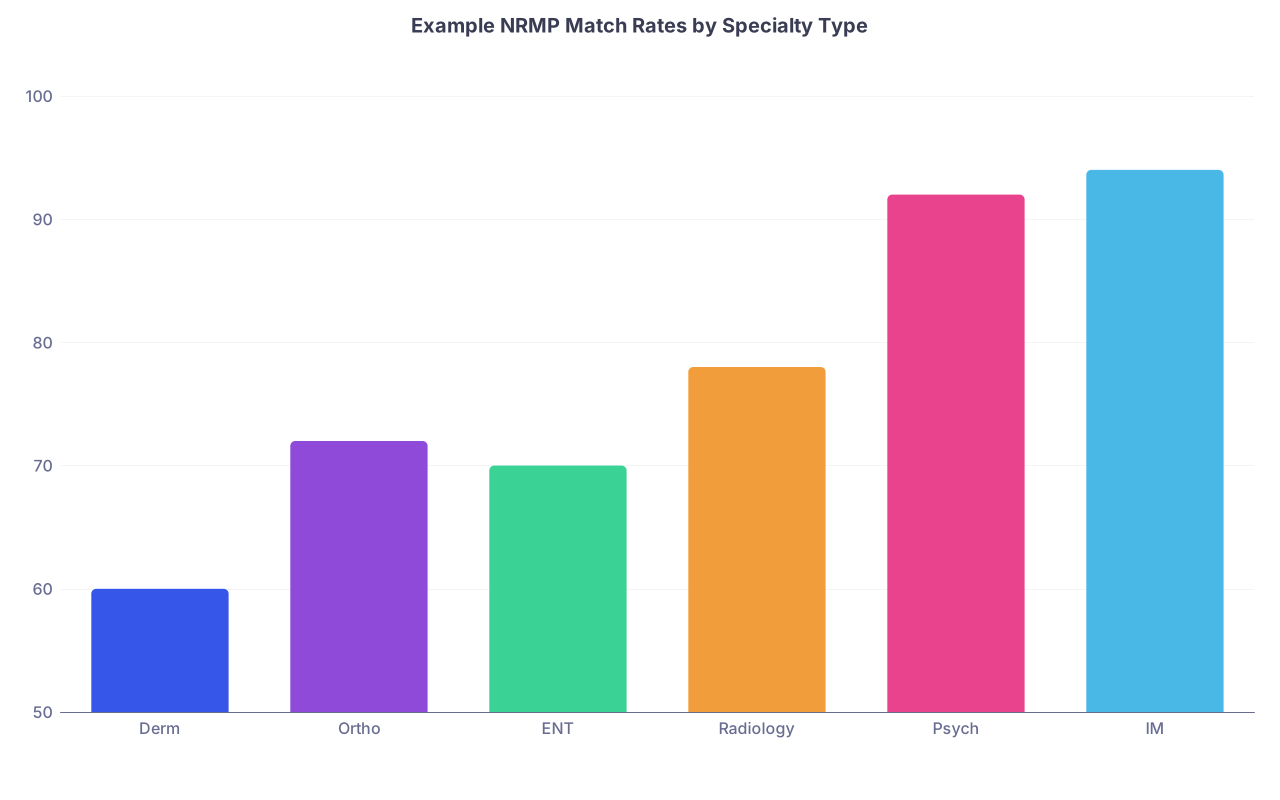
| Category | Value |
|---|---|
| Derm | 60 |
| Ortho | 72 |
| ENT | 70 |
| Radiology | 78 |
| Psych | 92 |
| IM | 94 |
Mistake #1: Assuming “Competitive” Means the Same Thing Everywhere
You know the usual line: “Derm is competitive. Ortho is competitive. ENT is competitive. Radiology is competitive. So I’ll just build a strong application and I’ll be fine.”
No. The type of competitiveness is different.
Some specialties are:
- Score-driven + research heavy (e.g., Dermatology, Plastics, Radiation Oncology)
- Score + “fit” + letters + manual skill reputation (e.g., Ortho, ENT, Neurosurgery)
- Fit-centric with moderate scores but huge personality weight (e.g., EM, Anesthesia)
- “Hidden competitive” for good programs, but overall moderate (e.g., PM&R, Child Neuro)
Treat those as identical and you miss what each field actually screens for.
How this shows up in real life
Example 1:
Student A: Step 2 CK 261, 10+ derm-focused publications, derm interest group leadership, 3 derm aways.
Student B: Step 2 CK 261, 0 derm-specific research, one random case report, strong ortho letter, no derm aways.
Both “have a 261.” Only one has a derm application. The other just has a high score.
Example 2:
Student C: Step 2 242, outstanding EM SLOEs, 3 EM aways, EM leadership, clear EM personal statement, lots of ED volunteering.
Student D: Step 2 242, okay generic letters, no EM aways, tried to pivot from anesthesia in August.
On paper, same score. In the actual match, those are two different universes.
The real problem
You make one generic plan: “Aim for 250+, do some research, get good letters, show interest.”
That plan is vague enough that you think you’re covering everything. You’re not.
Each specialty has:
- A different “language” in letters
- Different red-flag thresholds
- Different expectations for aways
- Different tolerance for “late interest”
If you ignore those differences, your application reads like you didn’t understand the field you’re applying to. Programs notice.
Mistake #2: Copy-Pasting Letter Strategy Across Specialties
Letters can make or break you. The dumb move? Assuming all strong, respected attendings carry identical weight everywhere.
They don’t.
What programs actually read between the lines
For surgical subspecialties and highly selective fields (ortho, ENT, neurosurg, plastics, urology):
- They care who wrote the letter and what they are known for in that field
- They look for field-specific language: technical ability, work ethic in the OR, team behavior, teachability
- A generic “hard worker, pleasure to teach” from medicine can feel irrelevant
For fields like EM:
- SLOEs (standardized EM letters) are basically a separate currency
- A random strong medicine letter doesn’t replace a mediocre SLOE
- Programs compare you directly to their other rotators based on a rubric
For derm/rad onc:
- Research mentors in the field writing, “This student drove this project from concept to manuscript” is far more powerful than “great team player in clinic” from someone outside the specialty
The mistake pattern
I’ve seen this so many times:
- Three letters: one IM, one surgery, one “famous” cardiologist
- Applying ENT
- Result: zero interviews at places that actually care about ENT letters
Or:
- Applying EM with 0 SLOEs and 3 generic letters
- Then being shocked when they get passed over for applicants with lower scores but strong EM-specific evals
You cannot just chase prestige of letter writer. You need relevance.
What to do instead
- For surgery-heavy specialties: prioritize field attendings and surgeons with reputations in that specialty
- For EM: get at least two SLOEs, ideally from different sites
- For derm/rad onc: you want at least one big letter anchored in tangible research/academic work
- For anesthesia: letters that emphasize composure, teamwork, and clinical judgment in OR/ICU/ED settings
If you treat letters like generic boxes to check, you’re telling programs, “I don’t fully understand what matters to you.” They hear that loud and clear.

Mistake #3: Using the Same Away Rotation Logic for Every Specialty
“Aways are important for competitive specialties.”
True. But how they’re important varies a lot, and treating them as interchangeable is how you over-rotate in the wrong places—or skip them where they’re mandatory.
Where aways are practically required
For ortho, ENT, neurosurgery, plastics, urology:
- Aways are often an audition
- Programs expect you to show up, perform, and prove you’re not a disaster in the OR or on call
- Some places rarely rank you highly without seeing you in person
For EM:
- Away rotations = SLOEs
- No aways → no SLOEs → you’re behind by default
For derm:
- Aways matter, but not always as auditions in the same OR-heavy sense
- They’re a way to signal genuine interest and get field-specific letters
- Research at home institution can sometimes outweigh away performance, depending on your school
For radiology, anesthesia, PM&R:
- Aways can help, but they’re often not as “do or die”
- One well-chosen away to show geographic interest or get a strong letter can be enough
The mistake versions
Common bad patterns:
- Doing three anesthesia aways when you’ve already got strong home support—wasted time you could have used bolstering research or backup specialty options
- Applying derm with zero derm rotations outside your home institution and assuming “my score will carry me”
- Applying ortho with no away at any program where you actually want to match, then being surprised when you get no love from the big-name places
Or the classic: deciding your specialty late (August–September of M4) and realizing all the meaningful aways are gone—or that you chose the wrong ones for how that specialty actually evaluates applicants.

| Step | Description |
|---|---|
| Step 1 | Student MS2 |
| Step 2 | Prioritize research and field mentor |
| Step 3 | Secure OR-heavy aways and field letters |
| Step 4 | Plan EM aways and SLOEs |
| Step 5 | Solid scores and 1 targeted away |
| Step 6 | Specialty specific application |
| Step 7 | Interested in competitive specialty |
Mistake #4: Misreading What “Impressive” Means in Each Field
The same activity can look wildly different on a derm CV vs an EM CV vs an ortho CV.
Research isn’t one-size-fits-all
Derm, plastics, rad onc:
- Deeply research-driven fields
- Multiple first- or second-author pubs, posters at national specialty meetings, and continuity with a single PI stand out
- Random case reports in unrelated areas do not impress the same way
EM, anesthesia:
- Research helps, but not required at most programs
- QI projects, ED flow initiatives, ultrasound education stuff can show alignment with field priorities
- You don’t need 10+ papers to be competitive at many places
Ortho, neurosurg:
- They like productivity, but they especially like surgical, outcomes, biomechanical, or spine-focused work for neurosurg/ortho
- Being the “stats person” on 6 endocrine papers might be less valuable than 1 or 2 strong ortho projects
Psych, PM&R:
- For strong academic programs, research definitely helps
- But a high-impact psych-related project beats a scattered collection of random fields
Extracurriculars: different fields care about different signals
Some specialties care a lot about:
- Leadership & advocacy (EM, psych, pediatrics)
- Technical hobbies/manual skill proxies (ortho, surgery subspecialties—woodworking, mechanics, athletics sometimes matter more than you think, honestly)
- Aesthetic attention and continuity (yes, derm and plastics people notice aesthetics, consistency in your interest)
- Teaching, mentorship, longitudinal commitment (IM, peds, psych, rads)
The mistake? Building a generic “highly involved” CV with no narrative that clearly matches your chosen field.
You look like someone chasing competitiveness points, not someone actually interested in that specialty’s work.
| Specialty | Primary Emphasis | Must-Have Element | “Nice-to-Have” Element |
|---|---|---|---|
| Dermatology | Research + Scores | Derm-focused mentor/letters | Aways at target programs |
| Orthopedics | OR performance + Fit | Strong ortho letters | Multiple away rotations |
| ENT | OR + Personality | ENT faculty support | Research in field |
| Emergency Med | Fit + SLOEs | 2+ strong SLOEs | ED-related leadership |
| Anesthesia | Clinical judgment + Fit | Solid core letters | 1 targeted away rotation |
Mistake #5: Using One Backup Strategy for All Competitive Fields
This one burns people every year.
You decide you want a “competitive” field. You also decide you’re “okay” with a backup. Then you design this vague two-track plan that doesn’t truly serve either specialty.
The common disaster scenario
- You apply to derm + IM
- Ortho + anesthesia
- EM + IM
- ENT + neurology
But:
- Your research is almost entirely in one field
- Your letters are heavily lopsided (3 derm vs 1 IM, or 3 ortho vs 1 anesthesia)
- Your aways only favor the primary specialty
- Your personal statements are rushed for the backup
Programs in the backup specialty look at your application and think:
- “So we’re the safety choice.”
- “They did nothing meaningful to show interest in our field.”
- “They’ll leave the second they can lateral over.”
Some will still rank you. Many competitive academic programs won’t, or they’ll rank you lower.
Different specialties require different backup strategies
Treating “backup” the same for all is lazy planning.
Example:
- Derm → rational backup: IM, medicine prelim + derm research year, maybe gen medicine with strong academic bent
- Ortho → rational backup: general surgery, prelim surgery, maybe PM&R if you actually pivot seriously and early
- EM → rational backup: IM or FM if you build real interest and evidence for those fields
- ENT → rational backup: general surgery, maybe neurosurgery or plastics with real planning
Where people blow it:
They try to apply to both with one generic set of letters, one half-hearted second application identity, and no clear signal to the backup they’d actually be happy there.
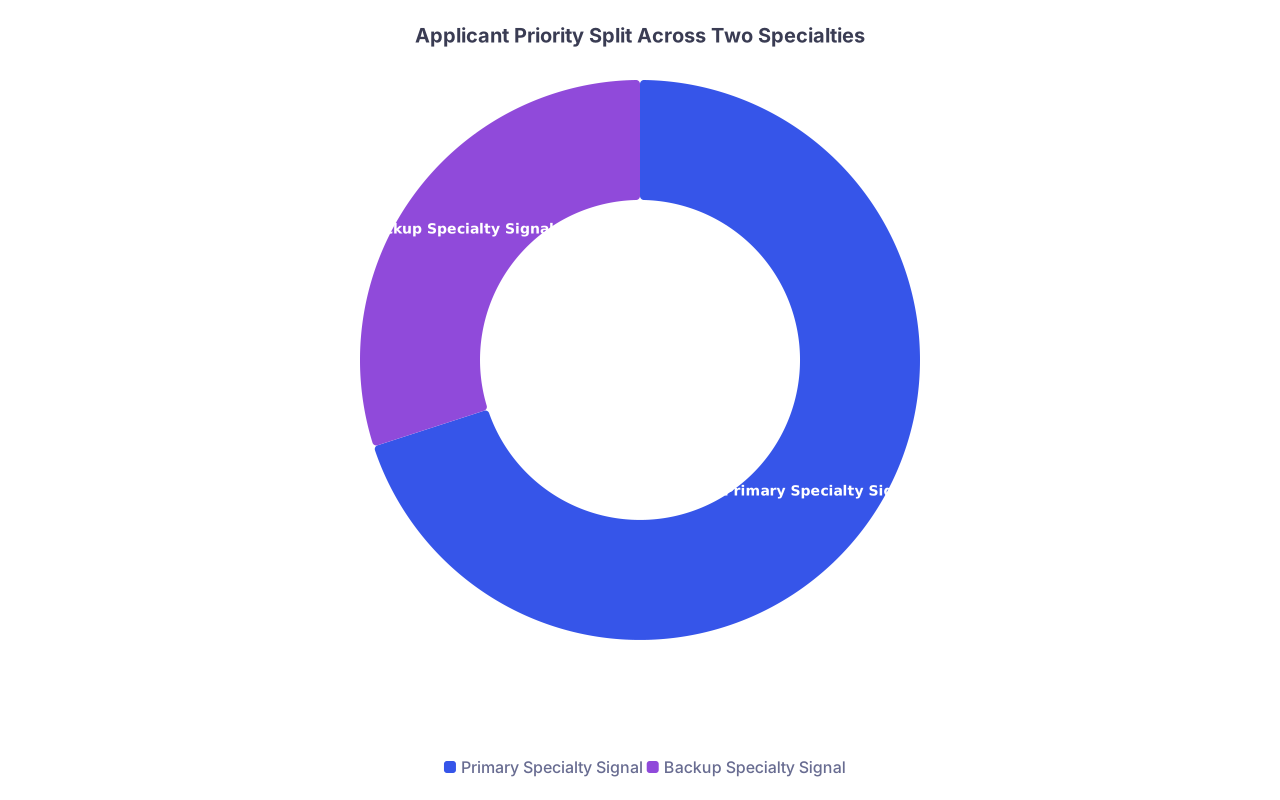
| Category | Value |
|---|---|
| Primary Specialty Signal | 70 |
| Backup Specialty Signal | 30 |
Mistake #6: Ignoring Culture and “Fit” Differences
This is the subtle one that data people tend to shrug off. Don’t.
You can’t treat “competitiveness” like it’s just a Step score threshold.
Specialties have different:
- Cultures
- Day-to-day vibes
- Values in residents
- Tolerance for certain personality styles
EM:
- Values adaptability, team play under chaos, communication with nurses and consultants, ability to laugh off insanity at 3am
- A brilliant but rigid, socially stiff applicant can have a rough time
Ortho:
- Often values athleticism, team sport mentality, physical presence in the OR, durability on tough call schedules
- Someone who hates team dynamics or being in the OR for hours will struggle
Derm:
- Detail-oriented, aesthetics-focused, outpatient-heavy, relationship-driven with long-term patients
- A pure adrenaline junkie “I live for trauma codes” persona doesn’t match well
Anesthesia:
- Values calm under pressure, anticipatory thinking, interprofessional communication in OR/ICU settings
When you pretend all “competitive specialties” share a culture, you write personal statements and show up to interviews with one generic persona. That reads as fake—or at best, clueless.
Programs don’t just ask “Can you do the work?”
They ask, “Do you get our work? Our patients? Our team dynamic?”

Mistake #7: Starting Specialty-Specific Strategy Too Late
This is the quiet killer.
You spend M1–M3 “keeping options open.” Generic research. Generic leadership. Generic shadowing. You tell yourself you’ll “decide in M4 after rotations.”
By the time you decide:
- The research runway for derm/plastics/rad onc is too short
- The key aways for ortho/ENT/neurosurg are full
- You don’t have time to generate meaningful EM SLOEs
- You can’t pivot convincingly into a research-heavy specialty from a blank slate
You then comfort yourself with: “But I’m a good student, programs will see that.”
They won’t. They’ll see a late, shallow, non-committal interest stacked against people who have been building a specialty-specific profile for 2–3 years.
No, you don’t need to lock in at M1
But by:
- End of M2: you should have a short list (2–3 specialties max) and at least one that you’re leaning toward
- Early M3: you should start biasing your research, mentors, and elective timing around your top choice or two
- Late M3: your “competitive specialty” strategy needs to go from generic to very specific
The mistake is staying in “I’m open to anything” mode until it’s logistically impossible to build a strong field-specific application.
So How Do You Avoid Treating All Competitive Specialties the Same?
Here’s the practical, non-fluffy version.
Pick 1–2 specialties to treat as “primary” by early M3.
Not five. Not “anything competitive.” One or two.Study that field’s actual match behavior.
- Look at NRMP data, program websites, and recent grads from your school who matched
- Ask them: “What actually mattered more than I think?”
- Pay attention to: research expectations, letters, aways, scores, red flags
Build a specialty-specific spine to your application.
- Research in that field or closely related
- At least 1–2 letters from respected faculty in that specialty
- Rotations that make sense given that field’s norms (aways where needed)
Design your backup with intention, not panic.
- Choose a backup that makes sense conceptually and culturally
- Give it real letters, a real personal statement, and at least minimal experiences to show you didn’t just tack it on
Stop asking, “Am I competitive in general?” Start asking, “Am I competitive for X?”
Generic competitiveness is a myth.
Competitive for what, exactly, is the only question that matters.
Final Takeaways
- “Competitive specialty” is not one category; derm, ortho, EM, ENT, and anesthesia each demand different signals, letters, and timelines.
- A generic strong application is not enough; you need a field-specific identity built from research, mentors, rotations, and culture fit.
- The earlier you stop treating all competitive specialties the same, the more options you actually preserve—and the fewer brutal surprises you face on Match Day.