The way many applicants approach “research” for competitive specialties is broken.
They’re doing token research—a thin, last‑minute box‑check that fools exactly no one and quietly tanks otherwise decent applications.
If you’re aiming for dermatology, plastic surgery, orthopedics, ENT, neurosurgery, rad onc, or similarly competitive fields, you cannot afford this mistake. Program directors see through it in about 10 seconds. So do residents and faculty reading your file.
Let me walk you through the traps I’ve watched applicants fall into year after year—and how you avoid becoming one more “great candidate… but no real research” story.
What “Token Research” Really Looks Like (And Why It Fails)
Token research isn’t about the number of lines on your CV. It’s about substance.
Here’s what token research usually looks like in competitive fields:
- You joined a project 6–9 months before ERAS.
- Your role: collect a few data points, send some emails, attend sporadic Zoom meetings.
- You can’t clearly explain the project’s hypothesis, methods, or what problem it actually solves.
- There’s no completed manuscript, no meaningful abstract, maybe a poster at a minor meeting if you’re lucky.
- The project has nothing to do with your target specialty… but it “counts” as research, right?
This is the mistake: thinking participation equals preparation.
Program directors are not impressed that you “helped with data collection.” They’re asking three questions:
- Has this person shown they can actually complete scholarly work?
- Do they understand what research in this field really is?
- Will they be useful and reliable when we need residents to produce data, QI, or academic work?
Token research usually answers all three with a quiet “no.”
How Programs Spot Token Research in 30 Seconds
You’re not hiding this. They can see it:
- Ten posters, zero first-authorships, and nothing published or even “submitted.”
- All projects are in random fields: pediatrics, psych, basic science in undergrad… and suddenly you’re applying ortho with zero orthopedic work.
- Vague ERAS descriptions like “helped with data collection and literature review.”
- Abstract titles that sound generic or disconnected from your stated interests.
- You mention “ongoing manuscript” in three places—none with clear roles or directions.
On interview day, the mask comes off faster:
- You can’t concisely explain one project’s aim and main finding.
- You overuse “we” and never get specific about your contribution.
- You butcher basic methodology questions (retrospective vs prospective, inclusion criteria, basic stats).
- You have no idea what happened to projects you “worked on.”
The subtext they hear: this applicant did the minimum to look like they did research. That’s a liability in a competitive field that leans heavily academic.
Why Token Research Hurts More in Competitive Specialties
| Category | Value |
|---|---|
| Derm | 15 |
| Plastics | 14 |
| Ortho | 10 |
| IM | 4 |
| FM | 2 |
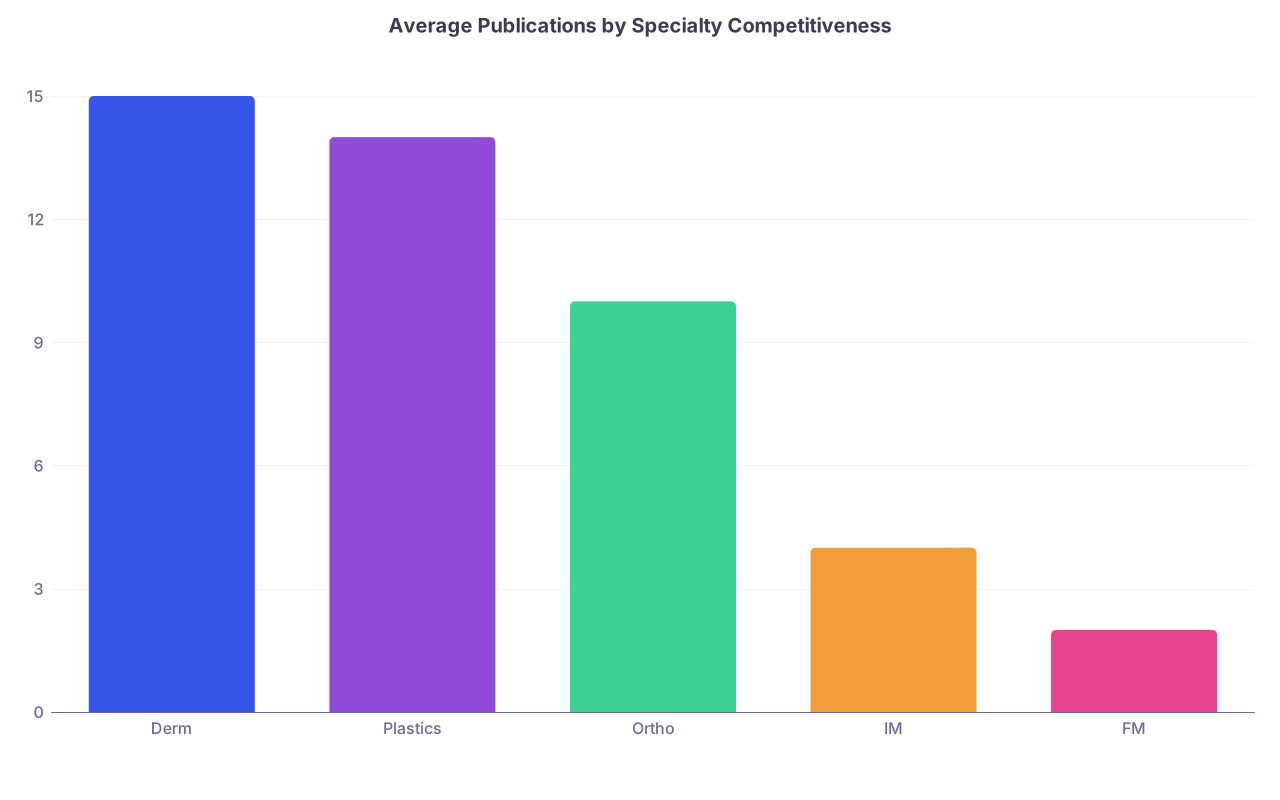
In internal medicine or family medicine, thin research might not sink you. In derm or plastics, it can absolutely be the deciding factor between “ranked” and “no thanks.”
Here’s the unspoken reality:
- In competitive fields, research is signal, not decoration.
- When everyone has high scores, strong letters, and honors, research becomes the tiebreaker.
- Programs use research to differentiate: Who has shown real commitment to this field? Who’s actually driven?
If your research looks like you slapped it together to appease advisors, programs will assume:
- You are not serious about academics.
- You’re applying to the field for prestige, not interest.
- You cut corners when it’s convenient.
Nobody says that to your face. But it shows up in rank meetings as comments like:
- “Good board scores, but research is very superficial.”
- “Lots of activity, nothing finished.”
- “Not clear they’re actually interested in our specialty—no related projects.”
And that’s how you lose spots to people with fewer total projects but real depth.
The Most Common Token Research Traps

Let’s get specific. Here are the traps I’ve watched destroy applications.
Trap 1: The “Last-Minute Research Sprint” in M3/M4
You decide on a competitive specialty halfway through third year. Panic sets in. You scramble to:
- Email any faculty whose name appears on PubMed.
- Attach a generic CV and say, “I’m willing to help with any projects.”
- Join 3–5 projects simultaneously, all on life support.
What happens?
- You touch a dozen things, finish none.
- Your ERAS looks like: “Involved in ongoing projects in X, Y, Z.”
- On interview day, you can’t clearly articulate a single complete contribution.
Programs don’t care that you “started late.” They only see that you couldn’t bring anything across the finish line.
Trap 2: Volume Over Value
Applicants love to chase line counts:
- 10 posters.
- 6 abstracts.
- 3 manuscripts “in progress.”
They think more is automatically better. It isn’t.
Committees care far more about:
- 1–2 first-author products you clearly led and can defend.
- Specialty-aligned work that shows actual commitment.
- Evidence that you saw a project from idea → data → product.
A long CV full of 3rd/4th/8th‑author posters on random topics screams “CV padding.” It’s almost worse than having fewer, stronger items.
Trap 3: Non-Specialty Research With No Bridge
This one’s subtle.
You did cardiology research for two years. Now you’re applying orthopedic surgery. You write: “My cardiology research taught me X, Y, Z skills I’ll bring to ortho.”
Except:
- You never did anything ortho-related.
- You can’t articulate why you changed fields intelligently.
- You don’t connect your skills to specific questions in ortho.
They see someone who jumped when the prestige/competitive allure popped up, not when genuine interest developed.
Non-specialty research is fine—sometimes excellent—if you bridge it thoughtfully and back it up with at least some field-related work. If you don’t, it looks accidental or opportunistic.
Trap 4: The Ghost Author
You “joined” a project by:
- Attending 2–3 meetings.
- Volunteering vaguely for “literature review.”
- Dropping off when exams or rotations got busy.
You’re still listing it on your CV. Maybe even as “manuscript in preparation.”
Then someone on the interview panel actually knows the PI. Or was also involved. Or pulls up the PubMed entry and you’re not on it.
Now you have a much bigger problem than weak research: credibility.
How to Build Non-Token Research That Actually Helps You Match
Enough doom. Let’s get practical. Here’s what “real” research looks like from a program’s perspective—and how to get there without wasting years.

| Step | Description |
|---|---|
| Step 1 | Decide on Specialty Direction |
| Step 2 | Find 1-2 Aligned Mentors |
| Step 3 | Join 1 High-Yield Project |
| Step 4 | Take Ownership of a Discrete Piece |
| Step 5 | Produce a Tangible Product |
| Step 6 | Present and Publish |
| Step 7 | Reflect and Connect to Specialty |
1. Start With Alignment, Not Desperation
Before you chase projects, answer:
- What fields am I realistically considering?
- Do I want academic medicine at all, or just enough research to be competitive?
- What kind of work actually seems interesting—clinical, QI, outcomes, basic science?
Then target mentors and labs that match those answers. Semi-random projects are how you end up with years of work that don’t move the needle.
2. Pick Fewer Projects—and Own Them
You avoid token research by owning parts of a project, not by touching everything.
What ownership can look like:
- You wrote the first draft of the manuscript.
- You designed the data collection sheet and did the bulk of chart review.
- You created the analysis plan with a biostatistician and can explain it.
- You designed or ran the survey and handled responses.
On ERAS, in your personal statement, and during interviews, you should be able to say, in plain English:
“I led [specific component] of this project, and here’s what we found and why it matters.”
If you can’t do that, your research will sound—and feel—token.
3. Aim for at Least One Complete Arc
Even one full arc from idea to “finished product” is powerful:
Idea → Protocol → IRB → Data Collection → Analysis → Abstract/Poster → Manuscript
Most students never complete that cycle. They help somewhere in the middle and drift away. If you can show you’ve done the whole thing even once, it separates you from the pack.
Choosing Projects That Won’t Become Dead Weight
| Factor | High-Yield Project | Token Project |
|---|---|---|
| Mentor availability | Meets regularly, clear expectations | Vague, hard to reach, unclear timeline |
| Timeline to product | Concrete plan to abstract/manuscript | “We’ll see how it goes” |
| Your role | Defined responsibilities, room for ownership | Generic “help with data” |
| Specialty alignment | Directly or logically related | Random topic with no clear connection |
| Track record | Group publishes regularly | Long history of “ongoing” student projects |
Red Flags When Picking Projects
Walk away—or at least be skeptical—if you hear:
- “We’ve been working on this for a few years, just need a student to push it over the finish line.” (Translation: five students have already failed.)
- “We’re still figuring out the research question.” (You don’t have time to sit in conceptual limbo.)
- “We’ll add you to a few things and see what sticks.” (You’re about to be CV filler.)
Good projects have:
- A clear primary question.
- A feasible data source and scope.
- A defined role for you.
- A realistic plan for abstract or manuscript submission within 6–12 months.
Timing: When It’s Too Late to Fake It
| Category | Value |
|---|---|
| MS1 Fall | 10 |
| MS1 Spring | 25 |
| MS2 | 60 |
| MS3 | 85 |
| MS4 Apps | 100 |
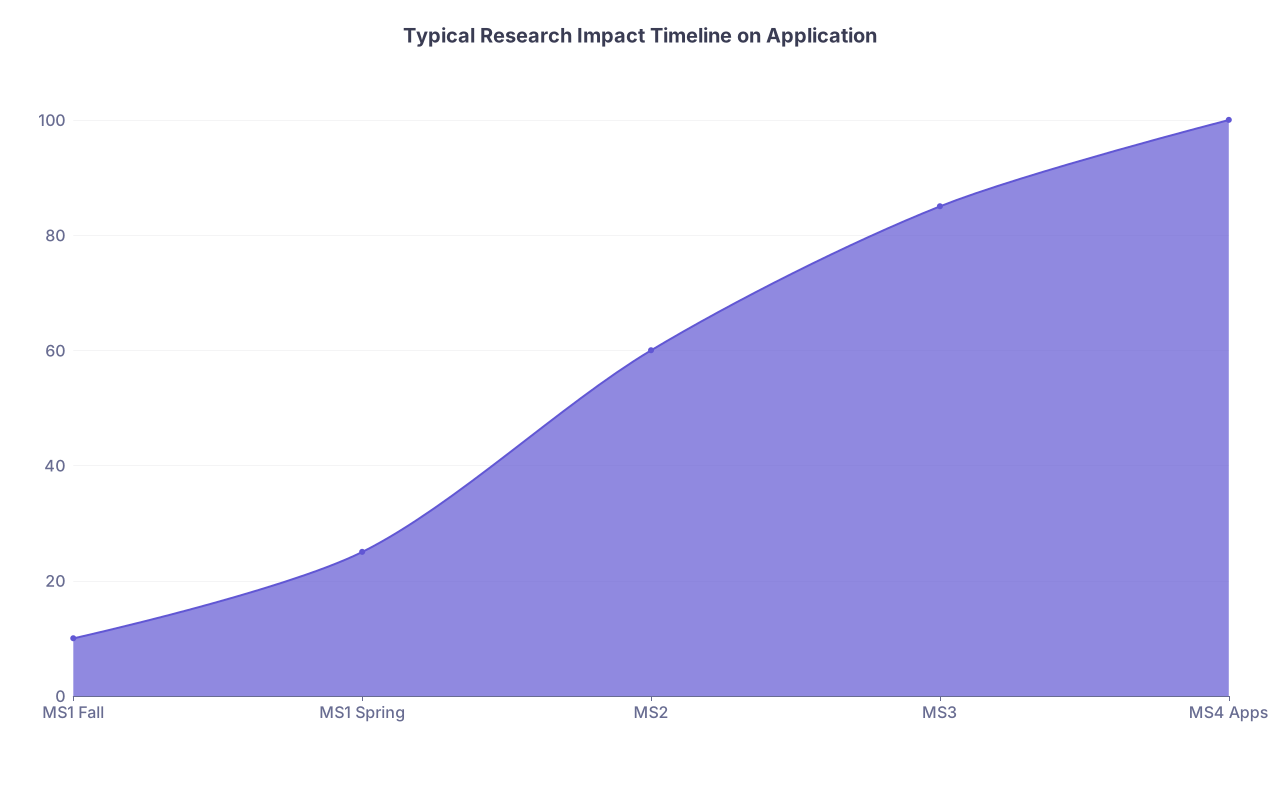
Here’s the hard truth: there is a point where trying to suddenly look “research heavy” becomes more dangerous than helpful.
If You’re Early (Preclinical / Early MS2)
You have time. Avoid these mistakes:
- Waiting “until after Step 1” to start anything. That’s how you end up with no finished work.
- Joining five different groups “just to see where it goes.”
Do this instead:
- Find 1–2 mentors in or near your target field.
- Commit to 1–3 projects max, but own real pieces of them.
- Aim for at least one abstract/poster by middle of MS3, one manuscript by applications.
If You’re MS3 and Just Decided on a Competitive Field
You’re not doomed, but you can’t play the same game as someone who’s been grinding since MS1.
Avoid:
- Taking on big, new, labor-intensive retrospective studies that will not be done by ERAS.
- Pretending 2–3 months of effort equals serious scholarly commitment.
Do this:
- Target smaller, faster projects: case reports, brief reports, QI with clearly defined endpoints.
- Look for projects that are 70–80% complete and truly just need final push.
- Get at least something specialty-aligned into abstract/poster form before applications.
If You’re 3–6 Months From ERAS
This is where applicants make catastrophic decisions.
Don’t:
- Join a massive multi-center project you can’t possibly finish.
- Pad your CV with five “manuscripts in preparation.”
- Try to fake depth—you will get exposed on interviews.
Do:
- Focus on polishing and making sense of what you already have.
- Tighten your ERAS descriptions so your actual contributions are clear and honest.
- Work with mentors to push 1–2 in-progress things to submission if realistically possible.
Sometimes the smartest move this late is to accept that your research is limited—then build a coherent narrative around what you did learn, rather than pretending you’re something you’re not.
How to Talk About Your Research So It Doesn’t Sound Token
Even good research can sound token if you present it badly.
Here’s the format I’ve seen work best when describing any project, whether in ERAS, personal statements, or interviews:
- One-line aim: “We studied whether X was associated with Y in Z population.”
- Your role: “I designed the data collection sheet, performed the chart review, and wrote the initial results section.”
- The outcome: “We found A, B, C and presented at [meeting]; manuscript is under review/accepted/published in [journal].”
- Takeaway: “This taught me how to [specific skill] and sparked my interest in [specific topic in your specialty].”
What not to do:
- Hide behind “we” for everything.
- Spend three minutes on background, zero on what you did.
- Be vague about status: “It’s kind of in progress.”
You should be able to talk through each major project in 60–90 seconds with specificity and without rambling.
Special Cases: When Your Research Really Is Light
Not everyone is going into an R01-funded academic life. That’s fine. But if you’re entering a competitive field without heavy research, you need to avoid a different mistake: pretending you’re something you’re not.
What to do if your research is genuinely thin:
- Be honest on ERAS and in interviews. Don’t inflate.
- Emphasize the skills you developed—even from small projects: curiosity, basic statistics, literature appraisal.
- Show specialty commitment through other means: sub-internships, strong letters, shadowing, teaching.
- If you’re applying more broadly (e.g., prelim/transitional or backup specialties), tailor your narrative to fit that reality, not a fantasy version of your CV.
Some programs will absolutely prioritize heavy research. Those may not be your programs. You’re better off aligning with places that value your actual strengths than faking scholarship and getting unmasked.
FAQ: The Token Research Trap
1. Do I really need publications to match a competitive specialty, or will “experience” be enough?
Pure “experience” with no tangible outcomes is exactly what looks token. A single meaningful, completed product (even a poster or case report) is often more valuable than four half-finished projects. For very research-heavy programs, publications help a lot. For many others, the key is demonstrating you can start something and finish it, not just orbit five different labs.
2. Is it better to have one first-author paper in a non-related field or multiple small things in my target specialty?
The mistake is thinking this is purely a numbers game. One solid, first-author paper shows ownership and follow-through. A few smaller but clearly specialty-aligned projects (case reports, QI, small series) show interest in the field. Ideal is some combination: one substantial product anywhere, plus at least some specialty-aligned work. What looks worst is ten trivial items that you clearly didn’t lead and can’t explain.
3. Can I list “manuscripts in preparation” or “submitted” on ERAS without looking fake?
You can—but only if they’re real and you’re prepared to discuss them in detail. “In preparation” is overused and often screams token padding. Better: only list items that are at least drafted with clear authorship, ideally already submitted. If your name won’t be on a final paper, don’t claim it. It’s safer to have fewer honest entries than a bloated, questionable list.
4. I decided late on a competitive specialty. Should I delay graduation or do a research year?
Sometimes, yes. Sometimes, that’s a waste. A research year makes sense if: you have weak research for a very research-heavy field, you can secure a productive mentor with a real track record, and you’re willing to grind for tangible outcomes (papers, presentations). It’s a mistake if you enter a vague “research year” with no structure, no clear projects, and no honest assessment of whether academics actually fits your long-term goals.
5. How do I know if a mentor or lab will help me avoid token research instead of using me as free labor?
Look at their track record with students. Do prior students from that lab have first-author papers or just “involvement”? Do they publish regularly, or is everything “ongoing”? Ask directly: “If I put in consistent work, what kind of product can I realistically expect before applications?” Vague answers, no clear timeline, or a history of student names disappearing from final manuscripts are giant red flags. Walk away before your effort turns into one more line of invisible, token work.
Key points:
Token research is worse than no research in competitive specialties because it signals you’re playing the game, not doing the work. Focus on a small number of aligned projects where you own real pieces and see them to completion. Then talk about them clearly and honestly—so your application looks like a future colleague, not another box-checker.