It is late September of your ERAS year. Your friends are locking in away rotations, talking about pre-interview dinners, and debating suit colors. You are staring at your own application and thinking a dangerous thought:
“I am not that excited about my chosen specialty. Maybe I should pivot into ophthalmology…or ENT…or urology. People do that, right?”
This is the point where people blow up an otherwise salvageable career trajectory.
I am not saying you cannot ever switch. I am saying that a late switch into highly competitive, small-match specialties like ophtho, ENT, and urology carries very specific, very predictable risks that most students underestimate or ignore. I have watched more than one student go from “guaranteed match in a solid field” to “scrambled, unmatched, and miserable” in one cycle because they made this decision without understanding the terrain.
Let us go through the main traps.
1. Misunderstanding Just How Small These Matches Are
The first mistake is thinking competitive = “slightly harder.” Ophthalmology, otolaryngology, and urology are not just “a bit more competitive than internal medicine.” They are structurally different.
You are not switching from IM to EM. You are trying to jump onto a small lifeboat that left the dock months ago.
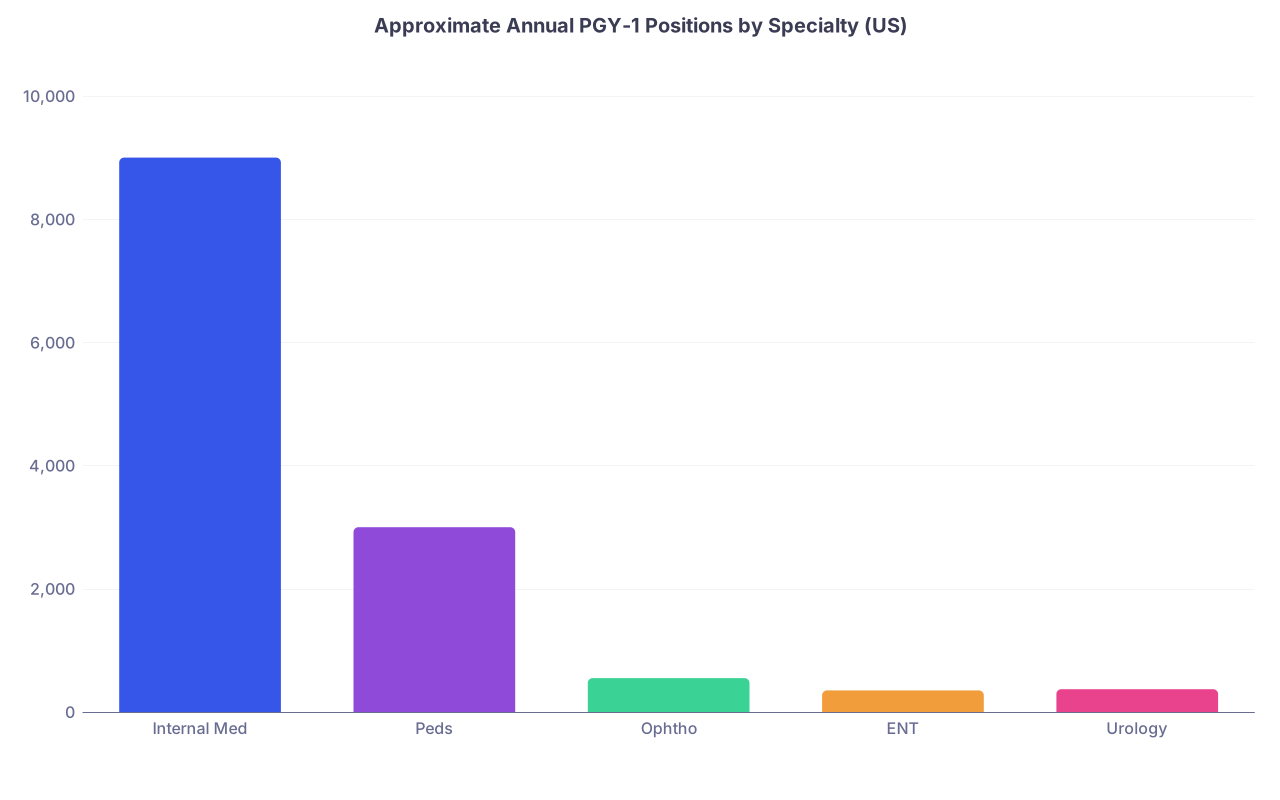
| Category | Value |
|---|---|
| Internal Med | 9000 |
| Peds | 3000 |
| Ophtho | 550 |
| ENT | 350 |
| Urology | 370 |
Here is the core issue:
- Tiny number of positions
- Disproportionately high number of strong applicants
- Programs that value deep, specialty-specific signals
In a big specialty:
- Being “a bit late” might mean you miss an away rotation or one additional letter, but your baseline odds can still be reasonable.
In a small, hypercompetitive specialty:
- “A bit late” often means you do not exist in that field’s ecosystem. No one knows you. You have no track record. Your specialty-specific experiences are thin or obviously rushed. Programs can see that instantly.
If you switch late into ophtho, ENT, or urology without:
- Early specialty exposure
- At least one strong letter from a known faculty in that field
- Some evidence of sustained interest (projects, electives, involvement)
…you are essentially walking into the most cutthroat segment of the Match as a complete outsider. That is survivable if you accept a high risk of not matching. Most students do not.
2. Ignoring the Timeline Reality: These Matches Start Early and Move Fast
The second big error is underestimating timing. These three fields are not simple “ERAS opens in September, I apply, done.”
They have:
- Earlier decision points
- Earlier networking requirements
- Earlier or separate match processes (e.g., SF Match, historically AUA match for uro, though integration has evolved)
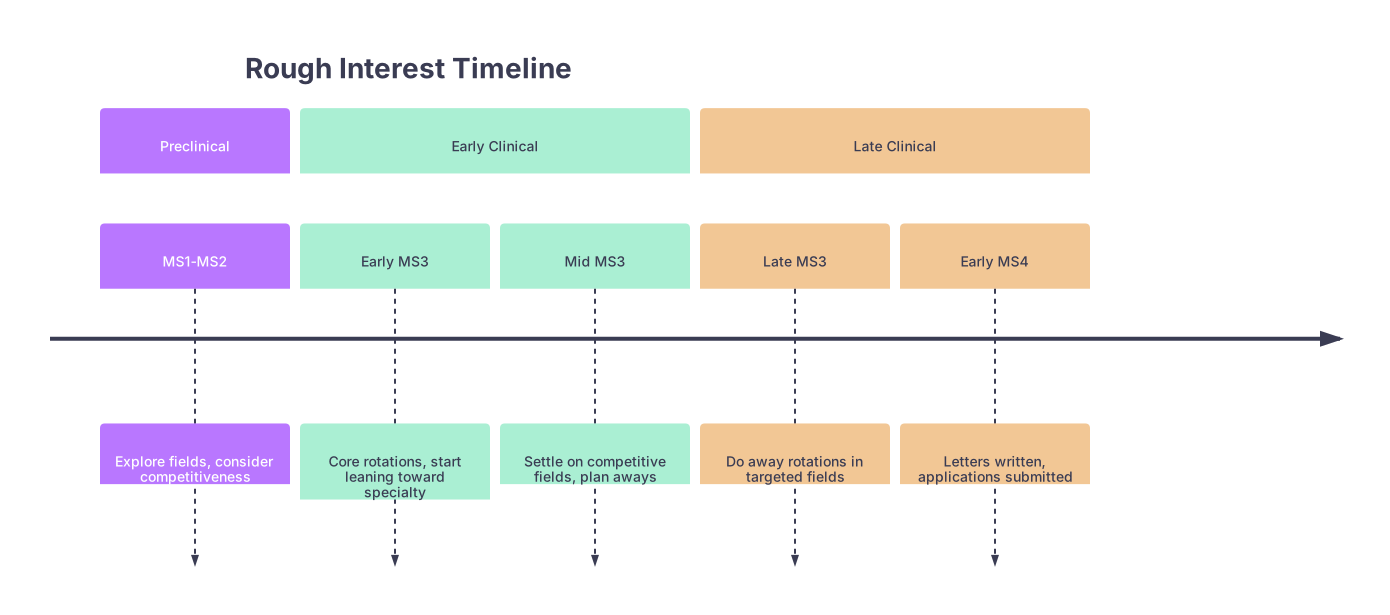
| Period | Event |
|---|---|
| Preclinical - MS1-MS2 | Explore fields, consider competitiveness |
| Early Clinical - Early MS3 | Core rotations, start leaning toward specialty |
| Early Clinical - Mid MS3 | Settle on competitive fields, plan aways |
| Late Clinical - Late MS3 | Do away rotations in targeted fields |
| Late Clinical - Early MS4 | Letters written, applications submitted |
If in late MS3 or even early MS4 you suddenly decide:
- “Actually, I want ENT”
- “Actually, ophtho seems better”
- “Actually, urology has the lifestyle I want”
You are probably behind on:
- Away rotations – most competitive applicants will already have:
- 1–2 away rotations completed
- Evaluations and letters from those aways
- Research – many will already have:
- Specialty-specific abstracts, posters, or publications
- Names that faculty in the field recognize
- Mentorship – they have:
- A home department that knows them
- Faculty pushing their application
You, in contrast, may be:
- Still on your core rotations
- Without a home department in that field
- Without a single meaningful connection in the specialty
Trying to “catch up” in a few months is where people start doing desperate, sloppy things—cramming in low-quality observerships, begging for last-minute letters, slapping superficial interest lines into their personal statements. Programs see right through this.
3. Overestimating How Far General Strength Can Carry You
Another classic mistake: “My scores and grades are strong. I will be fine.”
No. Not automatically.
| Factor | Typical Weight in Ophtho/ENT/Uro |
|---|---|
| USMLE scores | Necessary but not sufficient |
| Core clerkship grades | Baseline filter |
| Specialty letters | Critical |
| Away rotation performance | Critical |
| Specialty-specific research | Strong plus |
| Personal connection / fit | Often decisive |
You can have:
- Step 2 in the 250s
- Honors in most clerkships
- Solid research in another field
And still look like a weak ophtho/ENT/uro applicant if:
- Your letters are from IM, surgery, pediatrics only
- You have zero meaningful specialty contact
- Your personal statement reads like: “I recently discovered a passion for [insert specialty] and I am excited to explore it further…”
Programs in these fields are skeptical by design. They have many applicants who have:
- Spent years in an ophtho/ENT/uro interest group
- Multiple rotations in that field
- Publications, case reports, or at least posters in that specialty
- Faculty who will personally vouch for them at rank meetings
Against that, “I am a strong general candidate” is not compelling. It reads like you were aiming at something else, did not commit, and now want to jump onto a perceived “better” lifestyle or procedural field at the last minute.
4. Burning a Safe Match for a Longshot Without a Backup
This is the part I have seen hurt people the most.
You were on track to match comfortably in:
- Internal medicine
- Pediatrics
- Anesthesiology
- Psychiatry
- Even general surgery, depending on your profile
But because you got excited about clinic lifestyle and cool procedures and everyone online says “ophtho/ENT/uro have great lives,” you:
- Abandoned the safe plan
- Put all your eggs into a high-risk basket
- Did not build a real parallel plan
And then March (or January, depending on match system) hits and you are:
- Unmatched
- With a CV that now looks scattered
- With no strong Plan B relationships maintained
Here is the mistake: switching late into a hypercompetitive small specialty without either:
- A realistic, structured backup specialty plan, or
- A genuine, data-based reason to believe you are highly competitive in that new field
You are gambling your entire residency outcome on a fantasy.
If you want to switch, you must be ruthless with yourself about:
- “If I do not match in this field, what happens?”
- “Will I be content with that outcome?”
- “Did I build a real parallel application, or just tell myself I have a backup?”
Too many students label something a “backup” that is not even applied to properly. One ERAS submission with a half-hearted personal statement is not a backup. That is theater.
5. Underestimating How Much Signaling Matters in These Fields
In ophtho, ENT, and urology, you are not just selling your brain. You are selling a story:
- “This person is one of us.”
- “This person has been moving toward this for some time.”
- “This person will stick with the field, not bail for derm next year.”
Late switchers often have gaping holes in that story.
Red flags programs notice:
- Your CV is dominated by a different specialty:
- Three years of cardiology research, then one month of ophtho “interest”
- Tons of neurosurgery shadowing, then a sudden ENT pivot
- Letters that read more like “good generic medical student” than “future [specialty] colleague”
- A personal statement that is clearly written under time pressure and full of clichés:
- “Seeing the impact of sight on quality of life…”
- “The blend of clinic and OR appeals to me…”
I have read those personal statements. Faculty glaze over by the second paragraph. And when they compare you to someone whose entire arc screams “This person has wanted ophtho/ENT/uro for years and has receipts,” you lose.
You get away with a late narrative change in some big fields. These three are much less forgiving.
6. Practical Obstacles You Will Slam Into if You Switch Late
Let us get specific. Here is what actually happens on the ground when someone tries to make a late pivot.
Problem 1: No home department support (or weak support)
If your medical school:
- Has a small or non-existent ophtho/ENT/uro department
- Has faculty who barely know you
- Or worse, knows you in a totally different context (e.g., strong IM mentor, no surgical relationships)
You are not getting the kind of push other applicants get, like:
- Direct emails from faculty to program directors
- Advocates at national meetings
- Honest guidance on realistic program lists
Instead, you rely on:
- Cold emails
- Loosely connected mentors
- Generic career advisors who do not really know these fields
This is how you end up with mismatched program lists and unrealistic expectations.
Problem 2: Letters that come too late or say too little
Even if you manage to squeeze in an away rotation, you might run into:
- Letters written in a rush, after ERAS opens
- Faculty who barely observed you
- Comments like “pleasant, worked hard,” which are death in a competitive field
Late switches often force letter writers to:
- Compare you to students who have been around for months or years
- Make judgments based on short timeframes
You will not like that comparison.
Problem 3: Awkward questions you cannot answer convincingly
On the interview trail (if you get there), you will inevitably be asked:
- “So, when did you decide on ophthalmology/ENT/urology?”
- “You did a lot of [other specialty] work. What changed your mind?”
- “How do we know you will not change again?”
If the true answer is “Last spring, when I realized my original plan did not excite me and this lifestyle looked better,” you either:
- Tell the truth and sound impulsive, or
- Fabricate a long-standing interest and sound rehearsed
Either way, you are at a disadvantage vs. someone whose story is clean and consistent.
7. The Psychological Trap: Romanticizing the Switch
Another danger: you are probably over-idealizing the new field and underestimating its pain points.
Common patterns I hear:
- “Ophtho seems chill, no nights, great pay.”
- “ENT is a good mix of medicine and surgery and they seem happy.”
- “Urology has good lifestyle and fun ORs.”
You are seeing Instagram narratives and conference highlight reels, not the:
- 5am starts for some urology or ENT services
- Long OR days, complex post-ops
- Emotional weight of certain ophtho patients (e.g., irreversible vision loss)
- Turf battles, call responsibilities, scope creep, politics
Making a late pivot based on an idealized, superficial understanding is a setup for:
- Regret if you do not match
- Or even worse, regret if you do match and realize you built your career on a fantasy
You should not even consider a late switch into these fields unless you have:
- Spent real time in their clinics and ORs
- Talked to residents and attendings off the record
- Understood the actual training grind and not just the attending lifestyle 20 years from now
8. When a Late Switch Might Be Justified (And How Not to Screw It Up)
I am not saying a late switch is always wrong. It just needs to clear a high bar.
A late switch into ophtho, ENT, or urology is more defensible if:
- You are genuinely competitive on paper:
- Strong Step 2
- Strong clinical grades
- No major professionalism issues
- You have at least some early touchpoints in that field, even if you did not commit fully:
- A prior shadowing experience
- A small research project you can point to
- You can secure at least 1–2 strong, authentic letters from that specialty during this cycle
- You are willing to:
- Accept a real chance of not matching
- Build a serious parallel application in a safer specialty
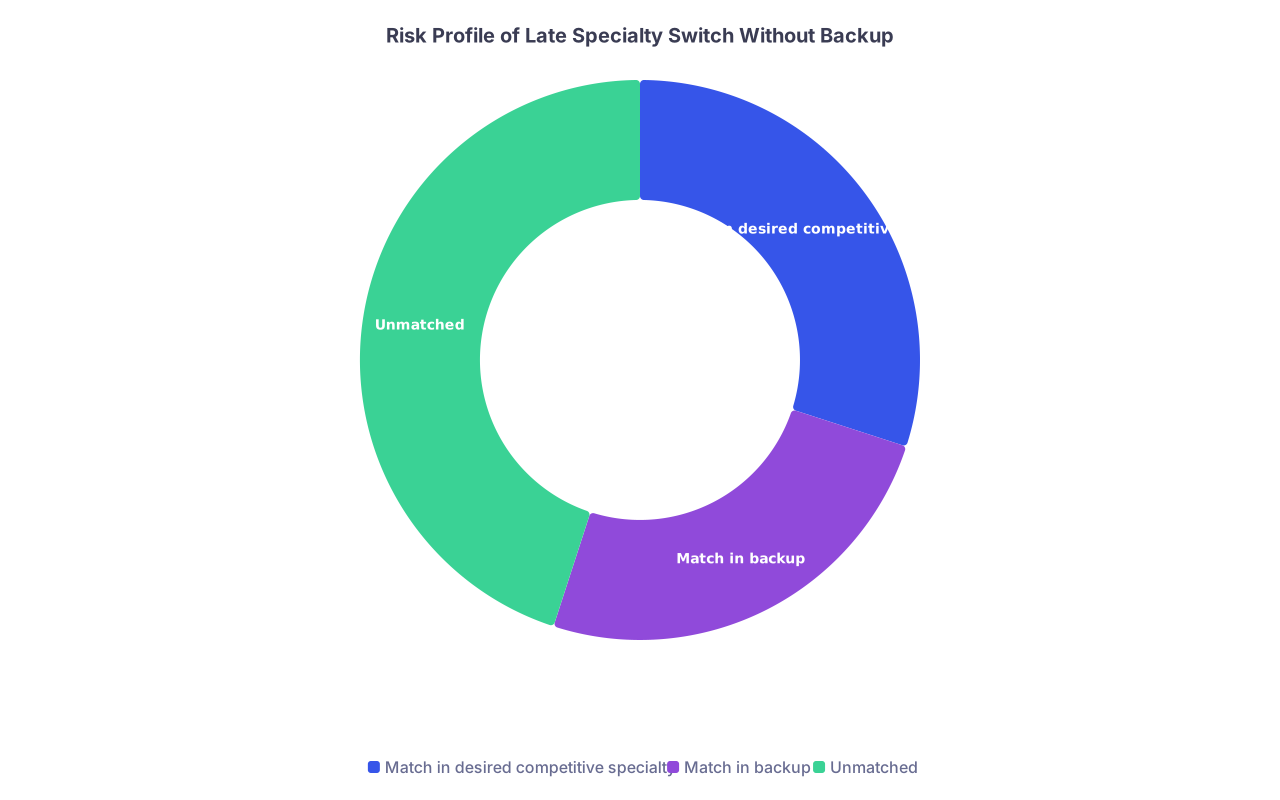
| Category | Value |
|---|---|
| Match in desired competitive specialty | 30 |
| Match in backup | 25 |
| Unmatched | 45 |
Those numbers are not exact data. They are the kind of distribution I have personally seen play out in late-switch stories that were not handled carefully. Almost half ending up unmatched or in chaos is not rare.
If you still choose to try:
- Do not abandon your original plan entirely
- Do maintain strong relationships in your original field
- Do apply broadly in both areas if finances allow
- Do get brutally honest input from someone in the new specialty (not just your dean)
If a trusted ophtho/ENT/uro faculty member looks at your application and says, “Your odds are quite low this cycle,” hear that. Do not think you are the miraculous exception.
9. The Safer Alternatives Students Ignore
If you are late in the game and unhappy with your current plan, there are options that do not involve detonating everything.
Consider:
Matching first, then transitioning:
- Match in your original, safer choice.
- During residency, explore fellowships that overlap with your interests.
- Example: If you liked urology for procedural work and cancer, an IM route to heme/onc with IR collaborations may scratch some of that itch.
- Yes, it is not perfect. It is also not “unmatched and starting over.”
Postponing graduation / taking a research year:
- If you are truly serious about ophtho/ENT/uro and clearly underprepared, a structured research year in that field before applying can:
- Build real relationships
- Produce specialty-specific work
- Demonstrate commitment
- It costs time and money. But so does going unmatched.
- If you are truly serious about ophtho/ENT/uro and clearly underprepared, a structured research year in that field before applying can:
Switching into a different but somewhat related, slightly less competitive field:
- Example: ENT interest but very late → consider general surgery with a plan for head and neck fellowship, or radiology with an interest in head/neck imaging.
- Example: Ophtho interest but weak competitiveness → consider neurology/neuro-ophthalmology route, or radiology with interest in orbital/neuroradiology.
None of these perfectly replicate the dream. That is reality. But they are not career-ending gambles either.
10. Red-Flag Signs You Are About to Make a Bad Late Switch
If you recognize multiple items on this list, stop and reassess:
- You decided on the new specialty within the last 2–3 months
- Your primary reason sounds like:
- “Lifestyle seems better”
- “They seem happy”
- “I am tired of my original field”
- You have zero significant experiences in the new specialty before late MS3 / early MS4
- Nobody in that specialty has told you, “I think you would be very competitive”
- You are planning to submit only 1–2 applications to a “backup field”
- You are embarrassed to fully tell your advisor how late this switch is
- Your personal statement for the new specialty is mostly generic and rushed
- You are relying on “my scores are good” as your main argument
If this is you, the bigger risk is not “What if I never get to do ophtho/ENT/uro?” It is “What if I blow up my entire residency trajectory chasing something I am not positioned for?”
Key Takeaways
A late specialty switch into ophthalmology, ENT, or urology is not a cute tweak; it is a high-risk career gamble in small, hypercompetitive matches that heavily reward long-term signaling and specialty-specific investment.
Strong general metrics (scores, grades) do not compensate for lack of deep specialty engagement, weak letters, and no track record in these fields, especially when you are competing against applicants who have been building their case for years.
If you are considering this move, you must either (a) build a serious, parallel backup plan and accept a real possibility of not matching, or (b) slow down—take a research year, gather proper support, and avoid turning a fixable dissatisfaction into an avoidable disaster.