
It is early September of fourth year. You just opened your Step 2 CK score report, and there it is: 262. The number you have been chasing for two years. You walk into the student lounge and someone says, “Bro, with that score you can match anywhere.”
And right there is where people start blowing up their chances at dermatology, plastics, ortho, ENT, ophtho, neurosurgery, IR, and every other hyper-competitive field.
Let me be blunt: overconfidence in a good Step score quietly destroys more competitive specialty applications than a mediocre score ever will. The 205 is forced to be realistic. The 260 convinces itself it does not have to be.
If you are thinking, “My score will carry me,” you are already in the danger zone.
The Core Myth: “My Step Score Makes Me Safe”
The biggest mistake is simple and devastating:
Believing a high Step score makes you safe in a competitive specialty.
You are not safe. You are just eligible.
Programs in competitive specialties use Step scores as:
- A screen (to cut down from 800 apps to 300)
- A signal (you can likely pass boards)
- A tie-breaker (between two otherwise similar applicants)
They do not use them as:
- A substitute for letters
- A substitute for research
- A substitute for real interest in the field
- A guarantee of an interview
I have personally seen:
- A 262 Step 1, 265 Step 2 CK, MD, mid-tier school, no derm research, generic letters → 0 derm interviews
- A 232 Step 1, 242 Step 2 CK, DO, two derm gap years, 8 pubs, multiple away rotations → matched derm
- A 255 applying ortho with “good” but generic medicine letters and no away rotations → did not match
- A 243 with three strong ortho aways and superb letters → matched at a top-10 ortho program
You know what all the “shock” no-match stories have in common? The applicant thought their score insulated them from risk. So they cut corners. On exactly the parts that competitive specialties care about most.
How Overconfidence Warps Your Strategy
A strong Step score is not the problem. Your behavior after you see it is.
Here is where things go off the rails.
1. Underestimating the Specialty’s Real Bar
You see NRMP charts and anchor on the “Mean Step 2 CK” line: 253 for derm, 255 for plastics, whatever it is this year. You think, “I am above that. I am good.”
You forget that:
- Those numbers are for matched applicants only
- They do not show who:
- Had 265 and still did not match
- Was weeded out before interviews despite great scores
- Matched mostly because of relationships, mentors, or a unique profile
Competitive specialties are small universes with:
- Limited spots
- Insane self-selection
- Heavy emphasis on “known quantities” (people they have seen in their clinics, labs, or ORs)
Overconfidence mistake:
- You interpret a 5–10 point advantage over the mean as “safe”
- Programs interpret it as “strong but still just one piece of the file”
2. Skipping or Minimizing Aways and Home Exposure
Classic Step-score arrogance move: “With my numbers, I probably do not need multiple away rotations. I can do just one, or even none.”
In derm, ortho, ENT, neurosurgery, plastics, ophtho, IR, even competitive fellowships down the line:
- Away rotations are auditions
- Home rotations are auditions
- Programs trust people they have seen work more than 1–2 digits on a PDF
I have watched students with 255+ Step scores:
- Choose “chill” electives to preserve Step-based confidence
- Delay or skip aways because “I want to focus on interviews”
- Avoid tough services where bad evals are possible
While their competition with lower scores:
- Show up early
- Stay late
- Get face time with faculty
- Collect glowing narrative letters that override mediocre scores
Your mistake is thinking:
- “If I show up, I might get an average eval and hurt myself.”
Reality: - Not showing up at all hurts you far more.
Letters: Where Step Overconfidence Really Kills You
This is where overconfidence goes from risky to lethal.
High-score students often:
- Do fewer away rotations
- Stay on cushier services
- Work with fewer big-name attendings
- Avoid “tough” evaluators
So what do they end up with?
Generic letters
“Hard-working, intelligent student who will do well in any residency.” (Translation: forgettable.)Irrelevant letters
Internal medicine letter for ortho. Family med letter for derm. “But they are strong!” No one cares. Wrong language. Wrong credibility.Thin relationships
No one willing to call a PD and say, “Take this person.”
Programs in competitive fields rank:
- Letters from within the specialty
- Letters from people they know and trust
- Letters with specifics about your performance
- Letters backed up by consistent behavior on the rotation
Overconfidence mistake:
- You assume your Step score compensates for:
- “Decent” letters
- Fewer specialty-specific letters
- No away rotation letters
It does not. The applicant with a 240 and a letter from Dr. Big Name saying, “This is the best student I have worked with in 5 years, take them,” beats your 260 + generic fluff every single cycle.
Research: The Trap of “I Don’t Need It”
Another predictable misstep.
The higher the score, the more often I hear, “I know research is nice, but with my score I should be okay without a ton of it.”
No. For competitive specialties, research is not a flex. It is a filter:
- It shows commitment to the field
- It plugs you into mentors
- It gives PDs reassurances about your academic potential
- It puts your name in conversations months before interviews
Look at real patterns:
- Dermatology, plastics, neurosurgery, ENT, ortho, IR, ophtho → many matched applicants have multiple abstracts, posters, and sometimes publications
- Some take an extra research year, not because their scores are weak, but because everyone high-achieving is doing it
Overconfident Step students frequently:
- Start research far too late (middle of third year)
- Bounce between projects without finishing anything
- Assume a couple of case reports are enough on their own
The danger is not “no research.” The real danger is thin, unfocused, or non-field research married to a high score and a belief that it will be forgiven.
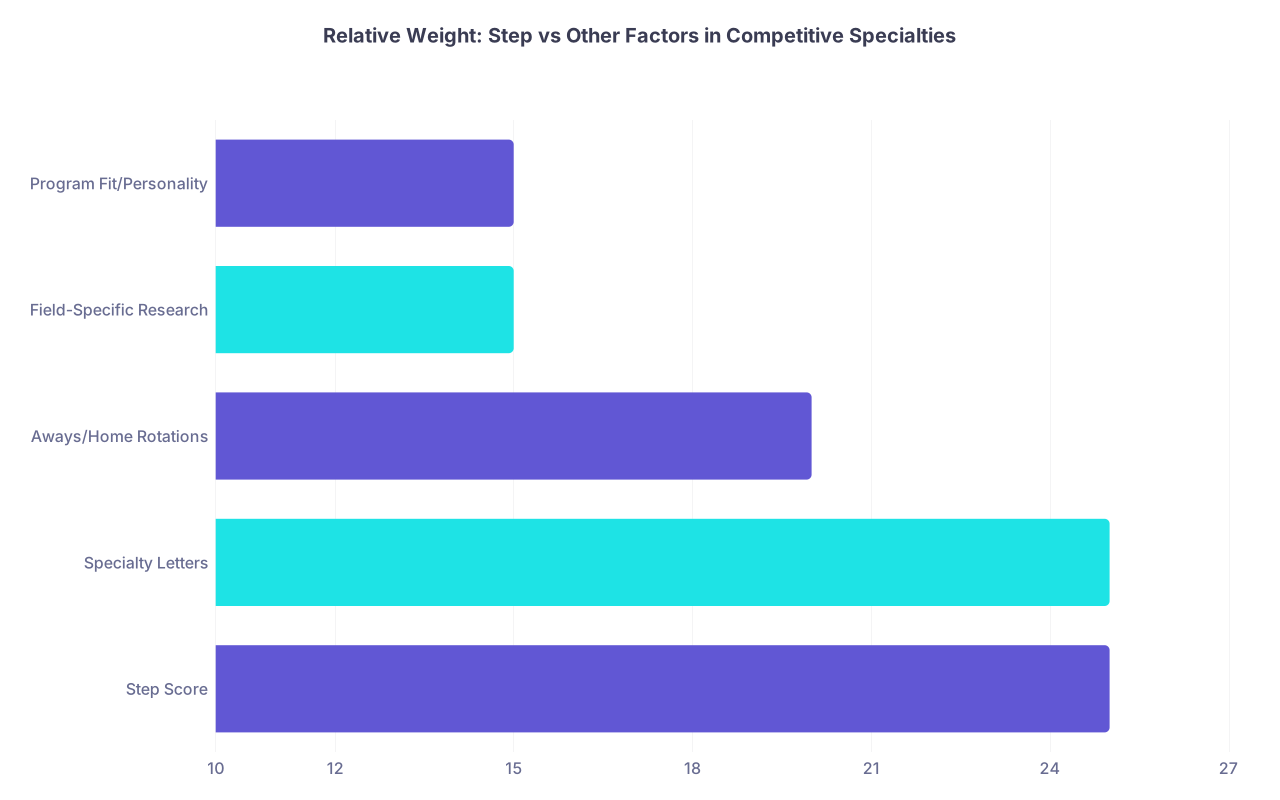
| Category | Value |
|---|---|
| Step Score | 25 |
| Specialty Letters | 25 |
| Aways/Home Rotations | 20 |
| Field-Specific Research | 15 |
| Program Fit/Personality | 15 |
Bad Backup Planning: Overconfidence Meets Reality
This is where things get painful.
The overconfident pattern:
- Apply only to the hyper-competitive specialty
- Minimal geographic spread
- Few or no “safety” programs
- No credible backup specialty
- Weak or last-minute parallel plan
Then Match Week comes. Suddenly:
- “I do not have a SOAP plan.”
- “I never did a strong rotation in my backup field.”
- “My letters are all in derm/ortho/ENT, and now I am scrambling for IM/EM/FM.”
You think this only happens to “borderline” applicants? No.
I have watched:
- High-scoring derm applicants end up scrambling into prelim medicine with no linked advanced spot
- Plastics applicants with strong scores unfilled, then scrambling into a random surgical prelim year in a city they never wanted
- Ortho and neurosurgery applicants frozen on Monday of Match Week because they never lined up a parallel application (and now they are blocked from applying to it in SOAP due to no letters and no real rotations)
Overconfidence mistake:
- Treating a backup specialty as an insult rather than an insurance policy
It is not insulting to have a realistic Plan B. It is irresponsible not to.
| Aspect | Overconfident Approach | Realistic Competitive Approach |
|---|---|---|
| Step Score View | “Guarantee” | “Ticket to be considered” |
| Aways | 0–1, picked for lifestyle | 2–3, targeted to realistic programs |
| Letters | Generic / non-specialty | Specialty-specific, from known faculty |
| Research | Minimal, late, unfocused | Early, field-specific, mentored |
| Backup Specialty | None or vague | Defined, with rotations and at least 2 letters |
Geographic and Program Prestige Delusions
High scores often breed another subtle problem: prestige tunnel vision.
You hear:
- “With your Step 260 you should only apply to top-20 derm programs.”
- “Your numbers are Hopkins/MGH level. Do not waste apps on ‘lower’ places.”
That is idiotic advice.
I have watched Step-strong applicants:
- Overweight “brand-name” programs where they have no connection
- Underapply to strong but less flashy programs where their chances are better
- Refuse to consider certain regions (“I would never live in the Midwest”), then not match anywhere
Programs are not dumb. They know:
- Everyone wants the big names
- Many people only apply to them “just in case”
- They will always have more qualified applicants than spots
Overconfidence mistakes:
- Not applying broadly because “I do not want to waste my score”
- Assuming PDs at “lower-prestige” programs will think you are “overqualified” and thus not rank you
Reality:
- High scores do not “go to waste” at a strong but non-Top-10 program
- They buy you stability, a good training environment, and a matched position
- An unmatched 260 at home is not more prestigious than a matched 245 at a solid mid-tier program
Interview Season: When Overconfidence Shows Up in the Room
The damage does not stop at the application.
I have seen applicants with high scores walk into interviews with:
- A subtle entitlement: “I am the kind of applicant you want.”
- Shallow understanding of the specialty beyond “I like procedures” and “I want a challenge.”
- Weak, memorized answers to “Why this program?” that scream “I barely researched you.”
Competitive specialties are small worlds. Faculty talk. They smell arrogance quickly.
Red flags they see:
- Overemphasis on Step scores in your story
- Minimal questions about case mix, teaching, mentorship, research opportunities
- Vague, resume-reading “tell me about yourself” answers
Overconfidence mistake:
- Believing that because you got the interview, your score already “proved” enough
- Not realizing that at this stage, everyone they are seriously considering has strong numbers
Once you are in the interview chair, your Step score mostly recedes. Your fit, maturity, humility, work ethic, genuine interest, and letters take center stage.

| Step | Description |
|---|---|
| Step 1 | High Step Score |
| Step 2 | False Sense of Security |
| Step 3 | Underinvest in Research |
| Step 4 | Limit Aways and Exposure |
| Step 5 | Weak or No Backup Plan |
| Step 6 | Thin Application File |
| Step 7 | High Risk of Not Matching |
Concrete Ways to Avoid the Overconfidence Trap
You do not fix overconfidence by pretending your score is unimportant. It matters. A lot. You fix it by treating it as one weapon, not your entire arsenal.
1. Reality-Check Your Competitiveness Early
By early third year, you should:
- Talk to at least two honest faculty in your target specialty
- Ask them directly:
- “With my current CV and this score, how would I stack up here?”
- “What are my biggest weaknesses?”
- “If I applied right now, would I be a realistic match at this or similar programs?”
If they hesitate or give you vague reassurance, push:
“I do not need flattery. I need to know if I am a risky applicant for this field.”
2. Build the Rest of the Application Like You Have a 220
Plan as if:
- Your Step score alone will not get you an interview anywhere
- You must earn every letter, every away, every research line
Concretely:
- Schedule 2–3 aways in realistic geographic and program tiers
- Prioritize rotations where faculty are known to:
- Write detailed letters
- Actually pick up the phone for you
- Get at least 2–3 letters from specialists in the field, not just generalists
3. Be Strategic but Humble With Program Lists
When building your ERAS list:
- Include:
- A reasonable slice of “reach” programs
- A solid core of mid-tier programs
- Some programs that are historically more interview-generous
- Do not trim “safer” options simply because your score is high
Better outcome:
- “I had more interviews than I needed and matched well”
than - “I tried to calibrate to my score ‘tier’ and came up short.”
4. Design a Serious Backup, Not a Fantasy
A credible backup specialty means:
- 1–2 real rotations in that field
- At least two letters from that specialty
- A personal statement that is not clearly recycled
- Enough applications sent to that field that you are actually viable
The wrong way:
- List “backup: internal medicine” on a spreadsheet and never act on it
- Pray you will not need it
The right way:
- Treat the backup as something your future self might desperately rely on
- Set a personal “tripwire”:
“If by X date my mentors think I am borderline for my primary specialty, I will fully activate my backup plan.”

The Subtle Psychological Trap You Must Watch
One last point, because this is the real engine driving all of this:
A high Step score gives you identity. For many students it becomes:
- “I am a 260+ applicant”
- “I am competitive anywhere”
- “I deserve X, Y, Z specialty”
When something threatens that identity (like the idea of a backup field, or applying broadly, or taking a research year), you feel it as an ego wound. So you unconsciously sabotage safety measures that make you feel “less special.”
You:
- Avoid a realistic backup because it feels like admitting defeat
- Skip aways at “lesser” programs because you want a “name”
- Ignore mentors who suggest you broaden your list
That is how people with excellent Step scores land in SOAP or spend a year unmatched, blindsided.
Do not let a number on a PDF dictate your common sense.
Key Takeaways
- A high Step score is a screening tool, not a guarantee. It earns you a look, not a match.
- Competitive specialties care just as much—or more—about specialty letters, aways, research, and fit as they do about test scores.
- The real disaster is not a 220. It is a 260 that convinced you to skip the hard, unglamorous work—and to ignore the need for a serious backup plan.