The people who decide your match fate are not who you think they are.
You imagine a noble “program committee” carefully weighing your whole application. A PD who reads your personal statement, residents who “advocate” for you, some vague consensus. That’s the marketing story.
Here’s the truth I’ve watched for years: in many programs, a small cluster of subspecialty faculty drive the rank list, especially for the top and bottom tiers of applicants. If you intersect with them—on a rotation, in their clinic, in their research lane—they can launch you. If you miss them, you’re often just another ERAS ID.
Let me show you how that actually works.
How Power Really Works Inside a Residency Program
Every residency has a formal structure and an informal one.
On paper, you have:
- Program Director (PD)
- Associate/Assistant PDs
- Clinical Competency Committee (CCC)
- Program Evaluation Committee
- Residents with “a voice”
On the ground, decisions for interviews and ranking are heavily steered by 3–7 attendings who control key levers: high-yield rotations, letters, and PD’s ear. Those attendings are usually subspecialists.
Think cardiology in internal medicine, surg onc in general surgery, NICU in pediatrics, trauma in EM, MFM in OB/GYN, neuro ICU in neurology. The people who run the “prestige” rotations and bring in the grants.
Why them?
Because the PD has two real jobs: satisfy ACGME and keep the department chair and hospital leadership off their back. That means they listen very closely to:
- Who generates RVUs and reputation (translation: subspecialty chiefs and research stars)
- Who runs rotations that can sink the program’s reputation if staffed with weak residents
So when those faculty say, “We want this person,” that request has disproportionate weight. And when they quietly say, “Do not take this one,” that file sinks.
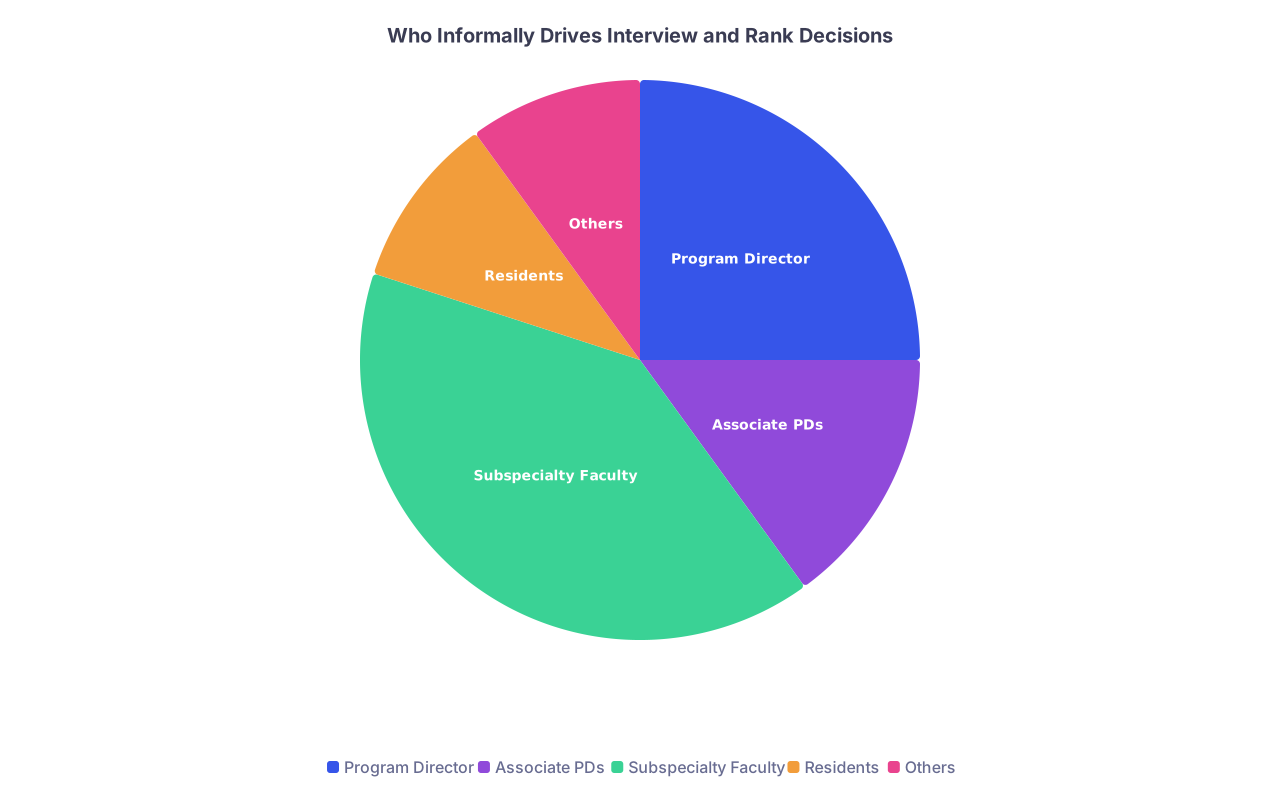
| Category | Value |
|---|---|
| Program Director | 25 |
| Associate PDs | 15 |
| Subspecialty Faculty | 40 |
| Residents | 10 |
| Others | 10 |
That’s the power structure nobody explains to you in med school.
The Archetypes: Which Subspecialties Actually Gatekeep
Not every subspecialist is a gatekeeper. You’re looking for people who combine three things:
- Control over a high‑stakes rotation
- Regular access to the PD/chair
- A track record of writing “program-changing” letters
I’m going to walk through patterns I’ve seen repeatedly across institutions.
Internal Medicine: Cardiology, ICU, Heme/Onc
In medicine, the quiet kingmakers are usually:
- Academic cardiologists (especially interventional, EP)
- MICU/PCCM attendings
- Hematology/oncology research heavy-hitters
At multiple mid‑tier and top‑tier IM programs, the PD spends more time in meetings with cardiology and ICU chiefs than with general ward attendings. Those services complain loudly about “weak interns” who cannot manage sick patients or keep up with the cognitive load. PDs listen.
Two consequences:
- MICU evals can absolutely kill your rank. One well‑written, detailed “concerns about clinical judgment and reliability” from an ICU attending will outweigh ten bland “solid” ward evals.
- Cardiology and heme/onc research mentors get their favorites on the list. I’ve sat in rank meetings where someone says, “This is Dr. X’s mentee,” and the default response is, “We’ll at least keep them in the top half.”
If you’re an applicant rotating at a place you’d like to match IM, you want a strong anchor with at least one of these groups. Not just “I liked the rotation.” You want a faculty name the PD already trusts.
General Surgery: Trauma, Surg Onc, Transplant
Surgery is even more blatant.
Power clusters around:
- Trauma/acute care surgery
- Surgical oncology
- Transplant
Trauma controls the “how do they handle pressure” narrative. Surg onc and transplant control “are they a future academic surgeon or just passing through.”
I’ve seen this play out the same way over and over:
- A trauma attending says, “This rotator was a machine—efficient, unflappable, took ownership.” That student gets pulled up the rank list even with average board scores.
- A surg onc attending who runs trials and NIH grants says, “This person did meaningful work with us and is staying in academics.” PDs will stretch for weaker Step scores to land that “future faculty” type.
On the flip side, a transplant attending who documents “repeated lateness, incomplete pre‑ops, poor communication” will tank you. They are the ones the PD has to keep happy because losing them means losing cases, prestige, and fellowship pipelines.
Pediatrics: NICU, PICU, Hem/Onc
Peds PDs lose sleep over two things: safety in high‑acuity settings and fellowship placement. That means NICU, PICU, and peds heme/onc faculty are disproportionately powerful.
- NICU/PICU: They decide who is “safe” vs “risky.” A single “I don’t trust them alone at night yet” comment lingers in the PD’s head.
- Heme/Onc: The big grant-funded heme/onc attendings often have direct lines to institution leadership. Their letter saying “this student functions at a resident level in research and clinical reasoning” is gold.
The subtle truth: your glowing general peds inpatient evaluation doesn’t mean much compared to a detailed NICU or PICU endorsement.
Emergency Medicine: Trauma, Ultrasound, EMS
In EM, the formal PD title matters, but power clusters around:
- Trauma/ED resus leads
- Ultrasound director
- EMS/flight medicine faculty
Why? They own the identity-defining parts of the residency: resuscitation, procedures, critical scenes.
At several EM programs, interview days include ultrasound or trauma attendings on nearly every panel. They’re not just “extra interviewers.” They are the ones who say, “This person will crush resus,” or “They felt scattered and slow with cases.”
If you’ve rotated there and made yourself indispensable in resus or with the ultrasound team—staying late, running the scanner, correctly presenting sick cases—those people will walk down the hall and say to the PD, “Do not lose this one.”
OB/GYN: MFM, Gyn Onc
OB/GYN is driven by two fears: adverse outcomes and OR reputation. So the voices that matter most:
- Maternal-fetal medicine (MFM)
- Gynecologic oncology
MFM decides whether you’re safe to handle complex pregnancies and not be a medicolegal nightmare. Gyn onc decides whether you are an OR asset or liability.
An MFM chief at one large program used to keep a private list: “can lead,” “can follow,” “should not be here.” Interns and applicants who impressed her on antepartum or high‑risk clinic basically never failed to match in the top quarter of her list. She did not care about class rank. She cared if you called her for help on the right patients and documented properly.
You do not see these lists. But they exist.
Neurology: Stroke, Neuro ICU, Epilepsy
In neurology, the gatekeepers are:
- Stroke faculty (often the face of the service)
- Neuro ICU folks
- Epilepsy attendings who run busy monitoring units
Stroke and Neuro ICU decide who can handle the pager and protocolized chaos. Epilepsy faculty, curiously, often control a lot of research and “scholar” branding.
What PDs quietly admit: a strong Sub‑I on stroke or neuro ICU, with a specific letter, is more predictive of your performance than your Step score. So they overweight those opinions.
How These Faculty Actually Shape Interview Invites
You probably imagine PDs reading hundreds of applications line by line. They do not. They triage aggressively, and they outsource judgment.
Here’s the unofficial flow I’ve watched at several programs:
Initial screen
Someone—often a chief or APD—pre‑screens by Step 2, failures, attempts, geography, school. They flag “auto‑invites,” “auto‑rejects,” and “review needed.”Faculty advocacy pass
Before finalizing invites, PDs ask: “Anyone we should not miss?”
This is where subspecialty faculty send a short email: “Please look closely at Jane Doe, worked with us in MICU, outstanding.” That moves you from borderline pile to invite.Letter‑weighted review
In the “review needed” pile, applications with letters from trusted subspeciality faculty get pulled up. Not because of the title alone, but because PDs know exactly how those people grade.
I’ve literally seen someone open ERAS, scroll to LORs, and say, “Oh, that’s Dr. [Big Name] from Heme/Onc; if he wrote a letter, this is probably solid,” before looking at anything else.
| Component | Relative Influence |
|---|---|
| Step 2 / COMLEX Level 2 | High (first pass) |
| Subspecialty LOR | Very High |
| Clerkship Grades | Moderate |
| Research Output | Moderate–High |
| Personal Statement | Low |
You’ve been told to obsess over your personal statement. The subspecialty gatekeepers care far more about how you carried yourself on their service and what they can honestly tell the PD.
The Rank List: Where Gatekeepers Quietly Overrule the Crowd
The rank meeting is not a fair democratic exercise. Never has been.
The structure usually looks like this:
- PD and APDs run the show
- A handful of faculty (disproportionately subspecialists)
- Sometimes chief residents
- Maybe a token non‑physician educator
What actually happens?
They start from a composite file score or rough stack rank combining metrics, interview, and some vague “fit.” Then individual names are discussed. This is where subspecialty faculty have outsized impact.
Three patterns I’ve watched repeatedly:
The promotion
A MICU or trauma attending says, “I worked with this applicant on our rotation. They were functionally an intern. I would be thrilled to have them.”
PD: “Are you comfortable with them on nights early?”
Attending: “Yes.”
Result: that applicant jumps 10–30 spots up.The quiet veto
Same room, different case. Stroke attending says, “I read their LORs and saw their Sub‑I notes. I have real concerns about their speed and prioritization.”
PD: “Would you be okay if they matched here?”
Attending: slight pause. “I’d be nervous.”
Result: applicant slides down or off the list completely. Nobody says “veto,” but everyone knows that’s what just happened.The favor
Research powerhouse says, “This is my mentee. They’ve done three years of work with us. I think they could be faculty one day.”
PD: “We’ll move them up. They’ll make the chair happy.”
You won’t see any of that written in policy. But that’s how chairs, divisions, and fellowship pipelines stay happy.
How You Actually Get on Their Radar (Without Being Annoying)
You cannot game this completely. But you can stop being invisible.
If you’re an MS3/MS4 or transitional year resident aiming at a specific program or region, here’s how people actually become “known quantities” to subspecialty gatekeepers.
1. Stop chasing generic names; chase the right rotations
At every academic center, there are rotations that matter more:
- The ICU run by the PD’s closest faculty ally
- The trauma service that scares everyone
- The MFM or NICU rotation that has a direct line to the chair
You’ll recognize these because:
- Everyone tells you “It’s hard but worth it”
- Residents say “That’s where they make the rank list judgment”
- Those attendings are always on key committees
You want those rotations early enough that evals and letters can be written for your application cycle.
2. Be strategically visible, not performative
Subspecialty gatekeepers are allergic to two things: fake enthusiasm and sloppy work.
I’ve watched students impress the right people not by being loud, but by being relentlessly reliable in very specific ways:
- Pre‑rounds tight, succinct, and always on time
- Anticipating immediate next steps (labs, imaging, consent, notes)
- Owning one or two patients or tasks completely rather than half‑doing everything
- Asking targeted questions that show pattern recognition, not just “teach me everything”
You need maybe 1–2 key moments where they think, “I would trust this person at 2 a.m.” That’s it. That’s the memory that surfaces at rank time.
3. Ask for letters the right way
Faculty gatekeepers hate vague, last‑minute LOR requests. They write perfunctory letters and then ignore your name at interview/rank meetings.
If you are going to lean on one of these people, approach them like this:
- Ask early, while they still remember concrete episodes: “Dr. X, I’m applying to IM and hoping to match at strong academic programs. Would you feel comfortable writing me a strong letter? I especially valued the MICU month and your feedback on my presentations.”
- Give them a short CV plus a 1‑page “reminder sheet” with 3–5 specific cases or projects you did on their service. They use this language in their letter.
- If they hesitate even slightly, thank them and move on. That hesitation will translate into a lukewarm letter.
The unspoken rule: If they agree quickly and say, “Of course, you did great,” they’re probably willing to go to bat for you beyond the letter.
4. Follow up without groveling
Where people blow this:
They pepper the attending with desperate emails about “advocating” for them. That’s how you get quietly blacklisted.
What works:
- A single concise email late fall: “Just wanted to update you—I interviewed at X, Y, Z including [their institution if applicable]. I’m still very interested in [program]. Thank you again for your support.”
- If it’s truly your #1 and you have a real relationship with them, a short note once rank season starts saying that program is your top choice. One email. Not three.
That’s enough for them to mention your name in a PD hallway conversation or in the pre‑rank huddle.
Programs Where Subspecialty Faculty Matter Less
Not everywhere is ruled by subspecialists. A few environments blunt their power.
You’ll see this more:
- In small community programs without heavy subspecialty presence
- In places where the PD is a strong‑willed generalist with minimal dependence on research divisions
- In newer programs still building prestige, where they care more about “safe, hardworking” generalists than future fellows
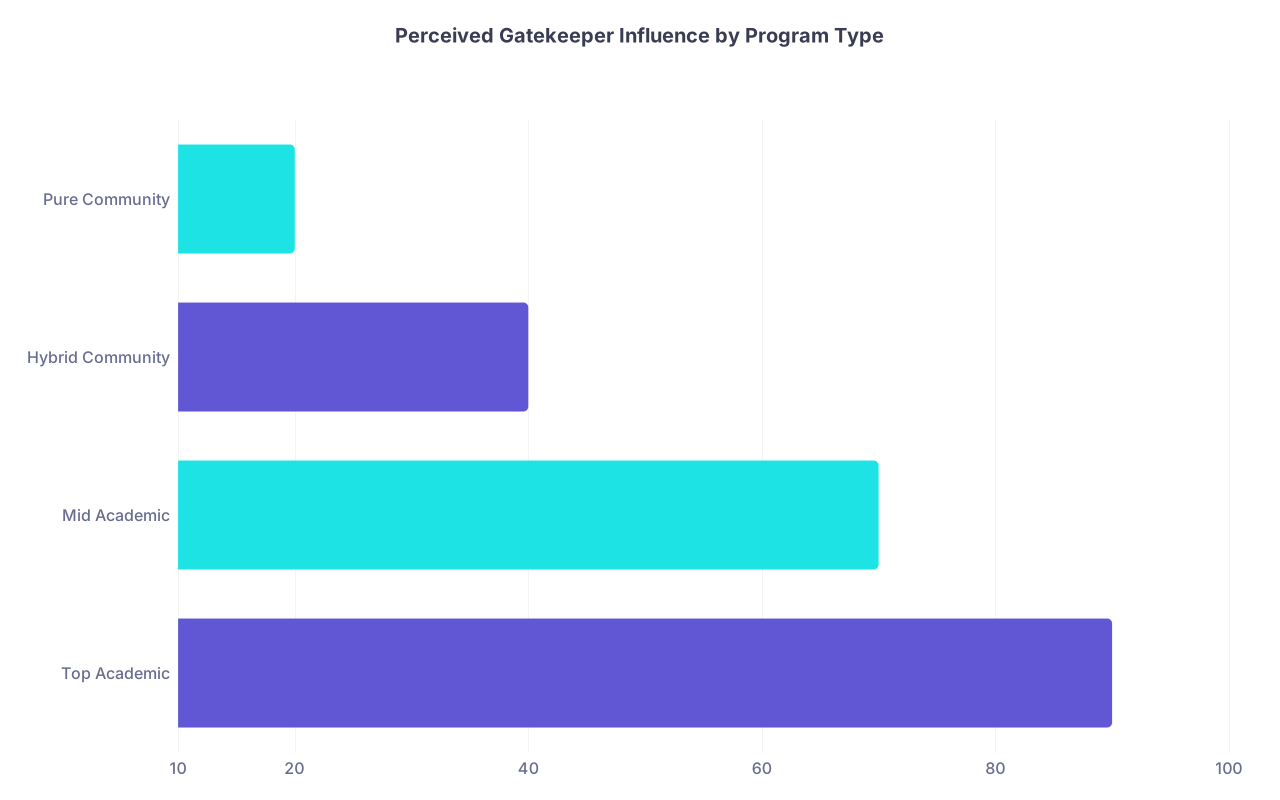
| Category | Value |
|---|---|
| Top Academic | 90 |
| Mid Academic | 70 |
| Hybrid Community | 40 |
| Pure Community | 20 |
But if you are applying to competitive specialties or any recognizable university‑based program, assume that at least three subspecialty voices can meaningfully push you up or down.
The more competitive the specialty, the more concentrated that power becomes.
What This Means for Different Applicant Profiles
Let me be blunt about who can benefit most from understanding these gatekeepers.
Strong scores, weak clinical narrative
You crushed boards, but your evals and letters are bland. Subspecialty faculty can either redeem you or expose the gap.
You should:
- Hunt for one high‑stakes rotation where you can stand out clinically
- Lock in one big‑name faculty who can write, “Despite being quiet on paper, they were outstanding in the ICU/OR/trauma.”
That letter will be used in the rank meeting to justify taking you over more “average but safe” candidates.
Moderate scores, excellent on‑the‑ground
This is where subspecialty gatekeepers can absolutely change your trajectory.
If your Step 2 is average but you are fantastic in the MICU, trauma bay, or NICU, those attendings can literally pull you into tiers you “shouldn’t” reach by numbers alone.
I’ve watched 225‑230 Step 2 candidates match at high‑tier IM or surgery programs because the ICU or trauma chiefs said, “Numbers aren’t spectacular, but this is the kind of resident we want.”
Red flags or non‑traditional background
Here, subspecialty letters can be either your shield or your executioner.
If you’ve got:
- A Step failure
- A leave of absence
- A career change
Then strong, specific subspecialty letters saying “functions at or above resident level,” “excellent judgment,” “would absolutely rehire” give PDs political cover to rank you. Without that, you’re dead in the water at many academic shops.
How to Read Between the Lines Before You Apply
You can’t see internal politics directly, but you can infer a lot.
Pay attention to:
- Who’s on the “Meet the Faculty” slides during interview day. Those names are not random.
- Which subspecialists seem to be on every committee: CCC, rank committee, recruitment. Those are gatekeepers.
- Resident gossip: “If Dr. Y likes you, you’re set.” This is usually more accurate than any official org chart.

Before you schedule away rotations, you should know who these people are. Not to brown‑nose them, but to understand who actually holds the keys.
FAQs
1. If I don’t get to work directly with these subspecialty faculty, am I doomed at that program?
No. You’re not doomed, but you’re anonymous. Many residents match without ever touching the main gatekeepers; they’re chosen off metrics, standard interview performance, and generic letters. What you lose is leverage. You won’t have anyone in the room saying, “This is my person.” At competitive programs with many strong applicants, that extra nudge matters. If you cannot work with the key subspecialists, at least target well‑known generalist attendings whose names carry weight and get them to write solid, specific letters.
2. Should I always pick the hardest, most high‑stakes rotation to impress these people?
Only if you’re ready. High‑stakes rotations magnify both strengths and weaknesses. If your clinical skills, organization, and stamina are shaky, a brutal trauma or ICU month can generate damaging evaluations. A better move is sequencing: do a slightly less intense but still respected rotation first to get your feet under you, then tackle the prestige service once you’ve dialed in your workflow. The goal is not to survive the gatekeepers. The goal is to look like someone they’d trust with their sickest patients.
3. Is it ever appropriate to ask a subspecialty faculty to “advocate” for me with the PD?
It’s usually better to let them volunteer that on their own. Directly asking, “Can you put in a good word with the PD?” often lands wrong unless you have a very strong, genuine mentorship relationship. What you can do: clearly communicate your interest in that program and specialty, ask for honest feedback on your performance, and then, if the feedback is strongly positive, say something like, “I’d be grateful for any support you feel comfortable providing as I apply.” The right faculty will know exactly what that implies and either step up or politely stay neutral. The wrong ones weren’t going to help you anyway.
Key points to walk away with:
- Subspecialty faculty on high‑stakes services quietly drive who gets interviews and how rank lists shift, especially at academic programs.
- One strong, specific endorsement from the right ICU/trauma/MFM/stroke/heme‑onc attending can outweigh a stack of generic praise and mediocre numbers.
- Your job is not to impress everyone; it’s to impress the few people whose words the PD actually treats as decisive.