
It’s late November. You’re a fourth‑year standing in a chilly hospital hallway, still half in scrubs, refreshing your email between cases. Your ERAS is in. Your letters are in. Your Step scores are what they are.
But the thing nagging you is a single, uncomfortable thought:
“Does Dr. X — the big research name in my department — actually like me? Or did I screw myself by not joining that project in second year?”
Here’s the part your dean’s office never says out loud: in the most competitive specialties, access to the “real” interview list runs straight through a small number of research chairs and section chiefs.
You already know scores and grades matter. But inside those selection meetings, they’re not arguing over who has a 254 vs 258. They’re arguing over whose chair called. Whose name came with a promise. Whose file came with the unspoken deal:
“If you take this one, you will not regret it — and I’ll remember the favor.”
Let me walk you through how that actually works, the way people talk when you’re not in the room.
The Real Gatekeepers: Why Research Chairs Matter More Than Your CV
In competitive fields — dermatology, plastics, ortho, ENT, urology, radiation oncology, some internal medicine subspecialties — the research chair or the big-name PI is more powerful than the program director in one specific domain:
They control the pipeline.
Program directors manage the house. Research chairs control the well.
Here’s the quiet reality inside most academic departments:
- The research chair knows who’s been in the lab since M1, who showed up for journal club, who pulled data on a Sunday, who vanished after the sub‑I.
- They also know who’s worth spending political capital on. That’s the currency that actually buys you interviews you shouldn’t get “on paper.”
At one top‑10 derm program I know, the PD once said flat out in a meeting: “If our chair personally flags them, they’re getting an interview unless there’s a major professionalism issue. I don’t care if they have three fewer pubs than the next person.”
That’s not an outlier. That’s standard.
Here’s the dirty part: from the outside, it looks like “student did a derm research year and got 12 interviews.” You don’t see the call the chair made to six programs where they trained. You don’t see the email chain that starts with: “Hey, this one is legit. Do me a favor and take a look.”
That’s the unspoken deal.
How Chairs Quietly Shape the Interview List
Most students imagine some objective process. Spreadsheet. Scores. Filters. Maybe holistic review.
There is some of that. But let me show you the part that doesn’t make it into the brochure.
The Pre‑Sort: Who Even Gets Looked At
Many programs run an initial screen using hard metrics: Step 1 (if they have it), Step 2, class rank, home vs away, red flags.
Then faculty sit down with a list of “borderline” or “review” candidates. On that list, there’s a column that really matters: “Known to faculty / internal advocate.”
This is where research chairs show up.
They don’t just say, “Oh yeah, I know this student.” They classify you, implicitly:
- “I will put my name on this one.”
- “Seems fine, but I don’t know them well.”
- “No. Hard pass. Do not bring them here.”
That first category is gold. When a research chair — especially one with national clout — puts you there, it’s almost impossible for the committee to ignore.
At one mid‑western ortho program, I watched a meeting where two applicants with similar numbers were compared. One was from a no‑name school but had a glowing email from the chair at a big coastal institution: “Tremendous work ethic, I’d take them myself if we had more slots.” The other was from a very good school with more publications but no champion.
Guess who got the interview.
The Side Channels: Calls, Emails, and “By the Way”
Research chairs don’t always go through official channels.
A typical pattern, right after ERAS apps drop:
- Chair sits with the home PD: “Here are the three from our place I’m backing this year.”
- Chair emails or texts old co‑fellows, training buddies, or former mentees now at other programs: “Keep an eye out for [Name]. Strong candidate. We’re backing them here.”
- In national meetings or Zooms, chair drops a casual: “We’ve got a really good student this year, I’ll send you their ERAS ID.”
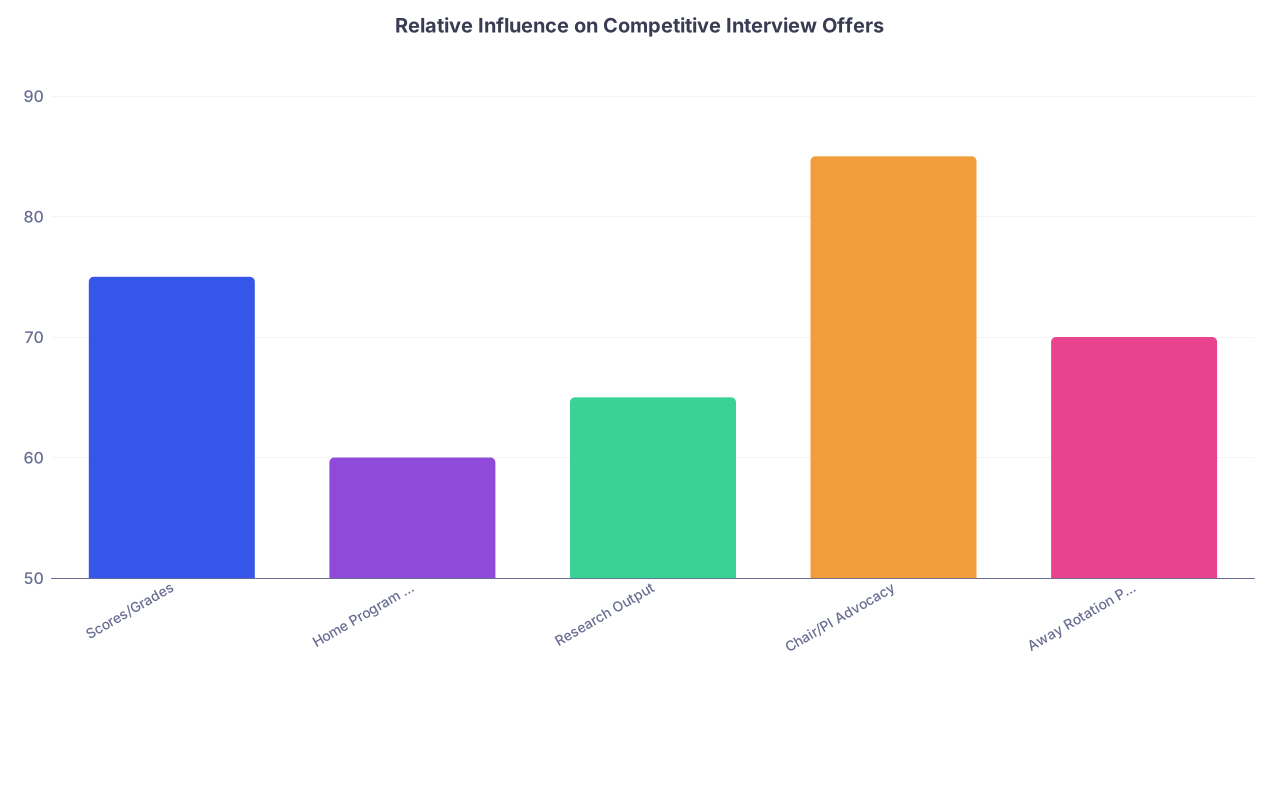
| Category | Value |
|---|---|
| Scores/Grades | 75 |
| Home Program Status | 60 |
| Research Output | 65 |
| Chair/PI Advocacy | 85 |
| Away Rotation Performance | 70 |
That “advocacy” column? In some programs, for borderline candidates, it’s worth more than everything else combined.
Nobody documents this. It’s not in the selection rubric. But I’ve seen an entire committee pause when someone says, “By the way, Dr. Smith from Hopkins called me about this one.”
You can almost hear the mental calculation:
“If we pass on this kid, we’re saying no to Dr. Smith, not just some random applicant.”
That’s power.
The Quid Pro Quo: What Chairs Get Out of “Helping” You
Chairs are not fairy godmothers. They are strategic.
They spend their clout on people who:
- Make them look good.
- Feed their research machine.
- Maintain their network capital.
When they call about you, they’re not just doing you a favor. They are also doing something for themselves.
Here’s the quiet calculus:
- If you matched at Big Name Program A and perform well, the narrative becomes: “Students from Dr. X’s shop are reliably strong.” That makes their next phone call more powerful.
- If they fill their own residency with “their” research students, they lock in a controllable workforce for their lab, their trials, their R01s.
- If you go somewhere they want stronger ties with, you become their ambassador whether you like it or not. You’re their name in that institution.
That’s why chairs will go to bat for some students and barely remember others exist.
The unspoken deal you’re entering when you attach yourself to a powerful research chair is something like this:
“You give me years of work, loyalty, and performance. In return, I’ll open doors you cannot open yourself — but only if I truly believe you’ll make me look smart for backing you.”
Not fair. But very real.
The Winners and the Frozen‑Out: Who Gets Access to These Deals
This is where the system gets ugly.
Not everyone has equal access to a chair’s advocacy. You know that. But let me spell out the mechanisms, because once you see them, you can actually do something strategic.
Who Chairs Like to Back
Patterns I’ve seen, over and over:
- Early joiners. Students who show up in the lab as M1/M2 and just keep coming back. Chairs trust continuity.
- The “reliable grinder.” Not always the smartest. But turns in drafts on time, answers emails, shows up to meetings even when they’re post‑call.
- The adoption projects. Occasionally, a chair will pick a student and basically decide, “You’re mine.” These tend to be high‑ceiling people: strong personality, clear talent, sometimes from under‑represented backgrounds the chair wants to support. These are the ones they’ll call three programs for, not just one.
- The alumni‑linked. If you remind them of themselves or of a favorite former mentee (same school, similar life story, whatever), they’ll over‑invest.
Who gets left out?
- Late interest students. The person who shows up M4 saying, “I’m actually thinking about ENT now, can I get a letter?” They might get a generic letter. They will not get calls.
- Drifters. They floated through a few projects, never really attached to one mentor. Everyone “sort of” knows them. Nobody owns them. Which means nobody spends capital on them.
- Quiet ghosts. Strong students who do not interact, who never present, who never put themselves in front of the chair. They’re not disliked. They’re just forgettable in the moments that matter.
At one radiology program, the vice chair said it perfectly in a ranking meeting:
“If I can’t picture their face, I’m not burning a phone call on them.”
The Home Program Bias
If you’re at a med school with a top program in your field, your chair’s word matters a lot — for you and against you.
Here’s the twisted part: other programs often treat your chair’s students as “pre‑screened.” So if you’re not one of the chair’s favorites, you’re not just neutral. There’s a quiet signal that you weren’t selected from your own pond.
At a strong derm department, an outside PD once told me:
“If their own chair isn’t making noise about them, I assume we’re getting leftovers.”
Brutal. But it happens.
If you’re from a smaller or non‑academic place, it’s different. A single well‑placed mentor can still do a lot, but they may only have juice at a handful of places. It’s not hopeless — I’ve watched community‑based mentors get their students into very strong programs by calling their old residency or fellowship contacts. But the network is thinner.
How This Plays Out in Different Specialties
Let’s be concrete. The influence of research chairs isn’t uniform.
| Specialty | Chair Influence Level | Typical Impact on Interviews |
|---|---|---|
| Dermatology | Very High | Can flip no to yes |
| Plastic Surgery | Very High | Can secure multiple invites |
| Orthopedic Surg | High | Strong tie-breaker |
| ENT | High | Key for borderline apps |
| Internal Med (Gen) | Moderate | Mostly for top programs |
Dermatology
This is probably the purest example.
Derm chairs and big‑name PIs essentially run a national trading network of “my student for your spot.” There’s a reason derm applicants do research years like it’s mandatory military service.
Your derm research mentor’s email carries massive weight, especially if they’re on committees, write board questions, or sit on national societies.
I’ve literally heard:
“We owe them one for taking our person last year. Let’s bring this student in.”
That’s not paranoia. That’s the actual conversation.
Plastic Surgery and ENT
Similar story. Small world, intense competition, everyone knows everyone.
In these fields, the research chair sometimes is the program director. Or the PD trained under them. So “chair support” is almost indistinguishable from “program leadership support.”
One ENT PD I know has a shortlist of three chairs whose recommendations are “auto‑interview unless scandal.” If one of those names emails, the answer is yes first, review later.
Orthopedics
Ortho is more score‑heavy than some fields, but at the top tiers, the network game is strong.
Here, department chairs and fellowship directors (often the spine, sports, joints research heads) carry weight. A spine chair might not be the PD, but they control a lot of prestige, grants, and reputation. When they back a student, the program knows that rejecting that student may cost them something down the road.
Internal medicine has this too, but mainly at the subspecialty fellowship level. For residency, the effect is muted unless you’re going for the absolute top programs — then the research vice chair’s call can bump you from “pile of 500” to “actually reviewed.”
How to Actually Work This System Without Selling Your Soul
You can’t change that this system exists. You can absolutely decide how you play it.
Here’s how you shift from being invisible to being someone your research chair might actually spend political capital on.
1. Get on Their Radar Early — and Stay There
“Early” doesn’t have to mean M1. But if you decide you’re serious about a competitive specialty, you need consistent visibility.
That does not mean fawning. It means:
- Presenting at the department research meeting, not just hiding in the author line.
- Volunteering for things that cross their desk: departmental QI projects, guideline papers, even helping with a review article if they’re leading it.
- Emailing brief, professional updates every few months: “Wanted to share that our poster on X got accepted to Y conference — thank you again for connecting me with Dr. Z.”
You’re not just working. You’re writing a story they can easily remember and repeat about you.
2. Become Someone They Can Safely Recommend
Chairs are risk‑averse about their reputation. They don’t want to call a friend about someone who might flake, implode, or embarrass them.
So your actual job, more than stacking PubMed, is becoming a low‑risk bet:
- Show up. On time. Every time. Chairs talk more about reliability than brilliance.
- Own your mistakes openly. Mentors are much more likely to back someone who screwed up once and handled it well than someone who pretends they’re perfect.
- Be normal. This sounds funny, but I’ve heard this phrase often: “Great CV, but a little…odd. I don’t want to attach my name to that.”
You want people to say, “Hard‑working, normal, no drama. You’ll be glad you took them.”
3. Make the Ask — But Do It the Right Way
Here’s something students constantly mess up: they wait for the chair to magically offer advocacy.
Do not do that.
At some point late M3 or early M4, if you have an actual relationship, you say something like:
“Dr. X, I’m applying in [specialty] this cycle and I’m very grateful for your mentorship. I wanted to ask — for programs where you know the PD or chair personally, would you feel comfortable reaching out on my behalf if you think it’s appropriate?”
You’re giving them:
- An opt‑out (“if you think it’s appropriate”)
- A clear ask (reach out, not just “a strong letter”)
- A chance to say who they can or cannot call
The answer you get is diagnostic. If they say, “Of course, send me your list,” you’re in good shape. If they hedge (“We’ll see how things go”), that tells you how they actually see you.
At one program, a chair told a student: “I’m happy to call people about you, but I want to be honest — you’re in a challenging position with your scores. Let’s be strategic and focus on [these 5 places].”
Harsh. But that chair still called. And the student still matched.
When You Don’t Have a Powerful Chair (or They’re Just Not That Into You)
Maybe you’re at a community program. Maybe your department is a mess. Maybe the chair genuinely doesn’t know your name.
You’re not dead in the water. But you need to recalibrate your “gatekeeper” concept.
Build Your Own Proxy Chair
You don’t need the literal department chair. You need any faculty member with:
- National visibility (committees, society roles, guideline authorship)
- Strong ties to a few specific programs
- A reputation for training solid people
Your job is to find someone like that and become their person.
Often this is:
- The research vice chair.
- A fellowship director.
- A prolific PI in a subspecialty area.
- A long‑standing community faculty with close ties to a particular academic center.
They may not be able to get you 20 interviews. But they can probably get you a serious look at 2–5 programs where their voice matters.
That can be enough to shift your entire cycle.
Use Away Rotations as “Backdoor” Chair Access
Away rotations are not just month‑long tryouts. They’re also intel runs.
If your home chair is weak, a strong away mentor can:
- Call their chair about you.
- Insert you into their own local research group.
- Attach your name to a more powerful network than your home institution ever could.
I’ve seen this play out where a student from a lower‑tier school went to a big‑name program for an away, crushed it, impressed the local research director, and then that director called three other institutions: “You should look at this one, they’re the real deal.”
That’s how you jump tiers.
The Part Nobody Tells You: There Is a Cost
You can’t have this kind of power pointing at your application without strings attached.
The unspoken deal doesn’t end on Match Day.
If you get in largely on a chair’s advocacy, a few things usually follow:
- You’ll feel pressure (spoken or unspoken) to stay in their lane — their subspecialty, their research area, their friends’ fellowships.
- They will sometimes ask you to “pay it forward” by helping their next batch of students or residents.
- If you decide to step away from research entirely, some mentors will take that as a personal affront. They backed you as a future academic. If you go community‑only and disappear, they lose their story.
I’ve seen residents feel trapped because, three years in, they realize they don’t want the academic career they sold in their personal statement. The same chair who got them in keeps introducing them as “one of our future investigators.” It’s awkward.
So you do need to ask yourself, before you plug into someone’s machine:
“Am I okay being associated with this person and their agenda for the next decade?”
If the answer is no, you may want a less ‘powerful’ but more aligned mentor.