
The idea that “residency is the hard part” is false. For cardiology, GI, and IR, fellowship is a bloodsport compared with most residency matches.
Let me break this down specifically, because people throw around “competitive” with zero nuance. Cards vs GI vs IR is not one question. It is three different ecosystems with different feeders, gatekeepers, and failure points.
Big Picture: Cards vs GI vs IR – Who Is Actually Winning?
If you are choosing between internal medicine with plans for cardiology or GI, versus diagnostic radiology with plans for IR, you are not deciding between “easy” and “hard.” You are deciding where you want to fight your hardest battles.
At a high level:
- Getting into a strong IM or DR residency is step one.
- Then you enter a second, more brutal selection process for fellowship.
- The bottleneck has shifted substantially from residency to fellowship over the last decade.
Here is the core landscape.
| Aspect | Cardiology (Cards) | Gastroenterology (GI) | Interventional Radiology (IR) |
|---|---|---|---|
| Entry pipeline | IM residency | IM residency | DR residency or integrated |
| Fellowship spots vs demand | High spots, high demand | Fewer spots, extreme demand | Limited spots, rising demand |
| US grads vs IMGs ratio | Mixed, IMG-heavy some places | More US-heavy at top | Mostly US grads at top DR |
| Research expectation (top tier) | High | Very high | High |
| Procedural intensity | High | Moderate–High | Extreme |
Now let us go system by system.
Cardiology Fellowship: Competitive, But Systematically Achievable
Cardiology feels “competitive” because everyone on your IM service wants it. But structurally, it is the most attainable of the three if you position yourself intelligently.
Pipeline and Numbers
- You must match into internal medicine (preferably university or strong community).
- Most cardiology spots are 3-year clinical fellowships out of IM.
- There are a lot of cardiology fellowship positions nationwide—far more than GI, and frankly more distributed than high-end IR.
The key reality: if you are a solid IM resident at a mid–upper-tier university program with targeted effort, you can land some form of cardiology fellowship. Maybe not at MGH or UCSF, but somewhere reasonable.
What Actually Matters for Cards
The cardiology selection filter is brutal but predictable.
You win on:
Internal reputation
PDs will tell you straight:
“If cardiology likes you by the end of PGY-2, you are done. If they do not, I cannot save you.”Translation:
- Show up on cards rotations early (PGY-1 or early PGY-2).
- Be the resident who knows the cath schedule, handles cross-cover intelligently, and never disappears when the STEMI arrives.
- Do not be the intern who dumps every syncope on “cards consult to rule out something.”
Research and mentorship
You do not need a PhD. You need:- A few abstracts/posters at ACC/aha-type meetings.
- A cardiologist who will literally pick up the phone for you.
- Basic productivity: QI project + maybe one first-author retrospective or case series.
Program pedigree and match culture
Some IM programs are “cards factories.” You know the names:- Big academics with strong cath/EP/heart failure: they overproduce applicants and often keep many internally.
- Good community programs with affiliated cardiology fellowships: internal match pipeline matters more than your Step score ever will at that point.
You do not need AOA + 270 Step 1 (when it was scored) + 50 PubMed citations to get a decent cardiology spot. That is GI-level insanity, not cards.
Where Cards Becomes Cutthroat
- Top 10–15 programs (Brigham, MGH, Duke, Penn, etc.):
Different universe. Here you are competing with IM residents who:- Have legit multi-center papers.
- Present nationally yearly.
- Sometimes already have grant support.
- Sub-subspecialty cards (EP, advanced HF, structural) from big-name programs:
That layer can be more competitive than your initial general cards match.
But zoom out. Across the country, compared to GI and IR, cardiology is competitive but more forgiving. There is more elasticity in the system: more total spots, more mid-tier programs, more geographic variability.
If you are willing to go to a less sexy location, cardiology is achievable.
Gastroenterology: The True Monster of IM Subspecialties
GI is where I have seen excellent IM residents burned. Not because they are bad, but because the funnel is narrow and the applicants are ridiculous.
GI is, in many cycles and regions, harder than the initial IM residency match, even into top programs.
Why GI Is So Painful
Several reasons converge:
Fewer positions per applicant
GI has far fewer fellowship spots than cards. Many academic IM programs:- Have 9–12 cards spots per year.
- Have 2–4 GI spots per year. Sometimes fewer.
Lifestyle + pay equation
Everyone knows the GI story:- Procedures.
- High RVUs (screening colonoscopies, advanced endoscopy).
- Generally good lifestyle compared with surgery or IR, especially in private practice. That mix pulls in a huge number of ambitious, procedure-hungry residents.
Programs filter hard
Academic GI is terrified of matching someone who cannot handle scope-heavy training and high-volume clinics. They overselect for:- Maturity.
- Workhorse mentality.
- Demonstrated interest.
What Top GI Programs Actually Want
If you are aiming for competitive GI, think of it like a mini-IM residency re-match, but with much poorer odds.
Features of successful applicants I have actually seen matched into strong GI:
- From strong IM programs (university or big community with existing GI fellowship).
- Research track record: often better than many cards applicants.
- Multiple abstracts at DDW/AGA.
- IM residents with 5–10 GI-related publications are not rare at the top.
- Subsystem fit:
- They did elective time in hepatology, IBD, motility, pancreaticobiliary.
- They latched onto one or two GI attendings who actively sold them.
Add on top:
- Letters that say:
- “This is one of the top 2–3 residents I have worked with over a decade.”
- “Already functioning at a junior fellow level on our GI service.”
This is not fluff. Those letters move PDs that know each other across institutions.
And then there is the unspoken filter: programs quietly prefer candidates who look like they will be “easy keeps” for faculty recruitment later—academically oriented, stable, no drama.
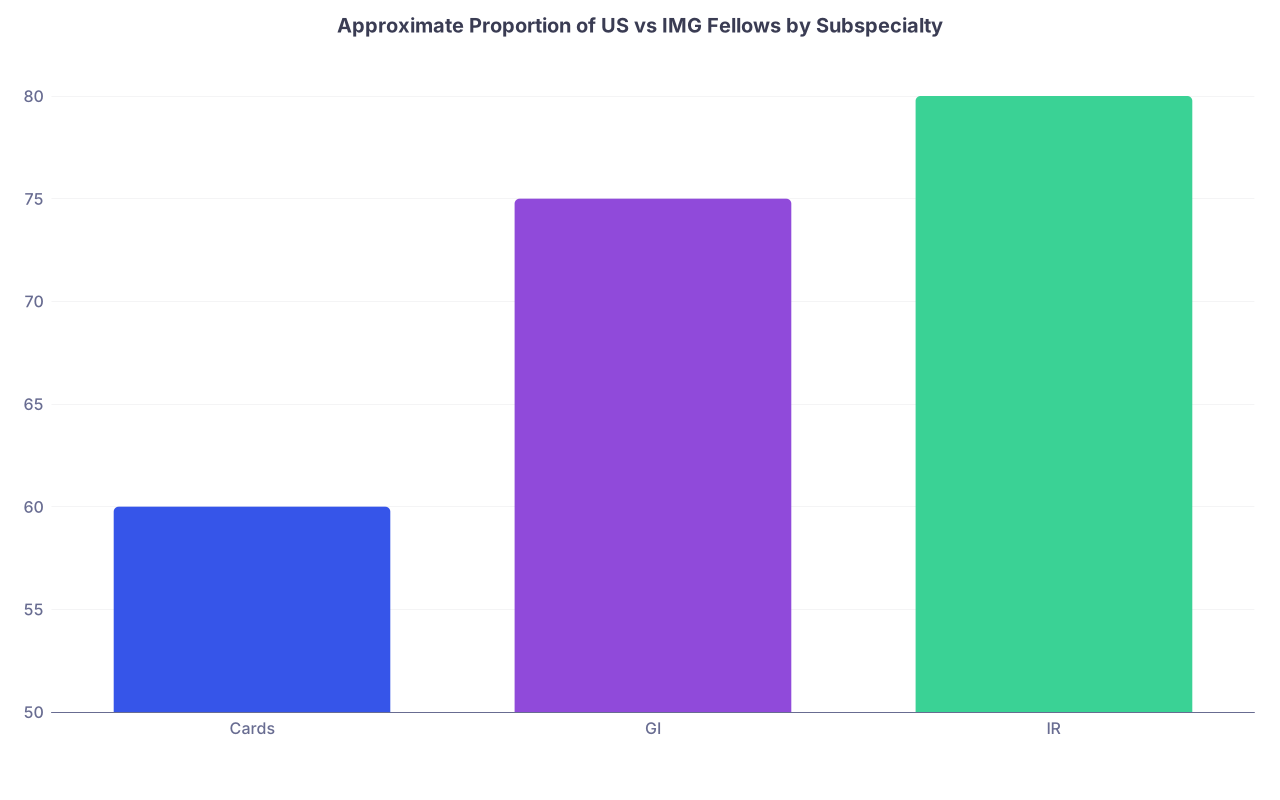
Where US Graduates and IMGs Land in GI
GI is rough on IMGs, especially at the top tier.
| Category | Value |
|---|---|
| Cards | 60 |
| GI | 75 |
| IR | 80 |
These are crude approximations from what I have seen at big programs and NRMP-style data over several years. The rough pattern:
- Cards: substantive IMG representation, especially at mid-tier and community programs.
- GI: shifts more US-heavy at the most desirable places.
- IR: overwhelmingly US-graduate dominated at integrated and strong DR-based IR programs.
If you are an IMG in IM and gunning for GI, you must be clearly exceptional inside your program. Average will not get you there.
Is GI Really Harder than Cards?
At the top tiers: yes.
- Fewer spots.
- Higher per-applicant research density.
- Many PDs will plainly tell residents, “Matching GI from here is often harder than matching into our cards fellowship.”
If you ask IM chiefs at mid–upper-tier programs which match they lose more good residents in—cards vs GI—it is often GI.
For raw competitiveness among IM subspecialties, GI is king right now.
Interventional Radiology: The New Gate Is DR, Not Fellowship
IR is messy, because the pathway changed. You have:
- Integrated IR residencies (straight from med school).
- Independent IR fellowships (after DR residency).
- Early-specialization pathways intertwined with DR.
So you cannot talk about “IR fellowship competitiveness” like it is separate from the radiology pipeline. The bottleneck is largely front-loaded.
IR Integrated vs DR → IR: Two Different Games
Historically, you did:
- DR residency → IR fellowship.
Now:
- High school–style thinking: students go straight after med school into integrated IR programs. These are extremely competitive—often at or above derm / ortho levels at the very top places.
But your question is framed as “subspecialty fellowships tougher than residency.” So let us focus on the:
- DR → IR pathway (independent IR or ESIR to IR).
DR Residency: The First Gate
You must match into a good diagnostic radiology residency. Not random, not malignant, not tiny with no IR presence.
Strong DR programs with robust IR:
- Filter hard at the med student level.
- Often attract students with Step scores and research profiles similar to mid-upper tier surgical matches.
Once you are in DR, the IR battle is inside the house.
Internal Competition: DR Residents vs Limited IR Seats
In many programs:
- There are more DR residents interested in IR than there are IR positions or ESIR spots.
- Division chiefs want:
- Technically excellent residents.
- People who will not flame out after 3 years of 2 AM embolizations.
So the fellowship-like selection begins inside DR:
- Who gets ESIR.
- Who is supported for independent IR slots.
- Who the IR attendings actually want to work with at 3 AM.
Factors that matter here:
- Your DR performance:
- Reading efficiency, case volume, no-show rate, consult quality.
- IR rotation evaluations:
- Are you good with wires, calm under pressure, safe?
- Engagement:
- QI or research in IR.
- Interest in complex venous, PAD, oncology cases, not just “I like procedures.”
How Competitive Is IR Compared to Cards and GI?
You have to separate integrated IR match (med school) from independent IR (fellowship). For the latter:
- At top academic IR programs:
- Extremely competitive. Small numbers of spots.
- They heavily prefer ESIR graduates from strong DR programs.
- At mid-tier, especially outside big coasts:
- Achievable for solid DR residents with decent IR exposure, especially if they are flexible about geography.
The psychological difference:
- For cards or GI, your main fight is during fellowship application.
- For IR, a big chunk of the fight happened earlier—at the DR residency and ESIR selection stage.
From the seat of a DR resident at a large program, trying for IR can feel as stressful as GI feels to IM residents. The numbers are small and the stakes high. If you miss IR, your backup is staying in DR. Not a disaster, but not what many had built their identity around.
Residency vs Fellowship: Which Match Is Harder?
Let us be very concrete.
A good way to conceptualize this is: What bar do you have to clear at each stage?
| Pathway | Residency Match Difficulty | Fellowship Match Difficulty |
|---|---|---|
| IM → Cards | Moderate to High (depends on IM tier) | High but broad opportunities |
| IM → GI | Moderate to High | Very High, narrow funnel |
| DR → IR | High at DR step for top places | High at ESIR/IR step, small numbers |
The pattern I see repeatedly:
For cards:
Residency match into good IM is often more competitive than the fellowship, if you are not chasing top 10 programs. Cards fellowship is tough, but flexible geographically and numerically.For GI:
Fellowship match is usually harder than IM residency match, even into relatively good IM programs. The funnel tightens dramatically.For IR: If you are aiming for IR from day one and you go integrated, the residency match itself is vicious.
If you go DR → IR, the competition is a two-step:- DR match.
- Internal/external IR positioning. The cumulative difficulty is absolutely in the same league as GI in many situations.
How Your Strategy Should Change By Target: Cards vs GI vs IR
You cannot apply the same playbook to all three. That is how strong applicants get burned.
For Future Cardiologists
Your risk is underperforming early in IM while assuming “I will figure it out in fellowship apps.” That is wrong.
What works:
- Hit the ground early:
- First-year cards consult or CCU rotation: show up prepared, read overnight, own your patients.
- Pick 1–2 mentors:
- Not 6. Two cardiologists who know you well and will vouch for you.
- Produce something:
- Case report, QI project, one or two retrospective analyses. Enough to show initiative.
- Be realistic:
- If your IM program is mid-tier with limited research, do not obsess over peacocking your CV. Your internal evaluations and letters matter more.
If you are competent, reliable, and even mildly productive academically, you can match cards. The top programs are another tier, but some cardiology spot is realistic.
For Future Gastroenterologists
You cannot coast. GI is not forgiving.
What you should be doing:
- Select IM program wisely:
- Prefer a place with an in-house GI fellowship.
- Look at recent match lists: do they regularly send residents to GI at solid places?
- Start early:
- PGY-1: attend GI conferences, volunteer for small projects.
- PGY-2: prioritize GI electives, continuity with one or two key attendings.
- Build a real GI portfolio:
- Actual GI-specific research, not random IM stuff.
- Abstracts for DDW, ACG, AASLD depending on your focus (IBD vs liver etc.).
- Look like a future fellow:
- Clinic notes that are clean.
- Comfort with GI cases, basic pathophysiology, and follow-through.
And you still may not match on the first cycle, if you are unlucky or geographically rigid. GI is that tight.
For Future Interventional Radiologists
Your biggest danger is not understanding where the real choke points are.
Two tracks.
If Aiming Integrated IR (direct from med school)
Then the key competition is:
- Step scores (or equivalents now that Step 1 is pass/fail), clinical grades, AOA, strong letters.
- Early radiology/IR exposure.
- Real interest: shadowing, IR interest group, elective time.
This is more like matching ortho or neurosurgery. Very front-loaded.
If Aiming DR → IR (traditional-ish)
Your priorities:
- Match at a DR program with:
- Strong IR presence.
- ESIR options.
- A recent record of sending residents into IR.
- As a DR resident:
- Hit DR fundamentals hard. No one wants a weak diagnostic radiologist doing IR.
- Prove yourself on IR rotations: procedural sense, good hands, safe judgment.
- Join an IR research or QI project, even small, to show longitudinal interest.
- Network:
- Get to know IR attendings locally and possibly at national meetings (SIR).
From a stress standpoint, the DR→IR resident in PGY-3–4, trying to secure an IR slot, feels very similar to the IM senior trying to get GI.
Realistic Risk Profiles: Who Actually Gets Shut Out?
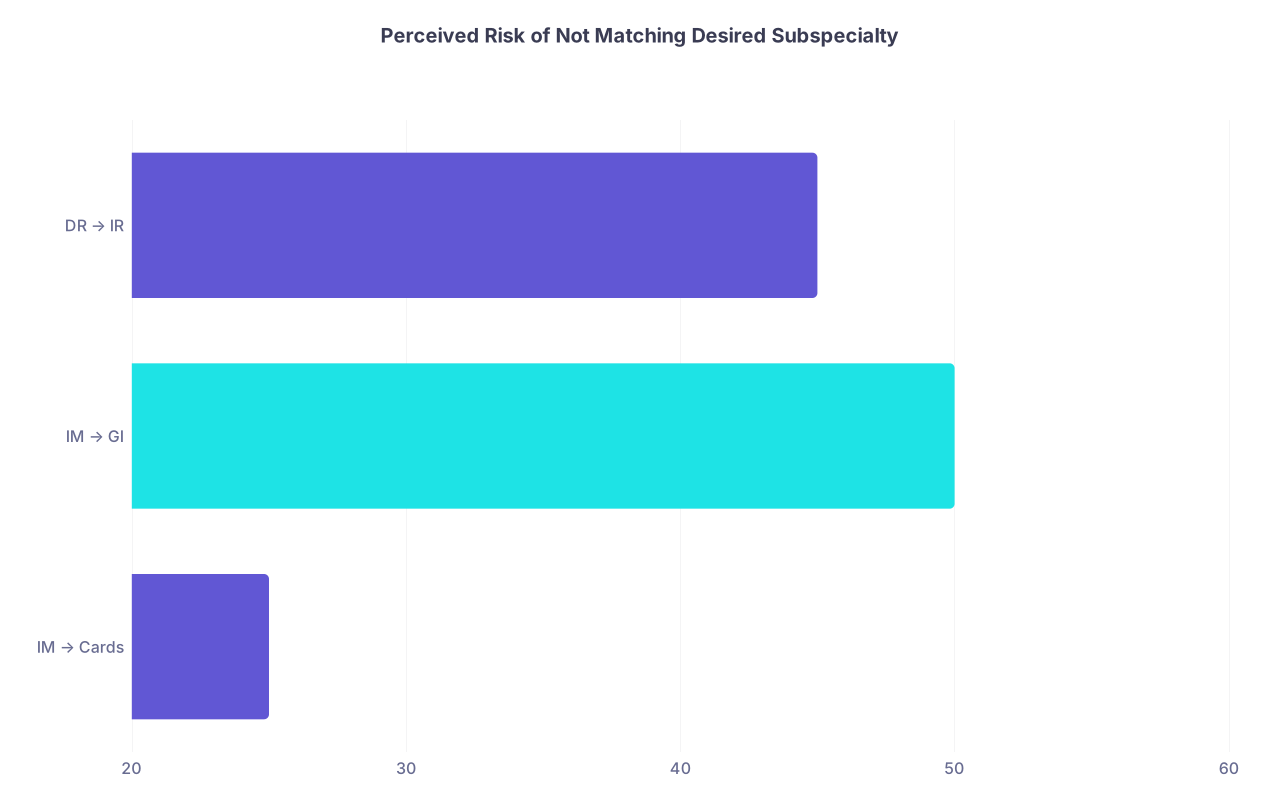
Let me be blunt. Here is where people get burned.
| Category | Value |
|---|---|
| IM → Cards | 25 |
| IM → GI | 50 |
| DR → IR | 45 |
These are not official statistics. They are composite impressions across programs:
IM → Cards (~25% risk)
Many residents aiming for cards eventually land somewhere in cards if they are broadly competent and flexible about location. Risk goes up if:- They are at weak IM programs with no cards fellowship.
- They have red flags or poor evaluations.
IM → GI (~50% risk)
This is where I see the most heartbreak:- Strong but not stellar residents.
- Decent research, but not stand-out.
- GI interest but from IM programs without strong GI pipelines. Many end up in hospitalist roles, general IM, or pivoting to cards/endocrine/heme-onc.
DR → IR (~45% risk)
IR positions are limited. Even good DR residents end up staying diagnostic if:- Their program has more IR-interested residents than IR-supportable slots.
- They discover too late they actually wanted IR and cannot build a record fast enough.
The takeaway: aiming GI or IR is a higher-risk career bet than cards, purely in match probability terms.
If You Are Choosing Between Cards vs GI vs IR
Here is how I would frame it if you were sitting in my office with a Step 2 of 245–255, solid clerkship honors, and no major red flags.
Ask yourself:
- Do you want:
- Long-term clinic + procedures + big RVUs + moderate call?
GI or general cards (with potential for interventions). - Imaging + procedures + minimal clinic + high acute care intensity?
IR. - Deep physiology + longitudinal chronic disease + some procedures + sepsis at 3 AM?
General or interventional cards.
- Long-term clinic + procedures + big RVUs + moderate call?
Then filter with competitiveness:
- If you cannot tolerate a high chance of not matching your dream fellowship:
- Cards is the “safest” of the three.
- If you are extremely driven, research-minded, and okay with real risk:
- GI or IR are options, but do not lie to yourself about the odds.
And remember: these are subspecialty bottlenecks. You will already have jumped through med school and residency by the time you hit them. Burnout, life circumstances, and shifting interests will also shape the path.