It’s late August of your application year.
You’re registered in ERAS. Your personal statement for that tough specialty—derm, plastics, ortho, neurosurgery, ENT, whatever your poison—is basically done.
You’ve got some interviews trickling in… but not as many as your friends. And a quiet, annoying question is starting to grow:
“What if this doesn’t work?”
This is where most people screw up. They either:
- Panic and shotgun a backup plan too late, or
- Refuse to plan at all because it “feels like giving up.”
You’re not doing either. You’re going to build a timeline-based backup plan that:
- Protects you if you do not match
- Improves your odds of matching your dream field over 1–2 cycles
- Keeps you from making desperation moves you’ll regret in five years
Let’s walk it chronologically, from one year before ERAS opens through post-Match outcomes.
12–9 Months Before ERAS: Reality Check Phase
Think: Fall of MS3 / Early PGY1 if you’re switching specialties.
At this point you should get brutally honest about risk.
Step 1: Compare yourself to real data (not vibes)
Pull NRMP “Charting Outcomes” and program-specific preferences. Then stack yourself against it.
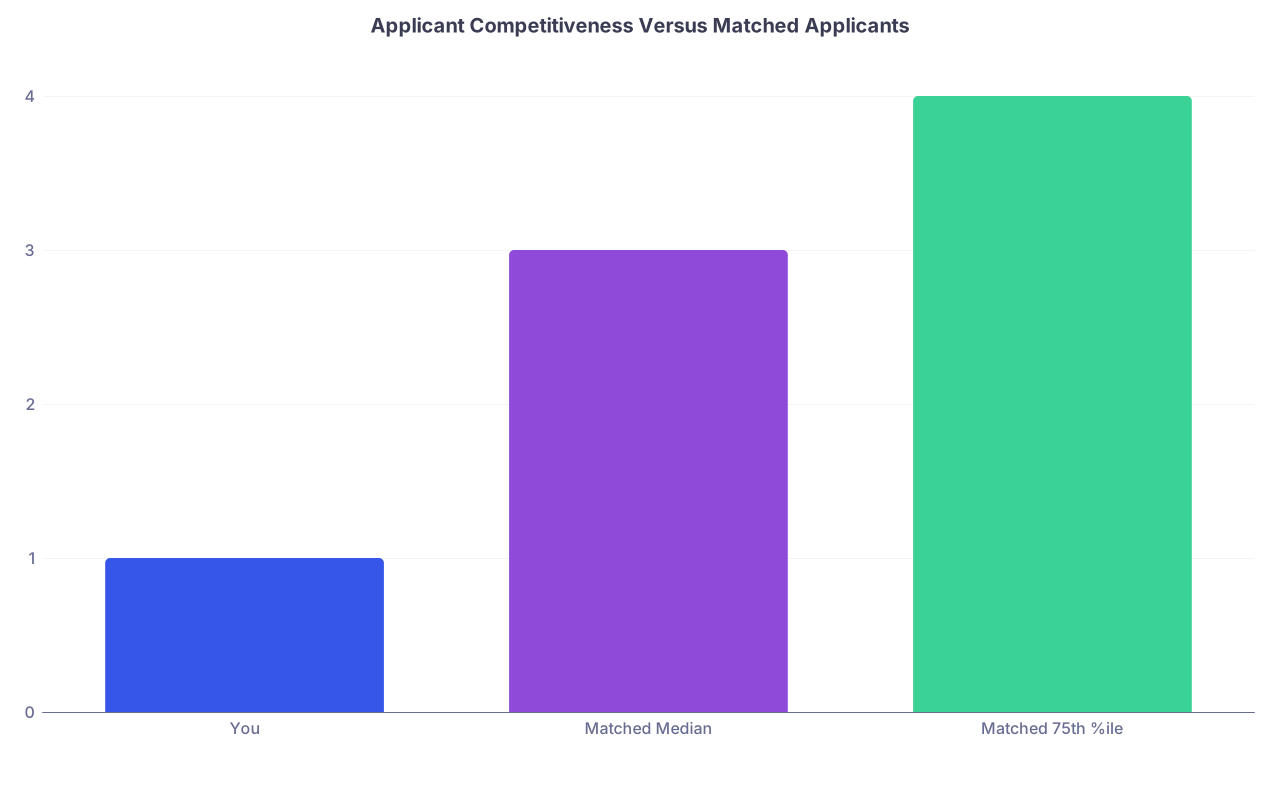
| Category | Value |
|---|---|
| You | 1 |
| Matched Median | 3 |
| Matched 75th %ile | 4 |
Use a simple mental scoring scale:
- 1 = Below average (red flag, low scores, minimal research, weak letters)
- 3 = Around median matched applicant
- 4 = Stronger than most
Do this for:
- Step 2 / COMLEX 2
- Research output in that specialty
- Letters from big names in the field
- Honors / AOA / Gold Humanism
- Home program strength (and whether they like you)
If you are solidly below median in 2 or more critical areas (scores + research + letters), your specialty is high-risk. That does not mean “do not try.” It means “plan a backup now, not later.”
Step 2: Define 1–2 realistic backup specialties
At this point you should identify backup fields that match your profile, not just “generic easier thing.”
Classic combinations:
| Primary (Tough) | Backup 1 | Backup 2 |
|---|---|---|
| Dermatology | Internal Medicine | Pathology |
| Plastic Surgery | General Surgery | IM + later fellowship |
| Neurosurgery | Neurology | Radiology |
| Ortho | PM&R | General Surgery |
| ENT | General Surgery | IM |
Your backup field should:
- Still be something you can tolerate long-term
- Have meaningful overlap in skills or patient population
- Allow fellowships that move you closer to your original interest (sports, pain, critical care, etc.)
Step 3: Quietly test-drive your backups
Over the next 1–2 blocks:
- Schedule at least one elective or clinical exposure in your backup
- Meet 1–2 attendings and a PD or APD if you can
- Ask residents honest questions: “Who actually struggles to match here?”
At this point you should decide your risk tolerance:
- All-in single specialty, no backup
- Dual apply (primary + backup)
- Primary this year, backup next year if no match
Write that decision down. If you later change it, it should be deliberate—not panic-driven.
9–6 Months Before ERAS: Laying Parallel Tracks
Think: Winter of MS3 / early MS4.
At this point you should start building optionality without broadcasting “I’m not confident.”
Step 4: Line up mentors in both specialties
You need:
- 1–2 mentors in your dream field
- 1 mentor in your backup field
What to say to the backup mentor (yes, you can be honest if you pick the right person):
“I’m planning to apply to [tough specialty] this year. I’m also very interested in [backup field] because of X/Y/Z and want to make sure I understand it as a real career path, not just a fallback. Would you be open to advising me over the next year?”
Red flag: A mentor who says “you’ll never match that” without looking at your whole profile. That’s lazy advice. Find someone else.
Step 5: Design your rotation schedule with contingencies
Use a simple Gantt-style mental map of the year.
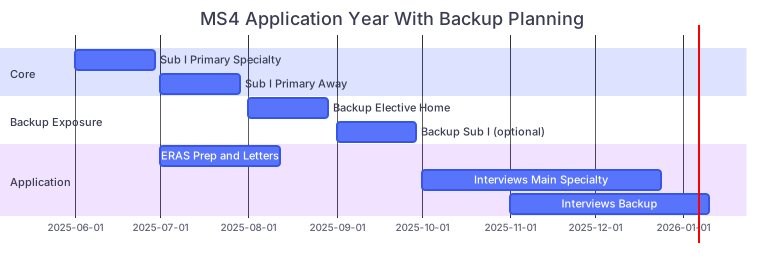
| Task | Details |
|---|---|
| Core: Sub I Primary Specialty | a1, 2025-06, 4w |
| Core: Sub I Primary Away | a2, 2025-07, 4w |
| Backup Exposure: Backup Elective Home | b1, 2025-08, 4w |
| Backup Exposure: Backup Sub I (optional) | b2, 2025-09, 4w |
| Application: ERAS Prep and Letters | c1, 2025-07, 6w |
| Application: Interviews Main Specialty | c2, 2025-10, 12w |
| Application: Interviews Backup | c3, 2025-11, 10w |
Key rules:
- Do not wait until January to touch your backup field clinically. Too late for meaningful letters.
- Aim for:
- 1–2 Sub-I/aways in your tough field (home + 1 away if needed)
- 1 rotation in your backup field that can generate a letter if you pivot
You don’t need to announce “this is my backup” when you rotate. Just be excellent. Let the story catch up later.
6–3 Months Before ERAS: Building Dual Application Infrastructure
Think: Spring/early Summer just before ERAS opens.
At this point you should have a clear sense:
“Am I dual applying or not?”
Step 6: Pre-ERAS decision deadline (hard stop)
Pick a date you will not move—for example, June 1.
By that date you must choose:
- Path A: Single apply to tough specialty only
- Path B: Dual apply with a defined program list split
If you push this decision into late August, you’ll rush letters and personal statements and your backup app will look like a half-finished side project. PDs can smell that.
Step 7: Assemble letter-writers for both paths
By 3 months before ERAS, you should have:
For the tough specialty:
- 2–3 strong letters in-field
- 1 general medicine/surgery letter or from a core rotation if needed
For the backup:
- At least 1 solid letter from someone in that field
- 1 “behavioral” letter: someone who can speak to work ethic, professionalism
Make sure each letter writer knows which specialty the letter is for. A “to whom it may concern in ANY field” letter is weak.
Step 8: Draft two personal statement “cores”
You don’t need two completely different lives. You need two coherent narratives.
Structure:
- Shared core: 60–70% of your story (values, clinical style, patient examples)
- Specialty-specific framing: 30–40% at the start and end
Do this before ERAS even opens. That way you’re customizing, not inventing from scratch when deadlines hit.
ERAS Opens to Application Submission (0–1 Month Window)
Think: Early June to early September.
At this point you should be locking in numbers and lists, not rediscovering who you are.
Step 9: Set program count and distribution
Here’s a rough reality table:
| Risk Level | Primary Programs | Backup Programs |
|---|---|---|
| Low risk | 30–40 | 0–10 |
| Moderate risk | 40–60 | 15–25 |
| High risk | 70–90 | 30–40 |
More is not always better, but for ultra-competitive specialties with average or below-average stats, underapplying is a common self-sabotage.
Rule of thumb:
- If your dream specialty has <70% match rate overall AND you’re below median, you should very seriously consider dual applying.
Step 10: Tailor your application just enough
At this point you should:
- Tag experiences differently for each specialty
- Re-order work/activities to highlight what matters in that field
- Use specialty-specific wording in your descriptions (procedural, continuity, diagnostic, etc.)
What you shouldn’t do:
Rewrite your life story for each specialty. That’s how you burn out before interview season.
September–October: Early Interview Season – Watch the Numbers
Applications are in. The urge now is to wait and “hope.”
Bad plan.
Step 11: Set an interview threshold and timeline
Use a simple mental chart:
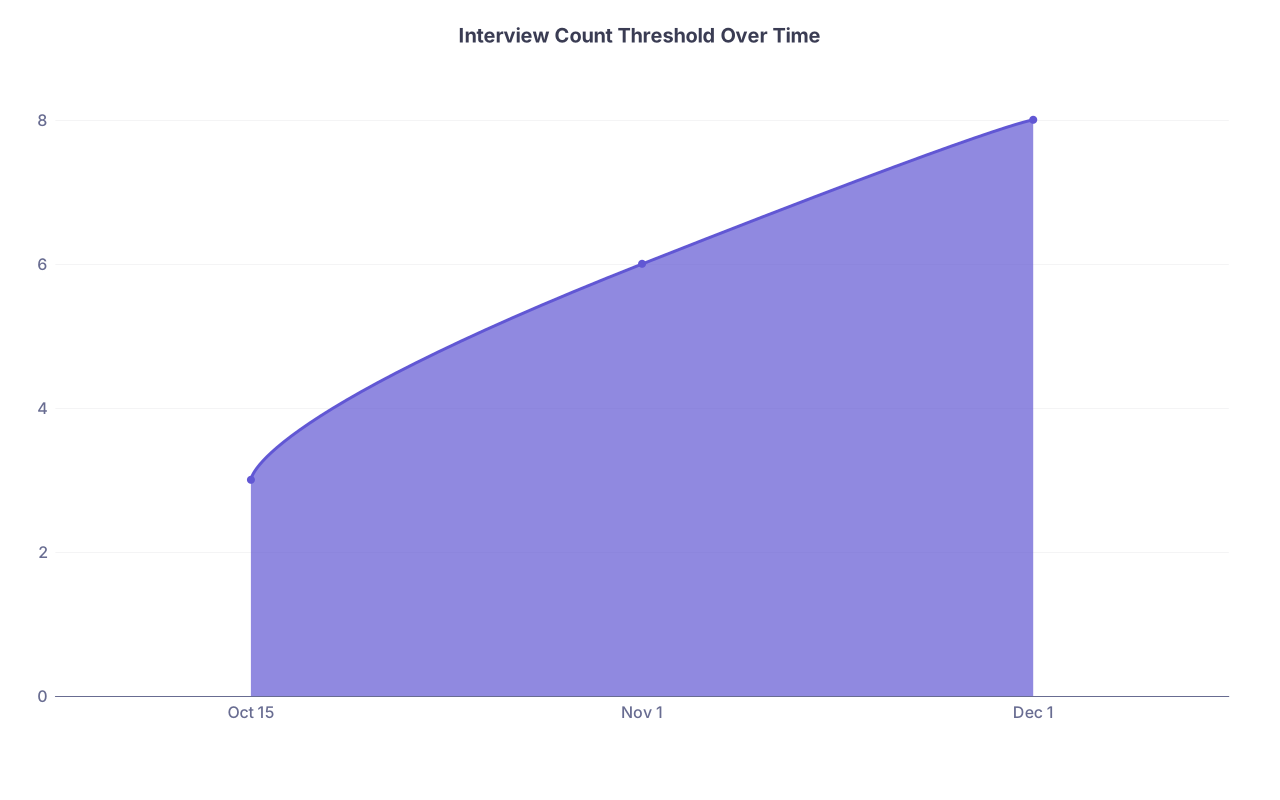
| Category | Value |
|---|---|
| Oct 15 | 3 |
| Nov 1 | 6 |
| Dec 1 | 8 |
Decide before invites start:
- “By October 15, I want at least X interviews in my tough specialty.”
- “By November 1, I want at least Y total (including backup).”
Rough targets for a tough specialty:
- 6–8+ interviews = decent chance
- 3–5 interviews = concerning, but not hopeless
- 0–2 interviews by late November = red alert
Do the same for your backup if you dual applied.
Step 12: Mid-season pivot rules
At this point you should be ready to adjust hard if the numbers are bad.
If you:
- Have 0–2 interviews in your tough specialty by early November, and
- Are getting much better traction in your backup field
Then your rank list strategy is going to matter more than your pride. We’ll get to that.
But don’t start panicking and sending random emails to specialties you barely know. Make moves based on the plan you laid 6–9 months ago.
November–January: Interviews in Both Worlds
You’re now living two parallel lives—talking about advanced reconstructive flaps on Monday and IM continuity clinics on Friday.
At this point you should:
Step 13: Keep your stories consistent, not identical
Across all interviews:
- Your core “why medicine” should be the SAME
- Your specialty “why” should feel like believable branches off that trunk
Example:
- Core: You like longitudinal relationships, complex diagnostics, systems thinking
- Makes sense for derm, rheum, IM, neuro
- Core: You like procedures, anatomy, fixing things with your hands
- Makes sense for ortho, ENT, plastics, PM&R with procedural focus
If in derm interviews you say you “could never imagine inpatient medicine,” then show up at an IM interview saying you “love the hospital environment”… they will notice the disconnect. You’ll feel fake, they’ll feel suspicious.
Step 14: Quietly signal sincerity to your backup
PDs in backup fields can smell “panic applicants” a mile away.
To not be that person:
- Know key issues in the field (e.g., outpatient access, burnout, procedural vs cognitive balance)
- Be able to name specific mentors or experiences in that field
- Ask questions that show you’ve thought about a career here, not just one year of safety
You don’t have to say, “You’re my backup.” But you do need to sound like someone who would not quit day 1 if their tough specialty magically opened a PGY1 spot.
February: Rank List Month – Fork in the Road
This is where people make the worst decisions. Because it’s emotional.
At this point you should have:
- Your interview counts
- Your sense of where you were well-received
- Your tolerance for another application cycle
Step 15: Decide your risk profile for the Match
You really have three strategies:
All-in on tough specialty
- You rank all your tough specialty interviews, then all backup interviews, or only tough if you know you’d rather go unmatched than do backup
- Best if: you have a decent number of interviews (≥6–8) and can tolerate high risk
Safety-first
- You rank backup programs highly once it’s clear your tough specialty chances are slim
- Best if: life circumstances (loans, visas, family) make going unmatched a disaster
Planned re-application
- You intentionally under-rank or omit backup interviews because you’d rather spend 1–2 years doing a research year, prelim, or a different path and try again
- Only reasonable if: you are truly willing to eat another cycle of uncertainty and work to fix the weaknesses that hurt you this time
Do not “accidentally” choose option 3. If you are going to swing for the fences and risk no match, own that decision.
Match Week: Four Outcome Paths and Timelines
Now we’re at the real fork.

| Step | Description |
|---|---|
| Step 1 | Match Week |
| Step 2 | Proceed with Residency |
| Step 3 | Reassess Career Plans |
| Step 4 | SOAP Path |
| Step 5 | Prelim Only |
| Step 6 | SOAP into Any Categorical |
| Step 7 | Plan Research Year |
| Step 8 | Reapply Next Cycle |
| Step 9 | Matched? |
Outcome 1: Matched in your tough specialty
Timeline here is simple:
- Celebrate
- Get ready
- Shift from backup planning to thinking about fellowships, location flexibility, and not burning bridges
Your backup plan did what it was supposed to: it protected you from panic and forced you to be disciplined. Keep the mentors; you may still cross paths with that backup field through consults, research, or patients.
Outcome 2: Matched in your backup specialty
At this point you should decide:
“Is my long-term identity in this field, or am I still aiming to cross back?”
3–6 month timeline:
- Do not talk about switching specialties during your first months as an intern. Just work. Earn trust.
- After 6 months, if you still feel strongly about the original specialty:
- Talk privately with a trusted mentor/PD
- Explore fellowships or niche paths inside your current field that move you toward your old interest (e.g., rheum or allergy instead of derm; pain or sports instead of ortho)
- Very rarely, people reapply to switch fields—but this is politically and emotionally expensive. Only move if you’re willing to burn some capital.
A lot of people I’ve seen end up genuinely happy in their “backup.” But it takes committing fully for at least a year.
Outcome 3: Unmatched entirely
This is where pre-planning saves months.
Immediate Match Week steps:
- SOAP smartly, not desperately. Use your pre-defined hierarchy of:
- Categorical spots in backup field
- Categorical in fields you can live with
- Prelim medicine/surgery if you’re set on reapplying
- Call the mentors you lined up 9–12 months ago. Today.
Next 1–3 months:
- Decide between:
- A dedicated research year in your tough specialty (or related field)
- A prelim year + reapplication
- Pivoting fully to a more realistic field and building a strong application there
Your early-year work—backup exposure, extra letters—gives you something to build on instead of starting from zero.
Outcome 4: Matched to a prelim year only
You’re half in, half out.
1–2 month plan:
- Clarify with your prelim PD how supportive they are of your reapplication
- Start lining up:
- Research projects
- Away rotations / PGY2 spots in your target field
- Updated letters from prelim attendings
Your backup plan timeline now stretches another year:
- By October of PGY1: you should have decided to:
- Reapply to your tough specialty
- Pivot to your backup and apply broadly for categorical PGY2
- Consider nontraditional paths (military, industry, etc.) if both doors are closing
The 2–3 Year View: Avoid the “Perpetual Applicant” Trap
One last piece. At this point you should look beyond this single Match cycle.
If you:
- Apply twice to the same ultra-competitive field with no real improvement in your application
- Or drift between prelims, research years, and half-hearted backup applications
You risk becoming what PDs quietly call a “perpetual applicant”—someone stuck in limbo.
To avoid that, set a hard horizon:
- “If by [X year] I have not matched in [tough specialty], I will:
- Fully commit to [backup specialty] OR
- Leave clinical medicine for [X path: industry, consulting, non-clinical roles].”
Write it down. Share it with one mentor who will hold you to it.
That horizon keeps you from casually sacrificing years of your life to a fantasy.
Today’s Action Step
Do this right now:
- Open a blank document.
- Create three headings:
- “Primary Specialty Snapshot”
- “Backup Specialty Options”
- “Decision Dates”
- Under “Decision Dates,” pick:
- One pre-ERAS date to decide whether you’ll dual apply
- One interview-season date where you’ll reassess based on interview numbers
- One 2–3 year horizon for how long you’re willing to chase the toughest path
If you put real dates on paper, you’ve already done more strategic planning than most applicants ever do.