
The worst specialty decision is not choosing something competitive. It is choosing it too late and torching your Plan B in the process.
You are trying to answer two questions at once:
- When do I commit to a competitive specialty?
- How do I do that without alienating another department, mentor, or program that might end up saving me if things go sideways?
You solve both with timing. And a disciplined, stepwise lock-in.
Below is a concrete, time-based guide from late MS2 through Match Week. Month by month, and when needed, week by week. At each point I will tell you: “At this point you should…” and what not to do if you want to preserve bridges.
Big Picture Timeline: When You Truly “Lock In”
Before we zoom into months, you need the skeleton:
| Stage | Approx Timing | Commitment Level |
|---|---|---|
| Early Exploration | Late MS2 – Early MS3 | 0% locked in |
| Focused Exploration | Mid MS3 | 30–40% locked in |
| Soft Commitment | Late MS3 | 70–80% locked in |
| Hard Commitment (ERAS) | Early MS4 (Jun–Aug) | 100% locked in |
| Backup/Bridge Maintenance | Late MS3 – Jan MS4 | Ongoing, parallel planning |
Now let’s walk this chronologically.
Late MS2 – Early MS3: Exploration Without Labels
At this point you should be curious, not branded.
This is the phase where I watch students sabotage themselves by announcing “I’m going into derm” on day one of surgery. Then they end up loving surgery and are suddenly “that derm person” trying to pivot. Unforced error.
Late MS2 (3–6 months before core rotations)
At this point you should:
- Reality-check competitiveness:
- Pull NRMP Charting Outcomes for your target field (derm, ortho, ENT, plastics, urology, neurosurgery, etc.).
- Compare your Step 2 CK practice scores, class rank, AOA, research count.
- Categorize yourself honestly:
- On target: Scores and research align with matched medians.
- Reach but plausible: A bit below, but with potential improvement.
- Major stretch: Consider parallel planning from the start.
What you should not do yet:
- Do not announce your specialty publicly.
- Do not ask for “derm-only” or “ortho-only” letters before anyone has worked with you.
- Do not start burning time on ultra-niche research if your test scores are nowhere close to viable.
You are still allowed to change your mind without drama. Protect that.
Early MS3 – First Two Core Rotations
At this point you should be collecting data silently.
On each core rotation (IM, surgery, peds, OB/GYN, psych, FM), ask yourself:
- Do I like:
- The pace?
- The patient population?
- The procedures vs cognitive balance?
- The lifestyle of attendings, not residents?
During this phase:
- Keep your language vague:
- “I’m keeping an open mind.”
- “I’m exploring a few options, really like the mix of [X] here.”
- Start noticing:
- Who seems to enjoy their job at 5 pm.
- Which teams you actually look forward to.
- Which specialty is dominated by residents who look miserable.
You still have 0% obligation to any specialty. Your job is to avoid pigeonholing.
Mid MS3: Focused Exploration, Still Reversible
This is the turning point. Around your 3rd–4th rotation, most students start leaning hard toward 1–2 fields.
At this point you should be narrowing and testing, not committing.
Months 6–8 of MS3 (roughly winter of MS3 for a traditional schedule)
Here is where timing becomes dangerous. Competitive departments want to “claim” you early; you want to keep options open.
At this point you should:
Identify 1–2 serious contenders
- Example: You are debating ortho vs general surgery, or derm vs medicine.
- If one of them is very competitive, assume that is Plan A, and the other is Plan B bridge unless something dramatic changes.
Arrange short exposures
- Schedule:
- 2-week elective or selective in your competitive specialty, if possible before late spring.
- Informal shadow days if formal electives are impossible yet.
- Schedule:
Start relationship-building — but neutral
- Tell faculty:
- “I am very interested in [specialty], but still early in the decision process.”
- Ask about:
- Research opportunities that are low-risk and somewhat transferrable (general QI, outcomes, multi-specialty topics).
- Tell faculty:
Guard your reputation in alternative fields
- When on IM but thinking EM or anesthesiology, do not say, “I am just here to pass; my real interest is X.”
- Let every team think you might be “one of them.”
What you should not do mid MS3:
- Do not tell two departments you are “definitely” going into their field.
- Do not ask for “strong specialty letters” from a field you might abandon in two months.
- Do not start telling classmates you are “100% ENT” if you have not rotated there.
You are maybe 30–40% locked in mentally. That is it.
Late MS3: Soft Commitment and Bridge-Building
Late MS3 is when the countdown starts. ERAS is closer than you think. This is where you soft lock your competitive specialty, build your real portfolio, and quietly prepare a backup lane.
March–April of MS3 (US-style academic calendar)
At this point you should:
Decide your “true north”
- Ask yourself:
- If I magically had guaranteed spots in both my competitive specialty and my backup, which would I choose?
- Whatever you choose here is your Plan A. You are now 70–80% locked in.
- Ask yourself:
Plan MS4 schedule strategically
- Front-load:
- 1 home sub-I / audition rotation in your competitive specialty early MS4 (Jun–Aug).
- 1 away rotation in the same specialty if needed (ortho, derm, ENT, etc.).
- Reserve:
- 1 home or away rotation in your realistic backup specialty (IM, FM, anesthesia, pathology, etc.) in the mid-to-late fall.
- Front-load:
Clarify your message to departments
- To your competitive specialty:
- “I am strongly leaning toward [specialty] and planning my schedule around applying.”
- To your backup field (select people only):
- “I am very interested in [specialty], currently focusing on [competitive field], but I also see [backup] as a field I could be happy in.”
- To your competitive specialty:
Start lining up letters the smart way
- Ask for:
- 1–2 letters in your competitive specialty from people who have actually seen you work.
- 1 medicine-style letter that can serve both fields (e.g., strong inpatient IM letter useful for EM, anesthesia, radiology backup).
- When you ask, keep it future-proof:
- “I am planning to apply primarily in [X], possibly with a [Y] backup, and I would value a strong letter focused on my clinical skills and work ethic.”
- Ask for:
You are now showing your hand, but not gambling the whole stack.
Early MS4 (June–August): Hard Commitment on Paper
This is the moment everyone wants to know: When do I actually “lock in” on ERAS?
For the vast majority of students targeting a competitive specialty, the true lock-in happens between June 1 and September 1 of MS4.
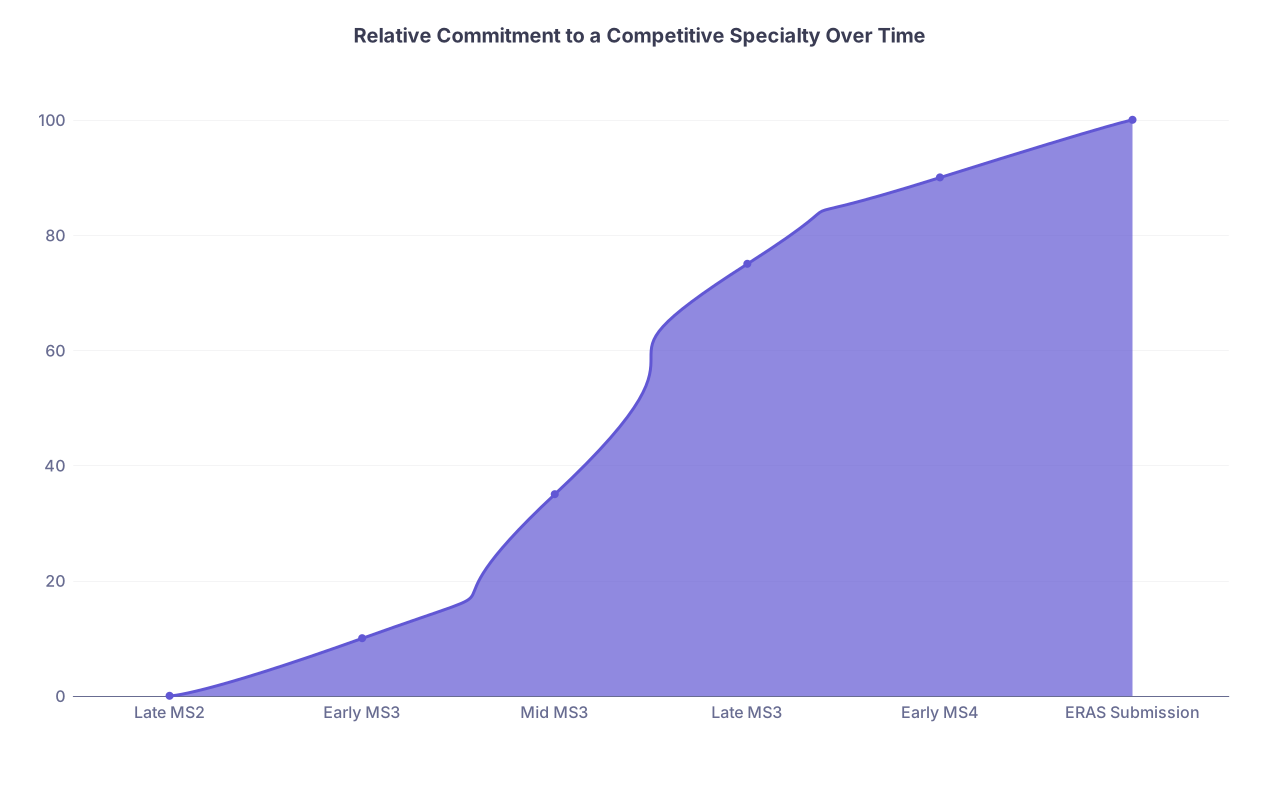
| Category | Value |
|---|---|
| Late MS2 | 0 |
| Early MS3 | 10 |
| Mid MS3 | 35 |
| Late MS3 | 75 |
| Early MS4 | 90 |
| ERAS Submission | 100 |
June–July of MS4
At this point you should:
Perform at a very high level on your home sub-I
- Show up early, stay a bit late, be teachable.
- You are auditioning not only for a letter but for your department’s willingness to make calls on your behalf.
Have your ERAS skeleton built
- Personal statement draft for your competitive specialty.
- CV updated, research and experiences cleaned up.
- List of programs in your competitive field and potential backup field.
Decide your application strategy by mid-July You have three main patterns:
Single-specialty application (high-risk, high-reward)
- Apply only in the competitive field.
- Works if:
- Strong metrics
- Strong home support
- You can tolerate the risk of a SOAP year or research year.
Dual-application with clear priority
- Primary: competitive specialty.
- Secondary: realistic backup (IM, FM, prelim surgery, transitional year, etc.).
- You customize personal statements and program lists.
Competitive + prelim-only approach
- For fields that often use prelim years (e.g., radiology, anesthesia, derm).
- You apply in your advanced field and to a wide range of prelim IM/surgery programs.
By late July, you should know which of these you are doing. This is your actual lock-in.
Clarify with mentors – without lying
- With competitive specialty mentors:
- Be clear: “I intend to apply in [specialty] as my primary field.”
- With backup mentors:
- “I am applying primarily in [X] but also applying in [Y] as a parallel path. I would genuinely be happy in both.”
- With competitive specialty mentors:
What you should not do in early MS4:
- Do not tell each department that they are your “only” specialty if that is false.
- Do not assume letters or support from a department you have never done a real rotation in.
- Do not try to hide dual-applying entirely; secrecy often backfires when people talk.
ERAS Submission (August–September): Irreversible on Paper
Once ERAS opens and you send your applications, your specialty choice is functionally 100% locked in.
At this point you should:
Have two clean application tracks if dual-applying
- Separate:
- Personal statement for competitive specialty.
- Personal statement for backup specialty.
- Targeted program lists:
- Competitive specialty: broad, with a spread of program tiers.
- Backup specialty: enough programs to match without assuming you will get an interview everywhere (think 20–40+ depending on field and applicant strength).
- Separate:
Distribute letters strategically
- For competitive programs:
- 2–3 letters from that specialty, plus 1 strong medicine/surgery letter when appropriate.
- For backup programs:
- At least 1 letter directly in that field, plus 1–2 generic strong clinical letters.
- For competitive programs:
Control the narrative
- On ERAS, you do not have to write “I am dual-applying.”
- In interviews, you answer honestly when asked:
- “I applied to [X] as my primary field but also submitted a limited number of applications in [Y] because I could see myself happy there as well.”
What you should not do after submission:
- Do not add another specialty spontaneously in October out of panic. That is how you end up with a scattered, unconvincing application in three fields.
- Do not start calling backup programs only after you get rejected widely from your competitive field. They notice the timing.
Interview Season (October–January): Protecting Relationships
This is where the bridge-burning usually happens. Not with ERAS. With your mouth.
At this point you should:
Be specialty-consistent within each room
- On a derm interview:
- Derm is your clear #1. You talk about derm longitudinally.
- On an IM backup interview:
- You talk about what you like specifically about IM.
- You do not volunteer, “I am only here because I might not match derm.”
- On a derm interview:
Avoid absolute statements you cannot defend
- Do not say:
- “I only applied in this one specialty.”
- “I would never do any other field.”
- If you are dual-applying, your wording can be:
- “I explored [other field] as well, but my primary interest and application focus has been [this specialty].”
- Do not say:
Read the room locally
- Some competitive departments hate dual-applicants.
- Some are realistic and even expect it.
- If asked directly:
- Tell the truth, but keep it measured:
“Yes, I did submit some applications in [backup], but my goal, if possible, is to match in [your specialty].”
- Tell the truth, but keep it measured:
Maintain relationships at home
- Loop back with both departments (competitive and backup locally) periodically:
- Quick email updates.
- Thank-you notes for letters and support.
- You want both chairs to feel you respected their time and specialty.
- Loop back with both departments (competitive and backup locally) periodically:
Rank List to Match Week: Final Bridge Management
By the time you are building your rank list, the specialty choice is done. But how you behave in the final weeks matters for long-term bridges.
January–February (Rank List Time)
At this point you should:
Rank by genuine preference, not fear
- If you dual-applied, decide:
- Would you rather be in your backup specialty at a great program or your competitive specialty at a marginal one?
- This is the last real “choice” you control.
- If you dual-applied, decide:
Keep faculty in the loop, not in the dark
- To your main specialty mentor:
- “I have ranked [X type of programs] highly and feel confident in my list.”
- To backup mentors (if you used them):
- “I included [backup specialty] programs that I would genuinely be happy at and really appreciate your help.”
- To your main specialty mentor:
Avoid post-interview drama
- No unnecessary “I will definitely rank you number one” emails. They often box you into awkward explanations later.
- No venting to faculty about other programs. People talk.
Match Week
If you match your competitive specialty:
- At this point you should:
- Thank both your competitive and backup mentors.
- Send short, genuine notes acknowledging their help.
- Keep the door open for future cross-specialty collaboration.
If you do not match your competitive specialty:
- At this point you should:
- Contact:
- Your home competitive department chair/program director.
- Your backup department leadership if SOAP or PGY-1 options exist there.
- Phrase it like:
- “I remain very interested in [competitive specialty], but I also would be committed to succeeding in [backup] if that becomes my primary pathway.”
- Contact:
Do not lash out. The people you call this week are the same ones who might create a spot for you, or help you take a research year, or support a reapplication.
How to Avoid Burning Bridges at Each Stage – Quick Reference
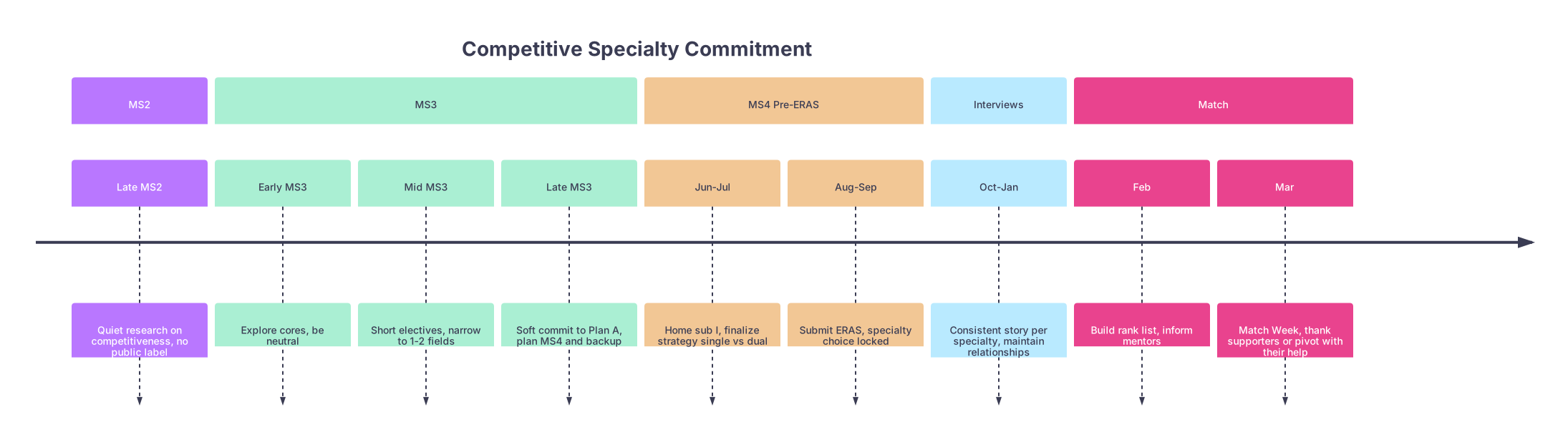
| Period | Event |
|---|---|
| MS2 - Late MS2 | Quiet research on competitiveness, no public label |
| MS3 - Early MS3 | Explore cores, be neutral |
| MS3 - Mid MS3 | Short electives, narrow to 1-2 fields |
| MS3 - Late MS3 | Soft commit to Plan A, plan MS4 and backup |
| MS4 Pre-ERAS - Jun-Jul | Home sub I, finalize strategy single vs dual |
| MS4 Pre-ERAS - Aug-Sep | Submit ERAS, specialty choice locked |
| Interviews - Oct-Jan | Consistent story per specialty, maintain relationships |
| Match - Feb | Build rank list, inform mentors |
| Match - Mar | Match Week, thank supporters or pivot with their help |
The core pattern never changes:
- Early: Say less, explore more.
- Middle: Signal interest, but keep one clean backup lane.
- Late: Commit clearly on paper, stay honest, and avoid grand declarations you cannot defend.
Key Takeaways
- You “soft lock” your competitive specialty by late MS3 when you design your MS4 schedule around it; you “hard lock” it between June and September of MS4 when you build and submit ERAS.
- You avoid burning bridges by never telling two fields they are your only choice, by asking for flexible letters, and by being consistent but not absolute in interviews.
- Every phase has its job: early exploration without labels, mid-year narrowing with honest self-assessment, and late-year commitment with a deliberate, realistic backup plan that you treat with real respect, not as a throwaway.