The fastest way to sink a competitive match is to treat fourth year like a victory lap.
If you are aiming at Dermatology, Orthopedics, or Ophthalmology, your M4 year is not a celebration. It is a carefully choreographed campaign. By the time ERAS opens, programs already have a first impression of you based almost entirely on where you rotated, who knows you, and how strategically you used those 12 months.
I am going to walk you month by month, and then block by block, through how to schedule fourth year for each of these three specialties. Derm vs Ortho vs Ophtho. Same overall logic, very different execution.
Big-Picture Timeline: Month-by-Month Anchor Points
First, the non-negotiables. Regardless of specialty, the calendar looks roughly like this for a traditional MS4 applying in the upcoming cycle.
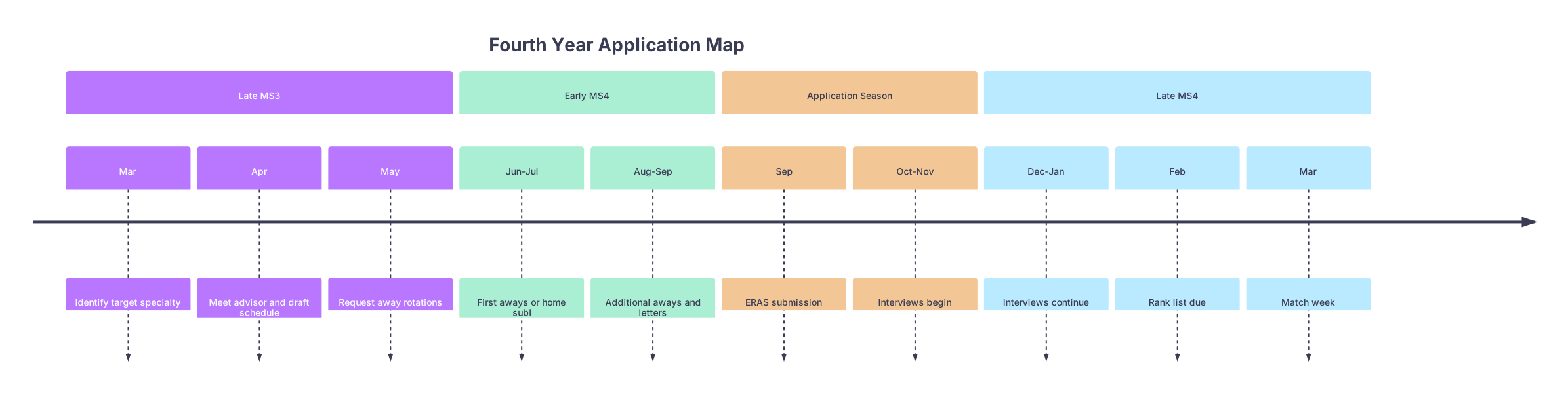
| Period | Event |
|---|---|
| Late MS3 - Mar | Identify target specialty |
| Late MS3 - Apr | Meet advisor and draft schedule |
| Late MS3 - May | Request away rotations |
| Early MS4 - Jun-Jul | First aways or home subI |
| Early MS4 - Aug-Sep | Additional aways and letters |
| Application Season - Sep | ERAS submission |
| Application Season - Oct-Nov | Interviews begin |
| Late MS4 - Dec-Jan | Interviews continue |
| Late MS4 - Feb | Rank list due |
| Late MS4 - Mar | Match week |
Think in terms of anchor months:
March–May (late MS3):
At this point you should:- Lock in your specialty decision.
- Meet with your dean’s office and a specialty-specific advisor.
- Submit VSLO/VSAS applications for away rotations.
- Rough in where your Sub-I, aways, Step 2, and lighter blocks will go.
June–September (early MS4):
At this point you should:- Be on your home Sub-I and/or your first away rotation.
- Start collecting strong letter writers.
- Have Step 2 CK scheduled (and ideally taken) by August.
- Finalize and confirm all aways by email.
September–October:
At this point you should:- Submit ERAS right when it opens.
- Have 2–3 specialty letters uploaded or pending.
- Shift into a lighter, more flexible rotation by October as interviews ramp up.
November–January:
At this point you should:- Be on electives that allow you to leave frequently for interviews.
- Avoid demanding inpatient blocks unless your school forces them here.
- Keep faculty updated on your progress and interview list.
Now, how that translates for Derm vs Ortho vs Ophtho is where it gets interesting.
Comparing Strategy: Derm vs Ortho vs Ophtho at a Glance
You do not schedule these three specialties the same way. You just do not.
Here is the quick comparison before we drill into timelines.
| Specialty | Aways Typical | Core Priority | Letters Needed | Ideal First Block |
|---|---|---|---|---|
| Derm | 1–3 | Research + Fit | 3–4 (2+ Derm) | Home Derm or Medicine Sub-I |
| Ortho | 2–3 | Aways + Work Ethic | 3–4 (2+ Ortho) | Ortho Away or Home Ortho |
| Ophtho | 1–2 | Early Exposure + Step 2 | 3–4 (2+ Ophtho) | Home Ophtho or Step 2-friendly block |
Now we get specific. Month by month and block by block.
Dermatology Aspirant: Research-Heavy, Letter-Dependent
Derm is brutally numbers and research driven, but fourth year is still about optics and relationships.
Late MS3 (March–May)
At this point you should:
Confirm Derm is actually what you want.
If you have not done:- A dedicated Derm elective
- Any Derm research
- Direct shadowing with Derm faculty
You are behind. Not doomed, but behind.
Meet with your Derm advisor and your dean’s office.
Ask blunt questions:- With my Step 1/2 and class rank, am I competitive for Derm?
- How many aways does our Derm program recommend?
- Which programs are realistic targets?
Apply for away rotations (VSLO).
Target:- 1–2 aways at places where your home mentors have connections.
- 1 “reach,” 1 “safer,” possibly 1 home-only strategy if your home Derm is very strong.
M4 Year: Block-by-Block Map for Derm
Assume a July–June academic year with 4-week blocks. Adjust dates as needed.
Block 1 (June): Home Derm OR Medicine Sub-I
At this point you should:
- Do one of two things:
Home Dermatology rotation
Best if:- You have not yet worked closely with your home faculty.
- You need letter writers and face time.
Focus:
- Show up early, leave late.
- Volunteer for every biopsy, procedure, consult.
- Ask 1–2 faculty early if you can aim for a letter.
Internal Medicine Sub-I
Best if:- Your school insists on early Sub-I.
- You already have strong relationships with Derm faculty.
Focus:
- Crush the Sub-I (programs still care about medicine competence).
- Secure a strong IM letter if possible.
Block 2 (July): First Away Derm Elective
At this point you should:
- Be on your first away at a program that:
- Knows your mentor.
- Has taken students from your school before.
- Is roughly in your stats range.
Your job for this block:
- Act like a subresident.
- Read each night on the clinic cases you saw.
- Ask 1–2 faculty by week 2–3 whether they would feel comfortable writing a strong letter.
Block 3 (August): Second Away + Step 2 Timing
Options here:
Option A: Second away Derm elective
Good for:- Expanding your program network.
- Getting a second Derm letter.
Option B: Step 2 CK + lighter elective
If your Step 1 was mediocre or pass-only and you need a strong Step 2, block off:- 2 weeks lighter elective + 2 weeks dedicated study.
- Take Step 2 by late August.
At this point you should:
- Have at least two Derm letter writers identified.
- Have Step 2 scheduled or completed.
Block 4 (September): Home Base + ERAS Submission
This block must be flexible and low-demand.
At this point you should:
Be on:
- A repeat home Derm elective, OR
- A low-intensity outpatient elective that tolerates days off.
Submit ERAS on day one.
Make sure:
- 2–3 letters are already in (including 1–2 Derm).
- Your personal statement has been reviewed by at least one Derm mentor.
Blocks 5–7 (October–December): Interviews + Electives
Derm interview season can be clustered and unpredictable.
At this point you should:
- Choose electives that:
- Are outpatient.
- Allow missed days.
- Do not require night call.
- Consider:
- Pathology
- Rheumatology
- Oncology
- Additional Derm research time
Use downtime to:
- Send thank-you emails.
- Update letter writers and mentors.
- Work on any last-minute research submissions or posters.
Blocks 8–10 (January–March): Cleanup and Backups
At this point you should:
- Close any loose ends:
- Finish graduation requirements.
- Complete any required Sub-I if not already done.
- If you are very worried about matching:
- Consider a strategically placed prelim medicine or transitional year friendly rotation.
- Talk to your advisor about backup plan timing.
Orthopedics Aspirant: Aways Are the Currency
Ortho is straightforward in one sense: your aways are your audition interviews. You must treat them that way.
Late MS3 (March–May)
At this point you should:
- Be fully committed to Ortho. If you are still torn between Ortho and something like Anesthesia, you are asking for trouble.
- Have:
- At least one Ortho elective done.
- A basic relationship with 1–2 attendings or a PD at your home program.
- Submit away rotation requests early. The good Ortho aways fill fast.
M4 Year: Block-by-Block Map for Ortho
Block 1 (June): Home Ortho Sub-I (or First Away)
Ideal plan:
- Home Ortho Sub-I in June.
At this point you should:- Learn the system, the expectations, the culture.
- Show you can function like an intern: pre-rounding, notes, consults, OR help.
- Identify 2 home faculty for letters.
Alternative:
- If you cannot get June at home, use June for:
- Medicine or Surgery Sub-I required by your school.
- Step 2 prep if your core schedule was heavy.
Block 2 (July): First Away Ortho Rotation
At this point you should:
- Be on your first away at a high-priority program.
- Treat this like a month-long interview:
- Arrive before the residents.
- Know every patient on the service.
- Volunteer for consults and ED calls.
By week 2–3:
- Ask the PD or a senior faculty member if they can write a strong letter supporting your application.
Block 3 (August): Second Away Ortho + Step 2
This is usually your second major away.
At this point you should:
- Be on a second away at:
- Either a dream program.
- Or a perceived “safer” but solid program where you could see yourself ranking highly.
Step 2:
- Ideal: Taken June/early July.
- If not done, wedge Step 2 between aways or accept that you will study in the evenings and test right after August.
You cannot underperform on aways and expect the match to be kind.
Block 4 (September): Third Away Ortho OR Home + ERAS
Here you have to balance letters, fatigue, and timing.
Option A: Third Ortho away
- Good if:
- You are strong clinically and have the stamina.
- You want another region/program type.
- Risk:
- Burnout.
- Less flexibility for ERAS and last-minute admin tasks.
Option B: Return to home Ortho or lighter elective
- Good if:
- You already have 2 strong away evaluations.
- You need time to polish ERAS.
At this point you should:
- Submit ERAS on day one.
- Have at least 2 Ortho letters, ideally 3.
Blocks 5–7 (October–December): Interview-Friendly Rotations
Ortho interviews are still relatively travel-heavy.
At this point you should:
- Avoid:
- ICU.
- Busy inpatient medicine.
- Any rotation that shames you for absences.
Better choices:
- Radiology (MSK-heavy if possible).
- PM&R.
- Sports medicine clinic.
- Research elective.
You want:
- Maximal schedule control.
- Minimal call.
- Enough mental bandwidth to rank programs thoughtfully.
Blocks 8–10 (January–March): Required Rotations + Safety Net
By now:
- Most Ortho interviews are done or tapering.
At this point you should:
- Finish any required Sub-I you have not done (medicine, surgery).
- Think hard about a prelim surgery or transitional year backup conversation if your interview count is low. That discussion starts here, not after a bad Match Day.
Ophthalmology Aspirant: Early, Parallel Track with SF Match
Ophtho is its own beast because of SF Match and the separate timeline. You cannot just follow the ERAS crowd.
Late MS3 (March–May)
At this point you should:
Confirm you understand the SF Match calendar:
- Applications open earlier.
- Interviews often start in the fall.
- Match happens before the NRMP main match.
Meet with:
- An Ophtho faculty mentor.
- Your dean’s office to align required rotations with the SF Match timing.
Apply early for:
- Home Ophtho elective if not yet done.
- 1–2 away rotations via VSLO.
M4 Year: Block-by-Block Map for Ophtho
Block 1 (June): Home Ophtho + Relationship Building
At this point you should:
- Be on your home Ophtho rotation if you have not already done a substantial one.
- Your goals this month:
- Identify 2–3 faculty who know you well.
- Request letters early, since SF Match submissions are earlier.
- Clarify which away sites your home faculty have good relationships with.
If you already did home Ophtho earlier:
- You can use June for:
- Medicine Sub-I.
- Step 2 prep.
Block 2 (July): First Ophtho Away + Step 2
This is prime away time.
At this point you should:
Complete your first Ophtho away at a program:
- Regionally where you want to end up.
- Or where your stats are competitive.
Manage Step 2 CK:
- Ideal: Taken late June or early July.
- If your Step 1 is weak, prioritize Step 2 earlier.
Your performance on this away directly feeds:
- Letters.
- SF Match rank lists.
Block 3 (August): Second Away or Home Research
You are now close to SF Match application deadlines.
At this point you should:
- Either:
- Do a second Ophtho away (common).
- Or return to home Ophtho / research if aways are limited.
You must:
- Have letters requested from:
- 1–2 home attendings.
- 1 away attending.
- Have a polished personal statement and CV ready for SF Match submission.
Block 4 (September): Application + Flexible Rotation
SF Match Ophtho applications generally go in early fall.
At this point you should:
- Be on a lighter elective:
- Pathology.
- Neurology outpatient.
- Radiology.
- Submit SF Match materials promptly.
- Confirm with letter writers that everything has been uploaded.
You need flexibility now because:
- Ophtho interviews can start as early as October.
Blocks 5–6 (October–November): Ophtho Interview Season
At this point you should:
- Be mostly on very flexible rotations. Honestly:
- Research elective
- Outpatient Neuro or Endocrine
- Reading elective (if your school allows it)
You will:
- Travel heavily.
- Juggle SF Match interviews plus preparing for the standard NRMP prelim year application.
Blocks 7–8 (December–January): SF Match Ends, Prelim/Transitional Focus
The Ophtho match occurs before the main match.
At this point you should:
Know your Ophtho match outcome.
Pivot immediately:
If matched:
- Confirm your prelim year requirements.
- Rank prelim/transitional programs accordingly for NRMP.
If not matched:
- Talk to your advisor about:
- Research year.
- Switching specialties.
- Emergency backup strategy.
- Talk to your advisor about:
Your fourth-year schedule must allow room for that pivot.
Practical “When Do I Do What?” Comparison
Here is a quick side-by-side of how your first six months might look based on specialty.
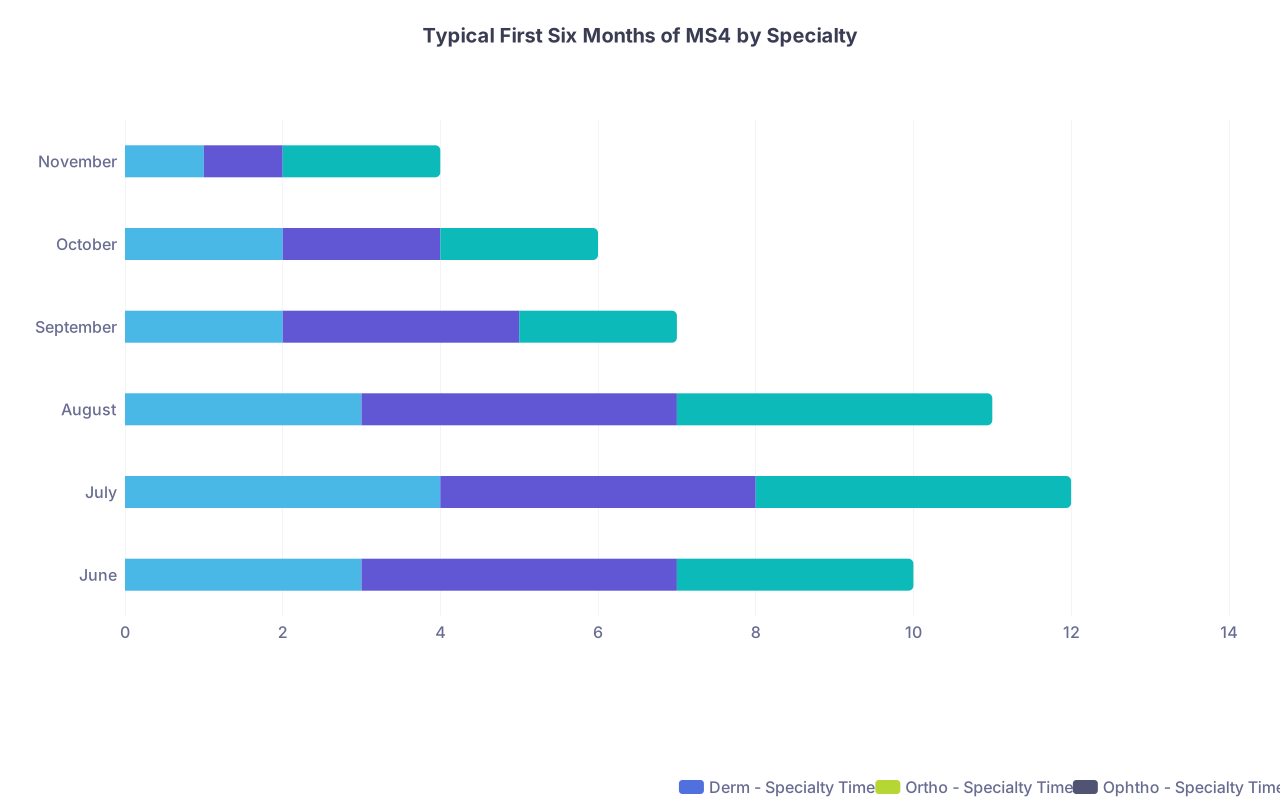
| Category | Derm - Specialty Time | Ortho - Specialty Time | Ophtho - Specialty Time |
|---|---|---|---|
| June | 3 | 4 | 3 |
| July | 4 | 4 | 4 |
| August | 3 | 4 | 4 |
| September | 2 | 3 | 2 |
| October | 2 | 2 | 2 |
| November | 1 | 1 | 2 |
Interpretation (rough “intensity” score out of 4):
- Ortho loads specialty time heavily June–September.
- Ophtho is front-loaded June–August for SF Match.
- Derm is intense, but with more room for research and Step 2 spacing.
Common Scheduling Mistakes I See (and When They Blow Up)
Let me be blunt. These errors are what sabotage otherwise competitive applicants.
Derm
Packing all Derm rotations after September.
Programs will have already built their impression of you based on a thin application.Ignoring Step 2 until October–November.
You lose the chance to rescue a mediocre Step 1.
Ortho
Doing only one away when everyone expects two or three.
You look underexposed and untested.Scheduling ICU or heavy medicine in October–November.
You will either:- Miss shifts for interviews and anger teams.
- Or skip interviews, which is worse.
Ophtho
Not understanding the SF Match calendar.
I have seen students find out in September that applications already opened. That is fatal.Delaying home Ophtho exposure until late fall.
Too late for meaningful letters.
How to Lock This Down in the Next 2–4 Weeks
A fancy plan that never makes it into the registrar’s system is useless. Here is how to make this real.

| Step | Description |
|---|---|
| Step 1 | Decide specialty |
| Step 2 | Meet specialty advisor |
| Step 3 | Draft block schedule |
| Step 4 | Request away rotations |
| Step 5 | Place Sub I and Step 2 |
| Step 6 | Confirm with dean office |
| Step 7 | Email final plan to mentors |
At this point you should:
Write out all 12 months of M4 on paper or a whiteboard.
- Mark school-required blocks (Sub-I, ICU, EM).
- Block out obvious conflicts (weddings, board exams).
Overlay your specialty’s key windows:
- Derm: Aways June–September, Step 2 by August.
- Ortho: Home Sub-I June, aways July–September.
- Ophtho: Home Ophtho June, aways July–August, SF Match apps early fall.
Email your draft schedule to:
- One specialty advisor.
- Your student affairs dean. With a clear subject: “Proposed M4 schedule for [Derm/Ortho/Ophtho] – feedback requested.”
Revise and submit official scheduling requests through your school and VSLO within 1–2 weeks.
Your Immediate Next Step
Open your school calendar and physically map June–November of your fourth year right now—month by month—labeling each block with either “home sub-I,” “away,” “Step 2,” or “light elective.” If you cannot fill those six months confidently for Derm, Ortho, or Ophtho, your next move is to email a specialty mentor today and attach that rough draft for critique.