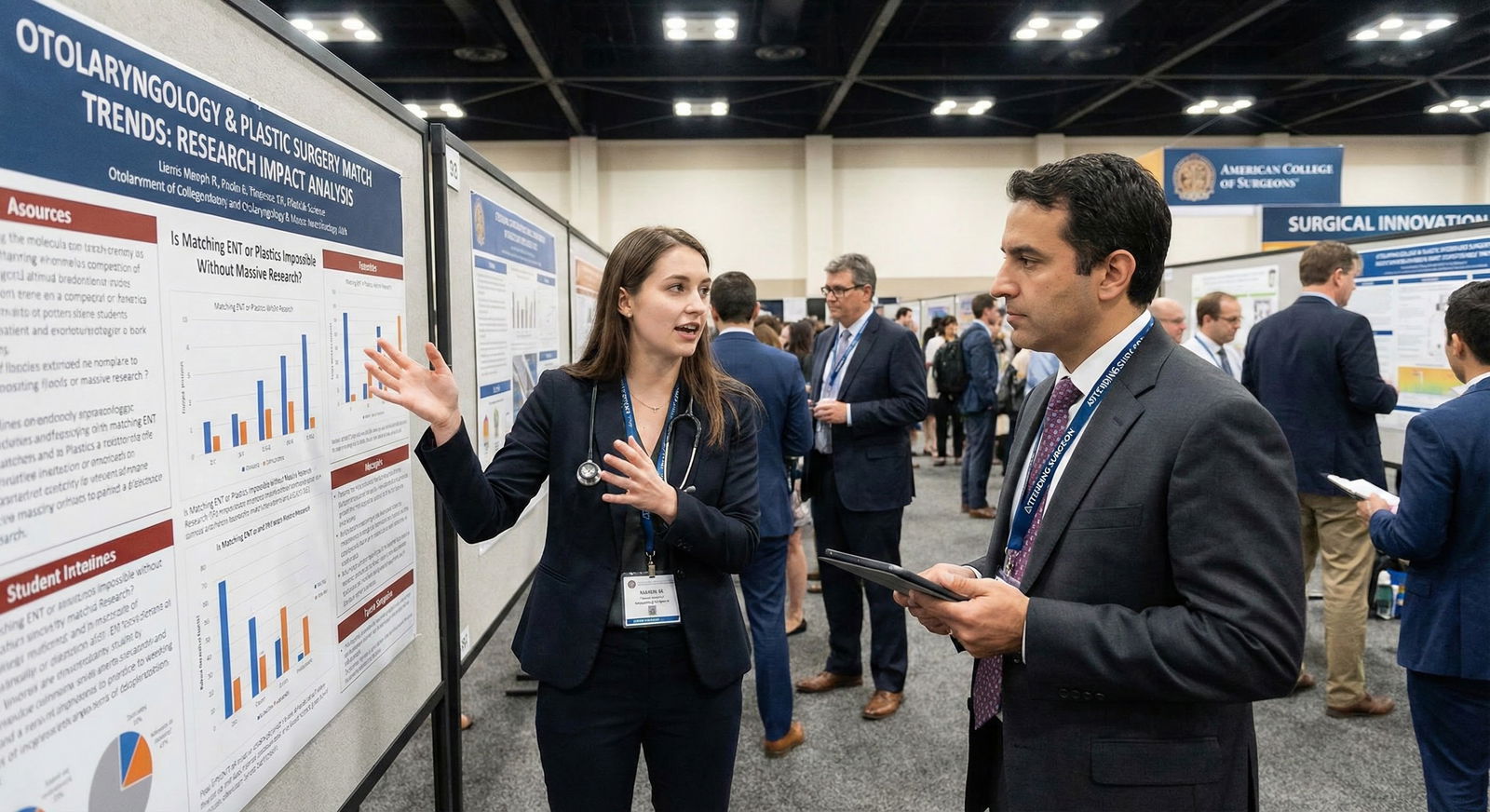
Is Matching ENT or Plastics Really “Impossible” Without Massive Research?
Did someone tell you, “If you don’t have 15+ pubs, forget about ENT or plastics”? Good. Let’s tear that apart.
This belief spreads every year in group chats and Discords: unless you’re a first‑author machine with a PubMed page that scrolls forever, you cannot match otolaryngology or plastic surgery. So people panic, scramble into meaningless case reports, or waste time on junk projects that neither help patients nor their application.
Here’s what the data actually shows — and where the myth goes off the rails.
What The Numbers Actually Show (Not The Reddit Version)
Let’s start with something concrete: what ENT (otolaryngology) and plastic surgery applicants actually look like on paper.
| Specialty | Programs Filled by US Seniors (%) | Mean Research Items* | Mean Abstracts/Pubs/Presentations* |
|---|---|---|---|
| Otolaryngology | ~85–90% | 12–15 | 6–8 |
| Plastic Surgery | ~70–75% | 18–22 | 10–14 |
| General Surgery | ~80–85% | 8–10 | 4–6 |
| Internal Med | >90% | 4–6 | 2–3 |
*“Research items” in NRMP data includes posters, abstracts, presentations, and publications. One project can generate multiple “items.”
So yes, these are research‑heavy specialties. No, they don’t require you to be a 30‑pub phenom.
The problem is people misread these averages:
- They forget it’s mean, not minimum. A few hyper‑productive applicants with 40+ items drag the average up.
- They treat “research items” like “peer‑reviewed, high‑impact, first‑author papers,” which is false. Posters, oral presentations, case reports — all counted.
- They assume quantity is the golden ticket. It’s not. Program directors care a lot more about evidence you can think, follow through, and function on a team.
Let me translate that table into reality: to be competitive, you generally need some research that makes sense, ideally somewhat related to the specialty, with clear evidence you actually did something. But there is a wide range among matched applicants.
The Core Myth: “No Massive Research = No Shot”
The myth usually comes in one of three versions:
- “You need at least a research year for ENT/plastics.”
- “Under 10 pubs? Don’t bother.”
- “If you didn’t start research in M1, you’re done.”
All three are wrong as universal rules.
I’ve watched applicants match plastics with 3–4 solid projects and no dedicated research year. I’ve seen ENT applicants match with one meaningful ENT project plus good letters and solid Step scores. I’ve also seen people with 20+ items go unmatched because their applications were messy or their personalities were a problem.
The underlying truth is less dramatic and more annoying:
you need to be excellent across multiple domains. Research is one domain. It can help patch some weaknesses. It cannot compensate for everything.
Where the myth really fails is pretending research is binary: either you have 15+ things and are safe, or you’re done. Program directors don’t look at it that way.
What Program Directors Actually Care About
Program directors are not scrolling ERAS going, “Pub count less than 12, instant reject.” They’re asking three questions:
- Can this person handle the workload?
- Do they actually care about this field?
- Will they make the program look good and not be a nightmare?
Research plays into #2 and sometimes #3. But it’s one signal among several.
Here’s how ENT and plastics PDs actually weigh things, based on survey data and what they’ll say (quietly) at away rotation dinners:
Clinical performance in core and surgical rotations
They want to see you’re strong in the OR and on the wards, not just in front of a laptop.Letters of recommendation from faculty in the specialty
In ENT and plastics this is huge. A strong letter from someone known in the field outweighs five extra case reports.Away rotations (sub‑Is) performance
ENT and plastics live on away rotations. You show up, work hard, be normal, don’t annoy the team, and demonstrate basic technical and cognitive competence. The attending then goes into the rank meeting and says, “Yes, I can work with this person at 2 a.m.”Step scores (especially Step 2 now)
They want reassurance you can pass boards and not become a problem later. High scores help more than an extra three case reports no one read.
Research sits behind these. Helpful, sometimes critical, but not the sun everything orbits around.
What “Enough Research” Actually Looks Like
Let’s be specific. Suppose you’re aiming for ENT or plastics without a dedicated research year. What does a reasonable research profile look like?
For a solid but not superstar ENT applicant, for example:
- 2–3 projects that went somewhere (poster, presentation, or paper), ideally:
- At least one in ENT/head & neck or related (onc, radiology, sleep, etc.)
- Clear role: you collected data, did chart review, helped with analysis, wrote part of the manuscript.
- Maybe 1–2 smaller things (case reports, smaller posters).
For a competitive plastics applicant without a research year:
- 3–5 meaningful projects:
- At least a couple within plastics / wound healing / recon / hand / craniofacial / microsurgery.
- Some form of output: regional/national poster, institutional symposium, or publication.
- Demonstrable continuity: you worked with the same group, stuck around, not just hopping from project to project for your name.
That’s not “massive.” That’s focused, intentional, and realistic for someone who starts M1 or early M2 and doesn’t waste time.
The applicants who end up with 20+ items often:
- Work in an insanely productive lab.
- Have one project spun into multiple abstracts across different meetings.
- Count every poster and talk separately, as ERAS wants.
They’re not producing 20 independent, novel studies.
Where Research Really Matters (And When It Doesn’t)
Research matters more in some scenarios and less in others.
It matters a lot when:
Your school has no home ENT or plastics program
You need an angle to get on people’s radar. Research with outside faculty, multi‑institutional projects, or national meetings helps.Your Step scores or clerkship grades are average for the field, not a strength
Research becomes one of the few ways to distinguish yourself on paper.You’re going after academic‑heavy, research‑oriented programs
Places like Mass General, Mayo, Michigan, Penn, WashU — they care more about research productivity. Not always “massive,” but meaningful and serious.
It matters less when:
- You’re from a school with a strong home program in that field, you’re well‑known there, and you crush your sub‑I.
- Your letters are outstanding and from people with weight in the field.
- You’re willing to apply broadly geographically and program‑tier wise.
You can’t get away with zero research in ENT or plastics and expect a smooth ride. But you don’t need to bury yourself under meaningless projects either.
The Dumb Ways People Chase Numbers
Here’s where the myth does real damage: it pushes people into garbage research just to pad line counts.
I’ve seen:
- Students jump on a dozen half‑baked case reports, never see most of them finished, and end up with drama, resentment, and almost nothing to show.
- People sign onto a project where their only “role” is finding emails or editing references, then try to sell it as real scholarship. Program directors can smell that fluff.
- Applicants paste obviously copy‑pasted project descriptions into ERAS that sound like buzzword soup. It’s embarrassing in interviews when they can’t answer a basic question about the methodology.
Quantity without substance does not fool anyone used to reading hundreds of applications a year.
If you’re going to do research for ENT or plastics, make it count:
- Work with one or two faculty consistently.
- Take on fewer projects but carry them across the finish line.
- Be able to explain clearly, in plain language, what you did and why it mattered.
Your goal is not to impress a spreadsheet. You’re trying to impress a human attending who has reviewed thousands of ERAS applications and can tell the difference between “meat” and “air.”
The Real Make‑or‑Break: Away Rotations and Letters
If you’re serious about ENT or plastics, here’s the ugly secret: your performance in person usually outweighs your research count.
Programs use research and scores to decide whom to interview. After that, what moves the needle?
- On ENT and plastics services, the residents and attendings write down whether you were helpful, teachable, and competent, or whether you were a liability. That feedback is loud in ranking meetings.
- Letters like “This is the best student I have worked with in 5 years and I would be thrilled to have them as a resident” crush the marginal difference between 7 versus 12 research items.
I’ve watched rank meetings where someone says, “Yeah, this person has unbelievable research, but they were tough to work with on their rotation,” and you can feel the room cool off. No one wants a high‑H index intern who disappears at 3 p.m. or melts down during a straightforward consult.
So while everyone else on Reddit is obsessing about whether they need 8 or 11 abstracts, the people who match are spending their limited time:
- Becoming actually good on the wards and in the OR.
- Building solid relationships with faculty.
- Preparing so that when they show up to sub‑Is, they function like an extra intern, not a confused observer.
What If You’re “Behind” On Research?
Let’s say you’re:
- End of M2 or start of M3.
- 0–1 research projects, nothing published yet.
- Just decided you want ENT or plastics.
Are you doomed? No. But you can’t be naive either.
You need to be strategic.
Anchor with one or two real projects
Go to a specialty‑interested attending and say, “I’m serious about ENT/plastics and I’m late to the game. I’d like a project where I can realistically get something submitted or presented within 6–12 months. What can I help with?”Accept that your early outputs might be small
Case series, retrospective chart reviews, QI projects, or database studies are fine. Don’t hold out for a five‑year prospective trial.Lean hard on clinical performance and letters
You’ll need to crush your surgical rotations, ENT/plastics elective, and away rotations. You’re trying to be the unforgettable student on service, not the ghost with the nice CV.Apply broadly
Not every program has the same research fetish. Some are clinically heavier, less academic. If you’re short on pubs, you can’t be precious about geography or “prestige only” programs.
Sometimes, if you’re very late and your school advisors are blunt, a research year might be rational. But that’s not because matching is “impossible” without it. It’s because, given your timing and profile, it increases your odds to where you’re comfortable.
The Bottom Line: Is It “Impossible” Without Massive Research?
No. Matching ENT or plastics without massive research is not impossible. It’s just harder if you have: no home program, average scores, weak letters, or you’re geographically rigid.
Here’s the distilled truth:
- You do need research, but you don’t need ridiculous volume. A handful of focused, genuine, completed projects is enough for many programs.
- Quality and coherence beat raw numbers. Being able to talk intelligently about a few real projects matters more than padding ERAS with fluff.
- Research is one piece, not the whole game. Away rotations, letters, clinical performance, and fit often matter more than whether you’re at 7 versus 17 “items.”
If you want ENT or plastics, stop asking, “Do I have enough research to be allowed to try?” and start asking, “Given where I am right now, what’s the smartest way to build a believable, coherent application?”
That mindset shift does more for your match odds than any rush‑job case report ever will.
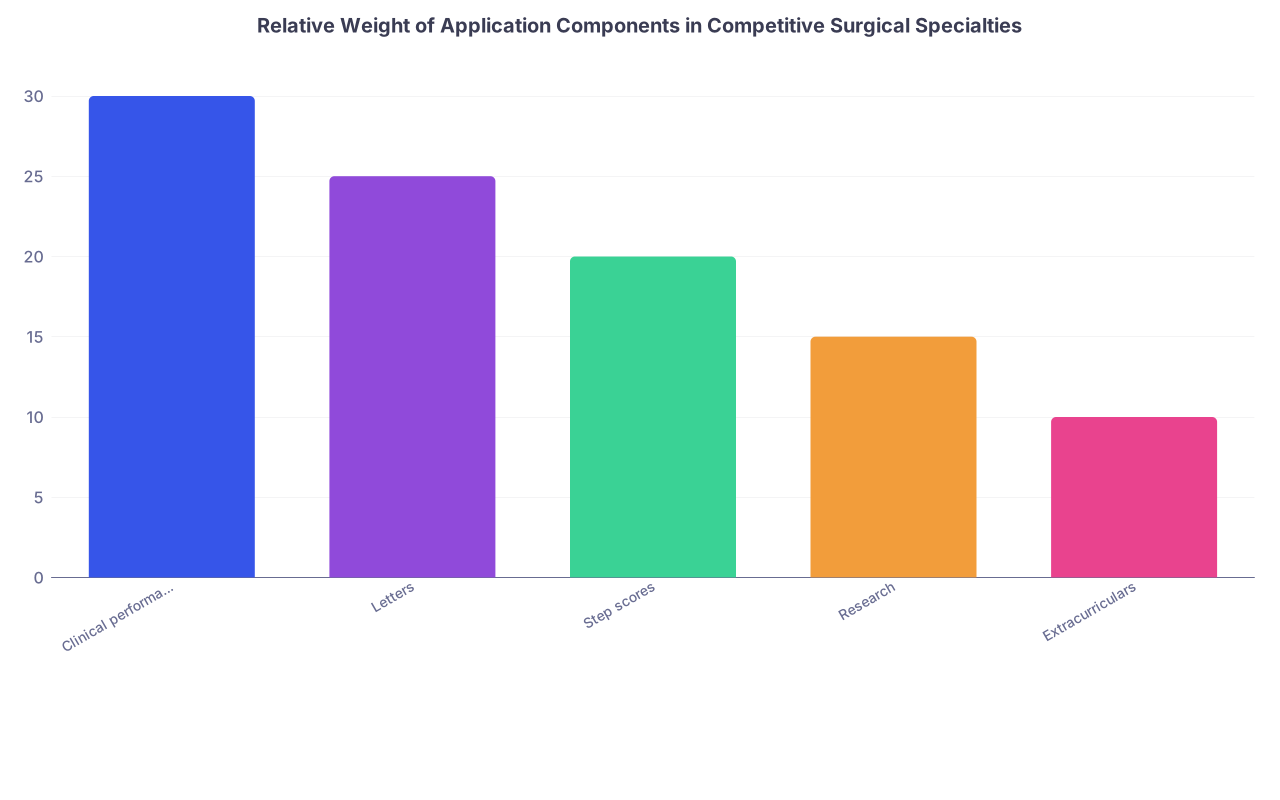
| Category | Value |
|---|---|
| Clinical performance | 30 |
| Letters | 25 |
| Step scores | 20 |
| Research | 15 |
| Extracurriculars | 10 |