3.8% of filled orthopedic surgery PGY‑1 positions in 2024 went to DO seniors.
Read that again. Three point eight percent. In a specialty where DOs now make up roughly 25–30% of U.S. medical students. That mismatch between pipeline and outcomes is the story behind almost every “MD vs DO” discussion in ENT, ortho, and ophtho.
Let me walk through what the data actually show, stripped of marketing fluff and forum mythology.
Big Picture: MD vs DO in Highly Competitive Surgical Fields
Most of the best numbers we have come from NRMP’s “Charting Outcomes in the Match” (for MD seniors), “Charting Outcomes in the Match for DO Seniors,” and the annual NRMP Match Results and Data reports. Some data are reported only at the aggregate level, but there is enough to see clear patterns.
Here is the high‑level comparison for the 2024 Match:
| Specialty | Group | Matched (%) | Notes |
|---|---|---|---|
| Otolaryngology (ENT) | US MD Sr | ~79–82 | Very low unmatched vs applicants |
| Otolaryngology (ENT) | US DO Sr | ~35–45 | Tiny absolute numbers |
| Orthopedic Surgery | US MD Sr | ~71–75 | High bar, but majority match |
| Orthopedic Surgery | US DO Sr | ~35–40 | Majority of DO applicants unmatched |
| Ophthalmology* | US MD Sr | ~70–80 | SF Match, strong match rates |
| Ophthalmology* | US DO Sr | ~20–30 | Very small DO cohort |
*Ophthalmology matches through SF Match, not NRMP; ranges above are based on recent SF Match summaries and program‑reported data, not a single unified NRMP document.
The crude story:
- US MD seniors match into these three fields at a rate roughly 2x that of US DO seniors.
- DOs are not excluded. But they are under‑represented and must dramatically outperform averages to get the same result.
To understand why, you have to look at three buckets:
- Competitiveness metrics (Step scores, research, AOA, class rank)
- Structural barriers (program attitudes, accreditation history, audition rotations)
- Actual match behaviors of PDs (who they interview and rank)
Orthopedic Surgery: The Starkest MD–DO Divide
Let’s start with ortho because the numbers here are the most unforgiving.
Match rates and volume
In 2024:
- Total ortho PGY‑1 positions: roughly 900–950.
- US MD seniors filled ~80–85% of those positions.
- DO seniors filled about 3–4% of positions.
- The rest went to US grads from prior years and IMGs.
From NRMP data:
- US MD seniors in ortho: match rate roughly in the low 70%s.
- US DO seniors in ortho: match rate around the mid 30%s.
In plain language: an average US MD senior applying to ortho has about double the likelihood of matching compared with an average US DO senior.
Step scores and performance thresholds
The data show ortho rewards extreme board scores.
For recent cycles (combining MD and DO Charting Outcomes; Step 1 now pass/fail but Step 2 CK still reported):
- Matched US MD ortho applicants:
- Mean Step 2 CK: ~255–258
- Often 8–11 research products (abstracts, presentations, publications)
- ~70–75% AOA or top quartile class rank in some cohorts
- Matched US DO ortho applicants:
- Step 2 CK typically 255+ (reported means are sometimes slightly lower but the DOs who succeed are almost always in this band)
- Heavy research: usually 5+ works; many did a research year
- High class rank; often from schools with strong ortho alumni presence
The Step 2 distribution is important. A DO with a 245 in ortho is not “average.” They are below the typical matched MD metric, and as a DO they are competing in an even narrower slice of programs.
Program behavior: Who is actually getting interviewed?
Orthopedic PD surveys (NRMP Program Director Survey) consistently show:
- 90%+ of ortho programs cite Step 2 CK as a screening cut‑off.
- Common cut‑offs for ortho are in the 245–250 range for MDs.
- A significant fraction of PDs explicitly report “medical school accreditation” and “reputation” as important.
The reality underneath:
- Many ortho programs interview zero DO students per year.
- Others interview 1–3 DOs out of 40–60 interview slots.
- A small subset of historically osteopathic programs (the old AOA ortho residencies) interview and match DOs at much higher rates. Those are essentially “must‑target” for DO applicants.
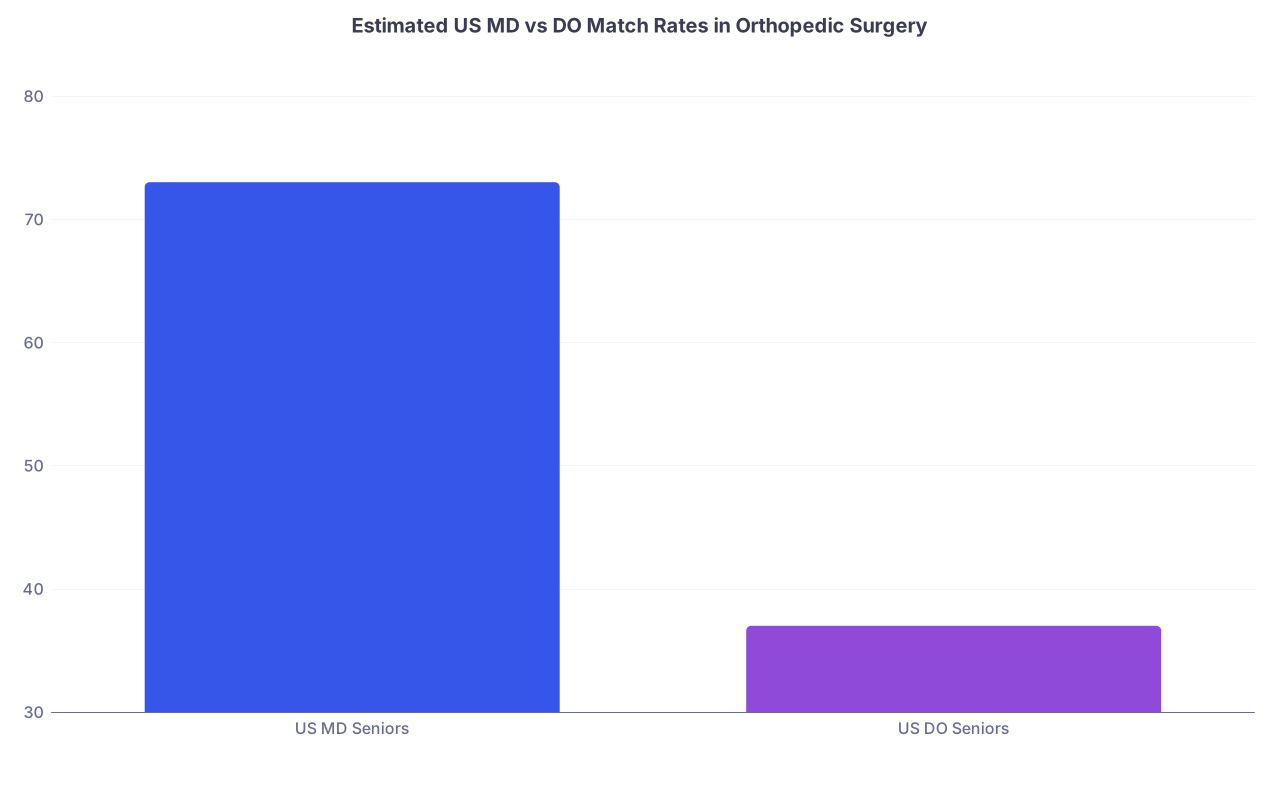
| Category | Value |
|---|---|
| US MD Seniors | 73 |
| US DO Seniors | 37 |
Does that mean DOs cannot match ortho? No. I have seen DOs match at places like Geisinger, Henry Ford, some university affiliates. But every one of them looked like this on paper:
- Step 2 CK ≥ 255–260
- Dedicated ortho research (often a full‑time research year)
- Multiple ortho sub‑internships, including at a program that already likes DOs
- Strong letters from well‑known ortho faculty
So the “actual data” for ortho is unforgiving: DO pathway is possible, but the statistical bar is meaningfully higher.
Otolaryngology (ENT): Slightly Better, Still Brutal
ENT used to be almost completely locked to MDs. The single accreditation system and a few programs opening up have moved the needle, but not by much.
Match rates and representation
2024 NRMP data for ENT:
- Overall fill rate by US MD seniors: still very high (majority of positions).
- DOs constituted a small single‑digit percentage of matched applicants.
- US MD senior match rate: hovering around 80%.
- US DO senior match rate: roughly half of that, in the 35–45% range depending on the year and sample size.
When your total DO senior applicant pool to ENT is, say, 30–50 people nationwide, one or two successes or failures move percentages. But the pattern repeats annually: DO match rate lags MD by a wide margin.
Applicant profiles
ENT is as score‑sensitive and research‑sensitive as ortho, sometimes more so.
For matched MD ENT applicants (recent Charting Outcomes):
- Step 2 CK mean: ~255–258
- Research products: 14–18 on average (yes, inflated by people with a research year at big-name places)
- Almost all had at least one ENT sub‑I at an away program.
For matched DO ENT applicants (from program reports and DO Charting Outcomes):
- Step 2 CK usually ≥ 250–255.
- Many had ENT‑specific research and at least one ENT‑focused research year.
- Nearly all had performed audition rotations at ENT programs that are DO‑friendly.
Where ENT differs slightly from ortho is that there are a few academic ENT departments that have made a conscious effort to diversify their intake, including DOs, and they track those outcomes openly. But that is still the exception.
Structural friction points
ENT has some peculiar barriers for DOs:
- Historically fewer DO‑heavy programs. There were not many AOA ENT programs pre‑merger, so there is less of a DO “home base” effect.
- ENT has a heavy academic research culture. DO schools, on average, have less built‑in ENT research infrastructure. So DO students have to travel or take research years to catch up.
- Many ENT programs still strongly prefer home students or known rotators. MDs at schools with ENT departments are automatically in the network. DO students often have to create that network from scratch with away rotations.
Anyway, the data again show: as a DO, you are competing, but your statistical odds per application are substantially lower than for an MD with similar Step and research numbers. The DOs who win in ENT look closer to MDs from top 20 schools in profile.
Ophthalmology: SF Match and a Quiet MD Bias
Ophthalmology does not go through the main NRMP Match; it uses SF Match. Data are less neatly packaged but the trends are obvious if you look at program websites and SF Match annual reports.
Match rates and numbers
Recent SF Match summaries indicate:
- Total ophtho PGY‑2 spots: ~500–550 annually.
- Majority of positions filled by US MD seniors.
- DO presence is growing but still small (single‑digit percent of matches).
From SF Match and scattered program reports:
- US MD senior match rate: around 70–80%.
- DO senior match rate: likely in the 20–30% range, with very small N.
The big signal: in many academic ophthalmology programs, you will comb through the entire list of current residents and find zero DOs. Or one DO in a 12–15 resident complement.
Applicant metrics
Matched MD ophtho applicants, recent era:
- Step 2 CK mean: ~250–255 (Step 1 used to be ~245–247 before P/F).
- 6–10 research items on average, often ophtho‑specific.
- Many had at least one rotation at a strong academic ophtho department.
Matched DO ophtho applicants (from DO‑heavy schools and alumni reports):
- Step 2 CK: typically ≥ 250.
- At least one ophtho research project; a decent fraction took a research year.
- Often from DO schools with strong ophtho placements (e.g., PCOM has historically placed a few; some AZ and MI DO schools have relationships with local MD ophtho programs).
Ophtho PDs are often fairly blunt in conference Q&A: they see fewer DO applications, and among those, fewer with numbers matching the MD pool. So they default to MDs unless a DO candidate clearly stands out.
Why DO Odds Are Lower: Structural, Not Just Scores
You can summarize the MD vs DO difference in ENT, ortho, and ophtho with four main mechanisms.
1. Historical accreditation and program culture
Before the single accreditation system (2015–2020 transition):
- Highly competitive surgical subspecialties were almost entirely ACGME (MD‑centric).
- DOs had a separate AOA match with a limited number of advanced surgical spots, mainly in ortho.
That history matters. Many ENT, ophtho, and ortho programs have 20–40 years of MD‑only residency rosters. Faculty, alumni, and leadership all trained in an MD environment. Habits like “we have always taken MDs from X and Y schools” are sticky.
When you see a program that has never had a DO in ENT or ophtho, you are not just looking at individual bias. You are looking at an institutional pipeline that never included DO schools to begin with.
2. Access to specialty departments and research
US MD schools:
- Almost all have home departments of ortho and ENT, and a majority have ophtho.
- They have built‑in research infrastructure: labs, clinical trials, existing databases.
- Students can start ENT or ophtho research in M1 or M2 without leaving campus.
Many DO schools:
- Either lack on‑site ENT / ophtho departments or rely on community preceptors.
- Have less grant funding and fewer residents / fellows in these niches.
- Offer limited on‑campus specialty research. Students often must seek external mentors, travel, or do virtual projects.
The data reflect that gap. Look at research products in Charting Outcomes:
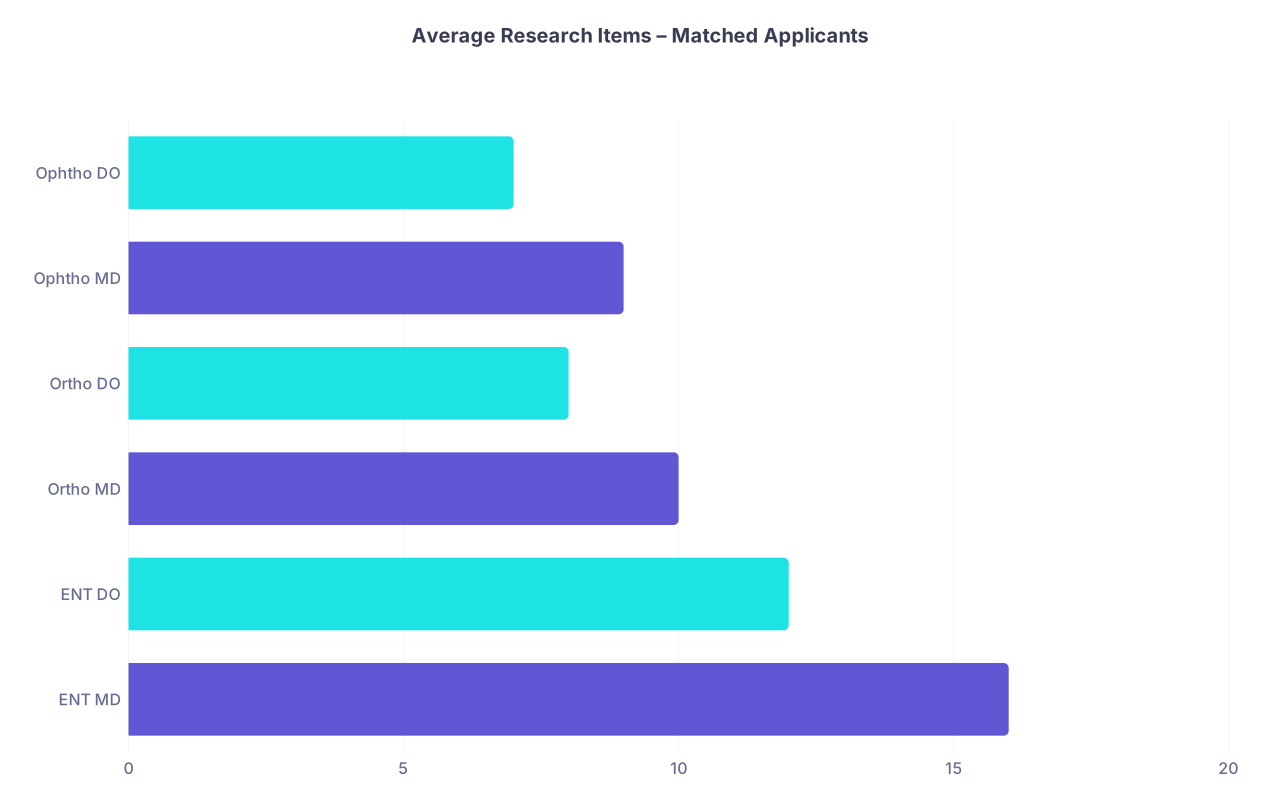
| Category | Value |
|---|---|
| ENT MD | 16 |
| ENT DO | 12 |
| Ortho MD | 10 |
| Ortho DO | 8 |
| Ophtho MD | 9 |
| Ophtho DO | 7 |
Exact numbers vary by year, but the pattern is stable: matched DOs who succeed still often trail the MD average in total counted “research items,” unless they did a dedicated year.
3. Away rotations (auditions) and hospital politics
In these specialties, auditions are everything.
What the data do not show on paper, but what I see repeatedly in real match lists:
- MD students at schools with strong ENT, ortho, or ophtho departments secure 2–3 high‑quality away rotations at target programs.
- DO students often fight just to get 1–2 away slots at mid‑tier programs.
There are explicit and implicit barriers:
- Some programs quietly restrict visiting students to LCME‑accredited (MD) schools.
- Others formally accept DO students but give priority to MDs from “partner” schools.
- A few have gone further, explicitly welcoming DOs in their VSLO descriptions. Those are your leverage points as a DO.
Since PDs in these fields lean heavily on “would we like this rotator as a resident,” lower access to rotations directly translates into fewer interviews. And the PD survey backs it up: “audition rotation performance” is consistently ranked as a top‑3 decision factor.
4. Program director biases and convenience
Look at the NRMP Program Director Survey:
- For ENT, ortho, and ophtho, “type of medical school” and “graduate of U.S. medical school” are high‑weight factors.
- A nontrivial fraction of PDs explicitly rate COMLEX alone as inadequate; they want USMLE scores.
Here is the uncomfortable but accurate interpretation:
- Many PDs default to MDs because there is an oversupply of competitive MD applicants.
- They do not need to take a risk (real or perceived) on a DO unless a candidate is exceptional or has proven themselves in person.
That is why you see DOs match these specialties mainly at programs where:
- The PD has a DO background.
- The department has previously had strong DO residents.
- The program is on the aggressive growth trajectory and needs more high‑quality applicants than the usual MD pipeline can supply.
So, Should a DO Student Aim for ENT, Ortho, or Ophtho?
This is where you want more than vague “follow your dreams” advice. You want conditional probabilities.
The data suggest something like this, assuming current trends continue:
A typical US MD senior with:
- Step 2 CK ~250
- 6–8 research items
- 2 specialty‑specific away rotations
- Decent letters has a realistic (not guaranteed) shot at matching in ortho, ENT, or ophtho if they apply broadly.
A typical US DO senior with:
- Step 2 CK ~250
- 6–8 research items
- 2 specialty rotations (half at community sites) faces odds that are roughly half as good, sometimes worse, especially at top‑tier academic programs.
For a DO student, the data‑driven strategy looks like this:
USMLE Step 2 CK must be elite.
The DOs who match these fields are not sitting at 240. They are typically ≥ 255. Below that, your viable program list shrinks fast.Research volume and relevance must match MD norms.
You cannot show up with “two posters and a case report” when your MD competitors all have 10+ entries. If that means a research year, the ROI can be very high in these fields.Target DO‑friendly programs intentionally.
Identify ENT/ortho/ophtho programs that:- Have DOs in their current or recent resident lists.
- State DO‑friendly policies.
- Are in regions with historically larger osteopathic presence (Midwest, certain parts of the South).
Maximize away rotations where they count.
One excellent away where you outperform MD rotators is worth more than three mediocre community rotations. The resident rosters will tell you who actually acts on that.Have a parallel plan.
Data say your risk of going unmatched is real. Most DO students gunning for these fields sensibly also apply to a somewhat less competitive backup (e.g., anesthesia, PM&R, general surgery at certain programs).
What the Future Likely Looks Like
Trend projection is always a bit of educated guesswork, but some things are clear.
- DO representation in these specialties will increase slowly. As the DO share of the U.S. medical student body approaches 30–35%, some programs will eventually adapt out of necessity.
- But the slope will be shallow. Competitive surgical subspecialties are conservative. They change slower than internal medicine or family medicine.
- As Step 1 remains pass/fail, Step 2 CK will harden as the gatekeeper. That does not help DOs unless their test prep and institutional support catch up to MD averages.
In other words: the bar for DOs is unlikely to drop soon. If anything, differentiation is going to lean even more on:
- Step 2 CK
- Specialty‑specific research
- Letters from well‑known faculty in the field
And that environment generally favors MDs, because they start with more built‑in access to those resources.
Key Takeaways
- The data are unambiguous: US DO seniors match ENT, ortho, and ophtho at roughly half the rate of US MD seniors, with DOs holding only a small fraction of positions in these specialties.
- DOs who succeed almost always look statistically exceptional—Step 2 CK ≥ 255, strong research output, and powerful audition rotation performance at DO‑friendly programs. The “average” DO applicant is largely screened out.
- The structural gap (research infrastructure, specialty departments, PD habits) is the real driver, not some mystical difference in ability. You can beat the numbers as a DO—but only by accepting that your target metrics have to be higher, your planning tighter, and your backup plan very real.