The mythology around “just apply broadly and you’ll be fine” is statistically wrong for derm, ortho, and ENT.
If you are aiming at these specialties and you do not understand interview offer ratios, you are flying blind. The data shows that for derm, ortho, and ENT, your interview yield—interviews per application and per program ranked—is the real bottleneck, not just how many places you click in ERAS.
Below I will walk through the numbers, realistic ratios, and what they imply for strategy.
1. What “interview offer ratio” actually means
People throw around “I applied to 80 programs” like it means something. It does not—unless you know what their ratios looked like.
There are three ratios that actually matter:
Application-to-interview ratio (A:I)
Number of programs applied to / number of interview offers received.
Lower is better.
Example: 80 applications, 12 interviews → A:I ≈ 6.7:1Interview-to-rank ratio (I:R)
Number of interview offers / number of programs you eventually rank.
This adjusts for canceled or withdrawn interviews.
Example: 12 interviews, 10 ranked → I:R = 1.2:1Rank-to-match probability
Given X programs on your rank list, what are your odds of matching?
The NRMP “Charting Outcomes” and “Program Director Survey” data do not give a nice clean “offer ratio” for every specialty, but they give enough to approximate:
- Average number of applications
- Average number of contiguous ranks for matched vs unmatched
- Self-reported interview counts from various specialty-specific surveys
From that, we can back into realistic ratio ranges.
2. High-level competitiveness: derm vs ortho vs ENT
First, a sanity check: these are all top-tier competitive.
Using recent NRMP data trends (categorical positions, US MD seniors):
| Specialty | Match Rate (%) | Mean Contiguous Ranks (Matched) | Mean Contiguous Ranks (Unmatched) |
|---|---|---|---|
| Dermatology | ~75–80 | ~13–14 | ~6–7 |
| Orthopedic Surgery | ~80–85 | ~14–15 | ~7–8 |
| Otolaryngology (ENT) | ~75–80 | ~13–14 | ~6–7 |
Three quick takeaways:
- Matched applicants are usually ranking about 13–15 programs.
- Unmatched applicants often plateau around 6–8 programs on their list.
- That gap—roughly 2x more programs ranked—is the difference between matching and not in many cases.
To get 13–15 programs ranked, you usually need at least that many interview offers (and probably a few more to allow for cancellations). That is where interview offer ratios start to bite.
3. Dermatology: brutal interview efficiency requirements
Derm is, statistically, where hubris goes to die.
US MD derm applicants with strong Step 2 (260+), AOA, publications, and home support may see decent yields. Everyone else is fighting a steep curve.
Using combined NRMP and specialty survey trends, a fairly realistic pattern for a reasonably competitive US MD derm applicant:
- Applications: 60–80
- Interviews received: 8–14
- Programs ranked: 8–13
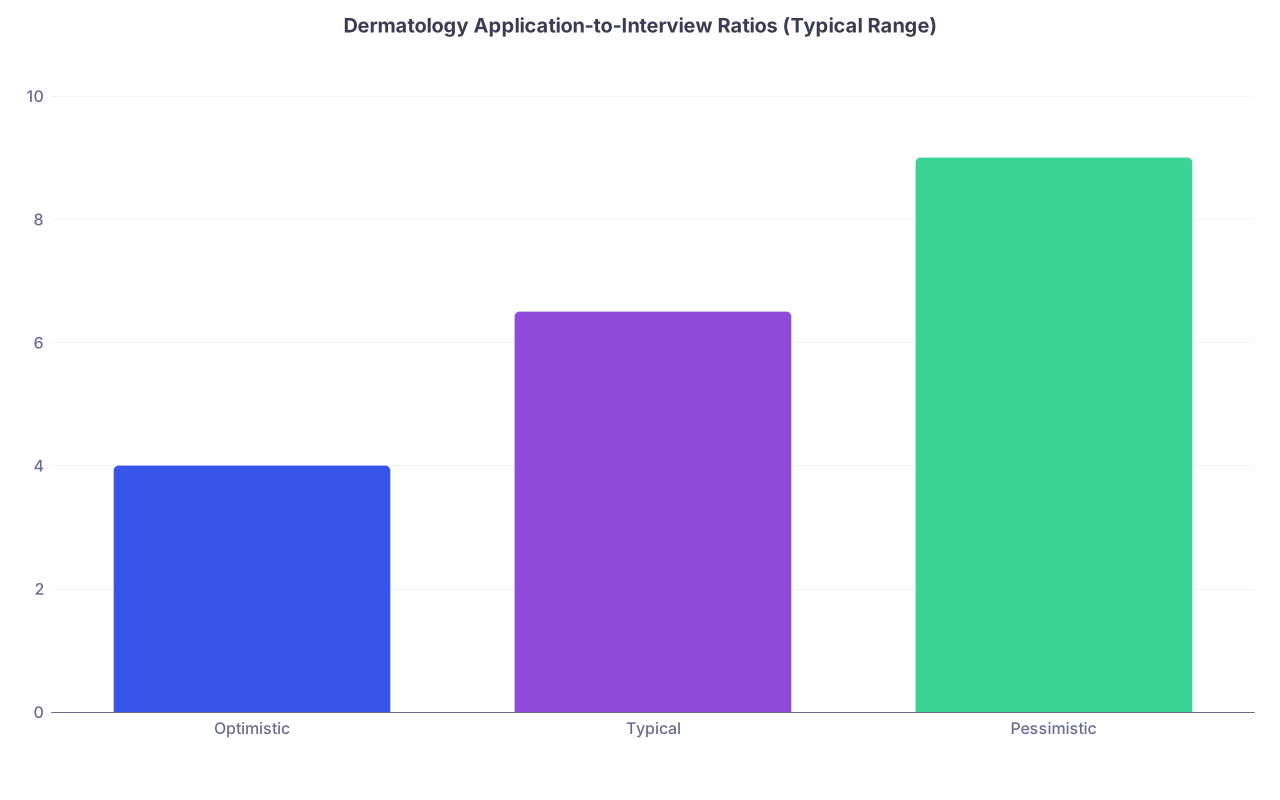
So the aggregate application-to-interview ratio for many solid applicants is in the 5:1 to 8:1 range.
| Category | Value |
|---|---|
| Optimistic | 4 |
| Typical | 6.5 |
| Pessimistic | 9 |
Interpreting that:
- Optimistic scenario: 60 apps → 15 interviews (4:1 A:I)
- Typical scenario: 70 apps → ~11 interviews (≈6.5:1 A:I)
- Pessimistic but not rare: 80 apps → 9 interviews (≈9:1 A:I)
In other words, for derm, every single interview matters because:
- You will not get dozens.
- The match probability curve is unforgiving below 10 ranks.
NRMP data across competitive specialties shows something very consistent: once you have 10–12 programs on your rank list, the marginal gain from adding more starts to flatten. Below 8–9, the drop-off is steep.
A functional way to think of it for derm (US MD, broadly competitive):
- 3–4 ranks → often <40% match
- 6–7 ranks → around 55–65% match
- 10–12 ranks → roughly 75–85% match or better
You do not control the exact curve, but you control how many interviews you convert to ranks.
The consequence:
- If your realistic target is 10 ranks, and your yield is 1 interview per 7 applications, you are staring at roughly 70+ derm applications.
- If your profile suggests a weaker yield (IMG, low Step 2, weak research), then 80–100 applications are not crazy; they are sometimes barely adequate.
4. Orthopedic surgery: high volume, slightly better yield
Orthopedic surgery is still very competitive, but the interview yield per application is typically a bit more forgiving than derm for strong US MD candidates.
Recent patterns:
- Applications for US MD seniors: often 60–80 programs
- Interviews: 12–18 for competitive applicants
- Programs ranked (matched): ~14–15
So a reasonably competitive ortho applicant might be looking at:
- Best-case: 60 apps → 18 interviews → A:I ≈ 3.3:1
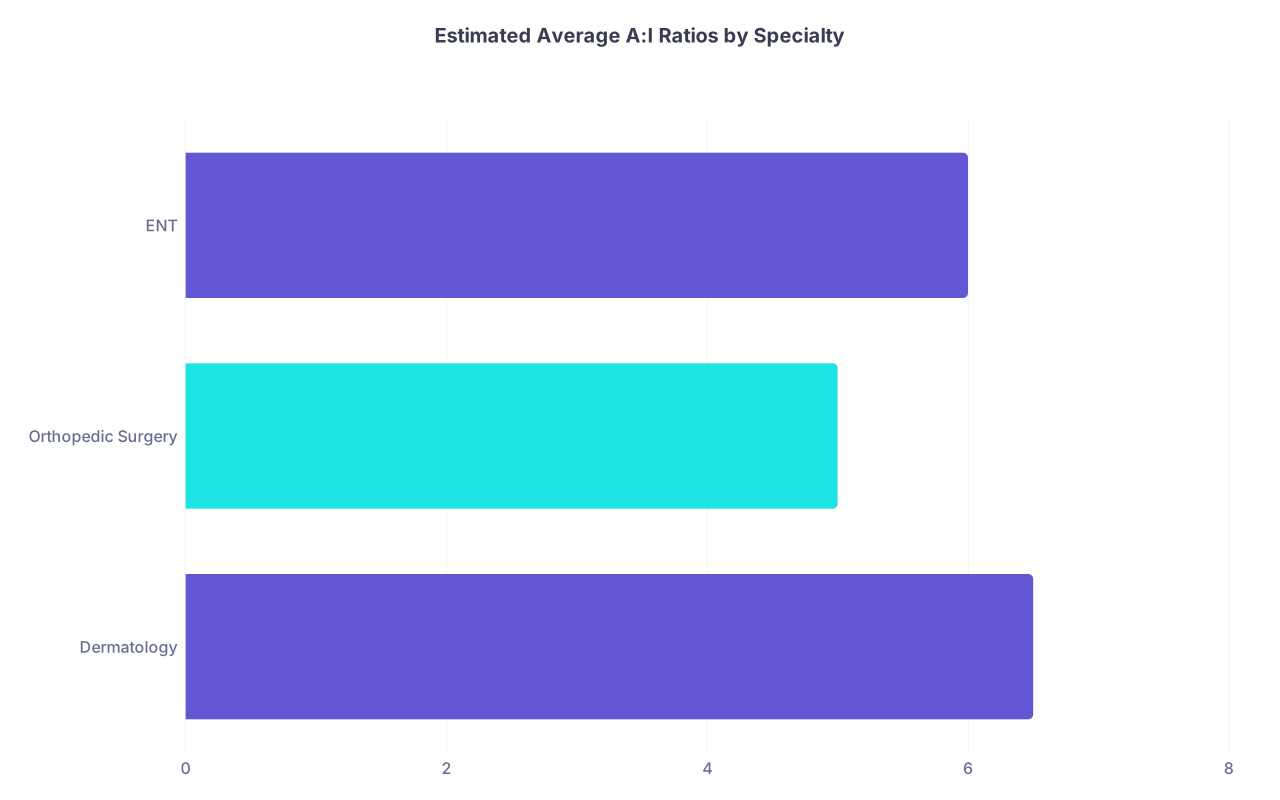
- More typical: 70 apps → 14 interviews → A:I ≈ 5:1
- Weaker case: 80 apps → 10 interviews → A:I = 8:1
| Category | Value |
|---|---|
| Dermatology | 6.5 |
| Orthopedic Surgery | 5 |
| ENT | 6 |
Ortho also has a strong away rotation effect. Programs disproportionately interview students who rotated with them. Away-heavy applicants often see higher interview yields at those specific programs and much lower yields elsewhere.
The data story you do not hear enough:
- Applicants with 2–3 away rotations and home support often have a cluster of interviews (home + aways) plus a modest yield from “cold” applications.
- Applicants without aways or home programs frequently see much weaker offer ratios, especially if they are not top-decile on Step 2 or class rank.
Interview-to-rank ratio for ortho:
- Many applicants cancel 2–4 interviews due to schedule or perceived poor fit.
- So a rough I:R ratio for matched US MD ortho applicants is about 1.2–1.3:1.
Example: 16 interviews → 13 ranks.
What that means operationally:
- If you want 15 programs ranked, you probably need to secure 18–20 interview offers.
- At a 5:1 application-to-interview ratio, that implies 90–100 applications.
At a better 4:1 yield, 70–80 might be sufficient.
I have seen several ortho applicants stall out at 7–8 interviews after 60 apps and stop. They assume the interview season is “good enough.” Then Match Day hits and they are in the unmatched bucket that usually had 7–8 ranks. The curves are public; the outcome is predictable.
5. Otolaryngology (ENT): mid ground with ugly tails
ENT sits between derm and ortho on several fronts. It is small, very competitive, and still has a bit of a “you need to be known” culture in many programs.
Approximate patterns for US MD seniors:
- Applications: 55–75
- Interviews: 8–14
- Programs ranked (matched): ~13–14, unmatched: ~6–7
A typical ENT A:I ratio:
- Decent scenario: 60 apps → 12 interviews → A:I = 5:1
- Typical/mid: 70 apps → 11 interviews → A:I ≈ 6.4:1
- Low-yield: 75 apps → 8 interviews → A:I ≈ 9.4:1
Where ENT gets dangerous is variance. I have seen nearly identical paper stats where:
- Applicant A: 65 apps → 15 interviews
- Applicant B: 70 apps → 5 interviews
The difference? Often network effects: home program letters, research mentors with national reputations, or known performance on aways.
So for ENT, you cannot treat A:I as purely a function of board scores and class rank. Those matter, yes. But the hidden variable is “signal strength” into specific programs.
6. How interview numbers translate to match probability
Let us put it in hard numbers across these three specialties.
Based on NRMP rank-vs-match curves and specialty trends:
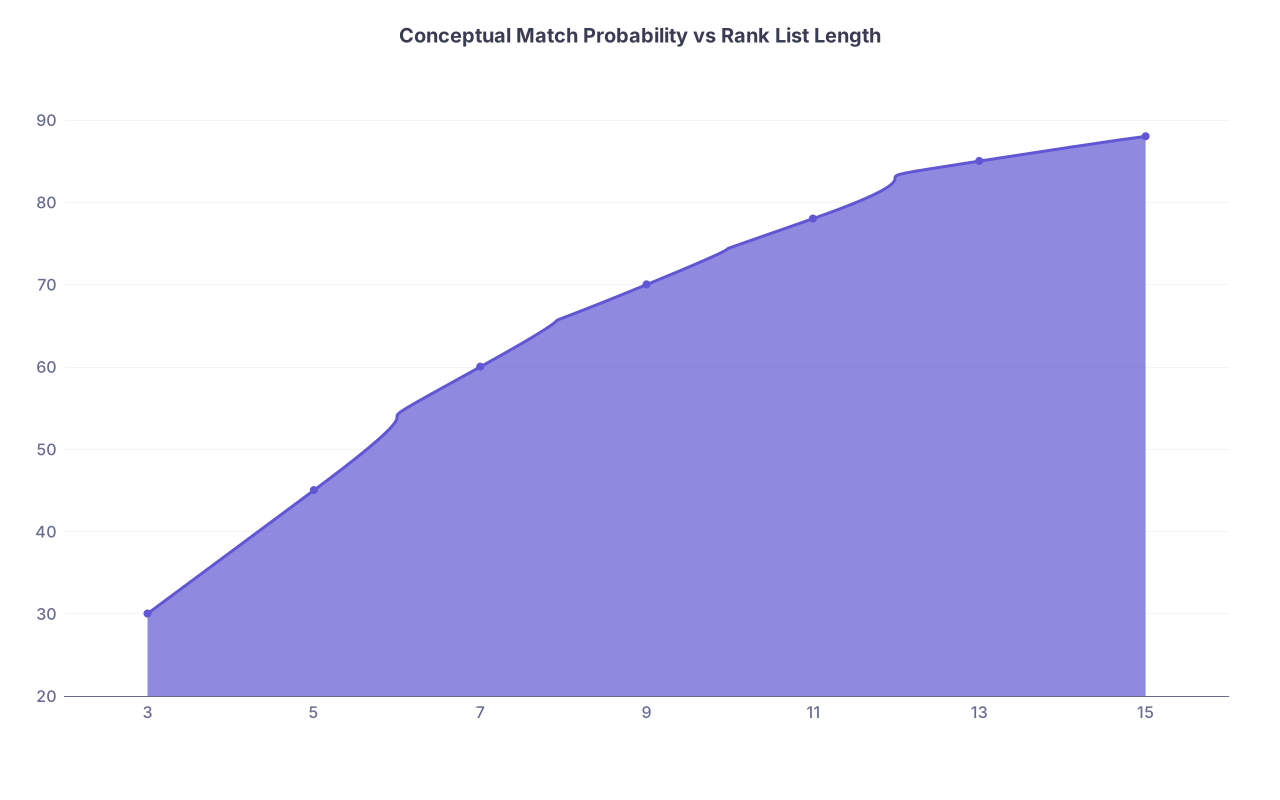
- Below 5 ranks: match probability in these specialties for US MDs is often <40–45%
- Around 8–9 ranks: frequently in the 60–70% range
- 12–15 ranks: often 80–90%+ for US MDs (still lower for DOs/IMGs)
That is not an exact formula, but the shape is unmistakable.
Now connect this to interview offer ratios:
Assume you want a reasonable (>75%) chance of matching and aim for 12–14 ranks.
Let us construct a simple, somewhat conservative model:
- You will rank about 85–90% of the interviews you accept
(You drop some for bad fit, location, or schedule conflicts) - So to get 12–14 ranks, you need roughly 14–16 interviews
We can then compute applications needed under different A:I ratios.
| Application-to-Interview Ratio | Apps Needed for ~15 Interviews |
|---|---|
| 4:1 | 60 |
| 5:1 | 75 |
| 6:1 | 90 |
| 7:1 | 105 |
| 8:1 | 120 |
If your realistic A:I ratio in derm or ENT is 6:1 to 7:1, then applying to only 50–60 programs is misaligned with the math. You are capping yourself at maybe 8–10 interviews in a good year.
7. Strategic implications by specialty
Dermatology
Data-backed bluntness: derm requires exceptional interview efficiency or huge application volume.
If you are:
US MD, Step 2 > 255, strong research, home derm program
→ You may see an A:I around 4:1–5:1, sometimes better.US MD, more average derm stats, no home program
→ 6:1–8:1 is common.DO/IMG without stellar metrics or strong US derm research
→ The functional A:I can easily exceed 10:1.
What to do with that?
- If your realistic A:I is 6:1 and you want 12–14 interviews → plan for 75–85 derm applications.
- If you are weaker on paper, you either increase volume even more or you create a structured backup plan (transitional year, prelim medicine, or a different specialty).
And no, “I will just crush interviews” does not save you if you never get them. The data never gives you a chance to show that skill.
Orthopedic surgery
For competitive US MDs, ortho often has the most “efficient” interview yields of the three, but only if you play the rotations game correctly.
Typical strategy based on the numbers:
- Home program + 2 aways = likely 4–6 interviews from those alone if you perform well.
- Then, even with a modest 6:1 A:I from cold applications, 40–50 additional programs may net another 7–9 interviews.
- Total: 11–15 interviews → 10–14 ranks. That gets you in the safer zone.
If you are missing a home program, or your away slots are limited, you cannot rely on the same clustered yield. That pushes you toward higher application volume.
I have seen applicants with:
- ~70 apps, 0 or 1 away, mid-240s Step 2 → 6–8 interviews
- Same paper stats, but home + 2 aways → 14+ interviews
So your effective A:I can be doubled or tripled by these non-exam factors.
ENT
ENT is where network effects and letters can easily swing your A:I ratio by several points.
If your faculty are nationally known and actively advocating, your cold-application yield might resemble 4:1–5:1 at programs where your mentors are connected.
Without that, your yield can drop into derm territory (7:1–9:1).
Operationally, that means:
- High-signal ENT applicant: 55–65 apps can reasonably generate 12–15 interviews.
- Low-signal ENT applicant: may need 75–90+ apps to reach the same interview count.
This is why ENT aspirants should obsess over:
- Getting on projects early with well-connected surgeons.
- Rotating strategically at places where those mentors can call and reinforce your file.
- Minimizing “anonymous” applications, because those often sit at the worst end of the ratio.
8. Red flags and misreads in your own numbers
Here is what I watch for when I look at an applicant’s interview season data.
Applications too low for realistic A:I
If a derm applicant with 245 Step 2, minimal research, and no home program applies to 45 programs, the math is unforgiving. Even at 6:1, that is 7–8 interviews best-case. Many will end up with 3–5.Early interview trickle that stalls
ENT and ortho applicants sometimes get 5–6 quick invites (home + aways + a few regional programs) then almost nothing from the rest of the list. That often means your “national” A:I is weak. If you have a chance to pivot (more prelim backups, additional applications in less competitive fields), that is the time.High number of interviews but poor rank list length
If you had 16 ortho interviews but only rank 9 programs because you “did not like the others,” you are playing against the data. The match algorithm is not sentimental. Programs you did not love can still be a better option than SOAP.
9. Practical steps to improve your ratios
You cannot completely overhaul your profile in 6 months, but you can tilt your A:I upward.
Targeted faculty-driven outreach
In ENT and derm particularly, having your mentor directly email a PD with a concise, data-heavy endorsement can shift you from “auto-screened out” to “interview reviewed.”Hyper-tailored applications to high-yield programs
Use your school’s match list and peers to identify where applicants “like you” have historically matched. These are the places most likely to convert an application to an interview.Fix obvious screening flags before applying
Step 2 retake where allowed, explain any leaves or remediation clearly, and ensure your experiences section is coherent. Programs sometimes use crude filters; if you can move just above those cut lines (e.g., Step 2 240 vs 248), your yield can shift significantly.Do not cancel early interviews lightly
Until you comfortably have 12+ interviews in hand, canceling because of location snobbery is poor risk management. The difference between 9 and 13 ranks is a real, quantifiable swing in match probability.
10. Quick specialty comparison snapshot
If you want a simple mental model:
| Factor | Dermatology | Orthopedic Surgery | ENT |
|---|---|---|---|
| Typical A:I (US MD) | 5:1–8:1 | 4:1–6:1 | 5:1–8:1 |
| Apps (competitive US MD) | 60–80 | 60–80 | 55–75 |
| Target interviews | 12–15 | 14–18 | 12–15 |
| Programs ranked (matched) | ~13–14 | ~14–15 | ~13–14 |
| Key leverage | Research, PD letters | Aways, home support | Mentor network, aways |
And a simple visual of rank list length vs match probability (conceptual, not exact):
| Category | Value |
|---|---|
| 3 | 30 |
| 5 | 45 |
| 7 | 60 |
| 9 | 70 |
| 11 | 78 |
| 13 | 85 |
| 15 | 88 |
The curve is why I keep hammering the same point: your interview offer ratio and final interview count are not vanity metrics. They are the core levers of your match probability in these specialties.
FAQ (exactly 3 questions)
1. How many interviews do I “need” to feel reasonably safe in derm, ortho, or ENT?
For a US MD with no major red flags, a practical target is around 12–15 ranked programs, which usually means 14–16 interview offers to allow for cancellations. Below about 8–9 ranks, the match probability drops sharply in these fields. If you find yourself with only 5–6 interviews by mid-season, you should treat your risk as high and look seriously at backup options.
2. If I have strong stats, can I apply to fewer programs than these ranges?
You can, but you are betting that your personal A:I ratio will be much better than average. Some top-tier applicants do see 3:1–4:1 ratios and match with 8–10 interviews. However, many applicants who thought they were “strong enough” to apply narrowly ended up with 4–6 interviews and very fragile rank lists. Unless your mentors have concrete, data-backed evidence that applicants with your exact profile and school historically do well with a smaller list, cutting applications aggressively is more ego than strategy.
3. Do away rotations actually change my interview offer ratio, or is that overstated?
For ortho and ENT, away rotations absolutely change your interview dynamics. The yield from “rotated-at” programs is often several times higher than from cold applications, and they can create a cluster of 4–6 interviews that anchor your season. In derm, the effect exists but runs more through research and local advocacy than through aways alone. Ignoring aways in ortho or ENT when your school lacks a strong home program is, statistically, putting yourself in the weakest-yield applicant group.