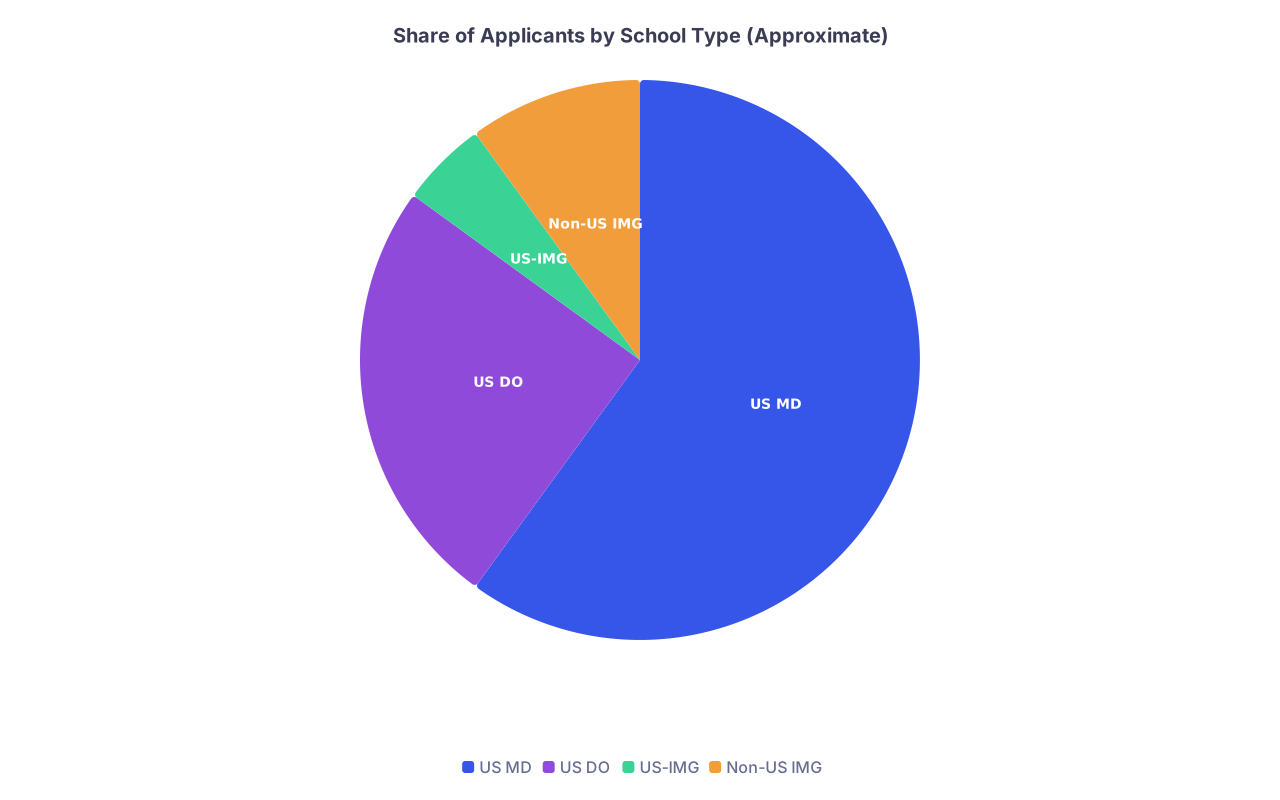
| Category | Value |
|---|---|
| US MD | 60 |
| US DO | 25 |
| US-IMG | 5 |
| Non-US IMG | 10 |
Competitive Specialty Match Rates by School Type: MD vs DO vs IMG
The hard truth is this: your school type matters more for residency competitiveness than most advisors will admit. The data is not subtle about it.
When you look at competitive specialties—dermatology, plastic surgery, orthopedic surgery, neurosurgery, ENT, radiation oncology, interventional radiology, and to a slightly lesser extent anesthesiology and EM—you see the same pattern over and over:
US MD at the top.
US DO improving but still behind.
IMGs fighting uphill almost everywhere.
Let me walk through the numbers and patterns the way a program director with a spreadsheet would.
1. The Baseline: Overall Match Rates by School Type
Before we zoom into individual specialties, you need the macro picture. Otherwise you misinterpret the specialty-level data.
Using recent NRMP and AACOM reports (data rounded for readability):
| Applicant Group | Overall Match Rate |
|---|---|
| US MD Seniors | ~92–94% |
| US DO Seniors | ~89–91% |
| US Citizens IMGs | ~55–60% |
| Non-US IMGs | ~58–60% |
That is the baseline. If you cannot clear 90% overall as a category (US IMGs / non-US IMGs), it means you are structurally disadvantaged when you start aiming for the top 5–7 specialties by competitiveness.
Now compare that with fill rates by school type in competitive specialties.
2. How Competitive Specialties Actually Fill: MD vs DO vs IMG
For each specialty, there are three questions that matter:
- What percentage of positions are filled by US MD vs DO vs IMG?
- Among applicants from each group, what share actually match?
- How often are programs using school type as a screen before scores, research, or anything else?
You will not find that third one in any official document. You see it when you analyze patterns across years and specialties.
High-Level Split: Competitive vs Less Competitive
We can roughly categorize specialties by how strongly they favor US MDs in their fill rates.
| Specialty Tier | US MD Share of Positions | DO Presence | IMG Presence |
|---|---|---|---|
| Ultra-competitive (Derm, Plastics) | 80–90%+ | Low–Moderate | Very Low |
| Surgical competitive (Ortho, ENT, NSG) | 75–90%+ | Low–Moderate | Very Low |
| Procedural competitive (IR, Rad Onc) | 70–85%+ | Moderate | Low |
| Moderately competitive (Anes, EM) | 55–75% | Moderate–High | Low–Moderate |
Those are not precise percentages for all years, but the pattern is stable: once you enter the ultra-competitive zone, the system is biased heavily toward US MD grads. DOs are making visible inroads in some fields. IMGs are effectively shut out of many.
3. Specialty-by-Specialty: What the Data Shows
Dermatology
This is one of the most lopsided specialties by school type.
- Historically, ~85–90% of dermatology positions are filled by US MD seniors.
- DOs occupy a small but slowly growing fraction of spots. Think single digits in percentage terms.
- IMGs (US and non-US combined) are usually in the very low single digits of filled positions.
Dermatology programs are research-heavy, frequently attached to big academic centers, and extremely score-sensitive. That combination strongly favors:
- US MDs with home derm departments.
- Access to NIH-level research.
- Strong clerkship / letter pipelines.
For a US MD with strong Step 2 CK (255+ range), research, and honors, derm is brutal but statistically possible.
For a DO, the bar is substantially higher: top scores, significant research, and often an away rotation at a derm-friendly institution.
For an IMG, you are almost in lottery-ticket territory unless you have exceptional US-based dermatology research and networking.
Plastic Surgery (Integrated)
Integrated plastics behaves similarly to derm, but with even more dependence on institutional prestige and research.
- Very high proportion of positions filled by US MD seniors. Often over 80%.
- DOs have a tiny footprint; there are a handful of successful match stories but still near the margins.
- IMGs matching integrated plastics are so rare that they are essentially case reports, not a category.
A concrete example I have seen: at one large academic plastics program, over a 10-year period, every matched resident was from a US MD school, and most from top 40 research schools. Zero DO. Zero IMG.
That is not an anomaly. It is how the specialty behaves statistically.
Orthopedic Surgery
Ortho is where DOs have actually carved out a more visible presence, but the gap is still clear.
- Historically, ortho is dominated by US MDs, often 75–85%+ of positions filled.
- DO seniors match at a lower rate than MDs but now with a non-trivial share of positions, due to DO-friendly programs and historically some DO-only ortho spots.
- IMGs are again at the fringes: a small fraction of positions and far lower match rates per applicant.
What the data shows here:
- US MD seniors: competitive but achievable with high board scores (250+ Step 2 CK), strong letters, AOA, etc.
- US DO seniors: path goes primarily through programs with a track record of taking DOs or previous AOA-accredited programs. Still competitive: you generally need top-tier performance.
- IMGs: heavy structural disadvantage. An IMG applying to ortho is statistically taking on one of the worst risk profiles in the entire Match.
Neurosurgery
Neurosurgery has small numbers, which exaggerates volatility, but the direction is consistent.
- Majority of spots filled by US MD seniors, often >80%.
- DO representation remains minimal.
- IMG matches exist but are scattered and rare.
Neurosurgery programs want:
- Stellar scores.
- Significant neurosurg research.
- Strong home or away neurosurgery experience.
Now ask who has easier access to neurosurg labs, funded research years, and home neurosurgery departments. That answer disproportionately favors US MD students at research-heavy institutions.
Otolaryngology (ENT)
ENT behaves like a classic highly competitive surgical subspecialty:
- Strong dominance by US MDs, usually in the 75–85%+ range of positions.
- DOs are matching into ENT more often now, but still a decided minority.
- IMGs again occupy very few spots relative to their applicant numbers.
For ENT, I have seen program lists where 20 residents across 5 years come from 15–18 different US MD schools and just one DO. Often zero IMGs. That is not unusual.
Radiation Oncology
Radiation oncology is a bit of an outlier. The specialty went through a period of lower applicant numbers relative to positions, which softened the edges for a few years. Still:
- Majority of positions are filled by US MDs (often >70%).
- DOs have improved entry but still represent a smaller slice.
- IMGs do better here relative to something like derm or plastics, but still are not anywhere near parity with MDs.
Because rad onc is research-heavy but with historically fewer applicants, strong IMGs with robust US-based research and high scores have occasionally carved out space. But you are still playing a game where program directors default to US MD first.
Interventional Radiology (Integrated)
Integrated IR is relatively new as an independent match target, but the pattern is familiar:
- High share of spots to US MD seniors at academic centers.
- Some DO presence, more often through DR first then IR, and in programs known to be DO-friendly.
- IMGs: limited, mostly those with DR training or strong US experience.
If you are DO or IMG and you want IR, the DR-then-IR fellowship route can be more realistic than direct integrated IR, but the competitiveness still remains high at each step.
4. Moderately Competitive Procedural Fields: Anesthesiology and EM
Here is where the story shifts slightly. The bias toward US MDs remains, but DOs start to show substantial representation, and IMGs—while still disadvantaged—are not completely excluded.
Anesthesiology
Anesthesia has been tightening in competitiveness again, but it remains more “open” than derm or ortho.
Patterns:
- US MD seniors often fill a majority of spots, but the share is frequently in the 55–70% range, not 80–90%.
- US DO seniors now make up a sizable share of new anesthesiology residents, especially at community and regional programs.
- IMGs have a consistent—if limited—presence: more than derm or ortho, less than internal medicine.
The data effectively says:
- US MD: strong chance with reasonable scores and a sane application list.
- DO: good outcomes if you apply broadly and avoid the small set of academic programs that rarely interview DOs.
- IMG: possible, but you need high scores, US clinical experience, and a broad set of target programs, often community-based.
Emergency Medicine
EM is in flux. Application numbers, workforce projections, and program expansions have distorted the competitiveness curve over the last few cycles. But school-type patterns:
- Historically, EM has been relatively open to DOs; many programs have long DO-friendly histories.
- US MDs still hold a plurality or majority of spots in many programs.
- IMGs are present but in much smaller proportions, and often at specific community programs.
At the moment, EM is probably one of the more accessible “procedural” specialties for DOs compared with ortho, ENT, or derm. For IMGs, it remains significantly harder than FM or IM but easier than neurosurgery.
5. Why School Type Changes the Numbers
Ignoring the root causes and only staring at match percentages leads to comforting but wrong interpretations. There are structural reasons the distribution looks the way it does.
The key drivers:
Program screening behavior.
Many competitive programs screen on “US MD only” or “US MD + selected DO.” They will never say that loudly, but applicant pools and rank lists tell the story. If you are a DO or IMG, you are often not even in the denominator.Access to academic resources.
Derm, plastics, ENT, neurosurgery, IR, rad onc are research and mentorship heavy. US MD students at research-heavy schools have:- Funded projects.
- Dedicated specialty mentors.
- In-house departments generating strong letters.
DO schools and many IMG paths do not replicate that environment at scale.
Clerkship and away rotation pipelines.
Top programs lean heavily on:- Performance in their own sub-internships.
- Letters from faculty they know and trust. US MDs with home departments and easy visiting student access dominate this pipeline. DOs sometimes face restrictions on away rotations at certain academic centers. IMGs often cannot do “official” core rotations at these places at all.
Historical bias and inertia.
Specialties that grew up inside old-school academic medicine—derm, ENT, neurosurgery, rad onc—often maintain higher barriers to “non-traditional” backgrounds. The inertia is real.Applicant self-selection.
DO and IMG applicants often self-select away from ultra-competitive specialties because they see the numbers. That further depresses their representation and keeps the field dominated by US MDs.
6. Comparing Relative Risk by School Type and Specialty
You cannot realistically quote an exact match probability for “DO applying to dermatology” or “IMG applying to ortho” from public data. The applicant numbers are too small and the self-selection too intense. But you can rank risk bands.
Here is a useful way to think about relative risk:
| Specialty | US MD Seniors | US DO Seniors | IMGs |
|---|---|---|---|
| Dermatology | Very High | Extremely High | Near-impossible |
| Plastics (Int) | Very High | Extremely High | Near-impossible |
| Ortho Surgery | Very High | Extremely High | Near-impossible |
| Neurosurgery | Very High | Extremely High | Near-impossible |
| ENT | Very High | Extremely High | Near-impossible |
| Rad Onc | High | Very High | Very High |
| IR (Integrated) | High | Very High | Very High |
| Anesthesiology | Moderate–High | Moderate–High | High |
| Emergency Med | Moderate | Moderate | High |
For competitive specialties, the implicit filter often runs like this:
- US MD: “Okay, in the main pool. Let us see scores, research, and letters.”
- DO: “Is this a DO-friendly program? If yes, apply similar standards but often slightly higher score expectations.”
- IMG: “Only consider if scores are exceptionally high, research is substantial, and US clinical experience is robust.”
They do not announce that in public materials. But you see it in the end result: the proportions of who actually sits in the resident lounge.
Key Points
- Competitive specialties are structurally tilted toward US MD graduates, with DOs making gradual progress and IMGs mostly shut out at the extremes.
- For DOs and IMGs, the risk curve in derm, plastics, ortho, ENT, neurosurg, rad onc, and IR is not just steep. It is often asymmetrical compared with US MDs with similar metrics.
- The data supports one blunt conclusion: align your specialty choices with your school type, performance, and realistic probabilities—or accept that you are operating in outlier-only territory.