The usual advice about “apply to as many programs as you can” is mathematically wrong for most specialties.
The data show something much less dramatic: returns flatten fast, and beyond a certain number of applications you are mostly lighting money on fire. But that break‑even point is very different for dermatology than for internal medicine.
Let me walk you through it by specialty, using NRMP and AAMC data, not folklore from panicked group chats.
1. The Only Three Numbers That Actually Matter
Ignore the noise. For residency applications, the decision problem is driven by three metrics:
- Probability of getting at least one interview as a function of number of applications.
- Probability of matching given a certain number of interviews in that specialty.
- Cost (money + time) per additional interview.
The NRMP and AAMC have given us partial visibility into all three.
From the AAMC’s Apply Smart data (program signaling era aside), you can see:
- Diminishing returns in interview yield after a specialty‑specific threshold.
- A clear point where the curve of “new interviews per 10 more applications” essentially flattens.
- Big differences between US MD, US DO, and IMG applicants.
We will use that to answer the question you actually care about:
“If I want a >90% chance to match in [X] specialty, about how many applications do people like me usually need?”
Not the mythical 100+ everyone throws around. The number where the data curve stops paying you back.
2. Big‑Picture Reality Check: Applications vs Interviews
First, zoom out. Across all specialties, here is what the data say about interview yield per application:
- Early applications (your first ~20–30 programs) have the highest interview yield.
- After the “Apply Smart” recommended range, every additional 10 applications usually yields 0–1 new interviews on average.
- For very competitive specialties, interview yield is low from the start, but still flattens.
To make this concrete, assume three archetypes:
- Competitive specialty (Derm, Plastics, Ortho, ENT, Ortho, Neurosurgery).
- Mid‑range (Anesthesia, EM, General Surgery, OB/GYN).
- Less competitive (IM categorical, Pediatrics, FM, Psych).
For U.S. MD seniors with no obvious red flags, the curves typically look like this:
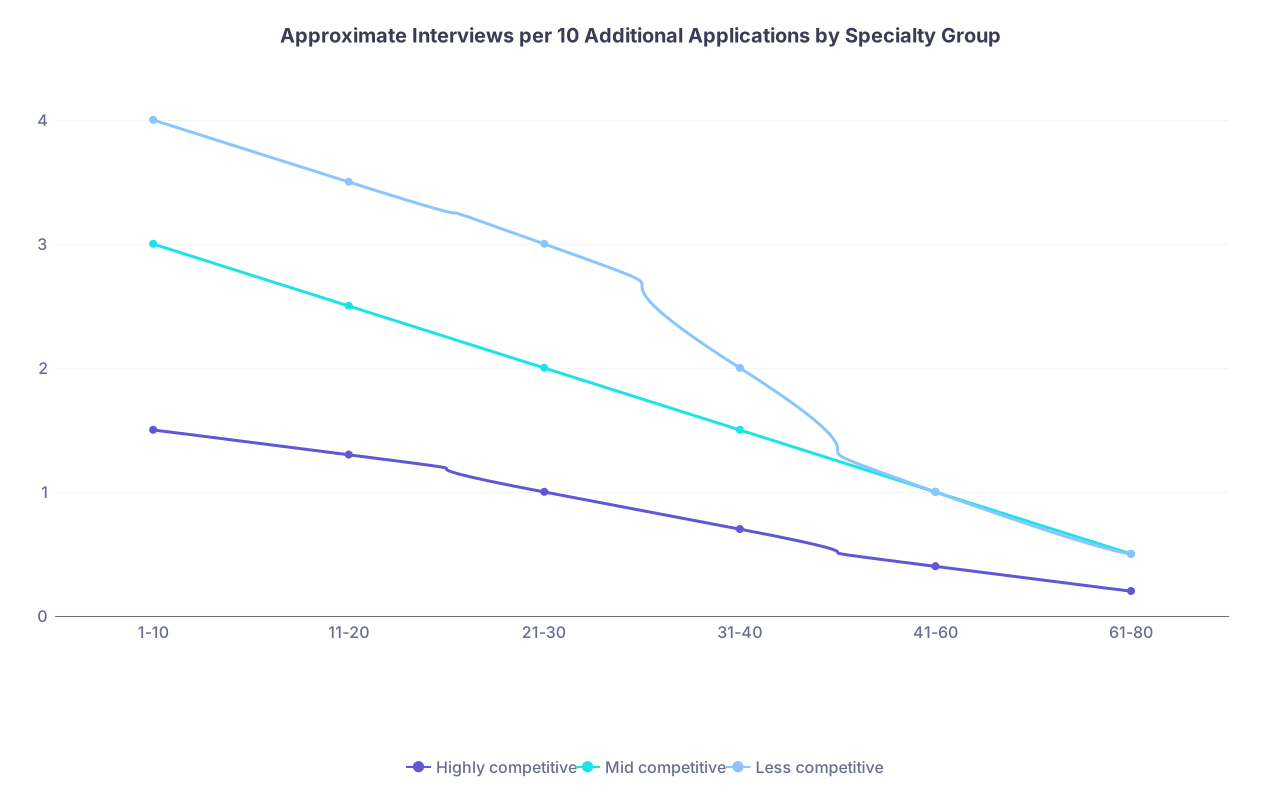
| Category | Highly competitive | Mid competitive | Less competitive |
|---|---|---|---|
| 1-10 | 1.5 | 3 | 4 |
| 11-20 | 1.3 | 2.5 | 3.5 |
| 21-30 | 1 | 2 | 3 |
| 31-40 | 0.7 | 1.5 | 2 |
| 41-60 | 0.4 | 1 | 1 |
| 61-80 | 0.2 | 0.5 | 0.5 |
The translation: after about 40–50 applications, the marginal payoff drops hard for most specialties. Yet many people are applying to 80–100+ programs because they are scared, not because the numbers support it.
Now let’s cut the averages and talk specialty by specialty.
3. How Many Applications by Specialty (For U.S. MD Seniors)
These are not “limits.” They are evidence‑based zones where the data show you get most of the benefit. More applications beyond the upper end usually add little in terms of match probability if your profile matches the specialty.
Quick overview table
These ranges assume:
- U.S. MD senior
- No major red flags
- Board scores and grades roughly at or slightly below the matched median for that specialty
- You are not geographically hyper‑restricted
| Specialty | Typical Range (Apps) | Aggressive Upper End |
|---|---|---|
| Dermatology | 60–80 | 90–100+ |
| Plastic Surgery (Int) | 55–75 | 80–90 |
| Orthopedic Surgery | 45–65 | 70–80 |
| Neurosurgery | 45–65 | 70–80 |
| ENT | 45–65 | 70–80 |
| Radiation Oncology | 30–45 | 50–60 |
| General Surgery Cat. | 35–55 | 60–70 |
| OB/GYN | 30–50 | 55–65 |
| Emergency Medicine | 25–40 | 45–55 |
| Anesthesiology | 25–40 | 45–55 |
| Internal Medicine | 20–35 | 40–50 |
| Pediatrics | 20–30 | 35–40 |
| Family Medicine | 15–25 | 30–35 |
| Psychiatry | 20–35 | 40–50 |
The “Aggressive Upper End” is for applicants who are weaker relative to the specialty (lower scores, fewer honors, or weaker home support) but still pursuing it seriously.
Now I will go specialty‑by‑specialty and explain where those numbers come from.
4. Highly Competitive Specialties: Why 70+ Applications Happens
Dermatology
Dermatology is a statistical outlier. High Step scores, heavy research, few positions.
Data points:
- Match rate for U.S. MD seniors historically hovers around 60–70%.
- Mean number of contiguous ranks for matched U.S. MDs is around 11–13.
- Interview yield per application is low, especially without strong research.
Because the interview rate is low, you need a larger pool of programs just to land enough interviews to build a safe rank list. For a mid‑tier U.S. MD applicant:
- About 60–80 applications is where most people land enough interviews (8–12) for a solid chance.
- Below ~50, I have repeatedly seen applicants end up with 3–5 interviews and a very fragile rank list.
- Above ~90, the data show sharply diminishing returns unless you have serious red flags.
If you are a top‑tier derm candidate (AOA, multiple derm pubs, strong away rotations), you can still match with fewer applications, but people in that range often overshoot anyway because they are risk averse.
Integrated Plastic Surgery
Integrated plastics is derm with a scalpel.
- Match rate for U.S. MDs usually below derm, often in the 55–65% zone.
- Heavy emphasis on research output and letters.
- Average matched applicant has very strong metrics and often double‑digit publications.
For a typical U.S. MD applicant who is “on profile” for plastics:
- 55–75 applications is common and defensible.
- The goal is 10–12+ interviews; below ~7 plastics interviews, the match probability drops sharply.
Again, past ~80–90 applications, you mostly gain anxiety and expenses, not proportional interview increments.
Orthopedic Surgery, Neurosurgery, ENT (Otolaryngology)
These three share a pattern:
- Competitive, but with slightly more positions than derm/plastics.
- Match rates for U.S. MDs often in the 70–80% range.
- Mean contiguous ranks for matched U.S. MDs usually around 12–14.
From what the data and real applicant behavior show:
- 45–65 applications is where most mid‑strength applicants cluster.
- Strong home program support and away rotations can lower that into the 35–45 range.
- Weak profiles or no home program push people into the 60–80 application territory.
If you are under‑applying in these fields (e.g., 20–25 ortho programs as an average candidate), you are likely running a sub‑50% probability scenario no matter how good your interviews are.
Radiation Oncology
Radiation oncology used to be hyper‑competitive; recent years have been volatile with unfilled spots.
- Match rates for U.S. MDs have been higher recently, partly due to fewer applicants.
- Interview yield per application is somewhat better than derm/plastics.
Translation:
- Many applicants can get away with 30–45 applications.
- In uncertain cycles or with weaker metrics, 50–60 is a safer ceiling.
People still spraying 70–80+ rad onc applications are mostly responding to older cultural memory rather than current match data.
5. Mid‑Competitive: Where Over‑Applying Is Most Common
Categorical General Surgery
Surgery has a decent number of positions but still significant competition for “good” programs.
- U.S. MD match rates are usually in the mid‑80% range.
- Mean contiguous ranks for matched U.S. MDs is often around 13–15.
Based on NRMP distributions:
- 35–55 applications is usually adequate for a typical U.S. MD categorical surgery applicant.
- Very strong applicants with strong home and regional ties can land enough interviews with 25–35.
- Applicants with lower scores or no home program wisely push closer to 60–70.
Above ~70, interview yield generally flatlines unless your application is borderline and you are trying to brute force geographic flexibility.
OB/GYN
OB/GYN sits in that middle cluster: not derm, not FM.
- Match rate for U.S. MDs is generally 80–90%.
- The average matched applicant ranks around 12–14 programs.
The pattern I see:
- 30–50 applications for a typical U.S. MD with average metrics is sufficient.
- 55–65 for weaker applicants or those without a home department advocating for them.
- People sending 70–80+ OB/GYN apps are usually anxious, not strategic.
Emergency Medicine
EM is complicated by the recent contraction in interest and some instability in the job market. Historically:
- U.S. MD match rates have been high, but recent cycles saw unfilled EM spots.
- Many programs interview broadly but cap numbers hard.
Pre‑contraction, Apply Smart analyses indicated:
- Interview yields flatten after about 30–40 applications for U.S. MDs.
- 10–12 interviews gave a very high match probability.
In the current environment:
- 25–40 applications is still a data‑justified target for most U.S. MDs.
- 45–55 if you have weaker Step scores or limited SLOEs.
Going above that is usually not what differentiated who matched and who did not; letters and performance on EM rotations matter more.
Anesthesiology
Anesthesia has drifted from “backup” to “solid mid‑competitive.”
- U.S. MD match rate typically in the 85–90% range.
- Matched applicants rank around 12–14 programs on average.
Apply Smart data indicate:
- 25–40 programs usually produces a robust interview set for U.S. MDs.
- 45–55 for those with lower scores or less prestigious schools.
I routinely see applicants applying to 70–80 anesthesia programs “just in case.” The math rarely supports that for a reasonably strong U.S. MD.
6. Less Competitive Specialties: Why 70+ Apps Makes No Sense
Now the side of the spectrum where people are burning application fees at scale.
Internal Medicine (Categorical)
I am not talking about prestige‑chasing people who only want MGH/UCSF/Brigham. I mean applicants who “want to match into IM somewhere.”
Data:
- U.S. MD match rate in IM categorical is typically >95%.
- Mean contiguous rank length for matched U.S. MDs commonly around 13–15.
For an average U.S. MD senior targeting IM:
- 20–35 applications is usually plenty to secure 12–15 interviews.
- You only need ~8–10 categorical IM interviews for extremely high match probability per NRMP charts.
- 40–50 is for weaker applicants or those who truly do not care where they end up geographically.
When I see someone with decent scores, solid clinical evals, no red flags applying to 70–80 IM programs, that is fear, not data.
Pediatrics
Very similar shape to IM but slightly fewer total positions.
- Match rates >95% for U.S. MDs are common.
- Interview yield is relatively generous across a wide range of programs.
Reasonable targets:
- 20–30 applications for most U.S. MDs.
- 35–40 if there are weaker academic metrics or some geographic restriction.
Above that, you are mostly increasing your email load and travel coordination complexity.
Family Medicine
Family medicine is where you see maximum over‑application because students are scared from watching their friends chasing derm and ortho.
Reality:
- U.S. MD match rate in FM is extremely high, near the top of all specialties.
- Many programs are actively trying to fill spots and will interview widely.
For a U.S. MD with no serious red flags:
- 15–25 applications is almost always enough.
- 30–35 for U.S. DOs or IMGs who are risk‑averse but have reasonable scores and U.S. clinical experience.
If a U.S. MD is applying to 60+ FM programs, the odds they needed that to match are extremely low.
Psychiatry
Psych has heated up in the last decade, but the match rate is still favorable.
- U.S. MD match rate often in the low‑ to mid‑90s%.
- Many community and mid‑tier academic programs have open capacity each year.
Reasonable application volume:
- 20–35 programs for a typical U.S. MD.
- 40–50 if lower scores, weaker evaluations, or non‑U.S. grad.
You do not need 70+ unless there is a serious mismatch between your profile and the specialty.
7. Where You Actually Get Leverage: Interviews, Not Applications
The NRMP data are crystal clear about one thing: match probability is a function of interviews, not raw application count.
For most specialties, for U.S. MD seniors:
- 1–3 interviews: coin‑flip at best.
- 4–6 interviews: match probability starts climbing but is unstable.
- 8–10 interviews: usually >80–90% chance of matching.
- 12+ interviews: marginal gains, but very strong safety margin.
You apply to generate interviews. You rank interviews to generate a match. Everything else is noise.
So practically:
- Decide your target specialty and your approximate competitiveness.
- Use the ranges above to choose a starting number of applications.
- Track interview yield in real time: if you are halfway through interview season and way below expected interviews, then you think about SOAP or backup planning, not retroactive over‑applying.
8. The Cost Curve: Money vs Yield
Every application has a marginal cost. ERAS fees escalate as you cross thresholds (e.g., 1–10, 11–20, etc.). The effective cost per additional interview explodes once you are past the Apply Smart sweet spot.
Here is a stylized estimate for a mid‑competitive specialty for a U.S. MD applicant:
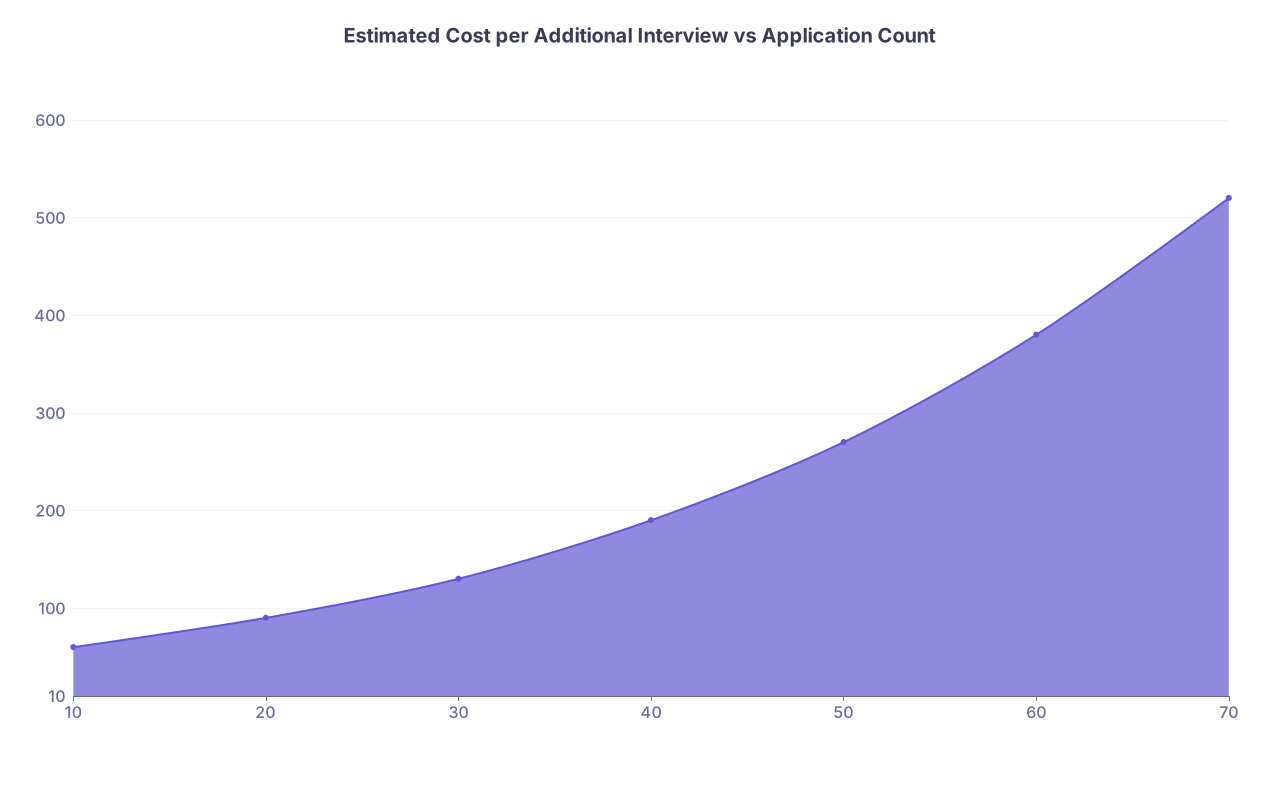
| Category | Value |
|---|---|
| 10 | 60 |
| 20 | 90 |
| 30 | 130 |
| 40 | 190 |
| 50 | 270 |
| 60 | 380 |
| 70 | 520 |
Interpretation of that area curve:
- First 20–30 applications are extremely cost‑effective.
- Once you cross ~40–50, each additional interview might be costing you several hundred dollars in application fees alone, before travel or virtual interview overhead.
Yet those late interviews often add minimal incremental match probability, especially when you already have 10–12 lined up.
9. Special Cases: DOs, IMGs, and Red Flags
Everything so far was U.S. MD baseline. The slope shifts for other groups.
U.S. DO seniors
- In less competitive specialties (FM, IM, Peds, Psych), DOs with solid scores and strong clinical letters are not far off MD ranges. Maybe +5–10 applications.
- In mid‑competitive specialties (Anesthesia, EM, OB/GYN, Gen Surg), I routinely see reasonable data‑aligned ranges be ~10–20 higher than U.S. MDs.
- In very competitive specialties (Derm, Ortho, ENT, etc.), DO applicants often need both more applications and exceptional profiles to overcome program bias. 80–100+ is not unusual, but the match probability is still lower.
IMGs (US citizen and non‑US)
- Application ranges balloon. There is no way around this; many programs simply do not routinely interview IMGs.
- For IMGs in IM, Pediatrics, FM, and Psych, 60–100+ applications is common and often rational.
- In competitive specialties, the data are frankly brutal; even huge application numbers may not move the needle much without U.S. research, U.S. LORs, and very strong scores.
Red flags (fails, gaps, professionalism issues)
Red flags shift you to the right on the applications axis, but they also lower your per‑application interview yield. That combination is ugly.
- A U.S. MD with a Step failure applying to IM may justifiably send 60–80 apps to secure a reasonable interview set.
- The same person applying to derm is usually engaged in magical thinking; extra applications cannot compensate for structural barriers in programs that auto‑screen.
10. How To Use This Without Lying To Yourself
Here is a simple decision flow that actually uses the data logic instead of anxiety:

| Step | Description |
|---|---|
| Step 1 | Choose specialty |
| Step 2 | Assess competitiveness vs matched median |
| Step 3 | Use lower half of range |
| Step 4 | Use mid range |
| Step 5 | Use upper end of range |
| Step 6 | Estimate 8-12 interviews needed |
| Step 7 | Apply and track invites |
| Step 8 | Activate backup plan or SOAP |
| Step 9 | Stop adding programs |
| Step 10 | Above, at, or below median? |
| Step 11 | By mid season, <5 invites? |
If you are above the typical matched metrics for your specialty, you use the lower half of the ranges I listed. At median, the middle. Below, the top third.
Then you stop. And you let the interview numbers guide your next move, not panic on Reddit.
FAQ (5 Questions)
1. How many residency applications is “too many” in absolute terms?
“Too many” is whenever the marginal new interview probability is near zero. For a U.S. MD in IM, that may be anything above 40–50. For derm, that threshold might not hit until 80–90. If your specialty‑specific Apply Smart curves show <0.1 interviews per 10 additional applications beyond a certain point, you are in the “too many” zone.
2. How many interviews do I actually need to feel safe?
For most specialties and U.S. MD seniors, 8–10 categorical interviews gives a very high (>90%) probability of matching according to NRMP outcome graphs. Hyper‑competitive specialties are a bit harsher, but the same principle applies: once you pass 10–12 interviews, extra ones add security but not massive new probability.
3. Should I cap my applications if I am couples matching?
Couples matching changes the game. You need enough overlapping interview geography to build a joint list. That often pushes each partner’s application numbers up by 10–20 beyond solo norms, especially if one partner is in a more competitive specialty. But even then, you should still respect the flattening of interview yield; 150+ per person is almost always wasteful.
4. How do program signals change the application numbers?
Signals make early choices more important. They do not magically reduce total application needs yet, but they do increase the value of a well‑chosen subset. If your specialty uses signals, you should still apply broadly, but you must treat your signaled programs as your highest‑leverage bets and align your interview expectations accordingly.
5. Can away rotations let me safely apply to fewer programs in surgical fields?
Yes, but only if they translate into strong letters and interviews. A stellar away at a top ortho or ENT program can effectively “replace” several mid‑tier applications, because that one rotation may generate two or three serious interview opportunities (home + away + network). But away rotations are not a blanket shield; if your numbers are marginal, you still need a broad base of programs to reach a safe interview count.