
Most applicants build mentor networks backwards—and it quietly kills their chances in competitive specialties.
You do not need “more mentors.” You need the right 4–7 people who can open doors, fix blind spots, and say your name in the rooms where rank lists are made.
Here is exactly how to build that kind of specialty-focused mentor network when you are aiming at competitive fields: derm, plastics, ortho, ENT, rad onc, IR, neurosurgery, ophthalmology, EM at top programs, or hyper-competitive academic IM.
1. Understand the 4 Types of Mentors You Actually Need
Stop looking for a unicorn “perfect mentor.” That person does not exist. The strong applicants I see match because they assemble a small team of mentors, each with a specific job.
You want four core roles:
- Insider Sponsor (your primary specialty mentor)
- Tactical Operator (applications / strategy)
- Skill Builder (research / clinical / technical)
- Psychological Anchor (sanity / resilience)
| Role | Ideal Level | Main Value |
|---|---|---|
| Insider Sponsor | Faculty in field | Advocacy and letters |
| Tactical Operator | Recent grad/resident | Strategy, logistics |
| Skill Builder | Research PI or senior fellow | Output and competence |
| Psychological Anchor | Any trusted physician | Emotional stability |
If you are missing one of these, that is the hole you feel but cannot name.
1. Insider Sponsor
This is the derm attending who emails program directors for you. The ortho trauma chief who says, “We need to get you on Dr. X’s radar.” Not just “supportive.” Politically useful.
They should:
- Work in your target specialty.
- Have a reputation for getting students/residents matched.
- Be comfortable sending emails or making calls on your behalf.
No insider sponsor? You are entering a knife fight with a butter knife. This is the mentor you prioritize first.
2. Tactical Operator
Usually:
- A PGY-1 to PGY-3 in your target field, or
- A fellow who just finished the match you are about to enter.
They help you with:
- Where to apply, how many, which tiers.
- ERAS, personal statement, signaling, away rotations.
- “This is what actually matters at my program.”
They are not always politically powerful—but they are tactically accurate.
3. Skill Builder
You go to this person for:
- Research projects.
- Case reports, QI, posters.
- Opportunities to scrub on cases or do advanced clinical work.
This might be:
- A PI in your department.
- A clinically heavy attending who runs a busy service.
- A senior fellow who runs the day-to-day on a project.
This mentor generates the evidence of your competitiveness.
4. Psychological Anchor
This is the person you can text: “I just got a rejection from my dream away. Am I screwed?” and they reply within 24 hours with perspective, not platitudes.
Often:
- A generalist (hospitalist, PCP).
- A non-competitive specialty doc who is emotionally grounded.
- A dean or advisor who actually listens.
Without this anchor, you will burn out, overreact, and make dumb strategic pivots late in the season.
2. Map Your Current Network—Then Identify the Holes
You cannot fix what you have not mapped.
Take 15 minutes and do this on paper or in a notes app.
Step 1: List Everyone You Have
Write down:
- Attending physicians you have worked with.
- Fellows and residents you know by first name.
- Research mentors, even outside your specialty.
- Career advisors / deans.
- Any physician family friends.
For each, add:
- Specialty
- Role (faculty, fellow, resident, admin)
- How well they know you (1–5)
- Whether they have power in your target field (Yes/No/Unknown)
Step 2: Place Them Into Roles
Assign each person to:
- Insider Sponsor
- Tactical Operator
- Skill Builder
- Psychological Anchor
- Or “Unassigned / Extra”
You will quickly see patterns:
- Lots of Skill Builders, but no true Sponsor.
- A great Anchor (your primary care mentor) but no one in plastics.
- Several residents you like, but nobody senior enough to pick up the phone for you.
Step 3: Identify Priority Gaps
Most common gaps I see:
- MS2/MS3: No Insider Sponsor, no Tactical Operator.
- Early resident switching specialties: No Sponsor in the new field, no Skill Builder.
- IMG: Weak or zero U.S. Sponsors, all mentors back home.
Your to-do list is simple:
- Fill the Sponsor gap first.
- Then lock down a Tactical Operator.
- Then upgrade your Skill Builder if needed.
- Make sure you have at least one Anchor who actually answers emails.
3. Where and How to Find Specialty-Focused Mentors
You are not waiting for “organic” relationships. That is how you end up with random letters that mean nothing.
You will intentionally place yourself where specialty-specific mentors live.
A. On Your Home Turf
This is your easiest starting point.
Targets:
- Clerkship directors in your specialty.
- Residency program director and associate PDs.
- Research PIs tied to that department.
- Chief residents.
How to approach (students or early residents):
Email template to request a meeting with a potential Sponsor:
Subject: MS3 interested in [Specialty] – request brief meeting
Dear Dr. [Name],
My name is [Your Name], a [MS3/MS4/PGY-1 in IM] at [Institution]. I am strongly interested in pursuing [Specialty] and have particularly enjoyed [specific rotation, clinic, or lecture of theirs].
I am early in the process and would value 15–20 minutes of your time to get your advice on how students from [your school] have successfully matched into [Specialty], and how I can position myself over the next [6–12] months.
I will prepare a brief CV for context and will keep our meeting focused. I am happy to meet [offer 2–3 specific times] or at your convenience.
Thank you for considering this,
[Name]
[Year, School]
[Phone]
Key points:
- You are not asking for a letter.
- You are asking for advice and pattern recognition (“how people from here match”).
- You show respect for their time and that you are organized.
Once you meet and they seem aligned with you, that is the seed for a Sponsor or Tactical mentor.
B. Outside Your Home Institution
Crucial if:
- Your school does not have the specialty (classic for derm, plastics, neurosurg at smaller places).
- Your department is weak nationally.
- You are switching fields and need connections elsewhere.
Sources:
- Away rotations / visiting electives
- National specialty organizations (e.g., AAD, AAOS, AANS, ARRS)
- Student/resident sections of those societies
- Virtual grand rounds / webinars
- Social media (Twitter/X, LinkedIn, sometimes Instagram for derm/ plastics)
Tactic: Join the student/resident section of the relevant specialty society this month. They usually have:
- Mentorship programs
- Abstract opportunities
- Virtual networking sessions
These are built for exactly what you are trying to do. I have watched otherwise “average” applicants land incredible mentors through society mentorship programs because they showed up consistently.
C. Residents and Fellows as Tactical Operators
You need at least 2–3 recent match survivors in your field.
Where to find:
- Your home program’s residents.
- Alumni from your school now in that specialty (ask your dean’s office for contacts).
- Residents who present at your hospital’s grand rounds.
- Residents active on social media who clearly help students.
How to approach without being annoying:
- Start with one specific question, not “Can you mentor me?”
- Show that you have done your homework.
- Offer to keep it to 15–20 minutes initially.
Example outreach to a resident:
Hi Dr. [Last Name],
I am [Name], a [MS3] at [School]. I saw that you matched into [Specialty] at [Program] last year. I am very interested in [Specialty] and would be grateful for 15 minutes to ask you a few specific questions about building a competitive application from [my background – e.g., lower-tier school, IMG, non-traditional].
I have already spoken with [local faculty mentor, if any] and started [research/step studying/etc.], and I am trying to refine my plan for the next 6–12 months.
Would you be open to a brief Zoom or phone call sometime in the next few weeks?
Residents respond to:
- Specificity
- Evidence of self-direction
- Respect for their time
You are not asking them to “be your mentor.” You are building a relationship by not wasting their time and then following through.
4. How to Turn Casual Contacts into Real Mentors
Meeting someone once is not a mentor network. It is a name in your email search bar.
You turn them into actual mentors by:
- Bringing them good information.
- Asking for specific guidance.
- Executing on that guidance.
- Reporting back concisely.
A. The 30-Minute First Meeting Structure
When you get 20–30 minutes with a potential mentor, do not ramble.
Use this structure:
- 2–3 minutes – Thanks and brief context
- Who you are
- What you are aiming for (specialty, rough timeline)
- 5–7 minutes – Snapshot of your CV and situation
- Boards, grades, research, life constraints (family, visa, etc.)
- 10–15 minutes – 2–4 pointed questions
- “Looking at my situation, what are the top 2–3 things I should prioritize in the next 6 months to be competitive for [Specialty]?”
- “From your experience, what separates the people who match at top programs from those who do not, coming from schools like mine?”
- 3–5 minutes – Clarify next steps
- “Would it be alright if I send you a brief update in a few months?”
- “Is there anyone else you think I should speak with?”
You want them leaving thinking: “This person is organized, serious, and coachable.”
B. The Progress Email That Actually Builds the Relationship
After you act on their advice, send a short update:
Dear Dr. [Name],
Thank you again for speaking with me on [date] about pursuing [Specialty]. I wanted to briefly update you and thank you for your guidance:
- You recommended [advice]. I have [joined X project / scheduled Y exam / arranged Z rotation].
- You suggested I connect with [Person]. I have reached out and we are [meeting next week / starting work on a project].
I truly appreciate your help. If you are comfortable, I would be grateful to keep you posted as I move through [applications / upcoming away rotations].
Best,
[Name]
Short. Concrete. No emotional dumping.
Do this 2–4 times over a year and that “one-time conversation” is now a genuine mentor relationship.
5. Getting What You Actually Need from Mentors (Without Being a Leech)
Your goal is not to collect warm fuzzies. You need very specific outputs from this network:
- Accurate specialty-fit assessment.
- Clear plan for making your file competitive.
- Strong letters of recommendation from the right people.
- Strategic program list and application strategy.
- Active advocacy (emails, calls, vouching for you).
A. Ask for Assessment, Not Just Encouragement
Wrong question:
- “Do you think I can match derm?”
Better:
- “Given my Step scores, class rank, school, and current research, what tier of programs do you think I should realistically target? And what would I need to add in the next year to move up one tier?”
Even better:
- “If you were designing my next 12 months from scratch to maximize my chances for [Specialty] given my current file, what would you have me do?”
Mentors respect applicants who want the unvarnished version.
B. The Right Way to Ask for a Letter
You want letters from:
- Sponsors with real specialty influence.
- Skill Builders who can speak to your work ethic and performance.
- People who know you well enough to write more than “hardworking and enthusiastic.”
When you ask, do it like this:
Dear Dr. [Name],
I am applying to [Specialty] this cycle and would be honored if you felt able to write a strong and detailed letter of recommendation on my behalf.
We worked together on [rotation/project] where I [brief reminder of impact]. If you are comfortable, I will provide you with my updated CV, personal statement draft, and a short summary of my work with you to make this as easy as possible.
If you do not feel you can write a strong letter, I completely understand and appreciate your honesty.
You explicitly ask for a strong letter and give them an out. Weak letters hurt more than no letter.
6. Avoiding the 7 Most Common Mentor-Network Mistakes
I see the same errors over and over in competitive specialty applicants. Fix these, and you are already ahead of half your competition.
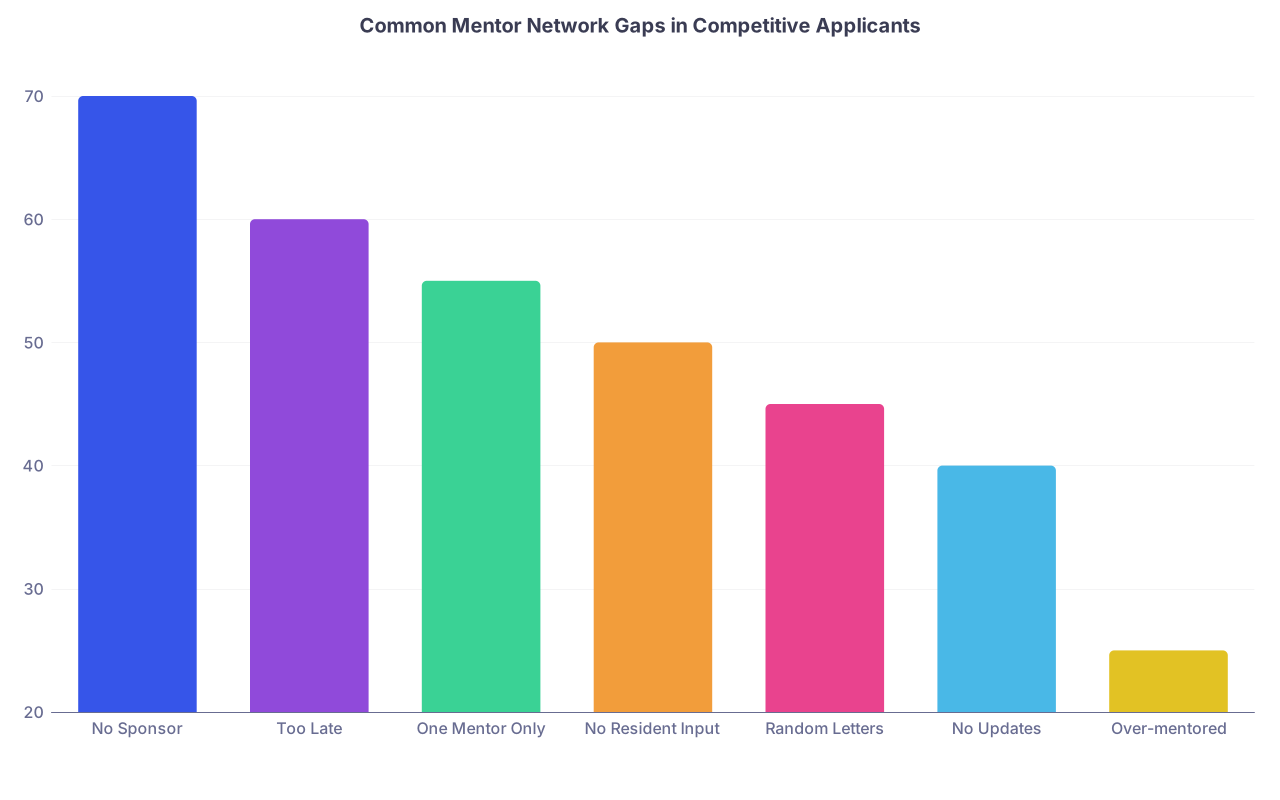
| Category | Value |
|---|---|
| No Sponsor | 70 |
| Too Late | 60 |
| One Mentor Only | 55 |
| No Resident Input | 50 |
| Random Letters | 45 |
| No Updates | 40 |
| Over-mentored | 25 |
1. Waiting Until Late MS3 / Early PGY-2
You should be seeding these relationships:
- For med students: During pre-clinical via interest groups, then early MS3.
- For residents switching specialties: As soon as the thought crosses your mind seriously.
Late outreach looks desperate. Early outreach looks strategic.
2. Over-relying on One “Big-Name” Mentor
One famous letter is not a network. If that person retires, leaves, or just forgets you, you are exposed.
Aim for:
- 1–2 high-impact Sponsors.
- 2–3 mid-level faculty / fellows.
- 2–4 residents.
3. Collecting Mentors Outside Your Target Specialty
No, the cardiologist who “really loves you” cannot fix your lack of ortho letters.
Out-of-specialty mentors are useful as:
- Anchors.
- Skill Builders (for general research).
- Supplemental letters.
They do not replace specialty-specific Sponsors.
4. Never Disagreeing
If you treat every mentor opinion as gospel, you will get whiplash. Mentors often disagree. That is normal.
Your job:
- Listen.
- Ask “What is the logic or data behind that?”
- Decide whose judgment carries more weight for that decision.
You are building a board of advisors, not a monarchy.
5. Not Managing Up
Many mentors are disorganized. If you wait for them to remember you:
- Your letter comes in late.
- Your research paper stalls.
- Your career talk never happens.
You fix this by:
- Sending short, clear emails with subject lines like “Derm application – 2 quick questions”
- Proposing specific times.
- Doing as much logistical work as possible yourself.
6. Emotional Dumping Without Asking
Telling your mentor you are anxious is fine. Making every interaction a therapy session is how mentors quietly drift away.
If you need ongoing emotional support, that is your Anchor mentor’s job. Be explicit when you are asking:
- “Right now I just need perspective: am I overreacting?”
- “I have a tactical question about [X]; I can save the emotional rant for my therapist.”
7. Ignoring Geography and Program Fit
Your Sponsor in a small community program can get you traction in similar places. They may have less impact at Harvard/Mayo/UCSF.
You want:
- At least one Sponsor with connections in your target tier of programs.
- At least one person who understands your geographic constraints (family, visa, etc.).
7. Put It All Together: A 6–12 Month Build Plan
You need a concrete plan, not vague “I should network more” guilt.
Here is a realistic 12-month build for someone targeting a competitive specialty as an MS3/MS4. Adapt the timeline if you are a resident.
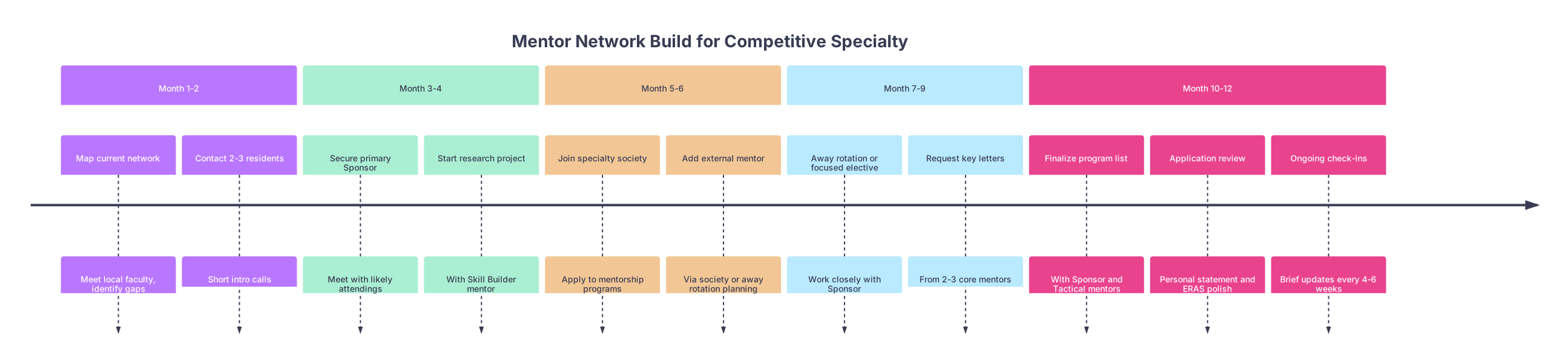
| Period | Event |
|---|---|
| Month 1-2 - Map current network | Meet local faculty, identify gaps |
| Month 1-2 - Contact 2-3 residents | Short intro calls |
| Month 3-4 - Secure primary Sponsor | Meet with likely attendings |
| Month 3-4 - Start research project | With Skill Builder mentor |
| Month 5-6 - Join specialty society | Apply to mentorship programs |
| Month 5-6 - Add external mentor | Via society or away rotation planning |
| Month 7-9 - Away rotation or focused elective | Work closely with Sponsor |
| Month 7-9 - Request key letters | From 2-3 core mentors |
| Month 10-12 - Finalize program list | With Sponsor and Tactical mentors |
| Month 10-12 - Application review | Personal statement and ERAS polish |
| Month 10-12 - Ongoing check-ins | Brief updates every 4-6 weeks |
You can compress this to 6–9 months by:
- Doubling the number of outreach emails per month.
- Combining research start + Sponsor hunt earlier.
- Using virtual electives or tele-rotations if away rotations are limited.
8. Quick Reference: Who Does What in Your Network
Print this mentally and start filling names in.
| Role | You Need Them To Do |
|---|---|
| Insider Sponsor | Honest viability assessment, calls/emails, top letter |
| Tactical Operator | Program list, ERAS strategy, interview prep tips |
| Skill Builder | Research output, clinical cases, concrete achievements |
| Psychological Anchor | Reality checks, emotional support, perspective |
And here is how often to touch base once relationships are established:
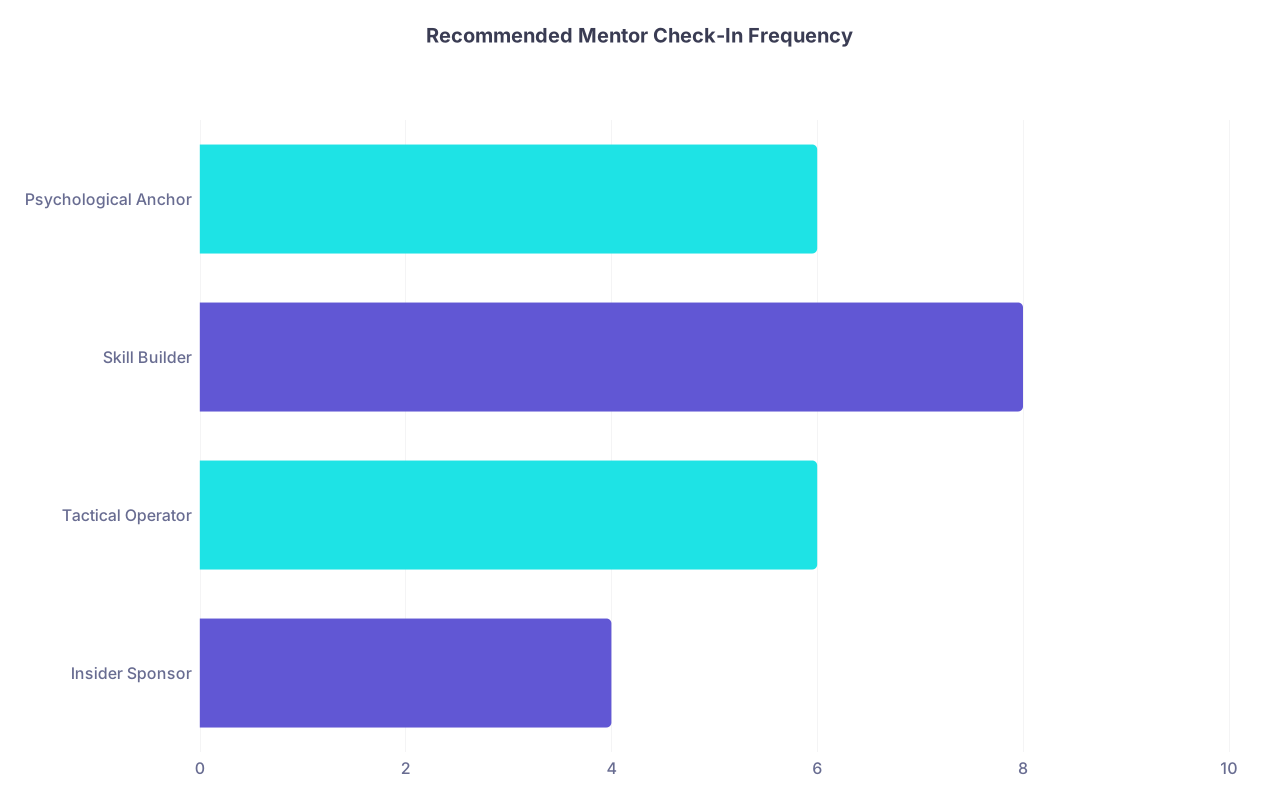
| Category | Value |
|---|---|
| Insider Sponsor | 4 |
| Tactical Operator | 6 |
| Skill Builder | 8 |
| Psychological Anchor | 6 |
(Values approximate check-ins per year—modify as needed, but if you are under these, you are probably under-communicating.)
9. Two Realistic Case Examples
Case 1: Mid-tier MD Aiming for Dermatology with Average Scores
- Step 2: 244
- Mid-tier state school
- Minimal research
Fix:
- Map network – realizes no derm faculty contact.
- Month 1:
- Emails derm clerkship director and one associate professor → 20-min meetings with both.
- Joins medical dermatology interest group + AAD resident & fellow section.
- Month 2–3:
- Starts case series + retrospective chart review with associate professor (Skill Builder).
- Paired with derm resident through AAD mentorship program (Tactical).
- Month 4–6:
- Becomes reliable on derm consults → attending offers to “help with applications” (Sponsor).
- Sends quarterly updates with progress and small wins.
- Month 7–9:
- Does away rotation at regional academic derm program arranged by Sponsor.
- Gets strong away letter + home letter.
- Outcome:
- Matches at solid academic derm program, not top-5, but more than competitive given starting point.
This did not happen because they were “brilliant.” It happened because they intentionally built the right network.
Case 2: Internal Medicine Resident Switching to Cardiology Fellowship Aspirations
- PGY-1 at community hospital
- Wants top cardiology fellowship, late realization
Fix:
- Month 1:
- Meets IM PD and local cardiology chief → honest conversations.
- Identifies that local cardiology is clinically strong but academically weak.
- Month 2–3:
- Contacted alumni now at big cardiology fellowships (through PD and med school connections).
- Lands one academic cardiology mentor at a nearby university → becomes external Sponsor.
- Month 4–6:
- Starts QI project at home hospital under local cardiologist (Skill Builder).
- Joins ACC (American College of Cardiology) and presents a poster under external Sponsor.
- Month 7–12:
- Quarterly Zoom calls with external Sponsor to refine fellowship strategy and program list (Tactical + Sponsor).
- Uses home PD as Anchor and secondary Sponsor for IM side.
Not magic. Just deliberate network design.

FAQ (Exactly 3 Questions)
1. How many mentors do I realistically need for a competitive specialty?
You need quality, not volume. For most people:
- 1–2 strong Insider Sponsors in the specialty.
- 1–2 Skill Builder mentors (often overlap with Sponsors).
- 2–4 Tactical Operators (usually residents).
- 1 Psychological Anchor (can be outside the specialty).
So roughly 4–7 people who actually know you, plus a wider circle of occasional advisors. If you are juggling 15 “mentors,” you are collecting names, not building a network.
2. What if my school does not have my target specialty at all?
Then your network will be 80–90% external by design. Your steps:
- Join the national specialty society and their student/resident section immediately.
- Use their formal mentorship program to get paired with at least one faculty mentor.
- Aggressively pursue away rotations / visiting electives at institutions with your specialty.
- Use alumni networks and deans to identify graduates who matched into your field elsewhere.
- Expect to travel (physically or virtually) for research and clinical exposure.
You are not doomed. You just cannot be passive. External mentors must become your Sponsors.
3. How do I handle conflicting advice from different mentors?
You stop treating mentors as oracles and start treating them as data points.
Do this:
- Write down each piece of conflicting advice.
- For each, ask: “What is their vantage point? What biases do they have?”
- Big-name PD at top-5 program vs. recent grad from community program.
- Go back to 1–2 mentors you trust most and say:
- “I received two different suggestions about [X]. Here is what they were. How would you think about this trade-off?”
- Then choose. And own the choice.
Indecision kills more applicants than “wrong” decisions. Strong candidates make informed decisions and move.
Open your notes app right now and make four headings: Sponsor, Tactical, Skill Builder, Anchor. Put actual names—or question marks—under each. Where you see blanks, that is your assignment for the next 30 days.