
It is April. You just opened your email, saw the word “unmatched,” and then stared at the screen long enough that the display dimmed. Or maybe you graduated last year, took a non-training job, reapplied, and your results were underwhelming. Few interviews. No offers. Now you are holding a diploma, some loans, and a gut-level question:
“What can I do in one year that will actually change my competitiveness?”
Not the fantasy version. Not “publish 10 papers in derm and reinvent my CV.” A real, structured, one-year plan that program directors will actually respect and that will move you from “borderline” to “viable” for your target specialty.
That is what we will build.
Step 1: Get Brutally Clear on Your Starting Point
Before you “plan your gap year,” you need to know what kind of problem you are actually solving.
You are not “generally weak.” You are usually weak in 1–2 specific domains. Different specialties care about different dials.
1. Run a Targeted Competitiveness Audit
Take one afternoon. No distractions. You are going to score yourself as a PD would.
Look at:
- Exam performance
- USMLE/COMLEX:
- Step 1 / Level 1 (now P/F, but low “pass” with multiple attempts still haunts you)
- Step 2 CK / Level 2 CE (the workhorse metric now)
- Any failures or multiple attempts
- USMLE/COMLEX:
- Clinical track record
- Clerkship grades (especially core rotations)
- Sub-I and away rotations
- Narrative comments (professionalism, work ethic, initiative)
- Research
- Number of publications / abstracts / posters
- Specialty-aligned projects
- Evidence of continuity (not just one poster 4 years ago)
- Fit with chosen specialty
- Letters from people in that specialty
- Specialty-specific rotations completed
- Time in the field (shadowing/externships)
- “Red flags”
- Leaves of absence
- Remediation
- Professionalism concerns
- Gaps with no clear story
Now, map that against your target specialty’s expectations.
| Specialty | Exam Priority | Research Expectation | Clinical Priority |
|---|---|---|---|
| Dermatology | Very high | Very high | High |
| Orthopedics | Very high | High | Very high |
| Internal Med | Moderate | Moderate | High |
| Family Med | Lower | Low | High |
| Psych | Moderate | Low–Moderate | High |
If you are aiming at derm with a 215 Step 2 and zero specialty research, your gap year is a different beast than someone applying FM with a Step failure and spotty professionalism comments.
2. Name Your Primary Deficit
You get one dominant problem and maybe one secondary.
Examples I see all the time:
- “Scores are my main liability. Letters and rotations are solid.”
- “I have okay scores, but nothing tying me to this specialty. No research, no aways, generic letters.”
- “I failed Step 1 and needed remediation on a clerkship. I need a professionalism and reliability redemption arc.”
- “I changed specialties late, so my whole portfolio screams something else.”
Write this in one sentence. That sentence will drive your one-year plan.
Step 2: Choose the Right Overall Strategy (By Specialty)
Not every specialty is realistic for a one-year “fix.” Some are. Some are salvageable but require recalibration. Some are delusional.
Let me be blunt:
Ultracompetitive (derm, plastics, ortho, neurosurgery, ENT)
If you:- Failed a Step/Level exam
- Are below ~230–235 Step 2 (or equivalent percentile for DO)
- Have no specialty research or home support
A single year will not “erase” that. You can improve, but you should plan a two-step path:
- One-year gap building credibility + 2) Backup or prelim/categorical in a related field, then later transition if possible.
Moderately competitive (EM, anesthesia, OB/GYN, neuro, radiology)
Here, a well-structured year can flip your odds, especially if scores are borderline but you build a strong story, research, and real-world clinical work.Broad-access (IM, FM, psych, peds)
One focused year will almost always help, often dramatically, especially if you correct red flags, secure strong new letters, and show consistent clinical work.
Step 3: Pick a Primary Vehicle for Your Gap Year
You are going to spend 9–12 months in one dominant role, plus side projects. Not 10 different random things.
Your “vehicle” must check at least two of these boxes:
- Provides direct clinical work (even if not as a resident)
- Allows new letters from US clinicians
- Opens doors to research or quality improvement
- Puts you in front of the same programs or specialty you want
Common Gap-Year Structures That Actually Work
Here are the main vehicles that move the needle. With pros, cons, and who they are best for.
| Option | Best For | Main Benefit |
|---|---|---|
| Research Fellowship | Competitive or academic fields | Publications + LORs |
| Clinical Externship | IM/FM/psych/peds, IMGs | US clinical + LORs |
| Transitional/Prelim Yr | Surgery, IM, EM backups | Real resident track |
| Non-ACGME Fellowship | Specific niche skills | Niche + continuity |
| Full-time Clinician | Scribes, hospitalist extenders | Real-world clinical |
Now details.
1. Research Fellowship / Gap-Year Research Position
Who this fits:
- Those targeting competitive specialties (derm, ortho, ENT, neurosurg, rad onc)
- Those with thin CVs but at least passable scores
- Those willing to live in a lab/office 50–60 hours a week
What it should look like (if you want PDs to care):
- Full-time, 1-year position in your target specialty, preferably:
- At an academic center
- With an attending who writes letters and sits on residency selection committees
- Clear output pipeline:
- 2–3 posters or abstracts
- 1–2 manuscripts (submitted, even if not accepted yet)
- Your name on something people can Google
Red flag: “Research” where you are mainly doing data entry, no clear projects led by you, no publications in sight. That is a resume line, not a competitiveness boost.
2. Formal Clinical Externship / Non-degree Clinical Position
Especially for IMGs or those with minimal recent clinical activity.
You want:
- Hands-on or closely observational work:
- Hospital-based externships
- Primary care clinics with supervised patient interaction
- Specialty-specific externships for your chosen field
- New, strong US letters from supervising physicians
- Clear dates demonstrating continuous clinical engagement
Avoid:
- Random week-long shadowing stints scattered around. Those do not read as real experience.

3. Prelim / Transitional Year (or Changing Specialty via Categorical Spot)
If you are truly unmatched and have the chance to:
- Take a prelim surgery or prelim medicine year, or
- Enter a categorical IM/FM/psych spot while originally targeting something more competitive
This can be invaluable if you use it correctly.
Reality check:
- A strong prelim IM year + excellent PD letter can rescue an EM, anesthesia, or even radiology application.
- A prelim surgery year can support future anesthesia, radiology, or even categorical general surgery if you crush it.
- But: doing a prelim year while performing poorly, being mediocre, or appearing bitter about “not getting your dream specialty” just buries you deeper.
You must:
- Treat it like an audition year
- Seek complex patients, take ownership, show up early, volunteer for procedures
- Have explicit conversations with your PD about your career goals and ask for guidance
Step 4: Build a 12-Month Plan by Quarter
Enough theory. Let us build the calendar.
I will give you a template you can adapt depending on your primary vehicle (research-heavy vs clinical-heavy).
Overall Focus by Quarter
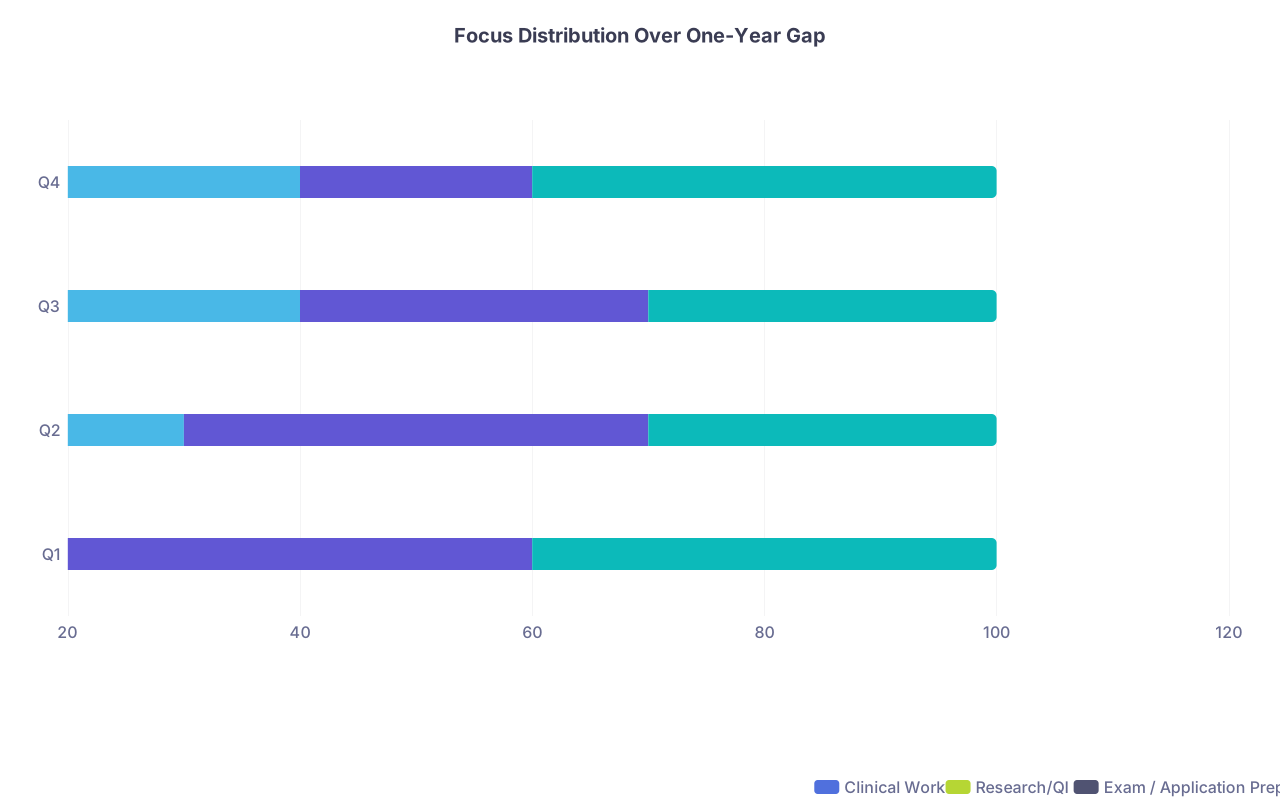
| Category | Clinical Work | Research/QI | Exam / Application Prep |
|---|---|---|---|
| Q1 | 20 | 40 | 40 |
| Q2 | 30 | 40 | 30 |
| Q3 | 40 | 30 | 30 |
| Q4 | 40 | 20 | 40 |
Quarter 1 (Months 1–3): Stabilize, Commit, Repair
Goals:
- Lock in your primary position
- Fix any exam issues
- Start a visible trajectory in one direction
Concrete tasks:
Secure your main role
- Sign contract for research fellow, externship, hospital job, or prelim / categorical seat.
- If you are between offers, this is your full-time job for 4–6 weeks.
Exam strategy (if needed)
- If Step 2/Level 2 is not taken → take it in Q2 at the latest.
- If already taken but low:
- Consider a Step 3 / Level 3 plan if:
- You are applying IM/FM/psych/peds/anesthesia/EM
- You have at least decent Step 2
- Do not waste 6 months chasing Step 3 if your Step 2 is the real anchor. Programs still rely heavily on Step 2.
- Consider a Step 3 / Level 3 plan if:
Start 1–2 major projects
- If research: get assigned to 1–2 concrete, publishable projects where you will be second or third author at worst.
- If clinical: propose 1 QI project you can realistically execute (e.g., handoff checklists, follow-up call systems, depression screening rates).
Document everything from Day 1
- Keep a simple log:
- Hours worked
- Roles
- Key tasks
- Any “wins” (patient feedback, compliments from attendings, etc.)
- Keep a simple log:
Quarter 2 (Months 4–6): Produce, Deepen, Signal
Goals:
- Show momentum in your chosen direction
- Start collecting letter writers
- Finalize exams
Concrete tasks:
Push projects toward tangible outputs
- Manuscripts:
- Draft at least one by the end of Q2.
- Abstracts/posters:
- Submit to at least one national or major regional meeting in your specialty.
- QI:
- Have baseline data collected and an intervention implemented.
- Manuscripts:
Clinical excellence
- For externs / prelims:
- Be the person who knows all your patients’ labs without looking.
- Stay late enough that residents and attendings notice your reliability.
- Ask for mid-rotation feedback instead of waiting until the end.
- For externs / prelims:
Secure 1–2 letter commitments
- Say it directly:
“I am reapplying to residency next cycle and focusing on [specialty/program type]. If I continue at this level, do you feel you could support me with a strong letter?”
- Say it directly:
If someone hesitates or hedges, you have your answer. Improve or pivot to a different letter writer.
Quarter 3 (Months 7–9): Application Build and Relationship Cementing
This is where people screw up. They get busy with their gap-year job and submit a bland re-run of last year’s application.
You will not do that.
Key moves:
Rebuild your application narrative
Personal statement:
- Explicitly, calmly, non-defensively explain:
- Why you had a gap
- What you did
- What you learned
- One paragraph. Not an essay on suffering. Focus on growth and concrete skills.
- Explicitly, calmly, non-defensively explain:
Experiences section:
- Fully describe your gap-year position with metrics:
- “Worked 45–60 hours per week in a hospital-based clinical research role with direct patient contact, enrolling 80+ patients into a stroke registry.”
- “Completed 1-year clinical externship in outpatient internal medicine, seeing an average of 10–15 patients per day under supervision.”
- Fully describe your gap-year position with metrics:
Ask for and lock letters
- Get finalized letters by late August / early September.
- Confirm letter writers:
- Know your story (previous mismatch/unmatched)
- Are willing to address growth and current performance
Align your program list with reality
This is where specialty competitiveness vs your metrics matters. Rough example:
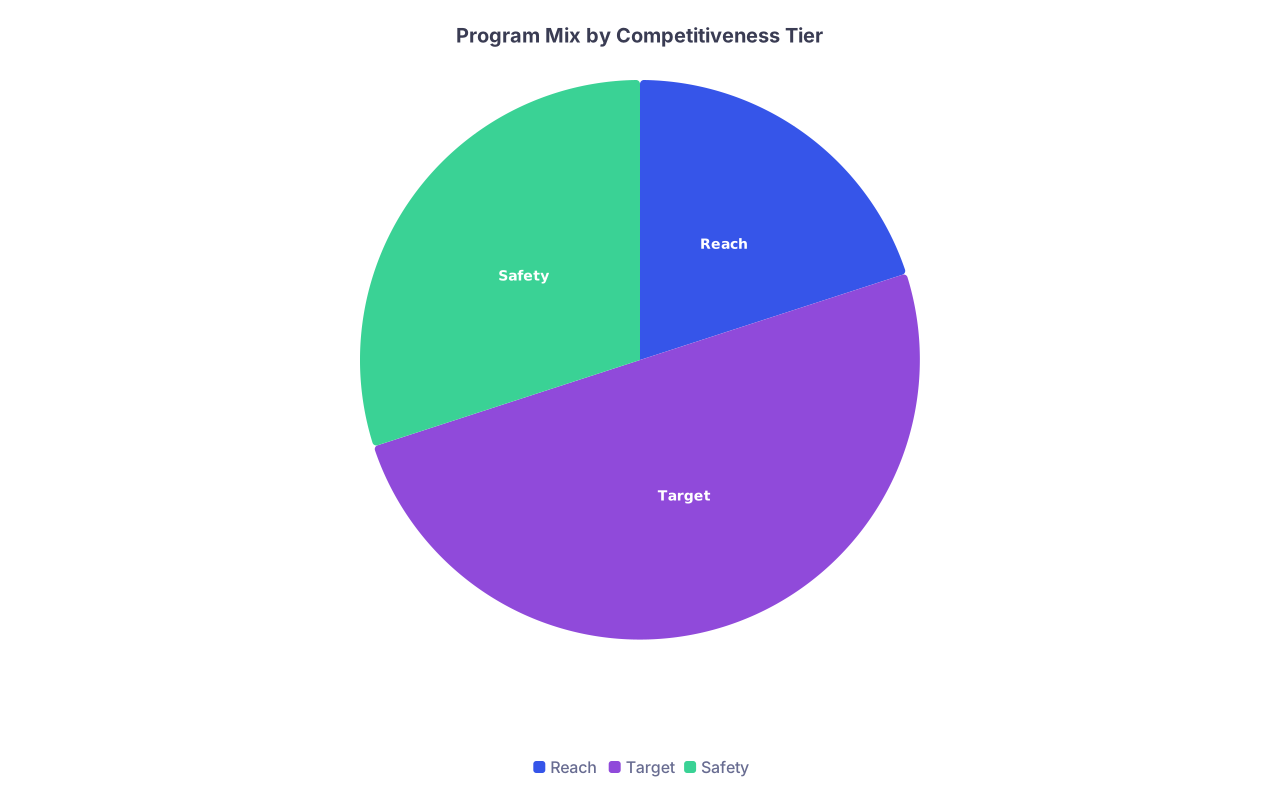
| Category | Value |
|---|---|
| Reach | 20 |
| Target | 50 |
| Safety | 30 |
For a competitive specialty with borderline metrics:
- 10–20% Reach
- 50–60% Realistic target programs (mid-tier academic, strong community)
- 20–30% Backup specialty or less competitive programs
For IM/FM/psych/peds:
- Reach academic programs are possible if your year was strong.
- But load up target and safety programs heavily. Pride does not pay loans.
Quarter 4 (Months 10–12): Execution and Interview Season
By now:
- Your gap-year story is on paper
- You have at least one strong, fresh letter
- You have active projects or accepted abstracts/posters
Your tasks:
Keep performance high
- People relax once ERAS is in. That is stupid.
- Attending comments from October–January still find their way into backchannel emails and informal discussions.
Prepare interview answers about the gap You should be able to answer this without flinching:
- “You graduated in 2024 but are applying for 2026 start. What happened?”
Structure it:
- One clean sentence about the mismatch or initial outcome
- 2–3 sentences about what you did this year (specifics)
- 1–2 sentences about how that makes you better for residency now
Example:
“I applied to emergency medicine during my fourth year, but received fewer interviews than would make a match likely and ultimately did not match. I took that as a signal that my application needed more depth, particularly in ongoing clinical work and scholarship. This past year I have been working full-time in a hospitalist-driven internal medicine service, taking responsibility for patient follow-up and QI work around discharge communication, and I have also co-authored two abstracts that were accepted to regional EM meetings. Practically, I have had a lot more independent responsibility for patient care, and I feel significantly more prepared to function as an intern than I did a year ago.”
Finish what you started
- Push manuscripts to submission.
- Attend conferences you submitted posters to.
- Let programs know (via ERAS or post-interview emails, sparingly) of any major new accomplishments.
Specialty-Specific Adjustments
Gap-year planning is not one-size-fits-all. Let us be specific.
If You Are Targeting a Highly Competitive Specialty
Examples: Dermatology, plastic surgery, neurosurgery, ENT, orthopedic surgery, radiation oncology.
Real talk:
- If your big deficit is scores, one year will not magically fix that. You can:
- Add Step 3 if appropriate
- Show excellent clinical performance in a related prelim or categorical
- Build a research portfolio with well-known mentors
Your one-year plan should:
- Anchor on a dedicated research position in that specialty, ideally at a program you would be thrilled to match at.
- Include:
- At least 2–3 specialty-specific letters
- A clear role on multi-project research, not just one small side project
- Simultaneously explore:
- Backup categorical paths (IM, general surgery, etc.) where you can later subspecialize toward your original interest.
If you are not willing to expand your acceptable endpoints (e.g., open to IM with cards vs only ortho), then understand you are accepting a higher risk of never matching.
If You Are Targeting Moderately Competitive Fields
Examples: Emergency medicine (market-dependent), anesthesia, neurology, OB/GYN, radiology.
Here a strong gap year can realistically turn things.
Plan focus:
- At least one of:
- Prelim year that proves clinical performance
- Dedicated research/clinical hybrid within the field
- Intentional networking:
- Meet PDs and APDs at regional/national meetings
- Present posters where they are in the room
And you must be honest about geography:
- Be willing to rank a broad set of programs and locations.
- Community and new programs may value your year more directly than oversubscribed big-name places.
If You Are Targeting IM, FM, Psych, Peds
Your biggest enemy is looking “inactive,” disorganized, or uncommitted.
Your one-year plan should:
- Show continuous clinical work:
- Externships, hospitalist extender roles, outpatient clinics
- Fix open questions:
- Step 2 retake or Step 3 success
- Strong recent letters that open with “Over the last year, I worked with Dr. X 4–5 days per week…”
You can massively change your trajectory here by:
- Removing red flags (no unexplained gaps)
- Demonstrating maturity and reliability through consistent performance
- Building one or two clear clinical or QI accomplishments that can be cited in letters

How to Explain Failure or Being Unmatched Without Killing Your Chances
You cannot hide it. Programs see the graduation year. They ask.
What does not work:
- Blaming “the system,” “COVID,” or “bad luck.”
- Turning it into a therapy session.
- Over-sharing personal hardship in a way that makes PDs question your stability.
What works:
- Short, direct acknowledgment:
“I applied to X in 2024 and did not match.” - One neutral sentence about why:
“In retrospect, my application lacked sustained clinical exposure in the field, and my Step 2 score was lower than is typical for that specialty.” - Then most of your energy on what changed:
Specific job, hours, responsibilities, projects, skills.
Your goal is simple: turn “failure” into “data-driven course correction.” PDs respond well to that.
Common Mistakes That Ruin Gap Years
You can absolutely waste this year. I have seen it over and over.
Top errors:
Doing “a little of everything” and mastering nothing
- Two part-time research gigs, some shadowing, a board course, random volunteering. It looks scattered and unserious.
Ignoring your main deficit
- If scores are weak and you do not add Step 3 or show cognitive improvement in some way, research alone will not fully cover that.
- If professionalism/red flags are the issue, hiding in a lab will not reassure anyone.
Treating your role like a job, not an audition
- Coasting, watching the clock, minimal initiative.
- Then being surprised your letters say, “reliable and pleasant,” instead of “top 10% I have worked with.”
Waiting too long to adapt
- If by Month 3, you have no defined projects and no potential letter writers, you are behind.
- If you are in a toxic or non-productive situation, switch early, not in Month 9.
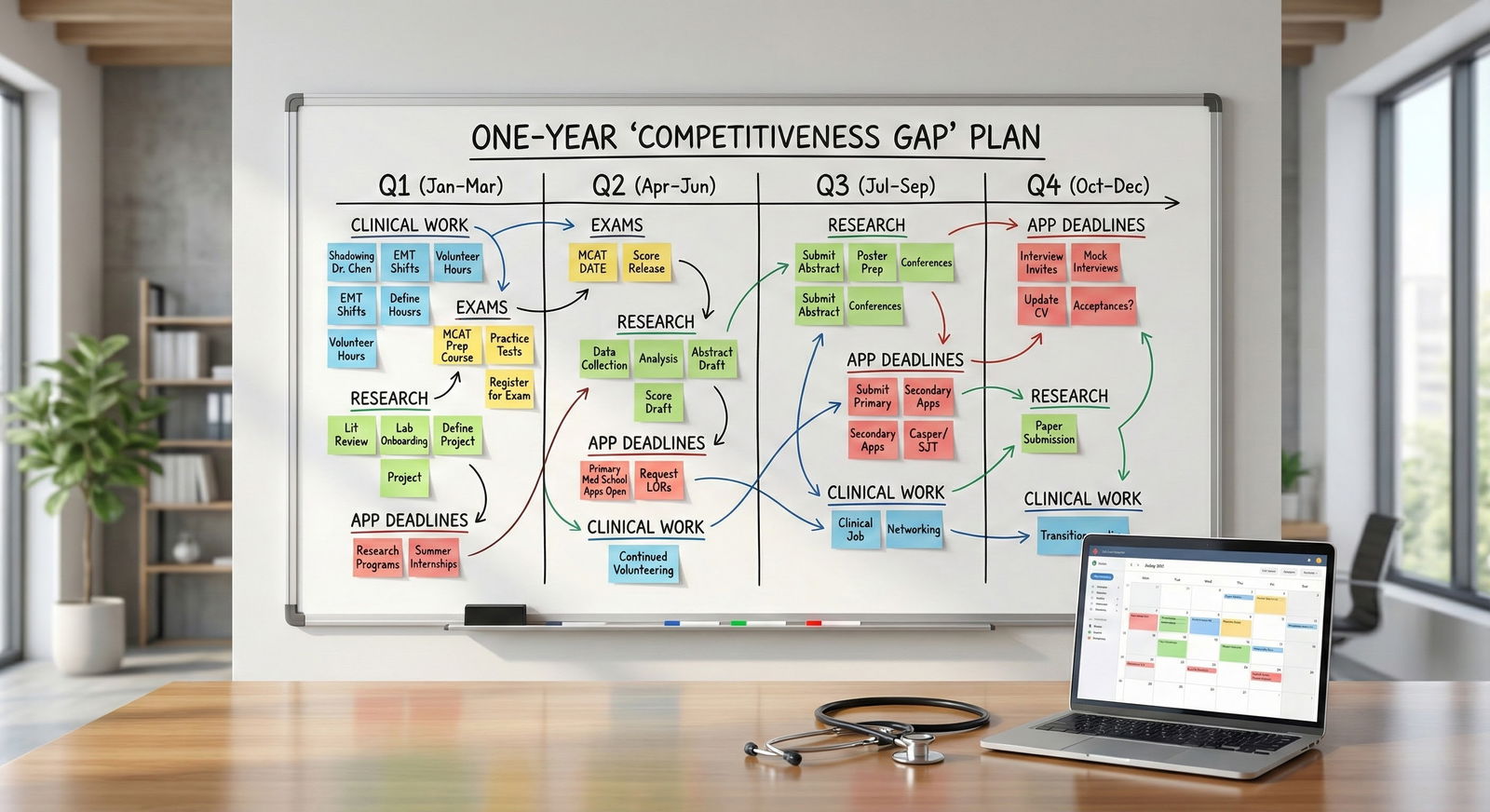
Putting It All Together: A Sample One-Year “Competitiveness Gap” Plan
Let me give you two quick sample blueprints so you can see what this looks like in real life.
Example 1: US Grad, Unmatched into EM, Applying Again with IM as Backup
Profile:
- Step 1: Pass
- Step 2: 224
- EM: 1 home rotation, 1 away, decent but not stellar SLOEs
- No significant research
- Unmatched EM
Plan:
- Primary vehicle: Full-time hospitalist service clinical position (ED obs unit or IM service assistant) at a teaching hospital.
- Secondary: One EM-focused QI project (e.g., 72-hour return visits) with an EM attending; 1–2 abstracts to regional EM meeting; consider Step 3.
By end of year they have:
- Strong letter from IM hospitalist director and one EM faculty member citing reliability, clinical reasoning, and ownership.
- Step 3 passed.
- 2 regional EM abstracts, 1 QI project implemented.
Apply:
- EM broadly (with realistic mix of community and academic)
- IM as a full, serious backup with a tailored personal statement and program list.
Example 2: IMG, Targeting Internal Medicine, Old Graduation (3+ Years Out)
Profile:
- Step 1: Pass
- Step 2: 235
- No US clinical experience
- Grad year 2021, currently in home country
Plan:
- Primary vehicle: 12-month full-time US clinical externship in IM at a teaching hospital with large residency.
- Secondary: Small QI project tied to that clinic/hospital + Step 3 in Month 6–8.
By end of year:
- Continuous, 12-month US clinical work clearly documented.
- Step 3 passed.
- 2–3 strong letters from US IM faculty.
- QI project included in PS and discussed in interviews.
Result: That profile is taken seriously at a wide range of IM programs, especially community and mid-tier academics.
FAQ (Exactly 4 Questions)
1. Is taking Step 3 during my gap year always a good idea?
No. Step 3 helps most if:
- Your Step 2 is borderline but passing
- You are applying to IM, FM, psych, peds, or sometimes anesthesia/EM
- You can realistically score solidly above your previous performance
It is not magic. If your Step 2 is very low or you have multiple failures, a marginal Step 3 will not fix that and can even confirm a negative impression. Use it when you can clearly outperform your earlier pattern.
2. Should I reapply to the same specialty or switch?
Base that on three things:
- Objective competitiveness gap (scores, research, letters) vs norms for that specialty
- Your willingness to accept a backup path (e.g., IM with cards instead of ortho)
- Honest feedback from trusted faculty in that field
If multiple honest mentors in the specialty tell you the odds are very low even after a strong year, seriously consider a switch or at least a dual-application strategy.
3. Do programs look down on taking a gap year after graduation?
They look down on unexplained, inactive, or chaotic gaps. A clearly structured year with:
- Full-time clinical or research responsibilities
- New, strong letters
- Concrete outputs (Step 3, publications, QI)
is not a liability. For many PDs, it is a sign of maturity and persistence, especially if you can explain the year calmly and specifically.
4. How many hours per week should I be working during my gap year?
Enough that it feels and reads like a real job, not a hobby. Typically:
- Research fellowships: 40–60 hours/week
- Clinical externships: 30–50 hours/week
- Hospital-based non-resident clinical roles: similar to junior resident hours
If you are below ~20 hours/week on your main activity, PDs may question the seriousness of that role. You can combine part-time roles, but then you must present them coherently on your application.
Key points to walk away with:
- Diagnose your real deficit, then choose one main vehicle (research, clinical, prelim/categorical) to address it.
- Treat the entire year like an audition, not a holding pattern. Strong new letters and tangible outputs are the currency.
- Align your specialty and program list with reality, using honest feedback, not wishful thinking.