
The usual advice about “backup specialties” is dangerously simplistic—and often wrong.
You are told either:
- “Always have a backup specialty.”
or - “Never apply to a backup specialty; it makes you look weak.”
Both extremes are bad. The truth is more tactical: you absolutely can create a backup specialty strategy without ever signaling doubt about your primary choice. But you need structure, not vibes.
I am going to walk you through a concrete, step‑by‑step system that I have seen work for:
- The Step 1 pass/fail era
- Overcrowded specialties (derm, ortho, ENT, plastics, urology, IR, rads, EM in some regions)
- Applicants with red flags or late specialty switches
If you do this right, program directors will only see a focused, committed applicant to their specialty. The backup architecture will be almost invisible.
1. Get Real About Your Risk Profile
You cannot build a rational backup plan until you are brutally honest about how risky your primary specialty actually is—for you, not in the abstract.
Step 1: Classify Your Primary Specialty
Use this quick competitiveness bucket. Do not overcomplicate.
| Bucket | Examples | General Competitiveness |
|---|---|---|
| A | Derm, Plastics, Ortho, ENT, Neurosurgery | Extremely high |
| B | Ophtho, Urology, Radiology, Anesthesia, EM (selective regions), IR | High |
| C | IM, Gen Surg, OB/GYN, Peds, Psych | Moderate |
| D | FM, Neuro, Path, PM&R (variable), IM prelim | Lower (but still competitive) |
This is not perfect, but close enough to design strategy.
Step 2: Map Your Personal Risk
Now look at yourself like a PD would. Harsh, but necessary:
- US MD vs US DO vs IMG
- Any failed Step or COMLEX attempt
- Step 2 CK below the current year’s average for your bucket
- Class rank / AOA / honors
- Real research vs token posters
- Strong vs generic letters
- Any professionalism issues
Create a quick self‑rating:
- Green: Above average for chosen specialty
- Yellow: Around average / some weaknesses
- Red: Below average or with major flags
Now combine these:
- Bucket A + Yellow or Red = you must have a backup specialty plan
- Bucket B + Yellow or Red = strongly recommended
- Bucket C and D + Red = smart to have selective backup options
If you are Bucket A + Green, you might still want a stealth safety net (e.g., more community, lower‑tier programs in primary specialty rather than a different specialty).
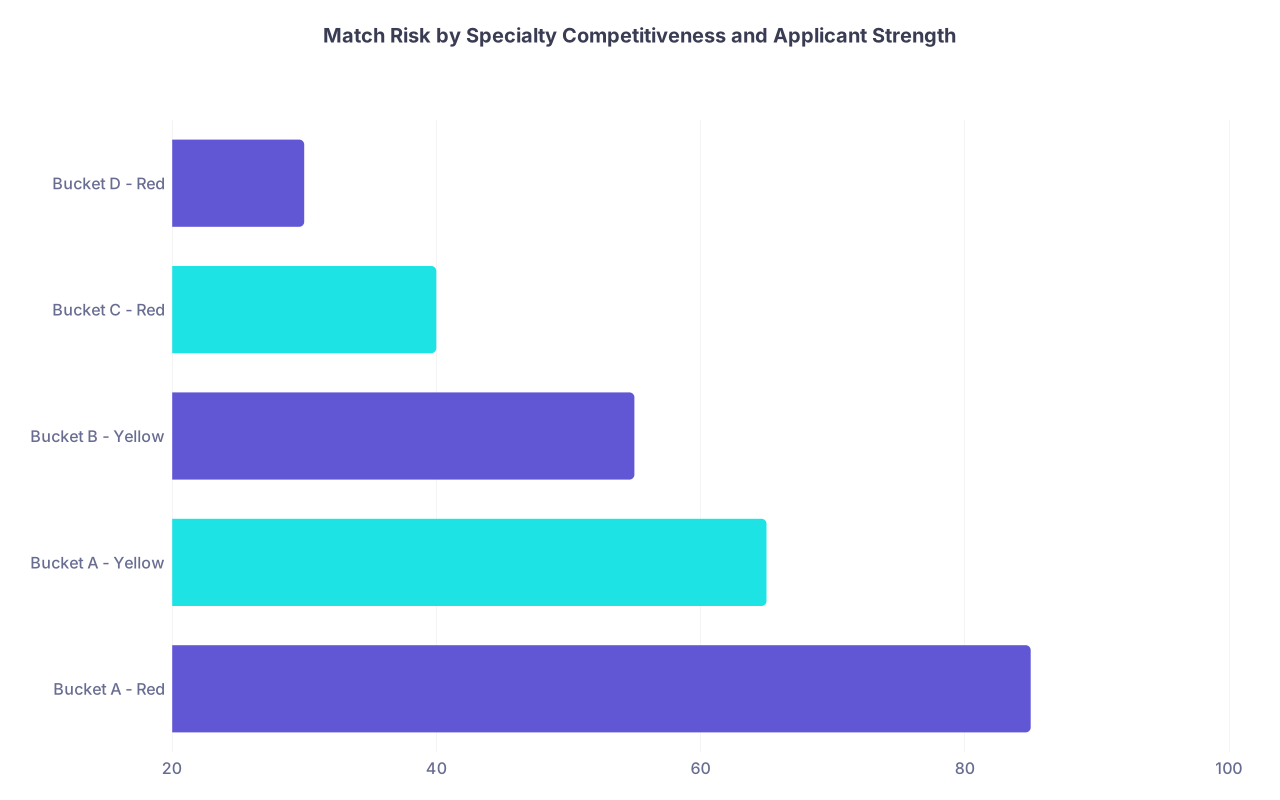
| Category | Value |
|---|---|
| Bucket A - Red | 85 |
| Bucket A - Yellow | 65 |
| Bucket B - Yellow | 55 |
| Bucket C - Red | 40 |
| Bucket D - Red | 30 |
(Values here are not exact NRMP data; they represent relative risk levels as I have seen in real advising.)
2. Core Principle: Two Parallel Narratives, Never Mixed
The way you avoid signaling weakness is simple in concept and hard in execution:
You run two completely separate, internally coherent application narratives, and you never cross the streams.
To dermatology programs:
You are 100% committed to dermatology. Your life story “always” bends toward derm.To internal medicine programs (your backup):
You are 100% committed to internal medicine. Your life story “always” bends toward IM.
You do not:
- Mention your backup specialty in personal statements
- Ask a derm mentor to talk about your interest in anesthesiology in a letter
- Use the same generic personal statement everywhere
- Tell programs “I’m hedging with [backup] in case [primary] does not work out”
You are not lying; you are managing narrative focus. Most students genuinely could see themselves happy in more than one field. You are allowed to highlight different authentic facets of your interests to different audiences.
3. Choosing the Right Backup Specialty (Not the Lazy One)
The lazy backup choice is “I will just add FM or IM if things look bad.” That is how people end up with incoherent stories and suspicious interviews.
You want a functionally aligned backup:
Clinical overlap – shared patient population or workflow
- Derm ↔ IM or peds
- Ortho ↔ PM&R
- ENT ↔ gen surg or anesthesia
- Neurosurg ↔ neurology or gen surg
- EM ↔ IM, FM, anesthesia
Skillset overlap – procedures vs cognitive, outpatient vs inpatient
- IR radiology ↔ diagnostic radiology, vascular surgery
- Anesthesia ↔ critical care, EM
- Plastics ↔ gen surg, ENT
Plausible longitudinal interest
Can you explain, without sounding panicked, why this has been on your radar for a while? Even if you only seriously committed more recently.
Make a quick alignment grid for yourself. Example for an ortho applicant:
- Primary: Orthopedic Surgery (Bucket A, very competitive)
- My stats: Yellow (mid Step 2, limited research, strong home support)
- Plausible backups:
- PM&R – MSK, rehab, procedures, shared patient population
- Gen Surg – OR‑based, similar mindset
- FM – possible but feels like a story stretch; last resort
I would push that applicant to build a PM&R backup, not just tack on random gen surg or FM programs at the last second.
4. Build the Backup Infrastructure Quietly (PGY‑2 You Will Be Grateful)
You cannot bolt on a “backup” in September of ERAS and expect it to look legitimate. You need minimum viable infrastructure in place months earlier.
Timeline Overview
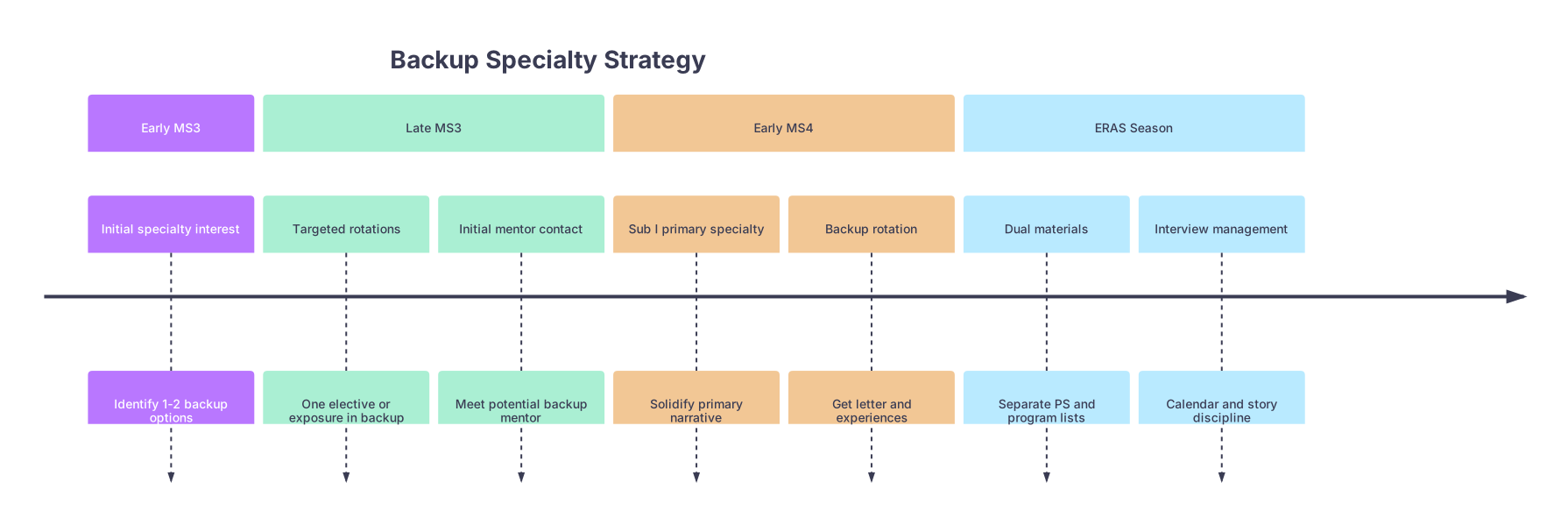
| Period | Event |
|---|---|
| Early MS3 - Initial specialty interest | Identify 1-2 backup options |
| Late MS3 - Targeted rotations | One elective or exposure in backup |
| Late MS3 - Initial mentor contact | Meet potential backup mentor |
| Early MS4 - Sub I primary specialty | Solidify primary narrative |
| Early MS4 - Backup rotation | Get letter and experiences |
| ERAS Season - Dual materials | Separate PS and program lists |
| ERAS Season - Interview management | Calendar and story discipline |
Concrete Actions (Minimum Viable Backup Plan)
By the time you open ERAS, you want:
At least one rotation in the backup field
- Could be a 2‑ or 4‑week elective
- Even better if it is at your home institution or a place you are willing to match
At least one backup‑specific letter writer
- Someone who has actually seen you work in that specialty
- They do not mention your primary specialty
- You tell them clearly: “I am applying to [backup], I would be grateful if your letter could focus on my potential as a [backup] resident.”
A credible backup personal statement (PS)
- Completely separate from primary
- No references to “also considering” anything
- You lean into aspects of your background that fit that field
A backup‑aligned program list
- Do not send a token 5 apps to your backup; that is not a strategy
- If you are truly at risk, you should have enough backup apps to reasonably match even if your primary does not work out
5. Application Mechanics: How to Keep Everything Clean in ERAS
This is where people get sloppy and expose themselves.
Personal Statements: One Specialty, One Story
- Primary specialty → PS only about that specialty.
- Backup specialty → totally separate PS about that field.
You may have slight variants (e.g., academic vs community focus) but the core story stays within the specialty lane each time.
Letters of Recommendation (LoRs)
You should have two separate pools:
- Primary pool: 3–4 letters from your primary specialty (plus maybe one medicine/surgery letter if that is standard for the field)
- Backup pool: 3–4 letters from the backup specialty (plus a strong generic clinical letter if you have one)
Use ERAS tools to assign letters strategically:
- Never send derm letters to IM programs.
- Never send “IM back when I thought I wanted…” style comments in a letter to derm.
If you absolutely need to share a generic letter (from a sub‑I in medicine, for example), confirm with the writer that it does not contain specialty‑specific language that will look contradictory.
Program Signaling and Preference Signals
The new signaling systems (tokens / signals / preference tiers) complicate backup planning, but they do not kill it.
Rules:
- All of your signals go to your primary specialty.
- You apply more broadly (geographically and tier‑wise) in your primary field.
- Backup specialty: no signals, or maybe 1–2 if you are honestly almost co‑primary between the fields.
If you spread precious signals across two specialties, you look unfocused and you also weaken your primary chances. Bad trade.
6. The Numbers: How Many Programs to Apply To
People want formulas. Here is a useful framework, not gospel.
Assume you are a US MD; adjust upward for DO or IMG.
| Profile | Primary Specialty | Primary Apps | Backup Specialty | Backup Apps |
|---|---|---|---|---|
| Bucket A, Yellow | Derm | 80 | IM | 40 |
| Bucket B, Yellow | Anesthesia | 40 | IM | 25 |
| Bucket C, Red | Gen Surg | 45 | IM or FM | 35 |
| IMG, Bucket B | Radiology | 70 | IM | 60 |
Core principles:
- You do not sacrifice adequate primary coverage.
- You only add backup apps that you can support with real materials (letters, PS, at least one rotation).
- Backup should be enough to generate 8–10 interviews on its own if that became your only path.
7. Interview Season: How to Stay Consistent and Not Slip
This is where people blow it. They walk into an IM interview and casually mention their derm applications. Or vice versa. And then they email me asking why they did not match.
Hard Rule: In Any Given Interview, That Specialty Is Your Focus
You are not required to lie about the existence of other applications, but you are also not required to volunteer it. If directly asked:
Bad answer:
“I am actually mainly going for ortho but I need a backup, so I also applied to PM&R.”
Good answer (for PM&R interview):
“I explored several fields early on, including orthopedics and internal medicine. As I spent more time with patients with chronic MSK issues and neuro rehab needs, I realized that what I valued most was long‑term functional improvement and the team‑based nature of rehab. PM&R became the clear fit for how I like to think and work, so that is where I have focused my application.”
Notice:
- You acknowledge past exploration (totally normal).
- You end with: “This is my fit, this is my focus.”
- You do not frame them as a fallback.
If an interviewer explicitly asks, “Are you applying to any other specialties?”:
- Keep it honest but controlled.
- Example: “I did explore [other field] and have a small number of applications there, but as the interview season has progressed it has become clear to me that [this field] is where I see myself practicing long term.”
Calendar Management: Avoid Looking Chaotic
Use a simple structure:
- Track primary and backup interviews on the same calendar but in different colors.
- Avoid canceling a primary interview for a backup one unless there is no chance you would rank that primary program above any backup program.
- Try not to schedule yourself so thin you are obviously exhausted or desperate on Zoom.
8. Rank List Strategy: Where Backup Actually Matters
Here is the actual purpose of the backup strategy: if your primary specialty implodes (few or no ranks), you still have enough backup programs on your list to reliably match into something you can live with.
Key ranking rules:
The Match algorithm favors your preferences, not your pessimism.
Rank programs in the true order of where you want to be, regardless of specialty. If you would truly rather be at a strong IM program than a toxic categorical surgery spot, rank accordingly.Be honest with yourself about misery risk.
Do not rank a primary specialty program above a backup one if, in your gut, you know you will hate that environment. You can have a great career in your backup field. You will burn out fast in a “dream specialty” in a nightmare program.If you gained momentum toward your backup during interviews, adjust your list.
I have seen plenty of people start as “derm‑or‑bust” and end up truly excited about IM or peds after a couple of outstanding interviews. That is not weakness. That is clarity.
9. Red Flags and Late Switches: Special Cases
Some of you are playing on “hard mode.”
If You Have Major Red Flags (failures, probation, big gap)
You must assume:
- Highly competitive specialties will be extremely unforgiving.
- Even moderate specialties may treat you as a risk.
What you do:
- Shift more weight earlier toward the backup (or even co‑primary) specialty.
- Invest heavily in rotations and mentors in the more forgiving field (often IM, FM, psych, peds, PM&R).
- Consider a transitional year or prelim year only if realistic mentors think it meaningfully raises your chance to reapply to primary. Otherwise, a solid categorical spot in a backup specialty is usually safer than a “reapply” fantasy.
If You Are Switching Late (End of MS4, after away rotations)
You do not have time for perfection. You need a salvage strategy.
- Focus: generically competitive but open fields—IM, FM, psych, peds, PM&R, prelim IM.
- Get one short rotation in the new field if at all possible.
- Have your dean’s letter / MSPE updated to not scream a different specialty only.
- Craft a PS that owns the switch: “I explored X, learned Y about myself, and this led me to Z, where my interests and strengths are better aligned.”
10. Concrete Example Scenarios
Let me make this real.
Scenario 1: US MD, Derm Primary, IM Backup
- Step 2: 245, strong but not elite.
- Research: 1 derm pub, 2 posters.
- Clinical: Honors in medicine, derm elective, 1 away derm rotation.
Plan:
- Primary: 80 derm programs, 4 derm letters, derm PS.
- Backup: 40 IM programs (mostly academic and mid‑tier university), 2 IM letters (sub‑I and wards), 1 generic medicine chair letter, IM PS focusing on immunology, chronic disease, clinic experiences.
- Signals: All tokens to derm. None to IM.
- Result: Even if derm interviews thin out, strong IM interest looks coherent and real.
Scenario 2: DO, EM Primary, IM Backup
- EM getting tighter in certain regions.
- Step 2: 232. DO, no AOA equivalent, decent SLOEs but nothing exceptional.
Plan:
- Primary: 40 EM programs, mostly community and DO‑friendly.
- Backup: 35 IM programs (DO‑friendly, many community).
- Letters: 2 EM SLOEs, 2 IM letters. EM letters only to EM, IM letters only to IM.
- PS: Two totally distinct documents.
- Ranking later: If EM interview yield is low and IM interviews are strong, shifting preference to IM higher on the rank list is completely reasonable. That does not negate your earlier EM attempts.
11. What Actually Signals Weakness (And What Does Not)
Program directors are not dumb. But they are not obsessively cross‑checking you across every specialty either. They mainly see:
Signals of weakness:
- A PS that reads like, “I like everything and cannot decide.”
- A letter that says, “He is considering many fields and has not really decided yet.”
- An interview answer where you openly describe their field as a “backup.”
- Obvious lack of exposure to their specialty (no rotations, no letters, superficial understanding).
Does NOT signal weakness:
- Having rotated in another field earlier in training.
- Research in a different but related specialty.
- A dean’s letter that mentions you explored multiple interests.
- Applying to more programs than average. PDs assume people cast wide nets.
If you maintain tight narrative discipline, your backup strategy is invisible. It just looks like you grew into their field as your best fit.
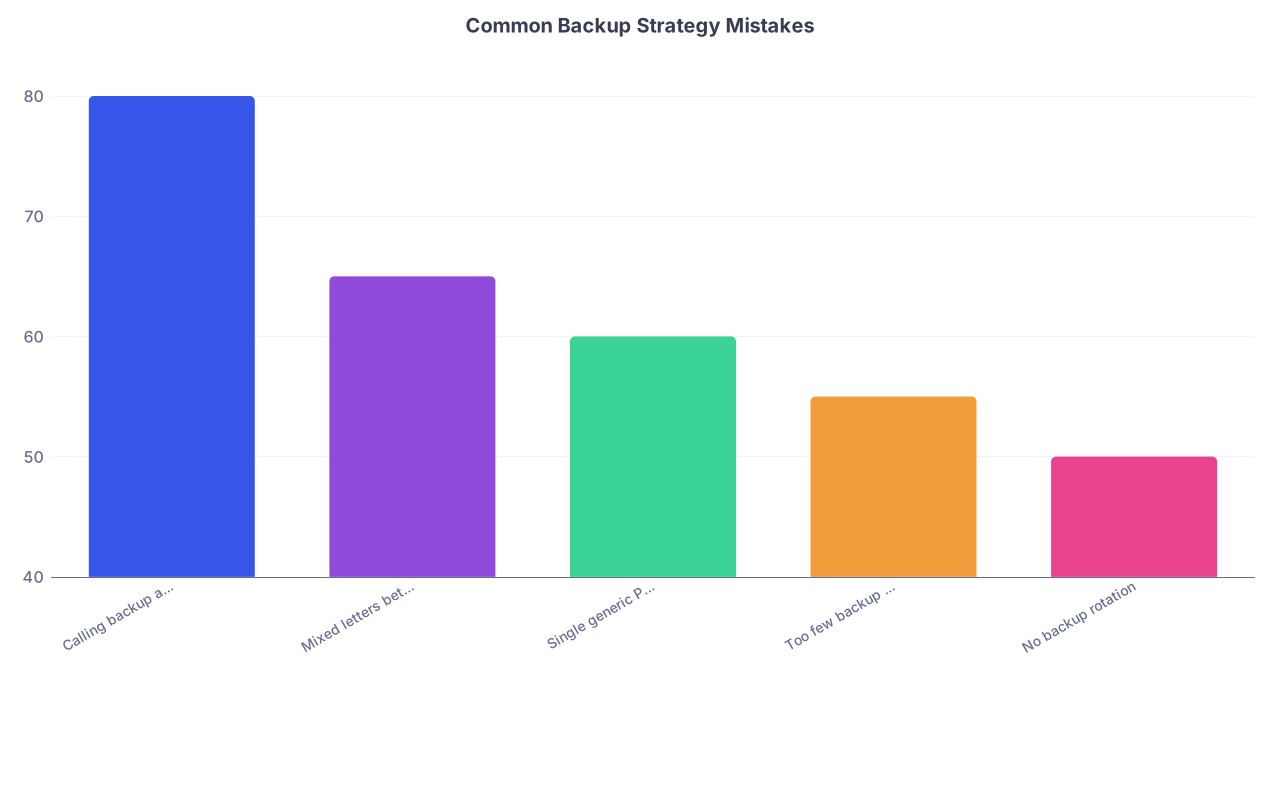
| Category | Value |
|---|---|
| Calling backup a fallback in interviews | 80 |
| Mixed letters between specialties | 65 |
| Single generic PS for all apps | 60 |
| Too few backup applications | 55 |
| No backup rotation | 50 |
12. Implementation Checklist
Use this as your working protocol.
6–12 Months Before ERAS
- Choose:
- Primary specialty
- 1 realistic backup specialty (aligned clinically and narratively)
- Schedule:
- At least one rotation in each field
- Identify:
- Potential letter writers in both specialties
3–6 Months Before ERAS
- Secure:
- 3–4 primary letters
- 2–3 backup letters
- Draft:
- Primary PS
- Backup PS
- Build:
- Preliminary program lists for both fields
ERAS Season
- Assign correct PS and letters to each program.
- Use all signals on primary specialty.
- Send a realistic number of apps to both, consistent with your risk profile.
Interview Season
- Treat every interview as if that specialty is your primary.
- Never label any field “backup” in interviews.
- Keep calendar organized; protect primary interviews.
Rank List
- Rank across specialties in true order of where you would prefer to train.
- Do not rank programs above places where you know you would be miserable just to “stay in the field.”

FAQs
1. Should I tell my mentors about my backup specialty?
Usually yes, but selectively. Tell:
- Your school advisor or dean
- At least one mentor you trust in your primary specialty
- The mentor in your backup specialty (they must know you are truly applying there)
You do not need to broadcast it to every attending. Phrase it as: “I am very serious about [primary], and I am also building a realistic application in [backup] because I would be genuinely happy there as well.”
2. Can I use the same personal statement for both specialties?
No. That is one of the fastest ways to look generic and unfocused. You can reuse some core anecdotes (patient story, background) but the framing and conclusions must be specialty‑specific. For every PS, you should be able to answer: “If I removed the specialty name, would this still obviously sound like it was written for this field?” If not, it is too generic.
3. Is it better to do a prelim year and reapply to my dream specialty than match a backup?
Only if three conditions are met:
- Multiple knowledgeable mentors in that specialty believe you have a realistic chance to succeed on a reapplication.
- You have a concrete plan: new research, stronger letters, additional rotations, not just “try again harder.”
- You are emotionally and financially prepared for the possibility it still does not work.
If any of those are missing, a solid categorical spot in a well‑chosen backup specialty is usually the smarter long‑term move.
Key Points:
- A backup specialty strategy does not signal weakness if you keep two clean, coherent narratives and never cross them.
- The backup must be chosen deliberately, built early with rotations and letters, and supported with enough applications to matter.
- Your rank list should reflect your true preferences across specialties, not fear or ego.