
The belief that “you cannot match competitive specialties without heavy research” is exaggerated and often misused as an excuse. You are not out of the game. You just do not get to be lazy or vague about your strategy.
You want a competitive or mid‑competitive specialty with low research output. That is fixable. But it requires a specialty‑specific, program‑level plan, not wishful thinking and “I hope my personality carries me.”
Here is the tactical breakdown.
1. First: Diagnose Your Research Problem Accurately
Before you pick a strategy, you need to know which kind of “low research” applicant you are.
A. Classify yourself
Use this rough categorization:
| Profile | Typical Output |
|---|---|
| Zero Research | 0 posters, 0 pubs, maybe 1 tiny school project |
| Minimal | 1–2 posters OR 1 low‑impact paper, no continuity |
| Moderate Non‑Target | 3–6 items but not in desired specialty |
| Moderate Targeted | 3–6 items, at least 2 in desired specialty |
If you are:
- Zero / Minimal and aiming at very competitive (derm, plastics, ortho, ENT, neurosurg, urology, integrated IR/rads, RO): you need a repair plan.
- Moderate Non‑Target aiming at any competitive field: you need a repositioning plan.
- Moderate Targeted but still anxious: you probably have an application framing problem more than a raw CV problem.
B. Know what “counts” more than raw numbers
Programs care more about:
- Specialty‑aligned work (derm research for derm, etc.)
- Recency (last 1–2 years weighs heavier)
- Role (first author, meaningful contribution, ability to discuss intelligently)
- Who vouches for you (letters from known faculty in the specialty)
Low overall count can be offset by:
- Strong board scores / class rank
- Strong clinical evaluations in that specialty
- Trusted letters from well‑known faculty
- Strategic program list and geographic ties
So, your problem is not “I have low research and therefore I will not match.” Your real problem is: in this specialty, with my numbers and my current timeline, what lever do I still have time to pull?
2. How Much Does Research Actually Matter by Specialty?
Here is the blunt truth: in some specialties, low research is a nuisance. In others, it is a brick wall unless you build a workaround.
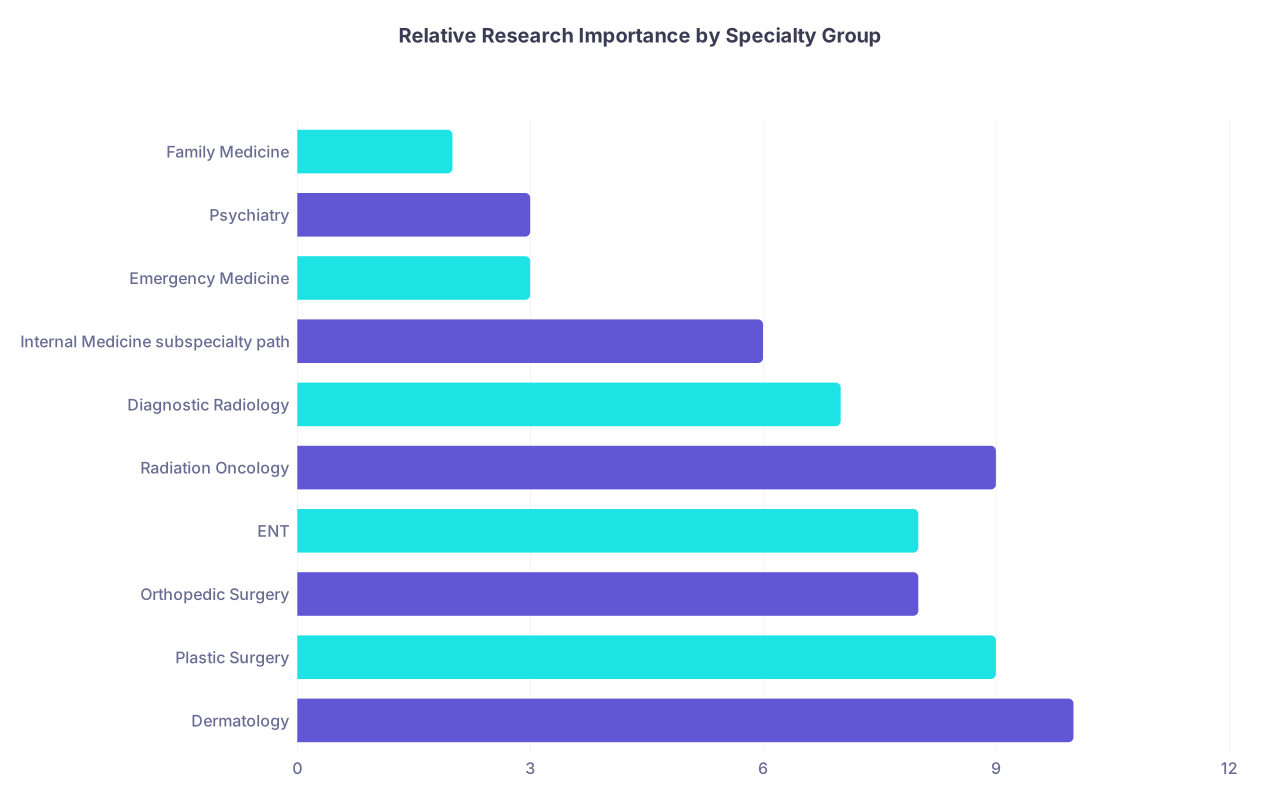
| Category | Value |
|---|---|
| Dermatology | 10 |
| Plastic Surgery | 9 |
| Orthopedic Surgery | 8 |
| ENT | 8 |
| Radiation Oncology | 9 |
| Diagnostic Radiology | 7 |
| Internal Medicine subspecialty path | 6 |
| Emergency Medicine | 3 |
| Psychiatry | 3 |
| Family Medicine | 2 |
Scale: 1 = almost irrelevant, 10 = extremely important on average for competitive programs
Let us go specialty‑by‑specialty and talk tactics.
3. Ultra‑Competitive Surgical Specialties
Derm, plastics, ortho, ENT, neurosurgery, integrated vascular, urology. These are harsh markets. Research can be a screening tool.
3.1 Dermatology
Reality: Derm is research‑heavy, academic, and insanely competitive. But not “no research = automatic death” for every program, especially community‑heavy or newer ones.
If you are pre‑application (≥ 12–18 months out):
Get into a derm research group yesterday.
- Email derm faculty with very specific offers: “I can take over data extraction for project X, run REDCap, or handle IRB follow‑up.”
- Do not ask “Do you have any research?” Ask: “I saw your paper on pediatric atopic dermatitis. I can help with chart review or data cleaning for ongoing or new retrospective work.”
Prioritize fast‑turnaround projects:
- Case reports (weird rash, rare drug reaction, cutaneous manifestation of systemic disease).
- Retrospective chart reviews with narrow questions (e.g., “Biologic start criteria in psoriasis patients at our center”).
Aim for 2–3 derm‑branded items minimum:
- Even if they end up as posters or small‑journal publications, you need your name tied to dermatology.
Add a research month or a research year if serious about top programs:
- A formal gap year in a derm lab is often the difference between generic and competitive.
If you are in the application cycle already:
- Realign your target list.
Heavy derm research programs (multiple R01 PIs, big NIH footprint) will be harder. Add:- Community programs
- Newer programs
- Programs with high clinical volume and modest publication output
- Exploit your other strengths:
- High Step 2, strong MS3 medicine/psych/peds evals, excellent derm letter.
- Show up on away rotations behaving like a junior resident—reliable, efficient, teachable.
Concrete action this month:
- Identify 3 derm attendings, read one of their recent papers each, and send 3 tailored, short emails offering specific forms of help.
- Ask your derm clerkship director directly: “Which programs compare to my profile where residents matched with light research?”
3.2 Orthopedic Surgery
Ortho likes research, but it likes work ethic and team fit more. It is not derm‑level academic everywhere.
Playbook with low research:
Maximize home‑institution ortho relationships:
- Show up to fracture conferences, journal clubs, cases even when not on rotation.
- Get an attending to say, “This student behaves like a PGY‑1 already.”
Do quick‑win ortho projects:
- Retrospective series on specific fractures, outcomes, or complications.
- Simple chart reviews you can help move quickly.
- Biomech or basic science is nice but slower. Do not anchor on it if you have limited time.
-
- Target 2–3 realistic programs where your Step 2 and class rank fit right in the middle of past match lists.
- On away, ask directly, “Is there a small project I can help push over the line this month?”
Program list strategy:
- Heavily include:
- State academic programs that take home students.
- Strong community programs.
- Programs with ortho‑heavy but not research‑obsessed culture.
- Heavily include:
If you are an M3 with little time:
- Get on one project that has a clear path to poster submission this cycle.
- Use that to demonstrate: “I know how to be a useful contributor, not just another name.”
3.3 Plastic Surgery / ENT / Neurosurgery / Urology
These differ in flavor but share one theme: small fields, lots of known names. Research is partly a productivity test, partly a networking tool.
If your research is low:
You need in‑field mentors. Full stop.
Not “generic surgeon,” but:- A plastics attending who can say you were their best student in 5 years.
- An ENT faculty who drags you into a retrospective study and then writes your letter.
Use niche angles if you lack volume:
- 1–2 high‑quality, in‑specialty projects where you can talk deeply in interviews can beat 10 shallow, irrelevant posters.
- Example: For ENT, a project on early outcomes after endoscopic sinus surgery at your institution. For urology, trends in prostate biopsy complications.
Real talk:
With zero in‑specialty research and no time to add anything, you must:- Either expand your geography massively
- Or be willing to re‑tier to a less competitive specialty
- Or add a dedicated research year
Do not pretend all three are equal prospects. An honest talk with your department chair can clarify which path is sane.
4. Diagnostic and Imaging Specialties
Radiation oncology and diagnostic radiology/IR are different beasts, but here is how to handle them with low research.
4.1 Radiation Oncology
This is still quite academic and research‑sensitive.
With low research and no time to add substantial volume:
- You must lean heavily on:
- Program choice: add more community‑leaning or smaller academic programs.
- Clinical exposure: meaningful elective time in rad onc with strong letters.
- Clear story: why rad onc, what you have done to explore it.
With at least 6–12 months:
Join a rad onc attending’s clinical research stream:
- Chart reviews on treatment toxicity, local control rates, or patterns of failure.
- Quality improvement (e.g., treatment delays and outcomes).
Co‑author 1–2 items and aim for at least one abstract or poster.
Be visibly engaged:
- Go to tumor boards.
- Volunteer for data collection, literature reviews.
If you cannot do that in time, you need to consider whether your profile might be more competitive in another specialty.
4.2 Diagnostic Radiology / Integrated IR
Radiology values research, but it is not as make‑or‑break as derm or rad onc at many places.
Low research rescue plan:
Do not be generic.
“I like images” is how you get filtered. Show:- Specific radiology experiences
- Concrete examples of cases that hooked you
- Any imaging‑related work (even QI) as “applied radiology thought.”
Short‑timeline projects:
- Teleradiology QA projects
- Simple retrospective studies on report turnaround, discrepancy rates, or incidental findings patterns
- Case reports of rare imaging findings
Letters from radiology faculty are key:
- A strong radiology letter can offset lower research volume.
- Ask explicitly: “Would you feel comfortable writing a strong letter in support of a radiology application?”
5. Internal Medicine and the “Fellowship‑Hungry” Applicant
You want cardiology, GI, heme/onc, PCCM, etc., but you did not stack big research in med school.
Good news: you have a second chance during residency.
5.1 Strategy for the IM applicant with low research
Matching IM is still realistic.
- Community and many academic IM programs will not kill you for low research if:
- Your Step 2 is respectable for their range
- Your medicine clerkship performance and letters are strong
- Community and many academic IM programs will not kill you for low research if:
Choose residency carefully:
- Do not obsess over research reputation now.
- Instead, ask:
- “Do your residents match into the fellowship I want?”
- “Are there accessible projects where residents get on papers?”
Present yourself as research‑hungry, not research‑light:
- In your PS and interviews:
“My undergraduate and early medical training did not emphasize research. I realized late that I want an academic career in cardiology, so I am specifically looking for a medicine program where I can get involved in ongoing clinical projects during PGY‑1.”
- In your PS and interviews:
First year of residency is your real research window:
- That is when you:
- Attach to a cardiology or GI mentor
- Join registry‑based projects
- Grab case reports and small series
- Push for at least a couple of abstracts and hopefully 1–2 manuscripts before fellowship apps
- That is when you:
5.2 If you are dead‑set on a very competitive fellowship
- You may want one of:
- A research‑rich IM program.
- A chief year.
- A research year or funded fellowship‑prep role.
But none of that matters if you do not first match IM somewhere. So do not self‑sabotage now by over‑tiering programs that expect you to show up with a card‑carrying research CV on day one.
6. EM, Psych, FM, Peds: Where Research Is a Bonus, Not a Gatekeeper
Here, low research is rarely the limiting factor. But there are ways to use targeted research to stand out anyway.
6.1 Emergency Medicine
Research helps, but EM cares much more about:
- SLOEs (standardized letters)
- Clinical performance
- Fit and professionalism
If you have low or no research:
- Focus on:
- Good EM rotations at a mix of academic and community programs
- Strong, specific SLOEs
- Demonstrated interest in EM (EMS ride‑alongs, ultrasound electives, toxicology, etc.)
If you have 6–12 months and want to add something:
- Join QI or education projects:
- Sepsis bundle compliance
- Door‑to‑needle times
- ED boarding interventions
Those are fast and show you understand ED systems issues.
6.2 Psychiatry
Psych programs vary. The big academic ones like research, but it is not derm.
With low research:
- Emphasize:
- Longitudinal psych experiences
- Community mental health work
- Psych‑relevant leadership or advocacy
Add quick wins if possible:
- Case reports (catatonia, ECT, unusual presentations)
- Simple retrospective analyses (e.g., readmission rates, clozapine monitoring issues)
Do not panic about low research. For psych, it is seldom the make‑or‑break factor unless you are aiming at the top handful of research‑heavy programs.
6.3 Family Medicine & Pediatrics
For most FM and many peds programs, research is near the bottom of the priority list.
They want:
- Evidence you like continuity, primary care, kids (for peds)
- Cultural fit
- Reliability and communication
Research helps if:
- You want academic careers, hospitalist, NICU, etc.
- You are using it to show interest in underserved populations, population health, or child development.
If you go in with essentially no research:
- Be ready to talk about:
- QI projects (immunization rates, screening tools).
- Clinic‑based initiatives you participated in.
- If you have time:
- Get on one simple project with a primary care or peds attending. It will reinforce the narrative that you go beyond basic requirements.
7. Tactical Framework: What To Do Based On Your Timeline
Enough theory. Here is what you should actually do based on where you are in the calendar.

If you are 18–24 months from applying
- Pick 1–2 target specialties, not 4.
- Get into the right lab/group (aligned with those specialties).
- Goal: Build moderate targeted research profile:
- 3–6 products, at least half in your intended field.
If you are 12 months out
Your focus is speed and specialty branding, not prestige.
- Prioritize:
- Retrospective chart reviews
- Single‑center outcomes projects
- Case reports
- Accept that:
- A poster at a mid‑tier specialty conference beats “working on a basic science project that will publish in 4 years.”
If you are ≤ 6 months out
You are not improving your match odds with massive new output. You are:
- Shaping your story:
- “I discovered X late, so my research is just starting, but here is how I plan to build it in residency.”
- Adjusting your program list:
- More community, more realistic academic targets, fewer research‑obsessed big‑names.
- Planning for after matching:
- Identify residency programs where resident‑level research is actually accessible.
8. Specialty‑Specific Risk Management With Low Research
Here is where applicants mess up: They choose both a high‑risk specialty and a high‑risk program list given their research profile.
Use this as a rough sanity check:
| Specialty Group | With Low Research | Strategy Label |
|---|---|---|
| Derm / Plastics / Neurosurg | Very high risk | Needs repair year or extreme realism |
| Ortho / ENT / Urology | High risk | Needs strong clinical network + smart list |
| Rad Onc | High risk | Consider alt specialty unless strong mitigation |
| DR / IR | Moderate | Focus on fit, letters, some targeted work |
| IM (fellowship-focused) | Moderate | Use residency for research build-up |
| EM / Psych | Low–moderate | Research secondary except for top places |
| FM / Peds | Low | Research mostly optional |
High‑risk + Low research + Unrealistic list = Catastrophe.
High‑risk + Low research + Well‑designed list + Strong other metrics = Possible.
9. How To Talk About Your Low Research In Interviews
You will get the question, especially in competitive fields: “Tell me about your research” or “Do you see yourself in academics?”
Bad answers:
- “I did not really have time.”
- “My school did not emphasize it.”
Good answer pattern:
- Own it briefly.
- Show what you did do.
- Show your forward plan.
Example for an ortho applicant with light research:
“I came to research relatively late. In my first two years I focused heavily on clinical work and did not understand how integral research could be for a surgical academic career. Once I committed to orthopedics, I joined Dr. Smith’s outcomes project looking at ankle fracture fixation; I took responsibility for data cleaning and early analysis and helped present our preliminary findings at our state ortho meeting.
I am now very aware that research is part of being a modern surgeon, particularly if I want to work at an academic center, so I am specifically looking for a residency where I can continue small but consistent clinical projects with my attendings.”
You are not apologizing. You are demonstrating insight and a practical plan.
10. Concrete Next Steps You Can Take This Week
Do not let this stay theoretical. Here is a one‑week protocol.
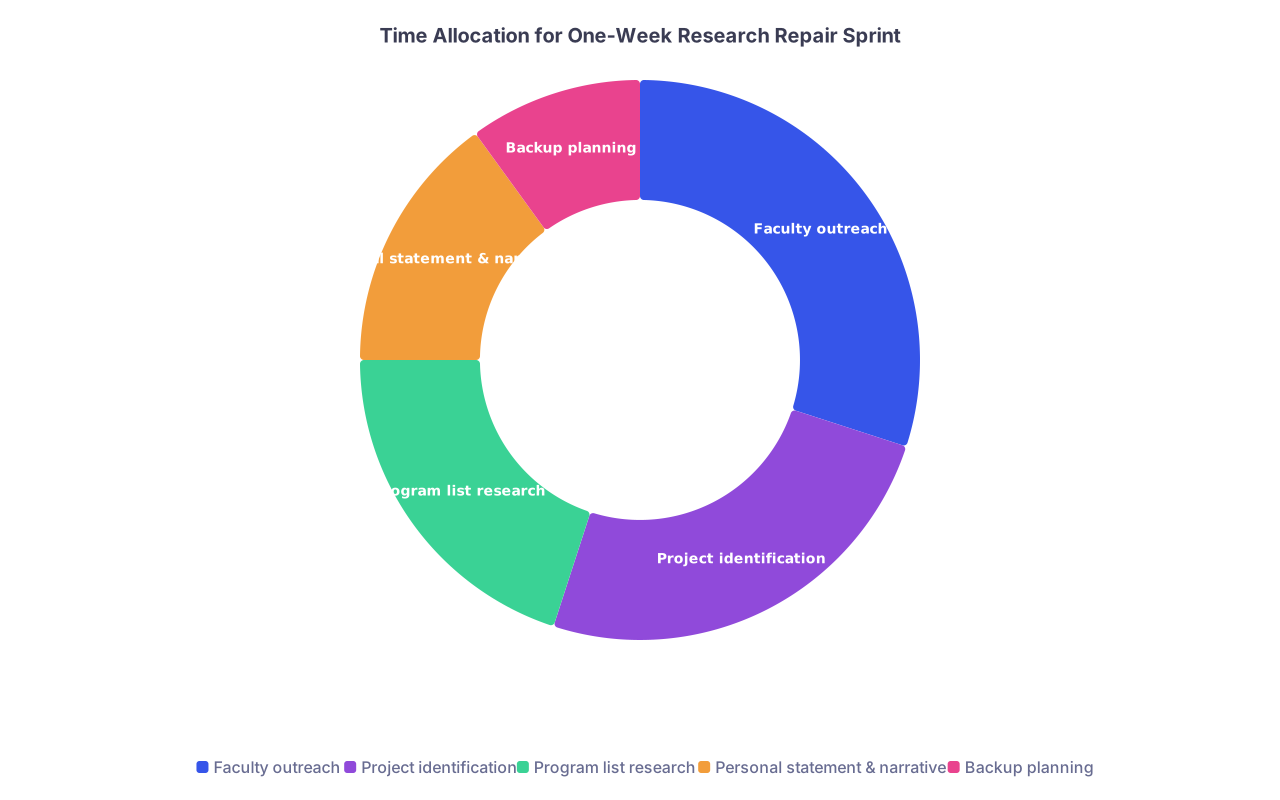
| Category | Value |
|---|---|
| Faculty outreach | 30 |
| Project identification | 25 |
| Program list research | 20 |
| Personal statement & narrative | 15 |
| Backup planning | 10 |
Day 1–2: Reality check and targeting
- Write down:
- Specialty you want
- Your board scores, class rank (approx), research items
- Classify yourself (Zero, Minimal, Moderate Non‑Target, Moderate Targeted).
- Generate a draft program list:
- 1/3 aspirational
- 1/3 realistic
- 1/3 safer (by metrics and research demands)
Day 3–4: Faculty and project outreach
- Identify 3–5 attendings in your desired specialty.
- For each:
- Skim 1–2 of their recent papers.
- Send a short, specific email:
- 3 sentences: who you are, what you read of theirs, exactly what you can help with.
- Ask your clerkship / program director for one honest, unfiltered conversation about:
- How people with your profile have matched in that specialty.
- Which programs would be realistic for you.
Day 5–6: Narrative and mitigation
- Draft 2 paragraphs you would use in a personal statement or interview answer explaining:
- Why your research is limited.
- How you made up for it with clinical work.
- What you plan to do in residency to grow academically.
- Ask one mentor to read it and tell you if it sounds like excuse‑making or like a mature plan.
Day 7: Decide your risk level
- Choose:
- Are you staying fully committed to your high‑risk specialty this cycle?
- Are you adding a more forgiving backup specialty?
- Are you going to pursue a research year first?
Make the decision, not just “see what happens.”
FAQ (Exactly 2 Questions)
Q1: Should I do a research year if I have almost no research and want a very competitive specialty?
If you are aiming for derm, plastics, neurosurgery, or similarly rarefied fields and currently have near‑zero research, a dedicated research year is often the difference between a long‑shot and a plausible candidate. But it is only worth it if you do it in that specialty, with productive mentors, and you treat it like a full‑time job. A weak, unfocused research year with 0–1 outputs is worse than not doing it at all. Before committing, speak with at least two attendings in that specialty who actually sit on selection committees and ask whether past applicants like you benefited from a research year at your institution.
Q2: Can strong clinical performance and high Step scores realistically compensate for low research in competitive specialties?
Yes, but with boundaries. High Step 2, honors in core rotations, and glowing letters can absolutely compensate for limited research at many programs, especially community and mid‑tier academic ones. However, at the very top‑tier academic programs in ultra‑competitive fields, research is often a threshold requirement, not a nice‑to‑have. The practical move is to let your strong metrics and clinical performance carry you at a wider range of realistic programs, while trimming programs whose residents’ CVs are saturated with early, high‑impact research.
Open your current CV right now and highlight every research item tied to your target specialty. If that section makes you wince, your next move today is simple: send one specific, concrete email to a faculty member in that specialty asking to help push an existing project across the finish line.