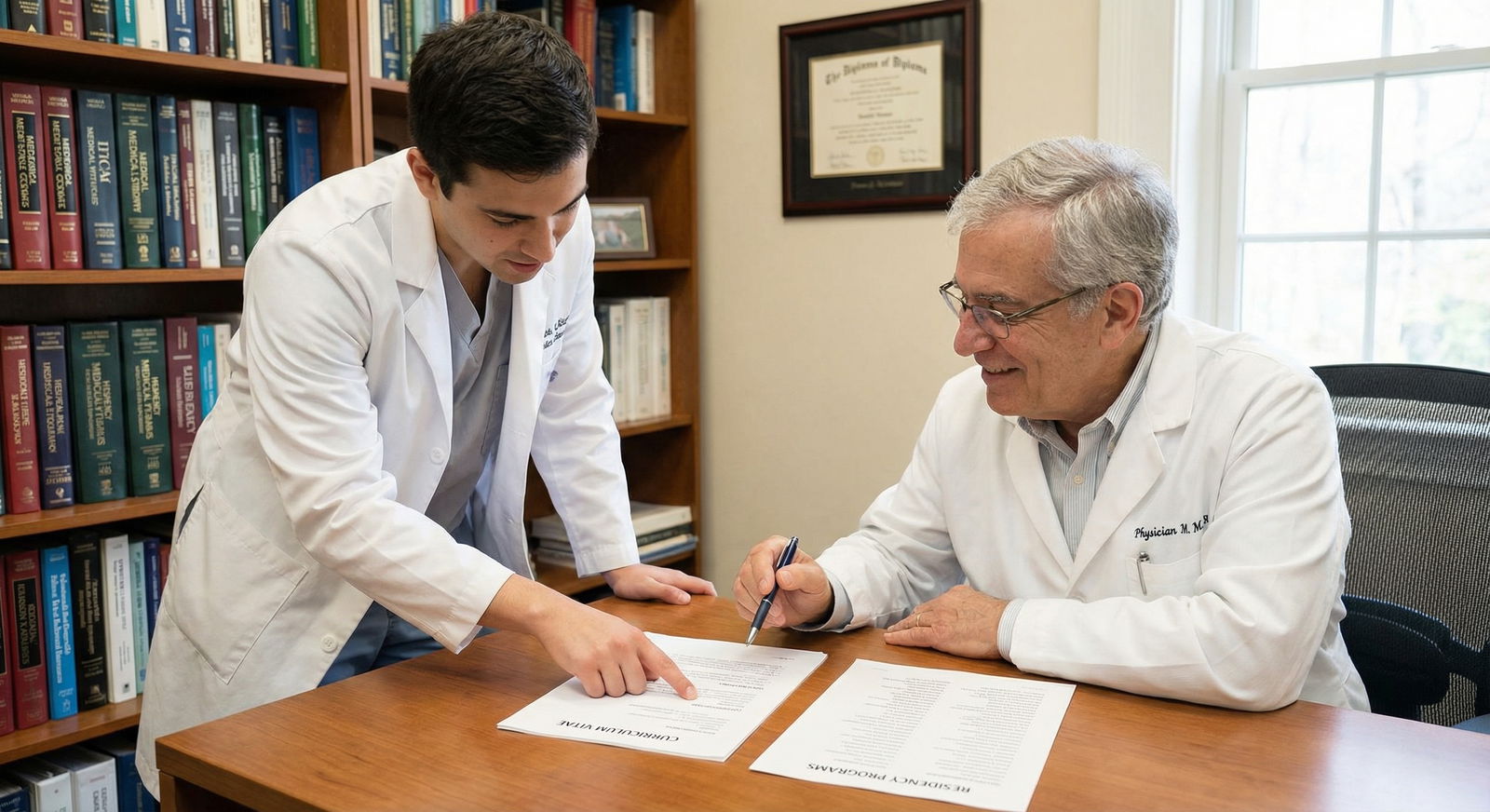
The riskiest way to switch from a competitive to a less competitive specialty is to assume it will be easy.
You are not “safe” just because the new field is less competitive on paper. Applicants get burned every year because they switch late, do it sloppily, or underestimate how much they must rebrand themselves. I have seen people go from near-certain match in their original specialty to completely unmatched because they treated the switch as a backup rather than a full, serious pivot.
This article is about doing the switch safely—with a real contingency plan, clear timelines, and concrete steps that protect you from ending up without a spot.
1. First Reality Check: Are You Actually Switching, or Just Panicking?
Before you draft a single new personal statement, you need clarity on why you are switching. Because program directors can smell panic and indecision from a mile away.
Ask yourself these questions and answer them in writing, not in your head:
What exactly is pushing me away from my current (competitive) specialty?
- Failed Step/COMLEX score requirement?
- Poor away rotation performance?
- Realizing lifestyle or culture is wrong for you?
- Weak application (research, letters, ranking) relative to that field?
What is pulling me toward the “less competitive” specialty?
- Specific patient population?
- Work-life pattern?
- Long-term career vision?
- Or just “I think my chances are better”?
If I remove match chances from the equation, which specialty would I pick?
If the only strong reason for the new specialty is, “It is easier to match,” programs will pick up on that. You need a genuine narrative that:
- Explains the switch logically.
- Shows maturity and insight.
- Does not sound like you are fleeing a burning building.
If your answers show that you still strongly prefer the original specialty but are anxious about matching, you may be in a “dual apply” situation rather than a full switch. That is a different, more complex strategy (I will cover how to do it safely later).
2. Understand the Risk Profile: Switching Is Not Automatically Safer
A less competitive specialty can still reject you if your application screams “backup.”
Here is the mental model you should use:
Competitive specialty (e.g., Derm, Ortho, Plastics, ENT, Rad Onc):
High bar, small number of spots, lots of signaling built around research and away rotations.Less competitive specialty (e.g., IM, FM, Psych, Peds, Path, PM&R in many regions):
Lower average board scores, more spots, but still selective about fit and sincerity.
You cannot just drop your derm CV into family medicine and expect a smooth landing. You need to systematically rebuild your story, your letters, and your signal to programs.
| Strategy | Main Risk |
|---|---|
| Stay in original competitive | Not matching anywhere |
| Full switch to less competitive | Look insincere, still not match |
| Dual apply | Match into field you like less |
| Reapply after interim year | Delay career, visa/financial issues |
Your job is to pick the least bad risk profile for your exact situation—then execute ruthlessly well.
3. Timing: When in the Application Cycle Is It “Safe Enough” to Switch?
The calendar matters more than most people realize. Late switches kill applications.
Think in four phases (for a typical ERAS cycle):
Early planning (Jan–June before apps open)
Safest time to pivot. You can:- Schedule a home rotation in the new specialty.
- Secure at least 2 letters from that field.
- Start research or a small project.
- Rewrite your CV and personal statement properly.
Pre-submission (July–early September)
Moderate risk. You can still:- Do a short rotation / observership.
- Get at least one letter.
- Adjust your personal statement and experiences.
Post-submission, pre-interview (late Sept–Nov)
High-risk window. You may:- Email programs with an updated PS or letter.
- Add a supplemental letter. But your core application is mostly locked in.
Post-interview, pre-ROL (Jan–Feb)
You are not “switching specialties” here. At best you are re-ranking or thinking about SOAP/next cycle.
If you are before submission, a full, clean switch is very doable if you move quickly. After submission, you are usually looking at:
- Dual applying,
- Targeted outreach,
- Or planning a structured reapplication next year.
4. Step-by-Step: How to Safely Execute a Full Switch
Let us say you are switching from a competitive field (like Ortho, Derm, ENT, Neurosurgery, Plastic Surgery, or competitive Radiology) to a less competitive one (IM, FM, Psych, Peds, Pathology, PM&R in many regions, etc.).
Here is the safest protocol.
Step 1: Get a Real Advisor (Not Just Your Friends)
You need someone who:
- Knows your actual file (scores, MSPE language, red flags).
- Understands both specialties involved.
- Is willing to be brutally honest.
That might be:
- Home program director.
- Dean or career counselor who actually reads your ERAS.
- A trusted attending in the new field who has seen many application cycles.
You walk in with:
- Your CV.
- Score reports.
- Draft personal statement if you have one.
- A short, honest summary of why you are considering switching.
Ask them specific questions:
- “If I apply to Specialty X only, how likely am I to match, realistically?”
- “Would you take me in your own program based on this file?”
- “What are the 2–3 biggest weaknesses I must correct for this specialty?”
If they waffle, push for a concrete answer. Vague optimism is useless.
Step 2: Build a Coherent Narrative That Does Not Trash Your Original Field
You need a story that:
- Shows exploration and growth.
- Does not insult your old specialty.
- Explains why the new specialty is a better long-term fit.
Bad version:
“I wanted ortho first but it is too competitive and I like lifestyle, so I chose family medicine.”
Good version (high-level structure):
- Early exposure to your original specialty → skills you gained.
- Specific experiences (clinic, patient population, longitudinal care, psych aspects, etc.) that shifted your interest.
- Deliberate exploration of the new field (rotation, project, mentorship).
- Clear, positive reasons why the new specialty fits your strengths, values, and long-term plans.
You are not running away from derm/ortho/etc. You are moving toward IM/FM/Psych/etc. That distinction matters.
Step 3: Secure At Least 2 Strong Letters in the New Specialty
One of the fastest ways to tank a switch is to apply to, say, Internal Medicine with:
- 2 Ortho letters,
- 1 Surgery letter,
- 0 Medicine letters.
Programs read that as, “Still an ortho applicant who panicked.”
Minimum safe target:
- 2 letters from the new specialty.
- 1–2 acceptable letters from your old field or core clerkships (if they speak to transferable skills and professionalism).
How to do this quickly if you are late:
- Ask for a 2–4 week elective, sub-I, or acting internship in the new specialty.
- Go in with one job: be the most prepared, reliable, teachable person on that team.
- On week 2, identify which attending seems impressed by your work and explicitly ask:
- “I am applying to [new specialty] this cycle and making a true switch. Would you feel comfortable writing me a strong letter for residency?”
If they hesitate, thank them and ask someone else. You cannot afford lukewarm letters.
Step 4: Rebuild Your Application Content for the New Field
This is where most people cut corners and get burned. You need to scrub your application for contradictions.
You must update:
Personal Statement
- Only about the new specialty.
- Do not leave a generic “I love surgery” statement and hope they guess.
- Briefly but clearly acknowledge your path if relevant:
- “I initially pursued X because…, but through [specific experiences] I realized Y better matched…”
- Keep the explanation focused and forward-looking, not apologetic.
Experiences in ERAS
- Reframe activities to highlight skills valued in the new field:
- For IM: continuity, complex medical management, teamwork.
- For FM: broad-based care, community work, longitudinal relationships.
- For Psych: communication, interviewing, behavioral health involvement.
- Do not hide your past research or electives. Reframe them.
- Ortho research? Emphasize data analysis, evidence-based practice, QI.
- Reframe activities to highlight skills valued in the new field:
Program Signaling (if applicable)
- If the specialty uses signals (like some pilot programs do), use them seriously.
- Do not half-signal the new field while saving your heart for the old one.
CV / Interview Talking Points
- Prepare a clean, rehearsed 60–90 second answer to:
- “So I see you had strong involvement in [old specialty]. Tell me about your path to [new specialty].”
- Prepare a clean, rehearsed 60–90 second answer to:
If that answer sounds defensive, scattered, or embarrassed, fix it now—not during the first interview.
Step 5: Choose Program Targets Strategically
Just because a field is “less competitive” does not mean every program in it is easy.
Your risk is lower if you:
- Apply broadly (50–80+ for IM/FM if you have red flags or are an IMG, fewer if you are strong US MD).
- Include:
- A mix of academic and community programs.
- Multiple geographic regions, not just one hyper-competitive city.
- Programs with a track record of taking non-traditional applicants or career-changers (ask current residents, check program websites, look at resident bios).
Signs a program might be receptive to switchers:
- Resident bios that show prior careers, PhDs in other fields, or late switches.
- Program leadership who emphasize “holistic review,” not just metrics.
- Mid-tier academic or larger community programs with decent fill rates but not hyper-elite reputations.
Do:
- Be realistic about “reach” vs “safety” even within a less competitive field.
Do not:
- Apply only to the very top 10 prestige programs because “the field is easier.”
5. Dual Applying: When to Do It and How Not to Blow Up Both Sides
Sometimes the safest move is not a full jump, but a controlled dual apply:
- Example: Ortho + PM&R; ENT + IM; Derm + IM; Neurosurg + Neurology.
You do this if:
- You still strongly prefer your original field.
- But your advisor realistically thinks your match chance is borderline.
- And you are not willing to risk a complete unmatched outcome.
The danger: You look non-committal to both specialties.
Here is how to reduce that risk.
Rule 1: Two Completely Separate Application Packages
You need:
- Separate personal statements.
- Different experiences emphasized in each (to the extent ERAS allows).
- Different letter combinations:
- For competitive specialty: majority letters from that field.
- For less competitive specialty: majority letters from that field.
Yes, this is extra work. The alternative is not matching.
Rule 2: Clear Internal Ranking
You must decide your real priority before rank list time:
- If you get just one offer in each field, which do you rank higher?
- Are you ok spending your career in the backup field if that is where you match?
Do not flip this decision at the last minute based on ego.
Rule 3: Keep Your Stories Straight
On interview days:
- If you are at an IM program, you are 100% an IM applicant.
- You do not mention your “secret” Derm or Ortho applications unless directly asked.
- If asked, answer honestly:
- “I explored X as well, but over this past year I became increasingly drawn to Y because…”
Never lie. But do not volunteer complexity that is not relevant.
6. Special Situations: SOAP, Reapplying, and Interim Years
Sometimes the switch is forced:
- You did not match your original specialty.
- You are sitting in SOAP trying not to panic.
Here is the safe way through.
A. Switching During SOAP
SOAP is brutal and fast. Safest protocol:
Stabilize your expectations.
The goal in SOAP is “secure a spot,” not “optimize dream specialty.”Identify open spots in less competitive specialties you could live with long-term:
- IM, FM, Psych, Peds, Path, PM&R often have SOAP spots.
- Some prelim medicine or surgery spots can be stepping stones.
Rapidly update:
- A shorter, SOAP-focused personal statement for the new field.
- A quick email to PDs explaining your path: short, calm, and forward-looking.
Commit internally that if you SOAP into the new specialty, you will show up as a fully engaged resident, not a resentful “failed surgeon.”
If you do not get a SOAP spot, you are in reapplication territory.
B. Reapplying After a Gap or Interim Year
You might:
- Do a research year.
- Work as a prelim or transitional year resident.
- Take a non-clinical year (family, health, visa issues).
If you use that time to switch to a less competitive specialty, you must show:
- Continuous growth.
- Clear alignment with the new field.
- Strong, recent letters from clinical settings.
Concrete steps:
- If you are in a prelim year:
- Seek rotations and mentoring in the new specialty whenever possible.
- Get new letters from that specialty this year.
- If you are in a research or non-clinical year:
- Arrange part-time clinic exposure or observerships in the new specialty.
- Document this clearly in ERAS as formal experiences.
Programs hate unexplained gaps and unclear plans. Spell it out.
7. Red Flags and How to Handle Them When Switching
Less competitive does not mean “they ignore your problems.” They do not.
Common red flags:
- Multiple exam failures.
- Leaves of absence.
- Unprofessional comments in MSPE.
- Poor clerkship performance, especially in core rotations.
When switching specialties, you must:
- Address red flags succinctly and maturely in your application or interviews.
- Show evidence that the underlying issue is solved:
- Improved later exam scores.
- Strong performance in sub-I.
- Documentation of health treatment and stability if relevant.
What you cannot do:
- Assume that changing fields magically erases your record.
- Pretend the red flag did not happen. PDs read everything.
8. Communication Scripts You Can Actually Use
You will have to explain your switch multiple times—to mentors, PDs, and in interviews. Use clean, repeatable scripts.
Email to potential mentor in the new specialty
“Dr. [Name],
I am a [MS4/PGY1/etc.] who initially pursued [original specialty] but over the past year I have developed a strong interest in [new specialty] through [brief specifics—rotation, clinic, patient type]. After discussing my goals with my advisors, I have decided to apply to [new specialty] this cycle.
I was very impressed by your work with [clinic/research/program] and would appreciate the opportunity to meet briefly to discuss this transition and how I can strengthen my application for [new specialty]. I am particularly interested in [specific aspect of the field].
Would you be available for a short meeting in the next couple of weeks?
Best regards,
[Name]”
Interview answer: “Why the switch?”
“I started medical school very focused on [old specialty], and I committed to it fully—I did research, sought mentorship, and spent significant time in the OR/clinic. What surprised me, though, was that my favorite parts of those experiences were [specific elements that naturally fit the new specialty: clinic discussions, chronic disease management, behavioral aspects, longitudinal relationships].
During my [rotation/elective] in [new specialty], I realized those were not side interests—they were the main things that energized me. I enjoyed [give 1–2 concrete patient interactions] and found that the pace, the problem-solving, and the long-term follow-up in [new specialty] matched my strengths much better.
Over the last [time frame], I have focused intentionally on [new specialty]: I completed a sub-I, worked with [mentor], and joined a [project/clinic] in this field. Those experiences confirmed for me that [new specialty] is where I see myself for the long term, and that is why I am applying to it exclusively this cycle.”
Clean. Honest. Forward-looking.
9. Quick Self-Audit Checklist: Are You Switching Safely?
Use this before you hit “submit”:
- Do I have at least 2 strong letters from the new specialty?
- Does my personal statement clearly commit to the new specialty, with a coherent story?
- Have I scrubbed my ERAS for contradictions and reframed my old experiences appropriately?
- Have I applied to a broad and realistic range of programs in the new field?
- Can I explain my path in 60–90 seconds without sounding defensive or confused?
- Have I accepted, internally, that I might never go back to the original specialty—and am I okay building a career here?
If you cannot say “yes” to most of those, you are not switching safely.
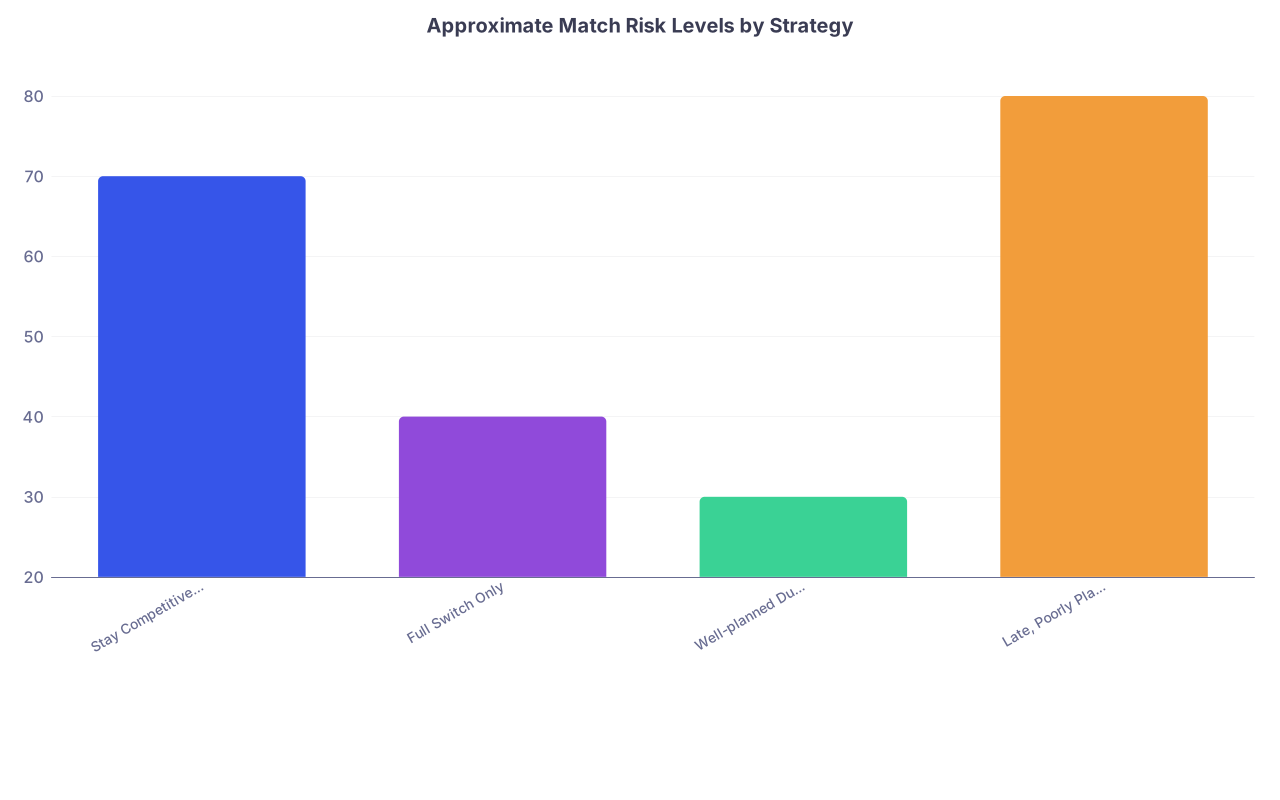
| Category | Value |
|---|---|
| Stay Competitive Only | 70 |
| Full Switch Only | 40 |
| Well-planned Dual Apply | 30 |
| Late, Poorly Planned Switch | 80 |
(Lower numbers = lower relative risk of going unmatched; rough conceptual comparison, not exact data.)

| Step | Description |
|---|---|
| Step 1 | Consider Switching |
| Step 2 | Advisor Review |
| Step 3 | Optimize Competitive Application |
| Step 4 | New Specialty Rotations |
| Step 5 | Build Two Application Tracks |
| Step 6 | New Letters and PS |
| Step 7 | Apply Broadly |
| Step 8 | Interviews |
| Step 9 | Rank List with Clear Priorities |
| Step 10 | Stay or Switch? |
FAQ (Exactly 2 Questions)
1. Is it dishonest to leave my old specialty off my personal statement for the new field?
No. You are not obligated to list every prior interest in your personal statement. However, if your old specialty is a major visible part of your CV (multiple publications, away rotations, leadership roles), it is usually better to briefly and honestly acknowledge that journey and explain your evolution rather than pretend it never existed. Omission becomes a problem when it makes your application look inconsistent or evasive, not because you “failed to confess” to earlier interests.
2. If I switch to a less competitive specialty now, can I later switch back to my original competitive specialty after residency?
Theoretically, yes. Practically, it is rare and difficult. Once you train and board in one specialty, switching back into a competitive field usually requires starting over as a new resident in that field, finding a rare open PGY spot, and convincing a PD to invest in retraining you. Some people do transitional pathways (e.g., IM → Cardiology vs. Derm → IM), but “FM attending → Derm PGY2” is extremely uncommon. If you are switching, assume this is your long-term career and choose a field you can live with, not just tolerate.
Open your personal statement draft and your letter list right now. Ask yourself: “If a PD in the new specialty read only these, would they believe I am genuinely one of them?” If the answer is anything short of a clear yes, you have work to do—start with securing those two strong letters in your new field.