
The worst thing you can do after failing a competitive match is pretend nothing happened and reapply with the same story. That is how people fail twice.
You are not starting over. You are rebranding. Different game.
I am going to walk you through exactly how to do that.
Step 1: Stop Telling Yourself the Wrong Story
You did not “just get unlucky.” Programs do not collectively “miss out” on a clearly strong, perfectly packaged candidate. Something in your application, your trajectory, or your strategy did not land.
You must figure out what, or you will repeat it.
Here is the structure I use with residents and unmatched grads who are regrouping:
| Domain | What Went Wrong? |
|---|---|
| Scores / Exams | Step/COMLEX performance |
| Clinical Performance | MS3/MS4 evals, sub-I's |
| Specialty Fit | Story, letters, experiences |
| Application Strategy | Program list, timing, regions |
| Professionalism | Red flags, communication |
Go through each domain brutally honestly:
Scores and exams
- Were you at or below the average for your target specialty?
- Did you have any fails, repeats, or late Step 2?
- Did programs ever ask about your scores in interviews in a slightly tense way? That was not random.
Clinical performance
- Any “good but not outstanding” evaluations on core rotations in that specialty?
- Any comments like “needs more independence,” “quiet on rounds,” “slow to formulate plans”?
- Were your sub-I’s in that specialty actually strong, or just “fine”?
Specialty fit
- Did your personal statement and activities scream sustained commitment, or “I decided late and tried to stack things this year”?
- Were your letters from well-known people who know you well, or just whoever would write something?
- Did your interests, research, and volunteer work actually point to that specialty, or were you stretching?
Application strategy
- How many programs did you apply to compared with what is actually recommended for that specialty given your stats?
- Did you apply broadly geographically, or just in a couple of desirable cities?
- Did you send post-interview thank-yous or interest signals strategically, or not at all?
Professionalism / red flags
- Any leaves of absence, conduct issues, big unexplained CV gaps?
- Did you cancel or no-show any interviews last minute?
- Did any interviewer seem oddly cold after a specific answer? That is often a “you stepped on a landmine” sign.
Write this out. Not in your head. On paper or on a screen. Label each issue:
- Unchangeable: old grades, exam attempts, leaves of absence
- Partially fixable: recent Step 2 performance, new letters, new experiences
- Completely fixable: personal statement, program list, interview skills, how you frame your story
Your rebranding will lean hard on the partially and completely fixable list.
Step 2: Decide Your Realistic Goal: Rematch vs Pivot
You cannot rebrand effectively if you do not know what brand you are building.
There are three main paths after a failed competitive match (think derm, plastics, ortho, ENT, ophtho, neurosurgery, etc.):
- Try again in the same specialty, stronger and sharper
- Pivot into a less competitive but still aligned specialty
- Build a two-step path: match now in something realistic, then subspecialize in a related field later
Here is the ruthless comparison I usually force with applicants:
| Path | When It Makes Sense |
|---|---|
| Reapply Same Speciality | Near-competitive stats, strong clinical feedback |
| Pivot to Related Specialty | Interest is broad, stats weaker for original field |
| Two-Step (Match then Subspec) | Need stability now, long-term niche still achievable |
Questions to answer:
- Are your objective metrics (Step/COMLEX, class rank, publications) even in the ballpark for another attempt at that specialty?
- Did programs actually interview you this year, or were you mostly ignored?
- Lots of interviews but no match → usually a branding / interview / rank-list problem.
- Almost no interviews → usually a metrics / CV / program-selection problem.
- Would you honestly be content in a closely related field? Example:
- Failed ortho → PM&R with a sports/MSK focus
- Failed derm → internal medicine then allergy/immunology or rheumatology
- Failed ENT → general surgery → then surgical oncology or plastics-adjacent work
- Failed radiology → internal medicine → cardiology with imaging focus
Do not romanticize your first choice. You are not your specialty. You are trying to build a career where you can live decently, practice competently, and ideally enjoy most days.
Make a decision now:
- “I am reapplying to the same specialty.”
- “I am pivoting and fully committing to a new specialty identity.”
- “I am applying to specialty X this year with the long-term intent of subspecialty Y.”
Everything else you do should line up cleanly behind that decision.
Step 3: Choose Your New Core Narrative
Your old story was something like: “I am deeply passionate about [ultra-competitive specialty] because of [some mix of research, personal story, role models].”
Now, that story is incomplete. It ends with: “I applied and did not match.”
You must upgrade the story to:
“I pursued [X]. I learned a lot, hit a wall, and then deliberately recalibrated based on what I value, what I am good at, and where I can contribute most.”
Programs are not stupid. They know what happened. The rebrand is not about hiding the failure. It is about owning it and integrating it.
Your new narrative needs three pieces:
- Past – What you pursued and why (brief, not a defense speech)
- Inflection point – What happened and what you learned from it
- Present & future – How that experience clarified why this new path is right
Example for someone pivoting from derm to internal medicine with a rheum interest:
- Past: “During medical school I leaned heavily toward dermatology because I was drawn to chronic immune-mediated diseases, visual diagnosis, and longitudinal care.”
- Inflection point: “After not matching and taking a step back, I realized what I enjoyed most was not derm-specific procedures, but managing systemic disease and coordinating complex care.”
- Present/future: “That led me to internal medicine, where I can deepen my understanding of multi-organ disease and eventually pursue rheumatology, continuing to care for patients with autoimmune and inflammatory conditions.”
The key: the new specialty is not a consolation prize. It is the logical, more mature endpoint of a process that involved real reflection.
Write this out as a 3–5 sentence paragraph. This is the spine of:
- Your personal statement
- How you answer “So tell me about your path to [specialty].”
- How your letter writers will frame your story
Step 4: Fix the Visible Weaknesses, One by One
Rebranding without improving the underlying product is just cosmetic. Programs notice.
A. Academic and exam issues
If your exam performance or transcript hurt you the first time, you need clear, recent counter-evidence.
Concrete steps:
- Crush Step 2/Level 2 (if still pending)
- Aim to outperform your earlier scores.
- Use a structured schedule with question blocks daily and weekly NBME/COMSAE style self-assessments.
- If all exams are done and you have a weak spot:
- Take and ace an in-service exam or standardized departmental exam during a research year or prelim year.
- Get your PD or research mentor to comment explicitly: “Their exam performance has been excellent this year, consistently above the resident mean.”
You cannot erase a low Step 1. You can show that it was not the whole story.
B. Clinical performance and letters
You need fresh, strong clinical data that match your new brand.
- Arrange sub-I / audition rotations in the new field (or in the same competitive field if reapplying) where you can:
- Take primary responsibility for patients
- Present daily
- Show improvement in pace, decision-making, and communication
- Tell your attending up front (in a mature way):
- “I did not match in [X] this year and I am fully committed to [new specialty]. I am working to show that I function at an intern level. I would really value direct feedback along the way.”
You want letters that say things like:
- “Functions at the level of a PGY-1.”
- “One of the best [MS4/prelim] I have worked with in recent years.”
- “Demonstrated resilience, insight, and growth after an unmatched cycle.”
That kind of language is gold in a rebranding year.
C. Research and scholarly work (especially for competitive specialties)
If you are still gunning for a competitive field (or a fellowship-heavy path), your research profile matters.
- Get a full-time research position or a heavy part-time role with:
- A known name in the field, or
- A productive lab/group that reliably publishes and presents
- Aim within 12 months for:
- Multiple abstracts/posters
- At least one manuscript submission (authorship of any level helps)
- Presentations at regional/national meetings
You are trying to change the perception from “applicant with light CV and unrealistically competitive choice” to “serious, academically engaged candidate with momentum.”
Step 5: Rewrite Every Visible Piece of Your Application
You are not just editing. You are rebuilding your public narrative.
Personal statement
What it must not do:
- Complain about the match
- Blame others, the system, or “competitiveness”
- Sound like you are grieving the old specialty on the page
What it must do:
- Briefly acknowledge your path without awkwardness
- Show reflection, maturity, and focus
- Make the reader think: “Fine, they had a detour. They are clearly in the right place now.”
Skeleton:
- Opening: A clinical scene that reflects your current specialty’s values, not your old one.
- Background: One short paragraph explaining your initial interest in medicine and how you initially leaned (e.g., procedure-heavy, highly visual field, etc.).
- Inflection: A paragraph about what you learned from not matching and how it clarified what you want in daily practice.
- Now: Concrete examples of recent work in the new field – rotations, prelim year, research, etc.
- Future: Clear, realistic goals within this specialty.
Experiences section
Your entries must now be filtered by your new brand:
- Emphasize experiences that align with the current specialty
- Reframe prior experiences:
- Old: “Derm clinic volunteer”
- New: “Longitudinal care for chronic inflammatory skin diseases within a multidisciplinary team”
- Bring anything recent (post-unmatched) to the top of the list. Programs care most about who you were this past year, not three years ago.
Letters of recommendation
You need:
- At least two strong letters in the specialty you are now applying to
- If you are reapplying to the same specialty:
- Replace any weak or generic letters
- Add at least one new letter that can speak to your growth since last cycle
- If you are pivoting:
- Ask one previous mentor (from the competitive field) to support your pivot explicitly:
- “Although they initially focused on [old field], I believe they are very well suited to [new field] given their strengths in [XYZ].”
- Ask one previous mentor (from the competitive field) to support your pivot explicitly:
Tell your letter writers your story clearly and give them your updated CV and personal statement. Do not leave them guessing.
Step 6: Change Your Match Strategy, Not Just Your Story
Rebranding without changing your tactics is pointless. Here is where most people blow it on the second try.
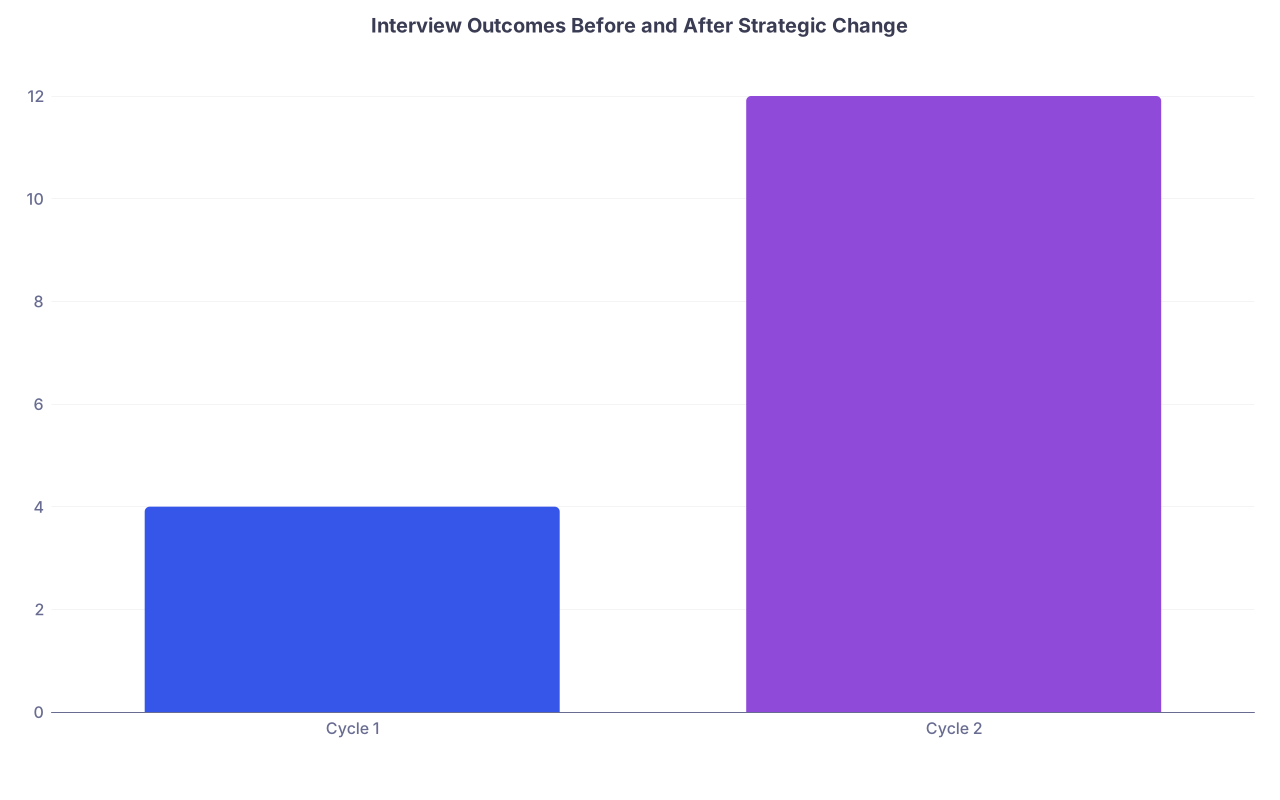
| Category | Value |
|---|---|
| Cycle 1 | 4 |
| Cycle 2 | 12 |
Program list
This time, you must be ruthlessly realistic:
- Use NRMP Charting Outcomes and specialty-specific advising data
- Compare your:
- Step/COMLEX percentiles
- Class rank
- Research output
- Prior interview count
Then:
- If reapplying to the same competitive specialty:
- Add more mid- and lower-tier academic and community programs
- Do not just chase the shiny names you like
- If pivoting:
- Construct a list that fits a “slightly below average but very motivated” candidate, not the median matched applicant
Geography: if you previously restricted yourself to coasts and big cities, expand aggressively. Stability beats zip code.
Dual applying (yes/no)
For a second attempt, dual applying is not cowardice. It is smart.
Examples:
- Reapplying to radiology + applying to internal medicine
- Reapplying to ortho + applying to categorical general surgery or prelim surgery
- Reapplying to EM + applying to internal medicine
If you dual apply, you need two coherent versions of your narrative, not a muddled “maybe this, maybe that” mess. That means:
- Two targeted personal statements
- Clear specialty-specific letters
- Honest, specialty-aligned interview answers
Timing and signals
If your specialty uses signals, preference signaling, or similar tools:
- Use them strategically, not aspirationally
- Target programs:
- Where your school has matched historically
- Where your mentors have connections
- Where your stats are competitive
Ask mentors explicitly: “If you were me, which 5 programs would you signal and why?”
Step 7: Control the Conversation in Interviews
This is where rebranding either solidifies or collapses.
You will get asked some version of:
- “So, what happened with last year’s match?”
- “I see you did a preliminary year / research year in [X]. Can you walk me through your path?”
You cannot look surprised. You need a rehearsed, calm, 60–90 second answer that:
- Owns the facts
- Accepts responsibility where appropriate
- Shows reflection and growth
- Ends firmly in the present and future
Template:
- Plain facts (10–15 seconds)
- “I initially applied to [specialty] and did not match last cycle.”
- Reasoning and reflection (25–40 seconds)
- “Looking back, I see that [my application was research-light / my scores were borderline / I decided late and my experiences did not clearly support that choice].”
- Growth (20–30 seconds)
- “Over the last year I have [completed a prelim year in X / undertaken full-time research / done focused rotations in Y] and received strong feedback about [clinical skills, teamwork, work ethic].”
- Present commitment (15–20 seconds)
- “Through that process, I realized that what fits me best is [current specialty], especially for its emphasis on [core features]. I am now fully committed to training in this field.”
Say it out loud. Many times. Get rid of the shame in your voice. Programs are not looking for perfection; they are looking for people who can take a hit and keep functioning.
Step 8: Fill the Gap Year (or Prelim Year) Intentionally
The year between failed match and reapplication is not a holding pattern. It is your evidence year.
Your options, roughly in order of impact:
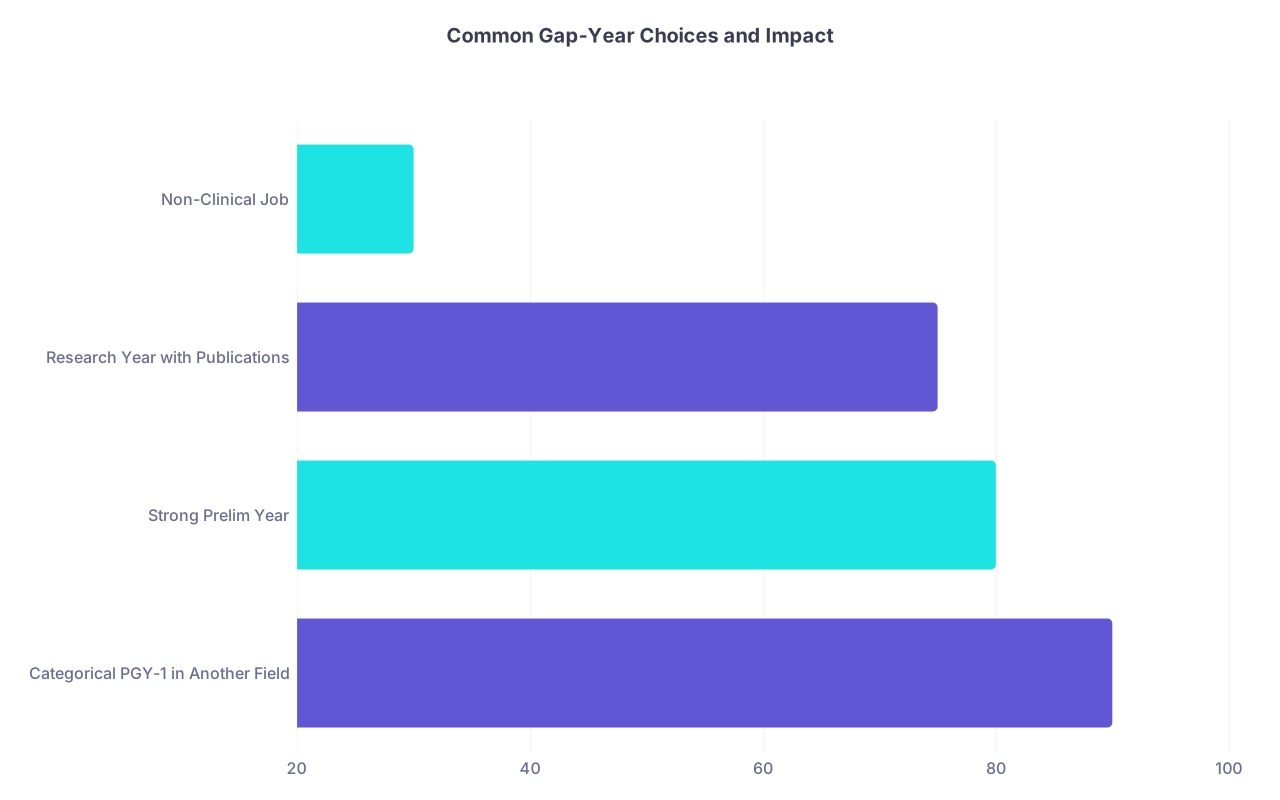
| Category | Value |
|---|---|
| Categorical PGY-1 in Another Field | 90 |
| Strong Prelim Year | 80 |
| Research Year with Publications | 75 |
| Non-Clinical Job | 30 |
Ideal: Categorical or prelim clinical year
If you secured:
- A prelim year (medicine or surgery) or
- A categorical PGY-1 in something else (often IM, transitional year, etc.)
Then your job is to become the standout intern:
- Show up early, stay late when needed
- Be the person others rely on when things are messy
- Ask your seniors and attendings for mid-rotation feedback and end-of-year letters
You want at least one letter that reads like:
- “We would gladly keep them in our program.”
- “They are in the top 10% of interns I have supervised.”
Huge difference from a generic “hardworking intern” letter.
Next-best: Research year with structured clinical exposure
If you are in a research year:
- Negotiate consistent clinical time: clinics, call shifts, inpatient weeks
- Ask to attend conferences, M&M, journal club
- Make yourself visible to the faculty who will be reading apps and interviewing
Your day should not be: data entry in a dark office. It should be: visible, engaged, and constantly building relationships and output.
Last-resort: Non-clinical jobs
If you are forced into a non-clinical role (family reasons, location limitations, visa issues):
- Keep some clinical involvement:
- Volunteer clinic
- Per-diem scribe with high-level involvement
- Telemedicine shadowing with charting exposure (where permitted)
You must be able to say: “I stayed clinically engaged and up to date” and have someone to vouch for that.
Step 9: Clean Up the Psychological Mess
Nobody talks about this, but it shows up in your interviews and letters if you ignore it.
People who just went through:
- Humiliation on Match Day
- Scramble/SOAP chaos
- Watching classmates post “So excited to be joining…”
often come into the next cycle:
- Bitter
- Defensive
- Desperate
Programs can smell that. It leaks into your tone, your body language, your answers.
You need to do actual repair work:
- Talk to someone outside your immediate circle: counselor, therapist, mentor not involved in your evaluation.
- Process the anger and grief now, not in front of an interviewer in October.
- Reframe the experience as: “Ugly but educational,” not “identity-destroying catastrophe.”
You do not need to be ecstatic. You do need to be emotionally stable enough that PDs trust you will not fall apart when residency gets hard. Because it will.
Step 10: Put It All Together – A Concrete Rebranding Checklist
Here is the end-to-end process laid out visually:

| Step | Description |
|---|---|
| Step 1 | Unmatched in Competitive Field |
| Step 2 | Honest Post Match Autopsy |
| Step 3 | Research and Clinical Year in Same Field |
| Step 4 | New Specialty Rotations and Mentors |
| Step 5 | New Letters and Improved CV |
| Step 6 | Rewrite Personal Statement and Experiences |
| Step 7 | Realistic Program List and Signals |
| Step 8 | Practice Explaining Your Path |
| Step 9 | Submit New Application |
| Step 10 | Interviews with Coherent Narrative |
| Step 11 | Stronger Match Outcome |
| Step 12 | Same Specialty or Pivot |
Use this as your literal roadmap. If something you are doing does not help one of those boxes, question whether you should keep doing it.
FAQ – Exactly 3 Questions
1. Should I tell programs explicitly that I failed to match previously, or let them figure it out from my CV?
Do not play games. They will see the dates and the prelim/research year. The right move is to acknowledge it briefly and confidently when asked or when it naturally fits: “I initially applied to [X] last year and did not match, which led me to reassess and commit to [current path].” Hiding it looks evasive. Owning it looks mature.
2. How many programs should I apply to after an unmatched cycle?
More than before, in almost every case. Especially if you are reapplying in the same competitive specialty. Use your first cycle’s interview count as data. If you applied to 60 and got 3 interviews, you are underpowered; think 80–100+ depending on specialty and your metrics. For a pivot into a less competitive field, most borderline candidates I have seen succeed applied at the higher end of the recommended range, not the median.
3. Will rebranding hurt me if I decide to try for a fellowship later?
No, as long as your story is coherent and your performance is strong. Fellowship PDs care about what you did in residency: evaluations, in-service scores, research in their area, letters from subspecialists. A rocky match history becomes background noise if you are a top-performing resident. I have seen unmatched derm applicants become stellar rheumatology fellows and unmatched ortho candidates become high-performing sports medicine or pain fellows. Performance and fit now will matter far more than the detour you took to get here.
Open your last ERAS application right now and highlight every sentence that still sounds like the person who failed to match. Those lines are your demolition list. Tomorrow, start rebuilding each one to match the physician you are actually becoming, not the one you were trying to impersonate.