
It’s late September. ERAS just opened. You’ve got one personal statement half-written for dermatology and another Google Doc titled “backup?” for radiology. Your mentor in one specialty says, “Go all in or you won’t match.” Your mentor in the other tells you, “You’d be crazy not to choose this field.” Meanwhile, your classmates are locking in their plans and you’re staring at two application folders wondering which life you’re about to commit to.
This is the “oh, crap” phase of fourth year: you’re not deciding between “family vs peds vs IM.” You’re choosing between two competitive fields. Think derm vs plastics. Or ortho vs neurosurgery. Or ENT vs ophtho. And you know you don’t fully control the outcome because the Match is ruthless.
You’re not just asking, “What do I like?” You’re asking:
- Can I actually match this?
- If I pick wrong, how screwed am I?
- Do I double apply, or is that death?
Let’s build a decision framework that actually matches the reality of the Match, not the fantasy version people like to recite.
Step 1: Get Real About Competitiveness and Risk
Before you ask “Which one do I love more?” you need to know whether both are actually on the table for you. Not in the abstract. For you, with your numbers, school, and CV.
1. Know where you realistically stand
This isn’t vibes. You need data:
- Your Step 2 CK score
- Your school’s name recognition (yes, it matters)
- Class rank / AOA / Gold Humanism
- How many strong specialty-specific letters you can get
- Research: number of pubs/abstracts in each field, and whether they’re meaningful
Then compare that against actual match data, but not just national averages. You want to know what successful applicants who look like you had when they matched.
| Factor | Specialty A (e.g., Derm) | Specialty B (e.g., Rad Onc) |
|---|---|---|
| Your Step 2 vs 75th %ile | Below / At / Above | Below / At / Above |
| # of strong letters | 1 / 2 / 3+ | 1 / 2 / 3+ |
| Specialty publications | 0–1 / 2–4 / 5+ | 0–1 / 2–4 / 5+ |
| Home / away rotations | 0 / 1 / 2+ | 0 / 1 / 2+ |
| Faculty who will call | None / Maybe / Yes | None / Maybe / Yes |
Be brutally honest filling that out. If for one field you’re “below / 1 letter / 0 pubs / no home program,” that’s not the same risk as a field where you’re “above / 3 letters / 4 pubs / home + away.”
2. Understand what “competitive” actually means
Some “competitive” specialties are competitive because:
- They’re ultra small (ENT, urology, neurosurgery).
- They want very specific profiles (plastics, derm).
- They have huge applicant:position ratios and tight networks.
Others feel competitive but have more flexibility or backup strategies.
To keep this concrete:
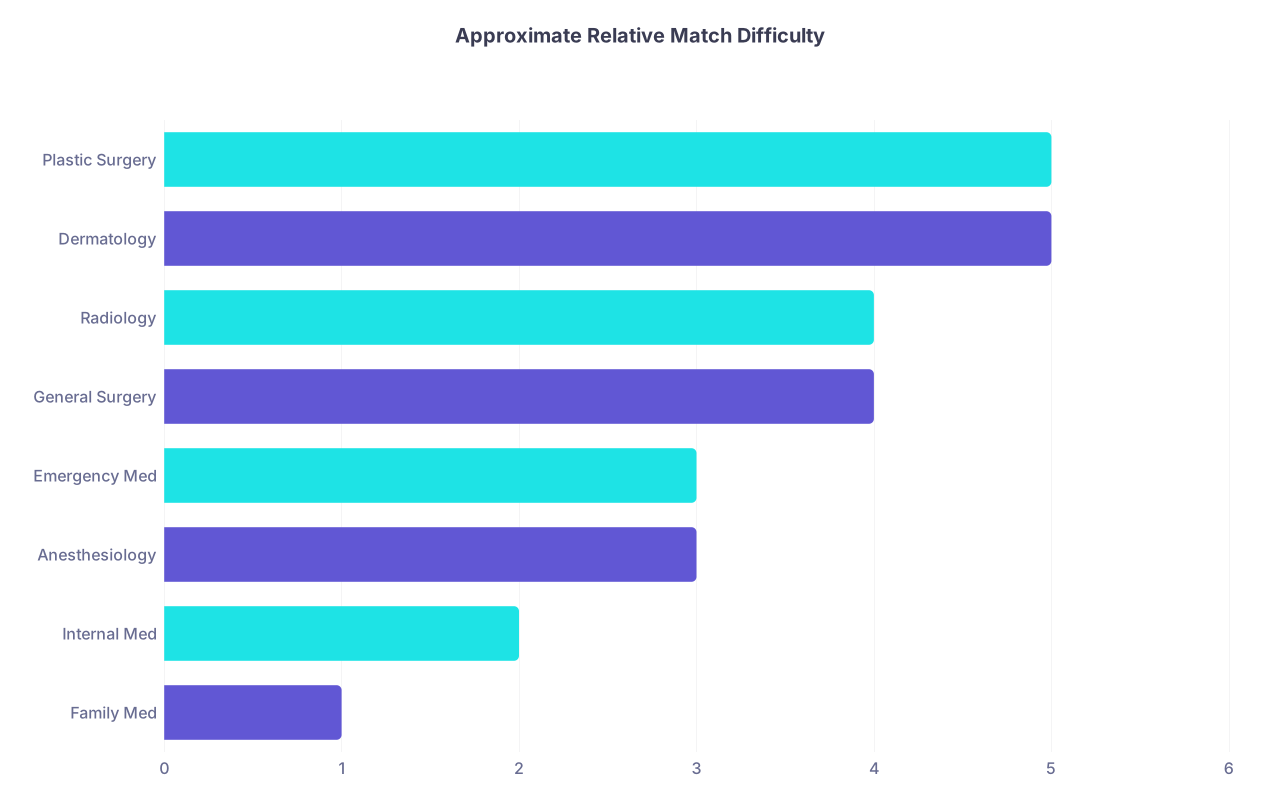
| Category | Value |
|---|---|
| Family Med | 1 |
| Internal Med | 2 |
| Anesthesiology | 3 |
| Emergency Med | 3 |
| General Surgery | 4 |
| Radiology | 4 |
| Dermatology | 5 |
| Plastic Surgery | 5 |
Scale: 1 = low, 5 = very high. Don’t obsess over the exact number; focus on which of your two is the clearly steeper climb.
If both of your chosen fields are in that “4–5” band, you have to treat this like a risk management problem, not just a passion project.
Step 2: Build a Clear Picture of Each Specialty’s Day-to-Day
You cannot make a good choice based on “I liked my AI” or “I liked the residents.” Everyone likes being treated well as a sub-I. That doesn’t tell you what post-call at 3 a.m. feels like or how your 40s will look.
You need to compare two very specific things:
- Daily work content
- Lifestyle realities (not the brochure version)
1. Daily work: what are you actually doing all day?
For each specialty, answer:
- How much time is spent:
- Talking to patients/families
- Doing procedures/OR time
- Staring at a screen (reading images, documentation, EMR)
- Interfacing with other services vs working solo
- How much cognitive “puzzle solving” vs protocol-driven work
- How much acute resuscitation vs slow, chronic management
If you can’t answer those for both fields, that’s your homework. Go back to rotations, shadow again if you have to, and write it down in brutal detail for a typical:
- Clinic day
- OR / procedure day
- Call shift
- Post-call day
I’ve watched people fall in love with derm clinic then realize they hate the repetition. Or love the drama of trauma surgery as a student, then burn out when 5 years of their life become night float and bowel anastomoses. You need more granularity than “I liked it.”
2. Lifestyle: ignore the myths, look at the pattern
Every specialty has its propaganda. Ignore it. Ask:
- During residency:
- Average hours/week?
- How often call is in-house vs home?
- Weekend frequency?
- After training:
- What do attendings at 5–10 years out actually work?
- How many nights/weekend calls?
- Is there a realistic part-time or shift-based option if you want it?
This is where seeing a true week-in-the-life helps. Not the unicorn private-practice derm who works 3 days a week with no call. The medium: academic or mid-size group.
Write down, side by side, what 35-year-old you looks like in each path:
- What time you wake up
- How often you miss dinners, holidays
- How many hours you chart at home
- What type of fatigue you feel (physical, cognitive, emotional)
If you actually force yourself to do that exercise, one of the two almost always starts to look more like your real life, and the other starts looking like a fantasy you like to visit, not live in.
Step 3: Map Out Risk Scenarios and Backup Paths
You’re not just choosing between A and B. You’re choosing between:
- Match A
- Match B
- No match with A
- No match with B
- No match with any
So you need to ask: “If this goes badly, what happens to me?”
1. Identify realistic backup specialties for each option
For each of your two competitive specialties, what’s the honest backup?
Examples:
- Derm → IM prelim → try again derm or pivot to heme/onc, rheum, allergy
- Ortho → gen surg prelim → try again, or go categorical general surgery
- ENT → gen surg prelim, or retool to anesthesia or radiology next cycle
- Plastics (integrated) → gen surg → independent plastics later, or stay gen surg
Then ask: which backup life are you OK with living if you never match your dream? Not “could tolerate for a year.” Actually OK if it becomes your career.
2. Compare backup attractiveness
Make yourself choose between:
- Being a solid, happy attending in Specialty A’s backup track
- Being a solid, happy attending in Specialty B’s backup track
If, deep down, one of those backup futures makes you want to quit medicine, you can’t treat those two paths as equal-risk choices. People screw this up by looking only at the dream spot, not the floor.
Step 4: Decide If You Should Single-Apply or Double-Apply
This is the part everyone gets anxious about, and most get wrong. Let’s be blunt.
Double-applying to two competitive specialties is often a bad idea unless you’re very strategic. It can tank your perceived commitment in both fields if you’re sloppy.
You have three main options:
- Single-apply to Specialty A only
- Single-apply to Specialty B only
- Double-apply with a primary and a “shadow” plan
1. When single-apply makes sense
You should heavily lean to single-apply when:
- Your application is clearly stronger for one specialty (letters, research, home department support).
- You have strong mentorship in that field and weak/no mentorship in the other.
- You are genuinely OK with that field’s backup scenarios (i.e., prelim + reapply or its adjacent specialties).
Also, if both specialties are ultra small (e.g., neurosurgery vs ENT), double-applying just broadcasts indecision to two tiny, gossipy communities.
2. When careful double-apply makes sense
Double-apply can be rational if:
- One is clearly more competitive (call it “reach field”) and the other is moderately competitive with decent numbers of spots.
- Your CV is flexible and believable for both (e.g., radiology + anesthesiology, or EM + anesthesia, or IM + neurology).
- You structure your story so that programs do not feel like your backup.
In practice, this usually looks like:
- You commit “heart and soul” to the more competitive field on paper (more letters, more research, more away rotations).
- You quietly also apply to a less brutal field where your story can still be coherent.
Do not double-apply to two ultra-competitive fields with small communities (e.g., derm + plastics, ENT + ophtho). They talk. They will figure it out when your letters and rotations do not match the story.
Step 5: Construct Your Personal Decision Matrix
Time to quantify what’s been swirling in your head.
List out the factors that actually matter to you. Things like:
- Competitiveness / chance of match
- Day-to-day enjoyment
- Procedures vs thinking vs patient interaction
- Schedule and call (during residency and as an attending)
- Backup options if no match
- Geographic flexibility
- Income and job market stability
Then force yourself to rate each specialty for each factor from your perspective, not generically.
| Factor | Weight (1–5) | Specialty A Score (1–5) | Specialty B Score (1–5) |
|---|---|---|---|
| Day-to-day enjoyment | 5 | 5 | 3 |
| Match probability for you | 4 | 2 | 4 |
| Lifestyle as attending | 3 | 4 | 3 |
| Backup options if no match | 5 | 2 | 4 |
| Income/job stability | 2 | 4 | 4 |
Multiply weight × score and total each column. Don’t obsess about the math being “perfect.” The point is you often see a pattern: one specialty wins big on your highest-weighted factors, or one has a catastrophic weakness in something you truly care about.
The key part here is the weights. If you secretly care more about backup options and sanity than you admit in public, that’ll show up.
Step 6: Fix the Personal Statement and Interview Problem
If you’re double-applying or if you’re still a bit torn even while single-applying, you have to manage optics.
1. You must commit in each specialty’s materials
Programs want to feel like they’re your first choice, even if they’re not. So:
- Two distinct personal statements. No shared generic “I just love the OR and innovation” nonsense.
- Specialty-specific experiences emphasized correctly:
- For the reach specialty: go heavy on that field’s research, mentors, specific cases that hooked you.
- For the secondary specialty: emphasize genuine experiences that relate, not just “I also like this.”
If you’re opaque or vague, faculty smell it. They’ve read thousands of these.
2. Prepare a clean verbal narrative
You will get some version of:
“Why this specialty?”
“Did you consider any others?”
“Why not X?”
Your answer needs to:
- Be honest without sounding flaky.
- Show that you actually explored alternatives and still landed here thoughtfully.
- Avoid bashing the other specialty.
A safe structure:
- “On rotations I was initially drawn to X because of [specific reason].”
- “I spent time exploring Y as well and realized [difference that tilted you].”
- “What ultimately decided it for me was [very concrete example that clearly belongs to their field].”
If you’re double-applying and worried they know: assume they do. Your safest play is a coherent story that doesn’t sound like random hedging.
Step 7: Talk to the Right People (and Ignore the Wrong Ones)
Random resident at a random away rotation telling you, “You’ll definitely match here” is noise. Your cousin who matched derm in 2012 is also noise.
You need three kinds of people:
- A program director or APD in each specialty (or at least one of them).
- A mentor who actually knows your full CV and personal situation.
- Someone 3–5 years ahead of you who chose each path and is honest about their regrets.
Bring them something concrete: your Step score, CV, research list, rotation grades, and an explicit question like:
- “If I single-apply to X with this application, what odds range would you give me?”
- “If I double-apply X and Y, how will it look from your side?”
You’re not asking them to choose your life. You’re using their experience to refine your risk estimates.
And then: stop shopping for opinions after 3–5 serious conversations. Endless polling just increases anxiety and usually leads you back to the same decision you started with.
Step 8: Run the “Future You” Test
Strip away prestige and fear for a moment. Imagine:
- You are 40 years old.
- You matched one of the two. You’ve been an attending for 5+ years.
- You are average in that specialty. Not a superstar, not a failure.
In Specialty A:
- What are you doing on a random Tuesday?
- What’s the part of the day that makes you glad you chose it?
- What’s the part you dread and will still be dreading a decade in?
In Specialty B, same questions.
Then the kicker:
If both were guaranteed matches, which one would you pick without hesitation? That’s your genuine preference. The real decision you’re making now is: how much risk are you willing to accept to chase that preference?
There’s no magic number. Some people are willing to go all-in, unmatched be damned. Others would rather sleep at night knowing they picked a slightly “safer” path that still fits them well.
Step 9: Decide, Commit, and Stop Tweaking
At some point you have to stop analyzing and live with a choice.
A practical timeline if you’re in the application phase now:
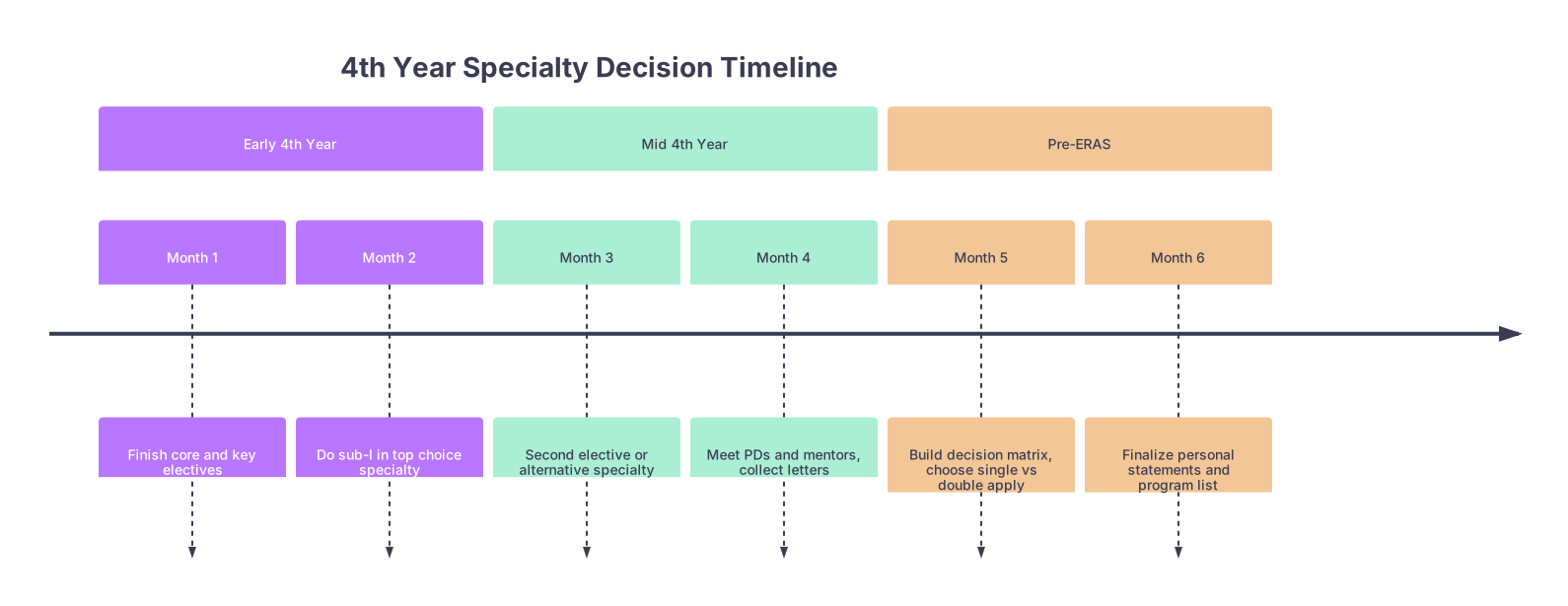
| Period | Event |
|---|---|
| Early 4th Year - Month 1 | Finish core and key electives |
| Early 4th Year - Month 2 | Do sub-I in top choice specialty |
| Mid 4th Year - Month 3 | Second elective or alternative specialty |
| Mid 4th Year - Month 4 | Meet PDs and mentors, collect letters |
| Pre-ERAS - Month 5 | Build decision matrix, choose single vs double apply |
| Pre-ERAS - Month 6 | Finalize personal statements and program list |
Once ERAS is in, your job is not to keep rethinking your specialty choice. Your job is to:
- Crush interviews.
- Signal commitment clearly and consistently.
- Build relationships with programs in at least one of those fields so that someone is willing to fight for you on rank day.
If you spend November refreshing Reddit and texting friends about whether you made the “right” decision, you will just add anxiety and hurt your performance where it actually matters.
A Final Reality Check
You’re not choosing between “happy life” and “miserable life” here. You’re choosing between two good but different lives, wrapped in uncertainty.
I’ve seen:
- People who went all-in on derm, didn’t match, did IM, and are now thrilled as oncologists.
- People who double-applied, matched their “backup,” and 5 years later are grateful the safer field chose them.
- People who took huge risks, matched their dream ultra-competitive specialty, and still have rough days wondering about the road not taken.
That’s normal. There is no choice that erases doubt forever.
What you can do is:
- Be honest about your risk tolerance.
- Understand the real day-to-day life on each path.
- Respect the Match as a probability game, not a meritocracy fantasy.
- Then commit like hell to whichever direction you choose.
Because once you’ve made that call and locked in your application strategy, your real work shifts: away from “Which specialty?” and toward “How do I become the kind of resident any program would be lucky to have?”
With that mindset, you’ll be ready not just to pick a lane, but to run hard in it—through interview season, rank lists, and whatever version of Match Day is waiting for you. The specialty question gets answered soon. After that, the challenge becomes learning how to actually thrive in the field you fought so hard to enter.