
The worst thing you can do after failing a Match cycle in a competitive field is… nothing.
You’re at a fork in the road. If you drift, the system will make the decision for you. Programs will quietly move on, gaps will grow, and your options will narrow. If you act deliberately, you still have leverage. More than you think.
This is the “Situation Handler” guide for exactly where you are: you shot for a competitive specialty, did not match, and now you’re staring at an unpleasant question—do I try again, pivot, or walk away?
Let’s walk through what to do, step by step, in the real world, not the fantasy-land advice you see on Reddit.
Step 1: Get the Full Autopsy on Your First Application
You cannot build a second attempt on vibes and hope.
You need a brutally honest autopsy of your last application. Not just “I guess I wasn’t competitive enough for ortho/derm/ENT/ophtho/anesthesiology/whatever.” You need numbers, comparisons, and feedback.
Here’s the minimum data you should collect:
| Metric Area | What You Need to Know |
|---|---|
| Exams | USMLE/COMLEX scores and how they compare to matched applicants in your specialty |
| Clinical | Clerkship grades, honors, AOA/GHHS, sub-I performance, comments |
| Specialty Exposure | Number/quality of rotations, away rotations, letters from the field |
| Research | Abstracts, posters, papers, especially specialty-related |
| Application Behavior | Number of programs, timing, signaling, red flags, interview count |
If you cannot answer things like:
- How many interviews did I get compared to typical unmatched and matched applicants in this field?
- Were my scores below, at, or above the median for this specialty?
- Did I have strong letters from known people in the field?
…you’re guessing. And guessing is how people waste 1–2 more years and still do not match.
Who to ask for real feedback
You’re too close to this. You need three outside opinions:
- A faculty advisor in the specialty you applied to
- A general advisor (Dean’s office, program director, or clinical mentor in another field)
- Someone who actually reads applications (former PD, APD, or selection committee member if you can get access)
Send them:
- ERAS application / CV
- Personal statement
- List of programs you applied to
- Your interview count (and which programs)
- Your rank list length
Then ask specific questions, not “what do you think”:
- “If you were on a selection committee in [specialty], would you have interviewed me? Why or why not?”
- “What are the 2–3 biggest weaknesses that would keep me from matching next cycle in this specialty?”
- “If I did [prelim year / research year / categorical in another specialty], would that substantially change my odds?”
Write their answers down. Patterns matter.
Step 2: Decide If a Second Attempt in That Field Is Rational
Notice I didn’t say “decide what you want to do.” I said “rational.”
You have three realistic paths:
- Reapply to the same competitive specialty
- Pivot to a less competitive but acceptable specialty
- Do a bridge year (research, prelim, or something else) while you decide—and then commit
What you cannot afford is limbo: “I’ll sort of keep options open in everything and see what happens.” That’s a plan to be mediocre to every specialty.
Look at the hard competitiveness numbers
Use NRMP data, but read it as an insider would:
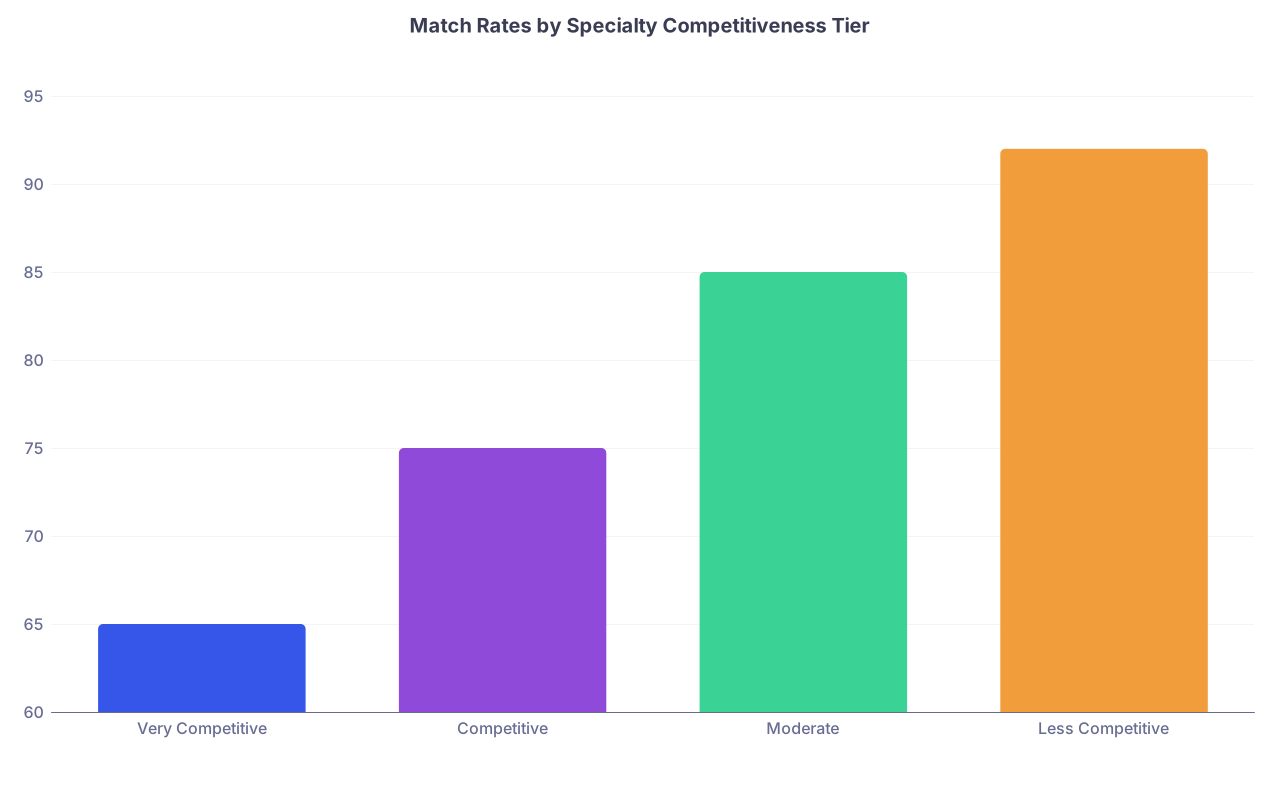
| Category | Value |
|---|---|
| Very Competitive | 65 |
| Competitive | 75 |
| Moderate | 85 |
| Less Competitive | 92 |
- “Very competitive”: derm, plastics, neurosurgery, ENT, ortho, ophthalmology
- “Competitive”: EM (varies by year), anesthesia, radiology, urology, some subspecialties
- “Moderate/Less competitive”: IM, peds, FM, psych, neuro, pathology, etc. (still not “easy”)
If you’re already below-average for your chosen field (scores, research, letters, school pedigree), then a second attempt without a major upgrade is just gambling with your life.
I’ll be blunt: if you—
- Had <5 interviews in a hyper-competitive specialty
- Do not have a clear plan to dramatically boost your profile (not marginally, dramatically)
- Are not at a top-tier school with powerful advocates in that field
—then a straight reapply to the same field with minimal changes is reckless.
Does that mean “give up your dream”? No. But it might mean “change the shape of the dream” (e.g., IM with a competitive fellowship, anesthesia instead of pain via PM&R, etc.).
Step 3: Pick a Concrete Strategy for the Next 12–18 Months
You’re now deciding where to put your year (or years) of life. You have a limited number of logical moves.
Option A: Research Year in the Same Specialty
This is best if:
- You were close but not quite there (decent interviews, maybe one or two top places)
- Your biggest gaps were research, networking, and visibility
- You can realistically match at some program if your application is stronger (not just “the top 10”)
What it should look like:
- Full-time, named research position (postdoc, research fellow, etc.) in that specialty
- At an institution with a residency program in your field
- With a mentor who has actually gotten unmatched students into that specialty before
Your goals in that research year are very specific:
- 2–4 tangible outputs: abstracts, posters, ideally at least 1–2 papers
- A glowing, detailed letter from your research PI
- Deep integration into the department: grand rounds, teaching, clinics if allowed, being “the known person”
- Explicit support when you reapply (“we’ll back you and make calls”)
If you do a research year that is poorly supervised, not in your field, at a random site with no residency? You’ve basically just added a gap year.
Option B: Prelim Year (Medicine or Surgery) + Reapply
This is viable if:
- Your desired specialty often likes prelim IM or surgery backgrounds (anesthesia, rads, EM in some cases, certain surgical subspecialties)
- Your biggest gap is clinical strength, letters, or being “unproven” as a working doctor
- You can handle a tough intern year while also reapplying
How to do it right:
- Choose prelim programs with a track record: they have previously had interns successfully re-match into your specialty
- Tell your program director your plan early (after they know you’re solid, not week 1)
- Perform like your life depends on it. Because it kind of does.
During that year you should:
- Get at least one letter from your prelim PD
- Build alliances with your target specialty at that institution (electives, moonlighting, call shifts with them, whatever is allowed)
- Apply broadly and earlier than before
Note: A prelim year does not magically fix a deeply uncompetitive application (like a massive score deficit in a hyper-competitive field). It shows you can function clinically and gives you fresh letters.
Option C: Pivot to Another Specialty (with or without a Bridge Year)
This is under-discussed because everyone wants to tell you: “Never give up on your dream.” That pseudo-inspirational advice has wrecked careers.
Sometimes the smart move is:
“I aimed at derm, did not match. My board scores are 225/235. I’m not at a powerhouse school. I don’t have a derm mentor who will go to war for me. I can be happy in IM with a strong subspecialty or in psych with a niche interest.”
You are not “less than” for making that decision. You are being an adult.
Common pivot paths I’ve seen actually work:
- Ortho/ENT/Neurosurg → General surgery, anesthesia, radiology, PM&R
- Derm/Optho → IM, FM, psych (with later subspecialty focus)
- EM (in tight markets) → IM, FM, anesthesia, psych
- Rads/Anesthesia → IM, EM (depending on market), FM
This is where a table helps clarify realistic pivots:
| Original Target | Realistic Pivot Options |
|---|---|
| Dermatology | IM, FM, Pathology, Psych |
| Orthopedics | General Surgery, PM&R, Anesthesia |
| ENT | General Surgery, IM, Anesthesia |
| Ophthalmology | Neurology, IM, FM |
| Anesthesiology | IM, EM, FM |
Pivot is most successful when:
- You commit fully (apply as if this is your first and only love)
- You get letters and rotations in the new field
- You address the transition intelligently in your personal statement and interviews
Step 4: Fix the Specific Weak Points That Sank You
You know the autopsy results. Now you have to operate on yourself.
If your scores were the weak point
USMLE Step 1 is pass/fail now, but Step 2 CK (and COMLEX equivalents) still matter.
If Step 2 is low:
- Consider a dedicated period (2–3 months) to retake CK (if allowed) or to crush shelf exams and in-service exams in your bridge year
- Aggressively highlight any stronger later scores (in-service, other standardized tests) in your CV and letters
- Choose specialties and programs where your score is not an automatic filter
Reality check: if you’re 20+ points below the average for a very competitive specialty and you cannot retake anything or show a new strong standardized score, a reattempt may be a long shot.
If your clinical performance or letters were weak
You need new rotations and new letters.
- During a research or prelim year, do targeted rotations in your chosen specialty (or pivot specialty)
- Ask explicitly for feedback mid-rotation: “What would I need to show to earn a strong letter from you?”
- Fix professionalism issues, punctuality, note quality, team behavior. People talk.
Your goal is at least:
- 2 strong letters from the specialty you’re applying into now
- 1 strong letter from a PD/Chair or senior faculty who can comment on your professionalism and reliability
If your application strategy was weak (too few programs, late application, poor PS)
I’ve seen people not match because they applied to 25 programs in a competitive field “because my mentor said I was strong.” That’s magical thinking.
For a repeat applicant in a competitive field:
- Apply broadly. Often 60–80+ programs if they exist and you’re truly committed
- Have your personal statement and experiences reviewed by someone who’s actually read residency applications before
- Submit early. As in: day 1 or close to it
And do not reuse the exact same personal statement if you’re reapplying to the same specialty. Programs notice.
Step 5: Use This Year Intelligently, Not Desperately
Wasted “gap years” kill future options. Intentional years create them.
Here’s what a high-yield 12–18 months can include:

| Step | Description |
|---|---|
| Step 1 | Unmatched Result |
| Step 2 | Join Specialty Lab |
| Step 3 | Start IM or Surgery Prelim |
| Step 4 | Arrange New Rotations |
| Step 5 | Publications and Posters |
| Step 6 | Strong PD Letter |
| Step 7 | New Specialty Mentors |
| Step 8 | Stronger Application |
| Step 9 | Next Match Cycle |
| Step 10 | Path Chosen |
Non-negotiables in that year:
- Documented productivity: publications, QI projects, teaching, leadership roles
- Clear narrative: “Here’s what I did with the year, here’s what I learned, here’s why I’m better now”
- Avoiding long unexplained gaps (months with nothing on your CV)
Try to avoid:
- Random non-clinical jobs with no connection to medicine (unless you absolutely need income—then you at least frame it well)
- “Studying” for a year with no concrete outputs
- Fuzzy explanations like “I took time to reflect” with no structured activity
Step 6: Rebuild Your Story So You Don’t Sound Like a Victim
Programs are not just asking “are you smart?” They’re asking, “What happens when this person takes a hit?”
You’ve just taken a big one. You can actually turn this into an asset if you handle the narrative correctly.
You need a coherent story that sounds like this:
- I aimed high for [specialty] for specific, grounded reasons.
- I did not match. That was a real setback.
- Instead of disappearing, I did A, B, and C to grow—clinically, academically, and personally.
- Here’s what I learned about resilience, teamwork, and my fit for [new or same specialty].
- Here’s what I’m offering your program now that I couldn’t have offered two years ago.
What it should not sound like:
- “The Match isn’t fair.” (even if it isn’t)
- “Programs just don’t give IMGs / DOs a chance.” (even if bias exists)
- “I deserve another shot at my dream.” (no one cares what you think you deserve)
Your past failure is now part of your brand. You cannot erase it. You can either let it read as: “crashed and flailed,” or: “took a hit and came back stronger.” Your actions this year decide which one it is.
Step 7: Logistics, Money, and Mental Health (the Unsexy but Critical Pieces)
You’re not just doing career strategy. You’re living a life.
Financial reality
You may be:
- On visa constraints
- Carrying massive loans that are entering repayment
- Supporting family or dependents
Spell this out for yourself. Then make a budget based on your chosen path:
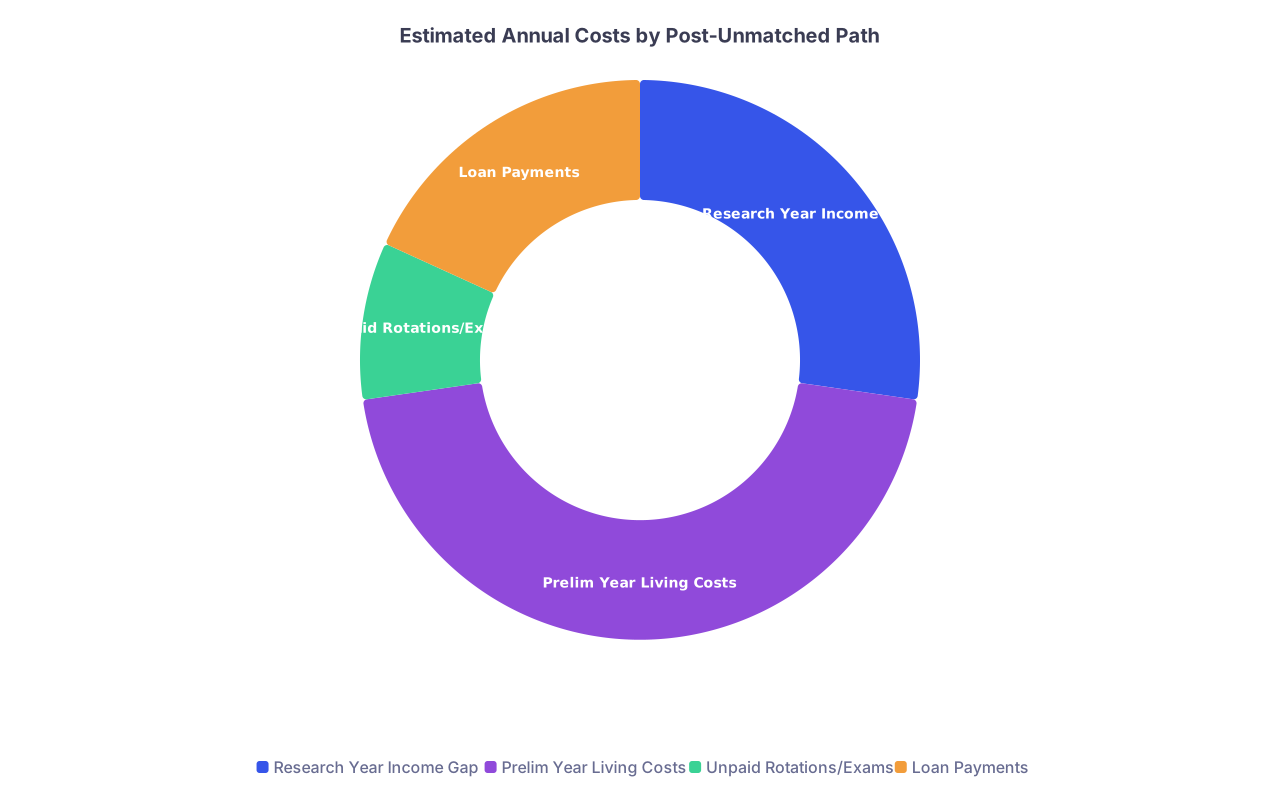
| Category | Value |
|---|---|
| Research Year Income Gap | 15000 |
| Prelim Year Living Costs | 25000 |
| Unpaid Rotations/Exams | 5000 |
| Loan Payments | 10000 |
I’ve seen people commit to unpaid “research fellowships” in expensive cities with no plan. Six months in, they’re delivering food at night to afford rent and too exhausted to be productive. Do not do that to yourself.
If money is tight:
- Look for paid research positions, not “volunteer” labels
- Consider prelim years that pay a resident salary (they all should)
- Talk to your financial aid office or loan servicer about forbearance/IDR plans
Mental health
You just watched your friends post “Matched!” photos. You’re seeing their new scrubs on Instagram. You’re stuck.
You’re going to feel shame, envy, anger. That’s normal. What you cannot do is let those emotions secretly run your decisions.
Get structure:
- Weekly therapy if you can access it (many schools still cover this for a period after graduation)
- Regular check-ins with a mentor who is outside your immediate program
- Basic health: sleep, exercise, actually eating occasionally
The red flag pattern I see: someone gets rejected, isolates, drifts for 6–12 months, applies again with a weak “gap year” and a flat affect, and PDs sense it immediately.
FAQs
1. Is it ever smart to sit out a full Match cycle and not apply at all?
Sometimes. If your application is fundamentally broken—massive professionalism red flags, very low scores, no meaningful specialty exposure—and you have a concrete plan to completely rebuild over 1–2 years, skipping a cycle can be rational. But that only works if you’re actually doing something structured (research fellowship, full-time clinical role with clear responsibilities, strong new letters). “Sitting out” while you drift and do nothing just widens the gap and makes you harder to rank later.
2. How many times can I realistically apply before programs see me as “damaged goods”?
By your third attempt at the Match (especially in the same competitive specialty), many PDs will be cautious. Not impossible, but harder. That’s why the second attempt is critical—you have to show clear growth, not just persistence. If you’ve already failed one attempt in a very competitive field, you should treat the next application as your last realistic shot for that field and plan accordingly. Beyond that, pivoting to a different specialty or path is usually wiser than banging your head against the same door.
3. Does doing a prelim year “lock” me into that specialty?
No. A prelim IM or surgery year is a tool, not a prison. Many people do a prelim year and then switch: surgery prelims into anesthesia or radiology; IM prelims into EM or anesthesia; or even prelims into their original competitive specialty if they upgrade their application and secure strong advocacy. But if you decide to pivot fully (say, into categorical IM), it often helps: programs see that you’ve functioned as a resident and can hit the ground running. The “lock-in” only happens if you mentally commit to that path and stop applying elsewhere.
4. How do I explain failing to match in interviews without sounding defensive?
Use a simple, clean structure. One or two sentences owning the outcome (“I applied to X, did not match”), one or two sentences about reflection and growth (“I realized I needed to strengthen Y and Z”), then more time on what you did (“Over the last year I completed a research fellowship/working internship, earned strong new letters, and confirmed that my best fit is [specialty]”). Keep blame out of it. No rants about the Match or bias or “I should have matched.” Interviewers are listening for maturity and insight, not excuses.
Key points to walk away with:
- Do a real autopsy of your last application and choose a specific path—reapply with major upgrades, pivot, or take a structured bridge year. No drifting.
- Use the next 12–18 months to produce tangible evidence that you’re stronger—new letters, research, clinical performance, and a coherent narrative of growth.
- Treat this as a career inflection point, not a death sentence. People have built excellent, satisfying careers from exactly where you are, but only when they stopped guessing and started acting deliberately.