
Last week, an excellent IMG sat across from me on Zoom. 256 on Step 2, three U.S. letters, solid research in cardiology. His first question wasn’t about personal statements or interview prep. It was: “If I need an H‑1B, should I just give up on cardiology‑friendly internal medicine and go for family medicine instead?”
If that sounds uncomfortably close to your situation, keep reading. You’re not dealing with just “competitiveness” anymore. You’re playing on “hard mode” because of visa constraints—J‑1 vs H‑1B, institutional sponsorship rules, and a lot of programs that quietly filter you out before anyone even reads your file.
Let’s untangle this into concrete decisions.
1. First, get brutally clear on your constraints
Before you start asking, “Which specialty can I match as an IMG on a visa?” you need to answer a stricter question:
What exactly is non‑negotiable for you?
There are three big levers here:
- Visa type
- Specialty competitiveness
- Location / lifestyle priorities
You do not get to optimize all three. No one does. You’re going to sacrifice at least one.
A. J‑1 vs H‑1B: what you’re really choosing
Strip away the noise:
- J‑1:
Easier to get. Widely accepted. But you owe 2 years back home afterward or you must secure a waiver job (usually underserved/rural or VA). - H‑1B:
Harder to get. Fewer programs sponsor. More exams and timing headaches. But no 2‑year home rule, more flexibility for fellowships and long‑term U.S. plans.
If you’re saying, “I absolutely cannot take a J‑1,” you’ve just shrunk your universe of programs by more than half in some specialties. That’s the reality. You’re not just choosing a visa; you’re choosing how narrow your options become.
Here’s the quick practical breakdown:
| Factor | J-1 | H-1B |
|---|---|---|
| Programs sponsoring | Many | Fewer |
| USMLE Step 3 required | No | Usually Yes |
| Two-year home residence rule | Yes | No |
| Waiver requirement | Often | Not applicable |
| Flexibility for fellowship | More constrained | Generally better |
If your long‑term plan is “I must work in a specific city / academic center after residency,” that leans H‑1B.
If your main goal is “get into U.S. training in any reasonably good program,” that leans J‑1.
Decide this early. It completely changes how you target specialties and programs.
2. How visa constraints change specialty competitiveness
The competitiveness charts you see online (for all applicants) are useless for your situation unless you mentally add another column: “Visa‑friendly?”
I’ll give you the real short version:
More visa‑friendly (relatively):
Internal Medicine, Family Medicine, Pediatrics, Psychiatry, Neurology, Pathology.Middle ground:
OB/GYN, General Surgery, PM&R, Anesthesia.Very tough with visa needs (especially H‑1B):
Dermatology, Plastic Surgery, Ortho, ENT, Ophthalmology, Radiology, Radiation Oncology, Neurosurgery, Integrated vascular / CT, etc.
Does that mean it’s impossible to match Radiology on an H‑1B? No. I’ve seen it happen. But “possible” and “smart bet given you need a visa” are not the same thing.
Where the visa really bites: program filters
Many highly competitive specialties do this:
- Do not sponsor H‑1B at all
- Accept J‑1 only at a few programs
- Quietly filter out non‑GC/non‑citizen applicants at the ERAS level even if they say “we accept visas” on the website
So in practice, if you’re an IMG needing H‑1B aiming at something like Radiology or Ortho, your “true” program list might be 5–15 realistic programs nationwide. Not 80.
You can’t play the same game as a U.S. citizen applicant. You need a different strategy.
3. Scenario breakdown: what to do in your situation
Scenario 1: IMG, strong scores, insists on H‑1B, wants a competitive specialty
Example: 250+ Step 2, multiple U.S. electives, publications in a surgical subspecialty, already passed Step 3.
You’re not crazy to aim high. But you must be calculated.
Here’s how I’d handle it if I were in your shoes:
Pick a realistic “tier” of competitiveness.
- Radiology, Anesthesia, PM&R, OB/GYN are hard but not hallucination‑level if your profile is genuinely top tier.
- Dermatology, Ortho, ENT, Ophtho, Plastics, Integrated Vascular/CT/Neurosurg on H‑1B as an IMG? That’s borderline masochism unless you have U.S. med school or essentially home‑institution status.
Build a dual‑path plan.
Do not go all‑in on the competitive one with H‑1B and nothing else.- Primary target: competitive but possible specialty
- Backup: more visa‑friendly specialty (IM, FM, Peds, Psych, Neuro) that also has H‑1B programs
Yes, this means applying to two specialties. Yes, that complicates your personal statement strategy. Still better than a total miss.
Aggressively pre‑screen H‑1B programs.
Do not trust “we sponsor H‑1B” on a website from 2018.- Check FREIDA
- Check program website last updated notices
- Email the coordinator with a one‑liner:
“I’m an IMG on [visa status/need], I’ve completed/passed Step 3, and I’m only able to train on an H‑1B. Does your program plan to sponsor H‑1B visas for the [year] cycle?”
Save their responses. Adjust your list.
Exploit geographic and institutional patterns.
H‑1B pockets tend to appear in:- Big academic centers with lots of foreign faculty / residents (think NYC, Boston, Chicago, Houston)
- Places with historically many IMG residents
- University hospitals familiar with international hiring
Do not waste money on 50 random places in the Midwest just because they look “mid‑tier.” They may simply not sponsor.
Consider a transitional / preliminary year as a stepping stone.
Some applicants lock in an H‑1B via:- Transitional year
- Preliminary internal medicine or surgery
Then use that to be physically in the U.S., gather strong references, and target their desired specialty next cycle. Risky. But I’ve seen it work when done deliberately.
Scenario 2: IMG or FMG, flexible on J‑1 vs H‑1B, wants a solid but not ultra‑competitive specialty
Let’s say you’d be happy with Internal Medicine, Pediatrics, Psychiatry, Neurology, or FM. You’re more open: you prefer H‑1B, but you’re not willing to torpedo your match chances over it.
You have more leverage than you think.
Here’s what I’d do:
Start with J‑1 + H‑1B capable lists.
For specialties like IM or Peds, a lot of programs will:- Sponsor J‑1 by default
- Be willing to consider H‑1B for outstanding candidates who have Step 3 done and no red flags
So your plan becomes:
- Apply widely to visa‑friendly specialties
- Label programs as: J‑1 only / H‑1B friendly / both
Use your application to keep doors open, not close them.
Don’t write:
“I must train on an H‑1B visa due to X.”
Instead:
“I’m able to train on either a J‑1 or H‑1B and have completed Step 3 in case that’s required for sponsorship.”Even if deep down you prefer H‑1B, you don’t want to get filtered out upfront at a program that auto‑screens for J‑1.
Be strategic with your “ask” timing.
Strategy that works:- During interview (or just after), if things feel positive, say:
“I’m eligible for both J‑1 and H‑1B and have Step 3 completed. Does your program have flexibility regarding visa options for strong candidates?”
Let them show their hand. - If they’re excited about you, some PDs push their GME office to make H‑1B work.
- During interview (or just after), if things feel positive, say:
Accept that visa flexibility is part of your competitiveness.
A less flashy candidate who is easy to sponsor on a J‑1 can beat a superstar who insists on H‑1B only. I’ve watched that happen in IM, Psych, and Neuro repeatedly.If your priority is: “Match this cycle into a decent program,” your willingness to take J‑1 is essentially a bonus point.
Scenario 3: You already matched a J‑1 program but want a competitive fellowship later
Different stage of the game, but same anxiety: “Did I kill my chances for cards / GI / heme‑onc / ICU / interventional by going J‑1 in a community IM program?”
No, you did not. But the path is narrower.
Here is the rational plan:
Maximize perception, not just visa status. Fellowship PDs will ask:
- Are you clinically strong?
- Do your letters scream, “Take this person”?
- Do you have specialty‑specific research or at least scholarly work? If the answer is yes, many will overlook J‑1 status as long as they have J‑1 slots.
Understand J‑1 fellowship realities. Plenty of big‑name cards / GI / heme‑onc programs have multiple J‑1 fellows every year. The choke point is after fellowship:
- You will likely need a J‑1 waiver job to stay in the U.S.
- That usually means underserved/rural or VA, not NYC/LA/Chicago immediately.
Plan backward from your waiver strategy. Work out:
- Are there waiver jobs in your desired subspecialty? (e.g., heme‑onc in a community cancer center)
- Are you okay with 3 years in a less‑ideal location after fellowship?
If yes, J‑1 → competitive fellowship → waiver job is completely viable.
Upgrade where you can. During residency, do away electives or research with:
- Academic centers that sponsor J‑1 fellows in your target subspecialty
- Mentors who can say, “I want this resident in our fellowship program”
Visa is one constraint, but perceived “fit” and relationships usually matter more at the fellowship level.
4. How to actually build a visa‑conscious program list
Let me show you what people don’t do and then what you should do.
What most applicants do (wrong):
- Filter by specialty and state on FREIDA
- Dump 80–120 programs into a spreadsheet
- Assume “Accepts visas: Yes” means “will sponsor me specifically this year”
- Apply blindly and then complain when 90% never open their file
You’re going to do it differently.
Step 1: Start with reality, not hope
Use three data sources:
- FREIDA – check:
- IMG %, DO %, MCAT/USMLE ranges
- whether they currently list visa sponsorship types
- Program website – specifically:
- GME / HR visa page (often more accurate than program page)
- “We only sponsor J‑1” language
- Anecdotal data:
- Contact recent graduates / current residents (LinkedIn, institutional emails)
- Look at resident photos/bios—names, countries, med schools. If half are IMGs, odds are better.
From this, mark each program as:
- J‑1 only
- J‑1 + H‑1B
- H‑1B sometimes / “case‑by‑case”
- No visa
Step 2: Use your competitiveness honestly
Rough and ready categories:
- Step 2 CK ≥ 245, strong U.S. LORs, no gaps, some research:
You can mix academic + community programs. - Step 2 CK 230–244, decent clinical, minimal U.S. research:
Community and mid‑tier university‑affiliated are your bread and butter. - Step 2 CK < 230 or multiple attempts:
You must maximize volume of visa‑friendly programs, mostly community‑heavy, and you probably cannot be choosy about J vs H.
Tie that to visa reality.
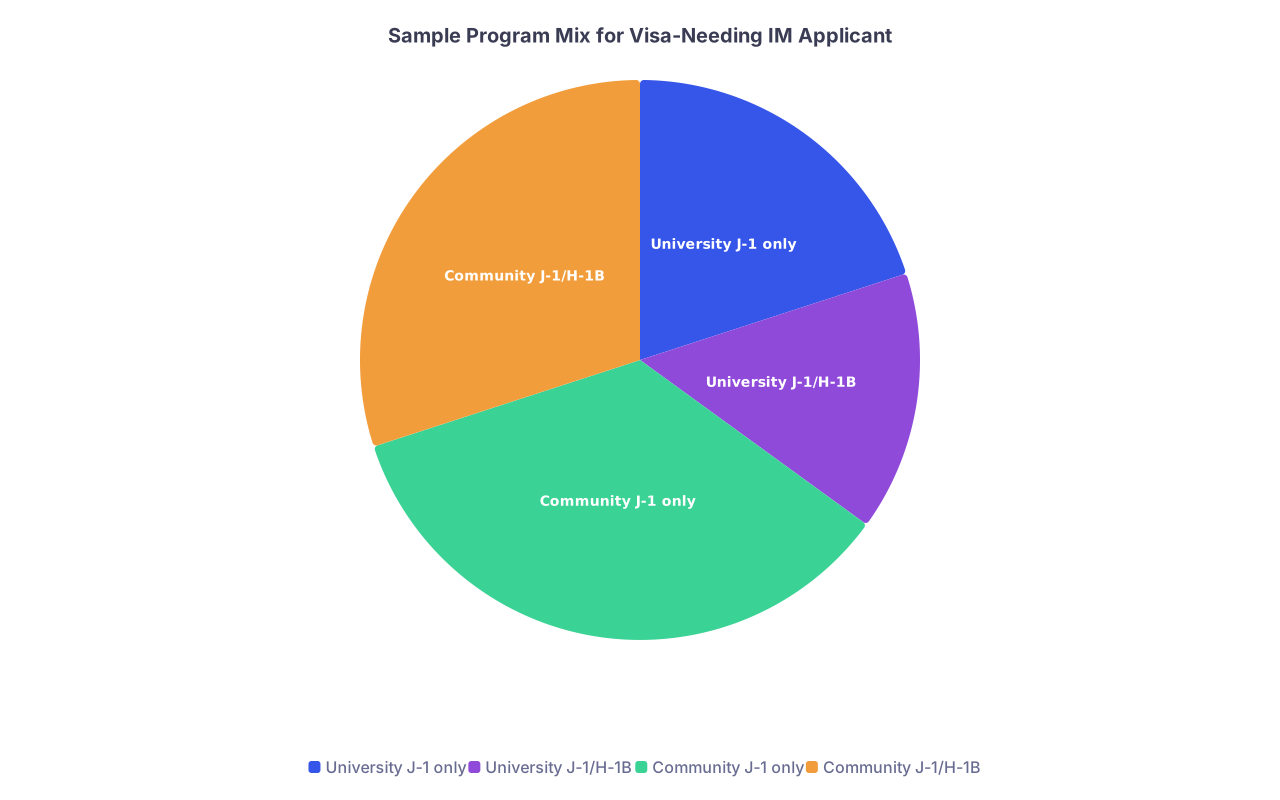
Here’s a simplified example for an IMG needing a visa targeting Internal Medicine:
| Category | Value |
|---|---|
| University J-1 only | 20 |
| University J-1/H-1B | 15 |
| Community J-1 only | 35 |
| Community J-1/H-1B | 30 |
If you’re demanding H‑1B only, your realistic slice might just be that “J‑1/H‑1B” portion—and that’s tiny.
Step 3: Build three lists
You should end up with:
- Core list:
40–80 programs that are demonstrably visa‑friendly and within your competitiveness range. - Stretch list:
10–20 more competitive programs that might take you if your profile is strong. - Safety list:
20–40 less desired locations or community programs that have a track record of taking people like you on your visa type.
If you need a visa and are not a superstar candidate, under 80–100 total applications is often too low in IM/Peds/Neuro. People hate hearing that, but I’ve watched strong applicants with 40–50 apps and a visa need go unmatched.
5. Timing, exams, and paperwork that will quietly kill your chances
Most visa‑constrained applicants do not get killed by interviews. They get killed by logistics.
USMLE Step 3 and H‑1B
If you want H‑1B for residency, assume:
- Step 3 must be done and passed before rank list certification or before contract issuance, depending on program/GME.
- Delays in scheduling or failing once can push your result beyond when programs can get H‑1B petitions filed.
So your options:
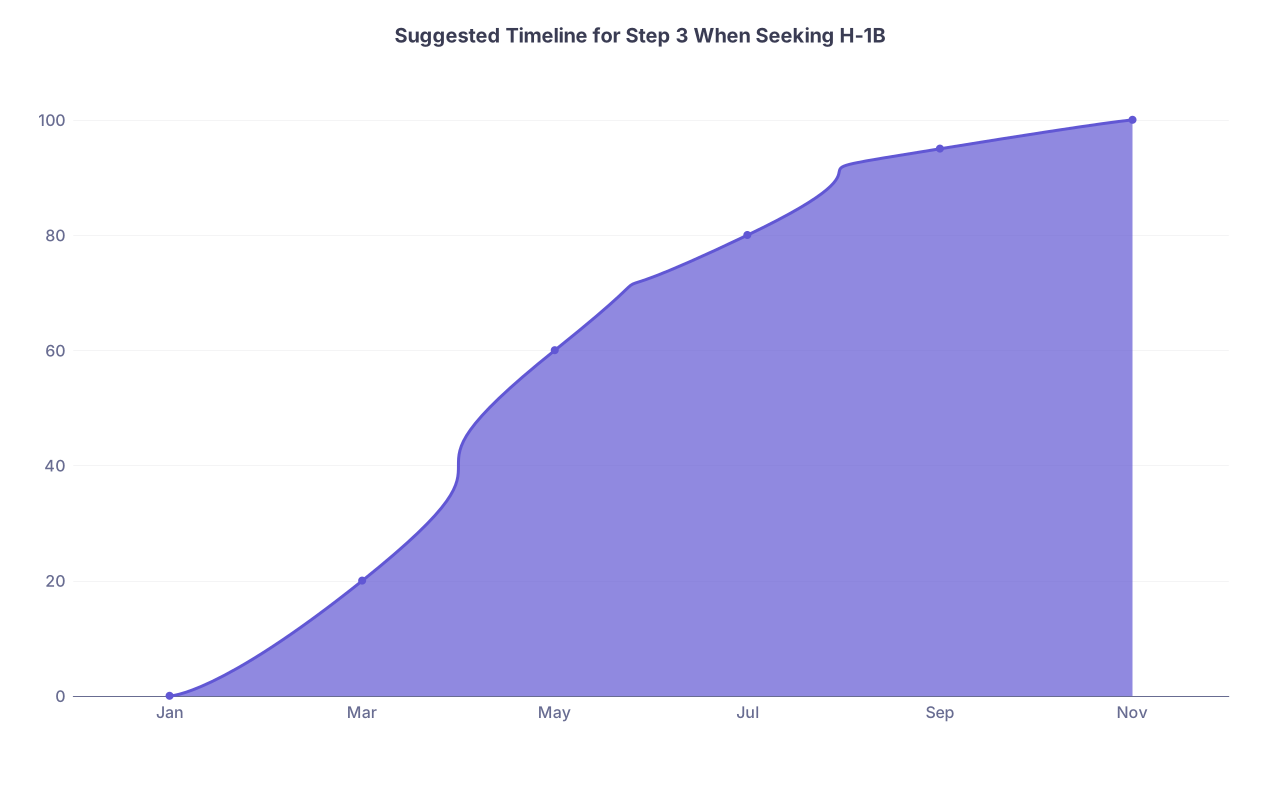
- If you’re 100% gunning for H‑1B, take Step 3 early (often before or during application season) so scores are back by December/January.
- If your Step 2 is borderline, do not rush Step 3 just to “check the box.” A Step 3 fail is poison for H‑1B chances at many programs.
| Category | Value |
|---|---|
| Jan | 0 |
| Mar | 20 |
| May | 60 |
| Jul | 80 |
| Sep | 95 |
| Nov | 100 |
This is conceptual: aim to be 100% done with Step 3 (exam + result) by around November–December of application year if possible.
DS‑2019 / J‑1 paperwork delays
For J‑1:
- Some programs are fast and experienced, others are slow and disorganized.
- If you reply late to emails or provide documents slowly, your start date can be threatened.
My advice:
- As soon as you match, treat every email from GME like it’s time‑sensitive.
- Keep scanned PDFs of passport pages, med school diploma, ECFMG cert, old visas, etc., in a cloud folder ready to send.
6. How visa needs change your interview behavior
On interview day, you’re not just applying for a specialty. You’re testing how they handle your visa reality.
Here’s how to handle that without shooting yourself in the foot.
What to ask—and when
Early in the day? Don’t make it all about visas. PDs hate that.
But you must get clarity before ranking. Ideally in these slots:
- With program coordinator or GME rep during info sessions
- With PD or APD near the end of your day
Phrases that work:
- “I’m very interested in your program and also need to understand the visa side to rank properly. How has your program handled [J‑1/H‑1B] in recent years?”
- “Are there any limitations I should be aware of regarding H‑1B/J‑1 sponsorship so I don’t misunderstand what’s possible?”
If their answer is vague or hesitant, assume risk. Do not fall in love with promises like “We’re working on being able to sponsor H‑1B” that are not already policy for the upcoming year.
Red flags you should treat as hard no’s
- “We sponsored H‑1B in the past, but not recently.”
Translation: GME probably moved away from it. Don’t bank on being the exception. - “We decide case by case, depending on the candidate.”
Could be okay if they have current residents on your visa type. If not, assume no. - “We usually prefer green card or citizen applicants.”
Believe them. That’s code for “we filter visa applicants unless forced by desperation.”
7. A few specialty‑specific realities you should not ignore
I’ll keep this blunt.
Internal Medicine:
Most flexible for visas, especially J‑1. H‑1B possible at a decent minority of programs. A very good anchor specialty if you want later cards/GI/onc.Family Medicine & Pediatrics:
Often very J‑1 friendly; H‑1B exists but less common. Great if your main goal is “get into U.S. training” and you’re flexible about first job locations.Psychiatry:
Increasingly competitive, but still relatively visa‑friendly, especially J‑1. Many community and some university programs sponsor. Good for long‑term U.S. practice, though some states have extra licensing quirks.Neurology:
Underrated visa‑friendly specialty. J‑1 widely accepted; H‑1B at a subset of programs, often academic.OB/GYN & General Surgery:
Competitive for IMGs even without visa issues. Many programs J‑1 only. H‑1B is much rarer. If you don’t have U.S. clinical years, strong scores, and meaningful LORs, be careful going all in.Radiology, Anesthesia, PM&R:
Possible, but you must be above average for IMG standards and very well researched in visa‑sponsoring programs.Derm, Ortho, ENT, Ophtho, Plastics, Integrated everything:
On a visa, especially H‑1B, these are essentially lottery tickets for IMGs. If you insist, at least build a parallel application path in a more attainable specialty.
8. Pulling it together: a simple planning flow
Here’s how I’d map your decision‑making if we were whiteboarding this together:

| Step | Description |
|---|---|
| Step 1 | Need residency with visa |
| Step 2 | Choose visa-friendly specialties |
| Step 3 | Restrict to H-1B programs |
| Step 4 | Consider moderately competitive specialties |
| Step 5 | Focus on IM, FM, Peds, Psych, Neuro |
| Step 6 | Build dual specialty application |
| Step 7 | Research real visa policies |
| Step 8 | Build core, stretch, safety lists |
| Step 9 | Plan Step 3 / paperwork timing |
| Step 10 | Interview, verify visa feasibility |
| Step 11 | Rank programs balancing specialty + visa reality |
| Step 12 | Willing to take J-1? |
| Step 13 | Target competitiveness |
9. The bottom line
If you’re trying to navigate visa constraints while aiming at competitive residencies, remember three things:
Visa type is not a side detail. It reshapes your realistic specialty options and program list. Decide early how hard you’re willing to fight for H‑1B versus taking a J‑1 and planning around it.
You cannot copy U.S. citizen strategies. You need a dual‑path approach (primary + backup specialties), ruthless program selection based on current visa policies, and smart timing with Step 3 and paperwork.
Competitiveness is not only about your CV. Programs factor in how easy you are to sponsor. Sometimes being flexible (J‑1 or H‑1B) is the single most competitive thing you can do.
If you build your plan around those truths—not wishful thinking—you give yourself a real chance to get both: a solid residency and a visa situation you can live with long term.