
Handling a Late Research Start When Aiming for a Tough Specialty
It’s August of MS3. You just finished your first core rotations, you loved your ortho (or derm, or neurosurgery, or ENT) month, and now you’re sure: you want one of the big, competitive specialties.
You open up residency program websites. Every “recent resident” profile says the same thing:
“15 publications.”
“2 first-author ortho papers, 3 book chapters.”
“NIH research fellow, dedicated year.”
You look at your CV. One poster from undergrad. Maybe a QI project that never went anywhere. No serious specialty-specific research. And you’re supposed to apply… in a year?
This is the situation: you started research late, but you’re aiming high. I’m going to walk through what to do, step by step, so you stop spiraling and start executing.
Step 1: Get Honest About How Late You Actually Are
“Late” means very different things for different specialties and timelines. You need a clear, not-delusional assessment before deciding your strategy.
Here’s the basic landscape:
| Specialty Type | Examples | Typical Research Expectations |
|---|---|---|
| Ultra-competitive lifestyle | Derm, Plastics, ENT, Ophtho | Multiple pubs, often specialty-specific, sometimes research year |
| Ultra-competitive surgical | Ortho, Neurosurgery | Several pubs/abstracts, often ortho/neuro-focused, research year common |
| Competitive academic | Rad Onc, IR, EM (top programs) | Some publications, strong research story, not always mandatory |
| Mid-competitive | Anes, IM, Gen Surg, Peds (top places) | Prefer some research, not always specialty-specific |
| Less competitive | FM, Psych, Neuro (non-elite) | Research is a bonus, not the gatekeeper |
And then, timing. Rough guide:
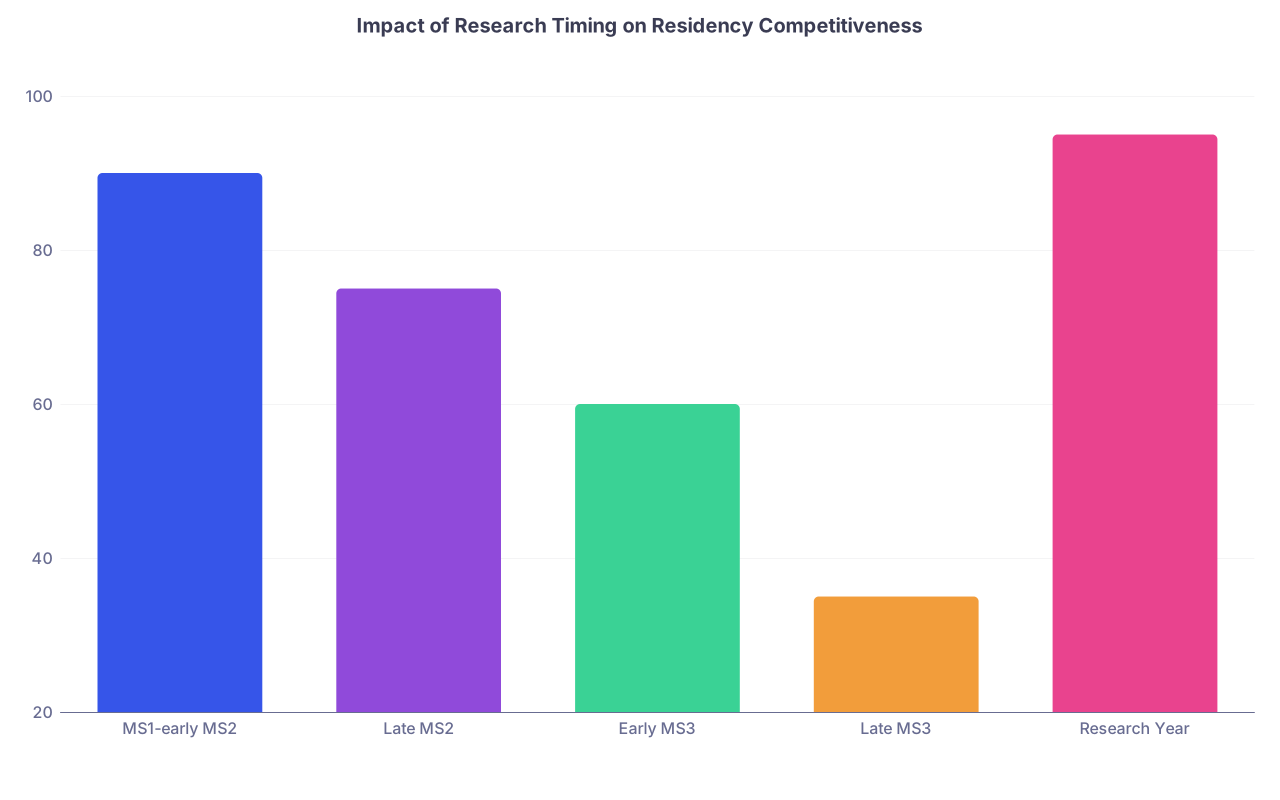
| Category | Value |
|---|---|
| MS1-early MS2 | 90 |
| Late MS2 | 75 |
| Early MS3 | 60 |
| Late MS3 | 35 |
| Research Year | 95 |
Those “impact” numbers are not real data, just a way to think: research that’s done early enough to be finished and on your ERAS application is obviously more powerful. A research year nearly resets the clock.
You’re probably in one of these camps:
Early MS3, no meaningful research yet.
Tough, but salvageable for many competitive specialties with aggressive work and some luck.Late MS3, ERAS within 6–9 months.
You are not going to transform into a 15-pub derm superstar in time. You need to pick a focused, realistic plan: add a research year or adjust your target specialty/program tier.Already on a gap year but started late / unproductive so far.
The clock is louder. You must pivot to high-yield projects you can finish and show.
Before anything else, decide which bucket you’re in and how rigid you are about both:
- The specific specialty you want, and
- The tier of program (top-10 vs “I just want to match somewhere”).
That clarity drives everything else.
Step 2: Decide Your Non-Negotiables
You can’t optimize for everything. Late research means tradeoffs.
You need to answer two questions bluntly:
Is this specialty itself non-negotiable, or is it “competitive and high-paying” that appeals to you?
If you’d be equally happy in, say, ortho, anesthesia, or radiology, you have more wiggle room than someone dead-set on derm.Are you willing to take an extra year (or two) to be more competitive?
This is where people lie to themselves. “I’ll just work harder this year” while not accepting that in derm or plastics, everyone else has already been working harder for three years.
Here’s the rough trade space:
| Priority | Willing to Add Research Year? | Likely Best Move |
|---|---|---|
| Must match derm/plastics/top ENT | Yes | Dedicated research year + heavy output |
| Must match competitive surgical (ortho/neuro) | Maybe | Either research year or very strategic, output-focused MS3/MS4 |
| Open to several fields, want strong match | No | Pivot to slightly less competitive specialty, focused but limited research |
| Just want to match somewhere solid | No | Take what research you can get, focus on clinical evals and letters |
If your answers are:
- “I refuse a research year” and
- “I must match at a top-10 derm program”
…you’re not being realistic. Something has to give. Either timing or prestige or specialty.
Make this decision now. Do not drift.
Step 3: Choose the Right Kind of “Late” Research
With a late start, the type of project matters more than almost anything else. You don’t have time for vanity projects or endless data collection that won’t mature before ERAS.
Here’s the hierarchy of impact vs timeline for someone starting late:
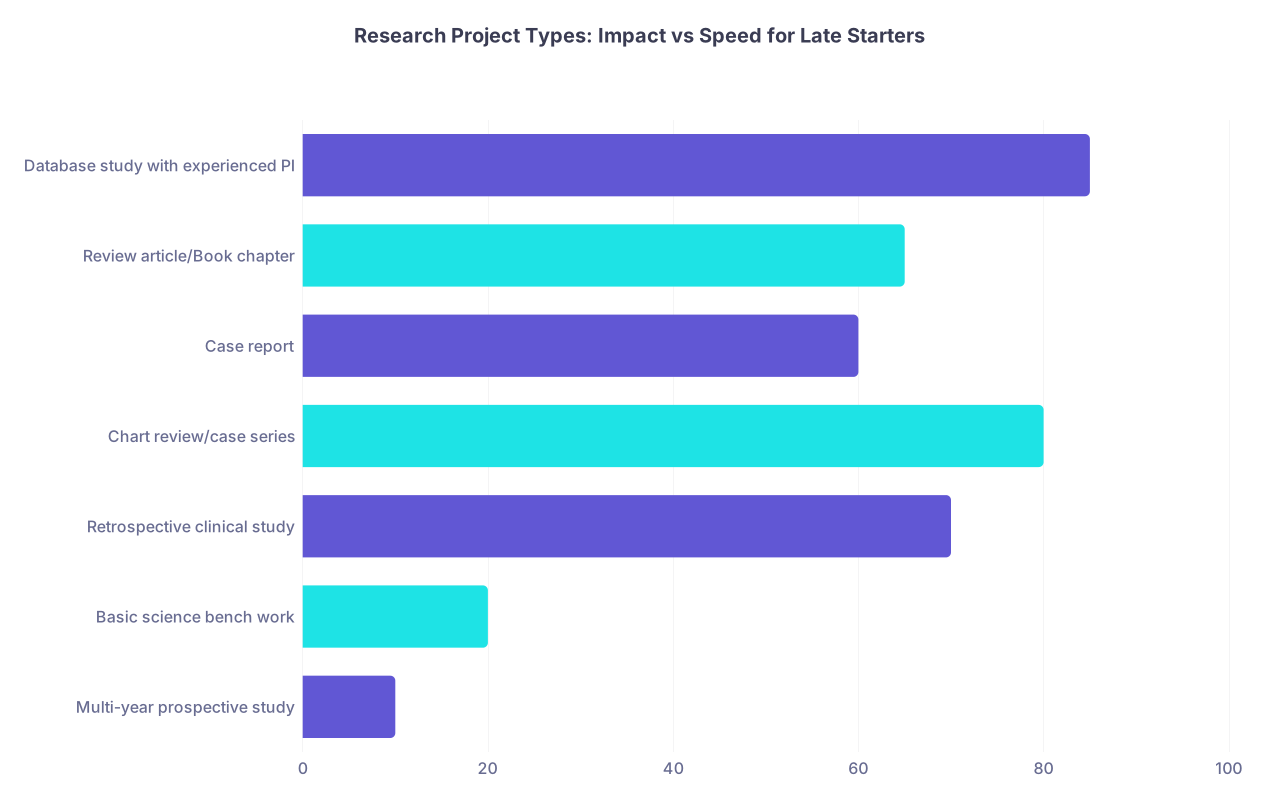
| Category | Value |
|---|---|
| Multi-year prospective study | 10 |
| Basic science bench work | 20 |
| Retrospective clinical study | 70 |
| Chart review/case series | 80 |
| Case report | 60 |
| Review article/Book chapter | 65 |
| Database study with experienced PI | 85 |
Interpretation:
- Left side (low numbers): terrible for late starters. Long, uncertain, slow to publish.
- Right side (high numbers): faster, controllable, more likely to yield something citable by ERAS.
If you’re late, you want:
- Retrospective chart reviews
- Case series
- Review papers
- Case reports
- Database projects where someone already has the data and needs a workhorse
You do not want:
- A brand-new RCT
- A multi-year prospective cohort
- Bench research where you’re “learning techniques” for the first year
I’ve watched students waste an entire “research year” waiting on IRB, recruitment, or finicky lab experiments, ending with zero publications. That’s career malpractice if you’re chasing a competitive field.
Your goal:
Projects with:
- Already-approved IRB, or clear, fast IRB path
- Data already collected or quickly accessible
- A mentor known for getting students on papers
- Clear, near-term endpoints (e.g., “We can submit this by February”)
Step 4: How to Actually Get Onto High-Yield Projects Fast
You don’t have time to cold email randomly and hope. You need to be tactically aggressive.
Here’s the playbook:
1. Start with targeted ask, not “I love research”
Your email should not be:
“Dear Dr. X, I am very interested in neurosurgery and research and was wondering if you have any projects I could help with.”
Everyone sends that. Faculty ignore it or give you a dead-end project.
You send something like:
- Short intro (year, school, interest in specialty)
- One line max about past research skills (stats, writing, data cleaning, whatever is real)
- Then this: “I’m specifically looking for ongoing projects that need a motivated student to help push them to submission within the next 6–9 months. Are there any retrospective, chart review, or manuscript-ready projects in your group where an extra pair of hands could help you get them across the finish line?”
You are advertising that you care about completion, not “experience.”
2. Talk to senior residents, not just attendings
Residents know which attendings:
- Actually publish
- Actually let students write
- Actually give co-authorship for real work
Ask a PGY-4 ortho resident:
“Who in the department is best for students trying to be productive quickly with research?”
They know. Every program has “the research machine” attending and the black hole.
3. Be okay starting with one small, boring project
You don’t have time to be picky. A case series on some obscure fracture pattern may be boring, but if it can yield your first PubMed paper by ERAS, it’s gold.
Your first win isn’t about topic prestige. It’s proof that:
- You can start something
- Finish it
- And that you’re not just another student who disappears mid-project
That first win also buys you trust. People who deliver get offered more, better projects.
Step 5: Build a Compressed, Aggressive Research Timeline
You need a blunt, written timeline. Not vibes. Not “I’ll work on it this year.”
Lay it out like an actual project plan.
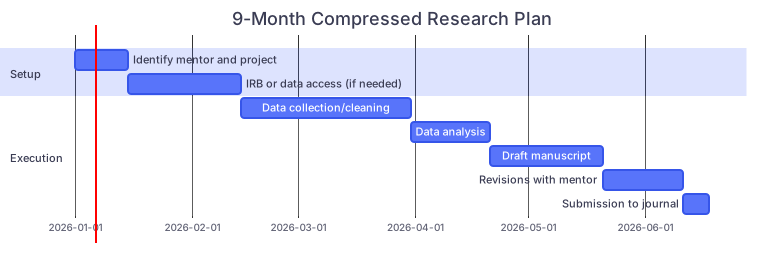
| Task | Details |
|---|---|
| Setup: Identify mentor and project | a1, 2026-01-01, 14d |
| Setup: IRB or data access (if needed) | a2, after a1, 30d |
| Execution: Data collection/cleaning | b1, after a2, 45d |
| Execution: Data analysis | b2, after b1, 21d |
| Execution: Draft manuscript | b3, after b2, 30d |
| Execution: Revisions with mentor | b4, after b3, 21d |
| Execution: Submission to journal | b5, after b4, 7d |
That’s about 6 months. Tight, but absolutely doable if:
- The scope is realistic (retrospective, not a 5000-patient RCT)
- You and your mentor are responsive
- You treat this like another required course, not “extra” when you feel like it
Then you have 3 months left for:
- A review article
- A case report
- Presentations/posters off the main project
If you’re starting mid-MS3, you need to accept that some of this happens during clinical rotations. That means:
- Saying “no” to optional fluff (random student org leadership, one more shadowing experience)
- Blocking 6–8 hours on your free weekends for research
- Reviewing data during downtime on lighter rotations (psych, outpatient, etc.)
Will this be fun? Not really. But you’re playing catch-up.
Step 6: Pair Research With the Rest of Your Application Strategy
Here’s where people mess up. They suddenly wake up about research and then let everything else slip. That’s how you end up with 3 publications and mediocre letters, which is not a win.
Late research must fit into a broader application gameplan:
Letters of recommendation
If you’re late on research, your letters become even more important. You need:- 1+ from a research mentor who can say, “This student did real work and followed through.”
- Strong clinical letters from your target specialty and maybe internal medicine/surgery.
Clinical performance and evals
Competitive fields still want people they can actually work with. If you try to do 4 research projects at once and then are a zombie on your sub-I, you lose the real battle: being ranked.Personal statement and story
You’re going to have to explain the late research honestly but confidently. The worst move is pretending you’ve been doing it since MS1 when your ERAS says otherwise.Use a framing like:
- You discovered a genuine interest in the specialty during clinical rotations
- Once you realized that, you intentionally sought out projects that would teach you how to ask questions and improve care in that field
- Emphasize intensity and follow-through rather than length of engagement
You’re not competing with “started research as a fetus.” You’re competing with “I figured out what I care about and then went hard.”
Step 7: When You Should Seriously Consider a Research Year
Sometimes the right answer is: “You need more time.”
I’ll be blunt. You should very strongly consider a research year if:
- You’re aiming for:
- Dermatology
- Plastic surgery
- ENT
- Neurosurgery at a top-tier/academic-heavy program
- AND you are:
- Late MS3
- With minimal or no specialty-specific research
- At a med school without a huge home department reputation in that field
In those cases, a research year can be the difference between:
- “No interviews at any of the programs you want” vs
- “You’re a serious candidate”
Used well, a research year can produce:
- 4–10+ PubMed-indexed outputs (mix of first- and middle-author)
- Several posters/oral presentations
- A deeply invested mentor who picks up the phone for you
Used poorly, it turns into:
- One half-finished project
- Your name buried on a big multi-author paper you barely touched
- A year of vague “I did research” with no receipts
If you take a research year, treat it like Step 1: the entire thing is pass/fail. Delivered or not. You should:
- Join a research group that has a track record of student productivity (ask for examples)
- Start 2–3 smaller projects that can mature fast + 1 bigger one
- Set quarterly targets: abstracts submitted, manuscripts drafted, etc.
And, crucially: talk to your school’s dean’s office and recent alumni in your specialty. Ask candidly:
“Given my CV now and no research year, what’s my realistic shot at [specialty]?”
If multiple people who actually sit on selection committees say “low,” believe them.
Step 8: If You Decide Not to Do a Research Year (But Still Want a Tough Field)
Let’s say you refuse an extra year. Fine. Then your strategy shifts from “be a research monster” to “build a balanced but clearly upward-trending profile.”
Your focus becomes:
One or two meaningful, fast-moving research projects you can list on ERAS as:
- Submitted
- In revision
- Accepted (ideal, not always achievable)
Heavy investment in:
- Doing extremely well on your away rotations / sub-Is
- Getting top-tier letters
- Doing some visible service or interest in the field (student interest group, small local teaching, etc.)
- Building connections at the places you’d actually like to match (reach out early, show up prepared)
You’re basically playing the “excellent clinician with evidence of interest in the field” angle rather than the “future R01-funded physician-scientist” angle. Programs still need strong clinicians. Not everyone has to look like a mini-PI.
For many specialties (ortho at non-top-10, anesthesia, radiology, EM, IM at solid academic places), that’s enough if the rest of your app is strong.
Step 9: How to Talk About a Late Start Without Sounding Weak
You will get asked some version of:
“I see your research really picked up in MS3. What changed?”
Here’s how not to answer:
- “I didn’t realize it was important until recently.” (Translation: I didn’t plan.)
- “I was busy with other things.” (So was everyone else.)
- “I just couldn’t find projects.” (They’ll wonder if you tried hard enough.)
Better framing:
- Anchor it in authentic discovery:
“During my third-year ortho rotation I realized I was most energized by [specific aspect], and that pushed me to seek out projects focused on outcome X.” - Highlight intentional action:
“Once I recognized that, I sat down with Dr. Y, asked which projects could realistically be completed in time for applications, and committed to seeing them through.” - Emphasize execution:
“In the last year, I’ve been able to [collect/analyze/write] leading to [X submissions, Y presentations], and I plan to continue building on that.”
You’re telling a story of acceleration, not excuse.
Step 10: Know What Actually “Counts” on ERAS
Last thing, because people get confused here: late starters often waste energy chasing the wrong “line” on the CV.
What matters most, in rough order:
- Peer-reviewed publications (especially specialty-related, first- or second-author)
- Abstracts and posters at recognized meetings
- Oral presentations (regional/national > local)
- Book chapters or invited reviews
- Non–peer-reviewed pieces (blogs, newsletters) are okay but lower-yield
- “Manuscript in preparation” is basically worthless unless your mentor will vouch for it specifically
If you’re short on time, you’d rather have:
- 2 small peer-reviewed specialty-related papers
Than: - 1 massive, never-finished “high-impact” project that you list as “in progress”
Think in terms of what a program director sees skimming your ERAS for 30 seconds. Clear, clean, finished work looks better than “ambitious but incomplete” every time.
Key Takeaways
- A late research start narrows your options but does not end them; you compensate with targeted, fast-moving projects and ruthless prioritization.
- Be honest with yourself about whether you need a research year for the specialty and program tier you want—and if you take one, treat productivity as non-negotiable.
- Sell your trajectory: show that once you committed to the specialty, you acted decisively, did real work, and actually finished projects that matter.