
The biggest myth about competitive specialties is that you must have a home department to match. You do not. But if your school lacks one, you have to play the game differently and much more deliberately.
You’re behind by default. Not doomed. Behind.
This is fixable if you stop thinking like a typical applicant and start thinking like someone building their own mini-department around them.
First, Be Honest About What You’re Up Against
If your school has no department in your dream competitive specialty—think dermatology, ortho, plastics, ENT, neurosurgery, urology, radiation oncology, ophthalmology—you’re missing three things that other students take for granted:
- Home program letters and mentors.
- Built-in specialty exposure and rotations.
- Automatic “we know our own students” interview bumps at that program.
Let’s be blunt: programs like known quantities. Their own students. Students from similar programs. Students they’ve seen on rotation.
You, at a school with zero faculty in your target field, are an unknown quantity. Unless you aggressively make yourself known elsewhere.
Here’s the mental shift:
You’re not “a student without a home department.”
You’re “a student whose home department is spread across 3–5 other institutions.”
You’re going to assemble it.
Step 1: Get Your Baseline Profile in Order
You cannot afford to be “borderline” on basics if you lack a home department. Programs will stretch more for their own students than for you.
Here’s what you need before you obsess over away rotations:
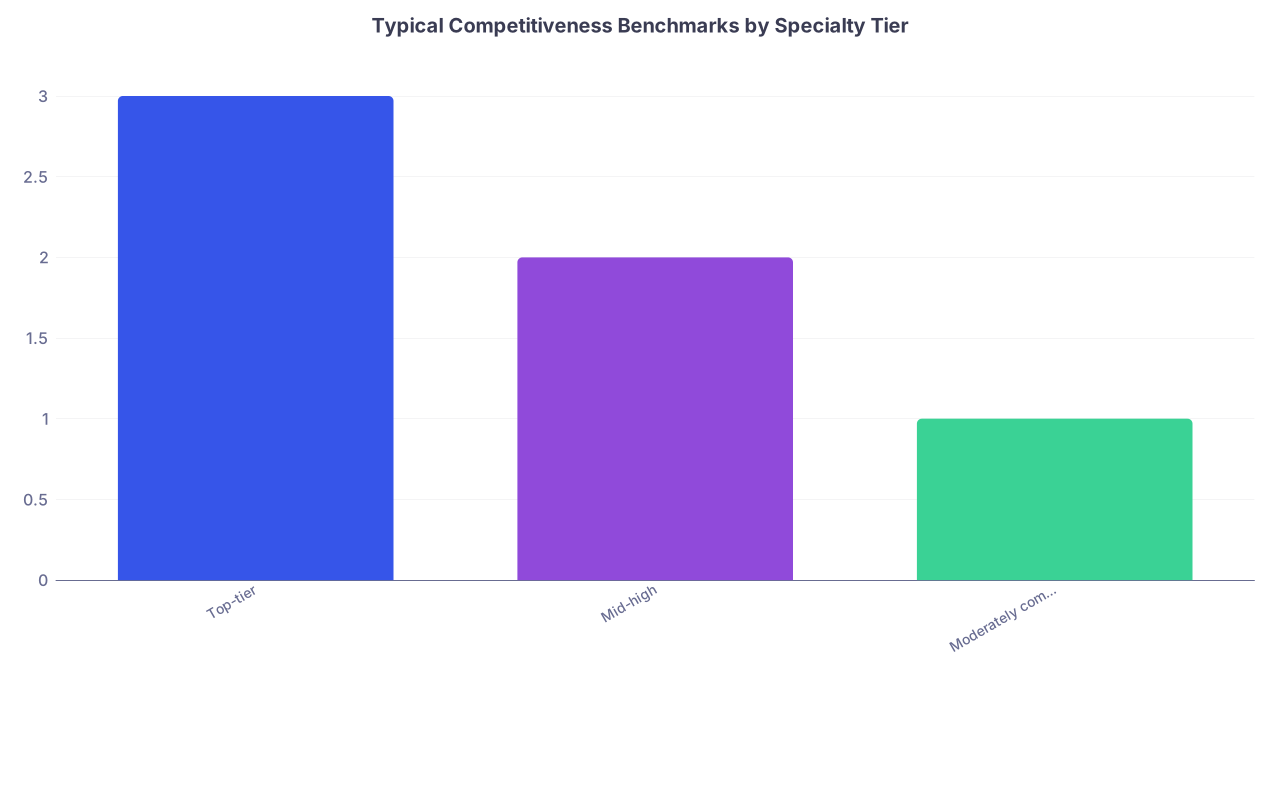
| Category | Value |
|---|---|
| Top-tier | 3 |
| Mid-high | 2 |
| Moderately competitive | 1 |
Legend (1 = strong, 2 = very strong, 3 = exceptional):
Top-tier (derm, plastics, ortho, ENT, neurosurg, ophtho, rad onc):
You need exceptional. Step 2 CK solidly above national mean, strong class rank, and something that makes eyes widen (research, unique skill set, or outstanding letters).Mid-high (EM, anesthesia, general surgery, OB/GYN):
You’ve got more margin, but coming from a no-home-department background still means you need to lean hard on away rotations, letters, and narrative.Moderately competitive (IM at strong academic places, peds at top programs, etc.):
Lack of department still matters for subspecialty interest, but less catastrophic.
Reality check list. If any of these are shaky, address them now:
- Step 2 CK: Is your score reasonably aligned with matched data for your specialty?
- Clinical evaluations: Mostly honors or high pass in core clerkships?
- Class rank/AOA: If available, where are you roughly?
- Red flags: Any repeats, professionalism issues, leaves of absence?
If your metrics are way below average for your dream specialty, your problem is not the lack of department. It’s your competitiveness. You either:
- Shift to a slightly less competitive specialty now, or
- Commit to a 1–2 year research + strengthening plan and apply later.
But if you’re roughly in the game? Then the “no department” issue becomes the main strategic problem, and that is solvable.
Step 2: Build an External “Pseudo-Home” Department
You don’t have a home department. So you steal one. Gently.
You’re going to create a hub at another institution (or two) that functions as your de facto department.
How to do it:
Identify realistic hubs.
Target: Academic centers within a few hours’ travel, or anywhere you have geographic/family ties. Look for:- Large departments in your specialty
- Existing track record of taking outside rotators
- Faculty with education and mentorship reputations (look at program websites, Twitter/X, specialty societies)
Get a faculty mentor early (MS2/MS3 ideally).
You send a short, tight email. Something like:Subject: Med student interested in [Specialty] seeking mentorship and possible research
Dear Dr. [Name],
I am a [MS2/MS3] at [School], which unfortunately does not have a [Specialty] department. I’m strongly interested in [Specialty] and am hoping to build experience and mentorship externally.
I’ve completed [relevant coursework/skills, Step 1 pass, Step 2 target date, brief research background].
Would you be open to a brief call or Zoom to discuss ways I might get involved with [research/clinics/observerships] at [Your Institution], and how to best prepare for a [Specialty] application coming from a school without a department?
Sincerely,
[Name, Med School, Contact]You send 10–15 of these, not 2–3. Polite but persistent.
Convert one mentor into a central anchor.
Once someone bites and is even mildly supportive, you ask:- “Would you be open to longitudinal mentorship as I go through this process?”
- “Could I help with ongoing projects or clinics?”
- “When the time comes, could I do an away rotation with your group?”
Stay useful.
Answer emails quickly, do grunt work on research, show up prepared. You’re trying to become “one of our students” in their head. That’s your win.
Step 3: Use Away Rotations as Your Primary Weapon
For students with a home department, aways are a bonus. For you, they are the main stage.
Think of aways as three things simultaneously:
- An extended job interview
- Your de facto home program exposure
- Your only real chance at top-tier specialty letters
You do not scatter aways randomly. You target.

| Step | Description |
|---|---|
| Step 1 | Decide Specialty |
| Step 2 | Check Stats vs Benchmarks |
| Step 3 | Consider Backup or Research Year |
| Step 4 | Identify Target Programs |
| Step 5 | Secure Mentor at One Site |
| Step 6 | Schedule First Away at Mentor Site |
| Step 7 | Do 2nd Away at Different Region |
| Step 8 | Apply to Mix of Programs |
How many and where?
Hyper-competitive specialties (derm, ortho, plastics, ENT, neurosurg, ophtho, urology, rad onc):
Aim for 2 aways, sometimes 3 if schedule allows. One at your “pseudo-home” institution, one at a different but realistic program (not all at ultra-elite places).Less extreme but still selective fields (gas, EM, gen surg at big academic centers):
1–2 aways is usually enough, targeted at realistic places you’d actually rank.
Avoid doing all aways at programs that almost never take your school’s grads and regularly pull only from top 10 med schools. Be ambitious, not delusional.
How to behave on an away when you have no home department
You are there to:
- Prove you belong in that specialty clinically.
- Be memorable for work ethic and professionalism.
- Get at least one genuinely strong SLOE/SLOR/chair-level letter.
Things that matter a lot more for you:
- Show you’ve done reading beforehand. If it’s ortho, know common fracture patterns and post-op issues. If it’s derm, know bread-and-butter rashes and how to describe them properly.
- Be the first one to volunteer for scut that helps the team (notes, calling consults with supervision, updating families).
- Never act above your pay grade. Ask when you don’t know.
At the end of a strong rotation, you ask specifically:
“Dr. X, would you feel comfortable writing a strong letter of recommendation for my [Specialty] residency applications?”
If they hesitate or sound vague—do not use that letter as one of your main ones. You cannot afford lukewarm.
Step 4: Construct a Letter Portfolio That Offsets Your Weakness
Without a home department, your letters must do heavy lifting. Program directors will look at your file and subconsciously think: “Who actually knows this person in our field?”
You need:
- 2–3 specialty-specific letters from real faculty in the field
- At least one from a recognizable name or respected academic center
- 1 strong non-specialty letter (core clerkship or IM/surgery attending) that says you’re outstanding to work with
Ideal setup for a hyper-competitive field:
| Letter Type | Source |
|---|---|
| Specialty Letter #1 | Away rotation at realistic target |
| Specialty Letter #2 | Pseudo-home mentor institution |
| Specialty Letter #3 | Second away or research mentor MD |
| General Clinical Letter | IM or Surgery core clerkship |
If your specialty has a standardized letter format (EM SLOEs, some surgery formats), you prioritize those from away sites.
Key detail: every letter should mention explicitly that you come from a school without a department and frame it as resilience, not deficit. You can even prompt your letter writers when they ask what to include:
- Your initiative to seek mentorship and rotations externally
- Your work ethic commuting or arranging extra experiences
- Your performance compared with their own students (“equal to or better than our home students” is gold)
Step 5: Build a Track Record Without a Department
No department = fewer built-in research or teaching chances. So you create your own.
You’re trying to communicate one message:
“I didn’t just say I liked [Specialty]. I reoriented my entire med school life around it.”
Research
You do not need a first-author NEJM paper. But you do need meaningful involvement in something specialty-related at some point in MS2–MS4.
Tactics:
- Ask your external mentor: “Do you have any small, discrete projects that need help—chart reviews, case series, poster prep?”
- Be willing to start with low-visibility work to get your foot in. Data cleanup, chart abstraction, lit review.
- Aim to walk away with at least:
- 1–2 posters or abstracts
- Ideally 1 manuscript (authorship position depends, but 2nd/3rd author is fine)
If absolutely no one in your region can help, look at:
- National student interest groups in your specialty
- Virtual collaboratives / multi-center projects often advertised on Twitter/X or specialty Slack groups
- Your own institution’s generic research office for connection to affiliated hospitals
Clinical exposure
If your school doesn’t offer clinical rotations in the field at all:
- Set up observerships or shadowing with your external mentor’s clinic early (MS2/MS3).
- Use elective time in MS4 for your aways plus any off-site electives your school will approve.
- Keep a simple log for yourself of cases seen, procedures observed, disease patterns. It will make your interviews much more concrete.
Step 6: Strategy for ERAS and Rank List When You Lack a Department
Your application list cannot look like that of a student from UCSF or Penn who has a derm or ortho department behind them and 5 home letters.
You’re playing a different game.
Build a wide but targeted list
For hyper-competitive specialties:
- Anchor programs:
- Places where you did aways
- Your pseudo-home institution
- Regionally realistic academic programs with a history of taking outside students
- A long tail of solid mid-tier academic and some community programs (where applicable)
And yes, you need a backup in many of these fields unless you’re an absolute statistical monster with multiple glowing letters.
For example:
- Derm: almost always needs a parallel application (IM prelim, transitional year, or a research year plan).
- Ortho/plastics/ENT/neurosurg: often smart to have a research year planned or a backup specialty in mind if you’re not in the top tier.
- Ophtho/urology: Prelim/TY year planning is essential if not matching is a real risk.
Where lacking a home department hurts you most is at top-10 name brand places that heavily favor their own and peer institutions. So you include some on your list if your numbers justify it—but you don’t build your whole strategy on them.
Step 7: How to Talk About This in Your Personal Statement and Interviews
Hiding the fact that your school doesn’t have your specialty is dumb. They will notice.
You do something smarter: own it and flip it.
In your personal statement, a short, direct narrative works:
- 1–2 lines: Acknowledge your school doesn’t have your specialty.
- 3–4 lines: Show what you did about it—seeking mentors, traveling to rotations, building research externally.
- 1–2 lines: Connect this to qualities they care about (initiative, resilience, adaptability, genuine commitment).
Example skeleton:
My medical school does not have a [Specialty] department, so my early exposure to the field did not come from a home rotation or required clerkship. Instead, I built my own path—seeking out mentors at [Institution], commuting [X] hours weekly during my preclinical years to observe in clinic, and later completing away rotations at [X] and [Y]. These experiences required more planning and initiative than I anticipated, but they also confirmed that [Specific Aspect of Specialty] is the environment in which I do my best work.
In interviews, if asked:
“Given your school doesn’t have [Specialty], how did you confirm this is what you want?”
You do not say: “I just know” or “I’ve always wanted this.”
You say:
- “I spent [X] weeks on away rotations seeing bread-and-butter and complex cases.”
- “I saw [specific case] that solidified my thinking.”
- “I worked with Dr. X on [project] and got to see the field from research and clinical sides.”
Concrete > vibes.
Step 8: If You’re Already Late in the Game (MS4, Apps Soon)
Some of you are reading this at the “oh no” stage. MS4, application season close, no aways yet, no research, no mentors.
You have fewer levers. But not zero.
Triage:
Get one strong away rotation ASAP if the window isn’t closed.
Use VSLO or directly email coordinators. Highlight that you lack a home department and this would be your only formal exposure.Salvage your letters.
- Ask your away faculty for one letter even if rotation is short.
- Use your strongest general clinical letters and explicitly ask them to comment on your work ethic and ability to thrive in a demanding field.
Be realistic about specialty and backup.
- If this is a hyper-competitive field and your metrics are average, strongly consider a parallel plan this year.
- Or decide quietly that you’re going to do a research year next year and apply stronger.
Use your personal statement and interview to explain, not plead.
No whining about what your school lacks. Just a clean narrative of what you did about it and what you learned.
FAQ (Exactly 5 Questions)
1. Do I absolutely need a research year if my school has no department in a competitive specialty?
No. A research year is a tool, not a requirement. It makes sense if:
- Your metrics are borderline for the specialty, and
- You can get into a strong research position at a reputable program, and
- You’ll gain real mentorship and letters, not just “time served.”
If your Step 2, clerkship grades, and away performance are already strong, you can often match without a dedicated year—as long as you execute your aways and letters well.
2. How many programs should I apply to if I lack a home department?
More than the average applicant in your specialty. For highly competitive fields, 60–80 is common anyway; being without a department might push you to the higher end. For moderately competitive specialties, you might go from 25–30 up to 40–50 if your stats are only average. This is insurance, not a replacement for good letters and aways.
3. Will programs hold my lack of home department against me?
The good ones won’t penalize you just for that. They will expect you to have compensated through external rotations, mentorship, and research. If your application looks like someone who had every resource and used none of it, you’re in trouble. If it looks like someone who had fewer resources and squeezed everything possible out of them, you stand out—in a good way.
4. What if my school only has one or two faculty in my specialty, but no full department or residency program?
You’re in a hybrid situation. Use those faculty for early exposure, letters, and maybe small projects, but you still treat outside institutions as your true “home.” You still need away rotations and at least one letter from a place that trains residents in your field. Programs care more about what residency faculty say than what isolated specialists at non-training sites say.
5. Is it better to do an away at a top-10 prestige program or a solid mid-tier where I’m more likely to match?
If you lack a home department, prioritize places where you have a realistic chance of matching and where your performance will be noticed. One “reach” away is fine if your stats support it. But doing all your aways at places that almost never take students from your school or region is a high-risk, low-yield move. You want at least one away where you’d happily train and where they could realistically see you as “one of ours.”
Key points: You’re behind, not broken. You fix it by (1) building an external “pseudo-home” department through mentors and aways, (2) letting your letters and performance on those rotations do the talking, and (3) telling a clean, concrete story of initiative rather than deficit.