
You’re sitting in a cramped advising office. On the wall: a couple of old conference posters, a faded residency match map. You’ve just said it out loud: “I really want to apply to dermatology” (or ortho, plastics, ENT, neurosurgery—pick your poison).
Your advisor leans back, pauses, and then drops it:
“I don’t think that’s realistic for you. You should really consider something less competitive.”
Your stomach drops. You nod politely. But inside, you’re thinking:
- Am I delusional?
- Are they right or just risk‑averse?
- Do I give up now or fight for this?
This is the situation. Let’s talk about what to do next—step by step, without the sugar-coating.
Step 1: Decode What Your Advisor Is Actually Saying
First thing: don’t react to the headline message (“you can’t”) until you decode what’s underneath it.
There are really only a few things they might mean:
- Your objective metrics are below typical matched ranges
- Your application has real gaps (research, letters, clinical performance)
- They personally dislike risk or “non-traditional” paths
- They don’t know the specialty well and are guessing based on reputation
- They’re trying to protect your ego from a painful failure
You need to separate ego bruise from data.
Ask them real questions:
- “Can you be specific? Which parts of my application do you think are out of range for [specialty]?”
- “What Step scores/GPA/AOA/grades/research do you usually see in students who match [specialty] from our school?”
- “On a scale from 1–10, how risky do you think it is for me to apply? And what would make it less risky?”
- “Are you saying ‘don’t apply at all’ or ‘apply with a viable backup plan’?”
Do not leave that room with only a vague “it’s competitive” statement. Vague advice is useless. You need numbers and comparison.
If they stay vague, that’s actually diagnostic: you might not be talking to the right advisor.
Step 2: Get Real About Your Stats vs the Field
Now you need data. Not vibes. Data.
Look at:
- Your Step 2 CK score (Step 1 is pass/fail now, but programs still care about your transcript and context)
- Class rank / quartile / AOA (if applicable)
- Honors vs High Pass vs Pass in core clerkships, especially the ones related to your specialty
- Home specialty evals and comments
- Research output (especially in that field): papers, posters, abstracts, even serious ongoing projects
Then you compare yourself to typical matches in that specialty.
Here’s a rough side‑by‑side to orient you. Yes, it’s simplified. But it’s directionally accurate.
| Specialty | Relative Competitiveness | Typical Step 2 CK Range (Matched) |
|---|---|---|
| Internal Med | Lower–Moderate | 230–245 |
| Pediatrics | Lower–Moderate | 225–240 |
| General Surgery | Moderate–High | 240–255 |
| Dermatology | Very High | 250+ |
| Ortho Surgery | Very High | 245–255+ |
| Plastics (Integrated) | Extreme | 255+ |
Now ask yourself coldly:
- Am I above, around, or below that typical range?
- Do I have offsetting strengths? (Insane research, stellar home rotation, unique background, elite letters)
- Am I at a school with a strong reputation in this field or essentially no presence?
If you’re far below on everything—scores, grades, research, letters—then your advisor might be right that straight application with no backup is reckless.
But if you’re close, or strong in some areas and weaker in others, it becomes a strategy question, not a “you can’t” question.
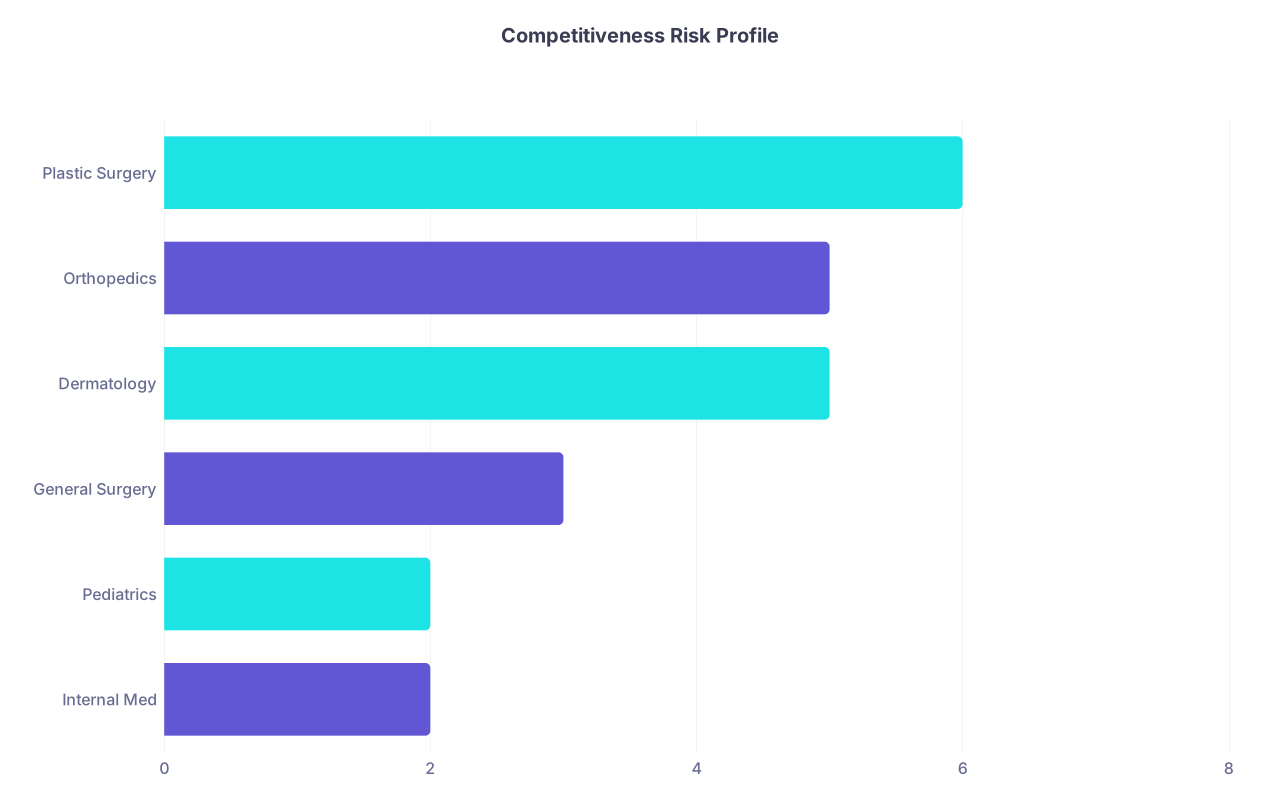
To make this visual:
| Category | Value |
|---|---|
| Internal Med | 2 |
| Pediatrics | 2 |
| General Surgery | 3 |
| Dermatology | 5 |
| Orthopedics | 5 |
| Plastic Surgery | 6 |
(Think of 1 as low stress, 6 as “you better have a plan A–D.”)
Step 3: Get a Second (and Third) Opinion from People Who Actually Match in This Field
If your advisor isn’t a derm/ortho/ENT/plastics person, their “this is impossible” speech may be based on outdated or secondhand info.
You need:
- A faculty mentor in that specialty
- A senior resident or chief who recently matched
- Possibly a recent grad from your school who matched into that field with similar or slightly better stats
Send a short, focused email. Something like:
I’m a MS4 at [School], strongly interested in [specialty]. I’ve been advised that it may be unrealistic given my [Step 2 score X, mostly HPs, limited research]. I’d really value a 20‑minute conversation to get a brutally honest assessment from someone in the field and ideas for a realistic application or re‑application plan.
People in competitive specialties respect directness. “Brutally honest” is the phrase that usually unlocks the real talk.
On the call, ask:
- “If I were your mentee, would you tell me to apply this year, delay and strengthen, or shift specialties?”
- “What does a minimally viable application look like in your honest opinion?”
- “Can you give me examples of applicants who matched from a similar starting point?”
You’re looking for patterns. If three people in the field tell you the same thing, believe them more than the one advisor who’s never written a letter to that specialty.
Step 4: Decide Which of These 4 Paths You’re Actually On
Once you’ve collected real data, you’re probably in one of four lanes:
- Legit competitive for the specialty (within or above typical ranges, with decent specialty exposure)
- Borderline but plausible with smart targeting + backup
- Currently underpowered but fixable with 1‑2 years of work
- So misaligned that it would take a heroic multi‑year reinvention
Let me spell those out in practical terms.
Path 1: You’re Legit Competitive (Your Advisor Is Just Risk‑Averse)
Example: Step 2 CK 252, HP/Honors in everything, 1 derm paper submitted, solid derm home rotation, but your advisor says, “Derm is really hard from here, you should do IM.”
In that case, ignore the discouragement. Replace it with execution.
Your move:
- Double down on mentors in the specialty
- Get 2–3 strong letters from people known in the field
- Apply broadly (not 40 programs; more like 70–100 for derm, ortho, plastics) based on your profile
- Have a backup specialty in your ERAS ready to go only if you get zero traction (we’ll talk about dual applying in a bit)
Path 2: Borderline but Plausible (This Is Where Most of You Actually Are)
Example: Step 2 CK 242 for ortho, HP in surgery, P in one rotation, limited research, no home ortho program.
This is not an automatic “you can’t.” It’s: this will be work and you need a rational backup plan.
Your move:
- Be surgical (no pun) in your program list: more community, mid‑tier, and geographic ties; less “prestige lottery”
- Lean hard into aways/sub‑Is where you can perform and get letters
- Figure out early whether you’ll dual apply (e.g., ortho + preliminary surgery; ENT + prelim general; derm + IM/transitional)
- Be emotionally prepared that you may match your backup. That has to be a specialty you can actually live with, not just something you say to sound flexible.
Path 3: Underpowered but Fixable (Requires Delayed Grad or Research Year)
Example: Step 2 CK 236, mostly Passes, minimal or no research, no real exposure in the field, and you’re trying for plastic surgery.
Your advisor telling you “don’t apply this year” might be doing you a favor. Not “never,” but “not like this.”
Your options:
- Take a research year (or two) in that specialty
- Delay graduation to beef up your clinical evaluations, leadership, and network
- Aim for preliminary year + reapplication if a structured path exists in that field (though for plastics/derm/ENT this is much harder than for, say, anesthesia or rads)
You’re not out. You’re just early and underbuilt.
Path 4: Wildly Misaligned (You Want Neurosurgery with a 215 and 6 Cs)
At some point, someone needs to say, “This is not a good use of your twenties.”
If your metrics are consistently way below norms and you have no standout factors—no stellar story, no crushing work ethic evidence, no insane research trajectory—then you’re burning time and energy on a dream that’s probably not salvageable.
That does not mean you “failed” medicine. It means you redirect into a field where you can actually thrive.
This is the hardest category to accept, but pretending otherwise is how people end up unmatched, bitter, and broke.
Step 5: Stop Treating Your Advisor’s Opinion as a Verdict
Your advisor is a data point, not a judge.
You should treat their discouragement like this:
- 30%: maybe they see real issues you’re minimizing
- 30%: their risk tolerance and personal experiences
- 40%: unknown biases, outdated info, institutional pressure to maintain match stats
I’ve seen:
- Advisors tell strong candidates “you’ll never match ENT” who ended up matching at academic programs
- Other advisors green‑light obvious long shots with no backup, leading to students going unmatched
- Advisors explicitly prioritize “our school’s match rate” over “this student’s actual goals”
So you listen. You extract actionable feedback (e.g., “you need more research,” “your professionalism comments worry people”). Then you move on and build a plan that doesn’t depend on them believing in you.
If your advisor is openly dismissive or mocking (“you? derm? good luck with that”), switch advisors if your school allows it. You’re not required to keep someone on your career team who doesn’t act like they’re on your team.
Step 6: Build a Concrete Strategy for This Application Cycle
Now, assume you’re going ahead in some form—either primary or dual application. What do you actually do?
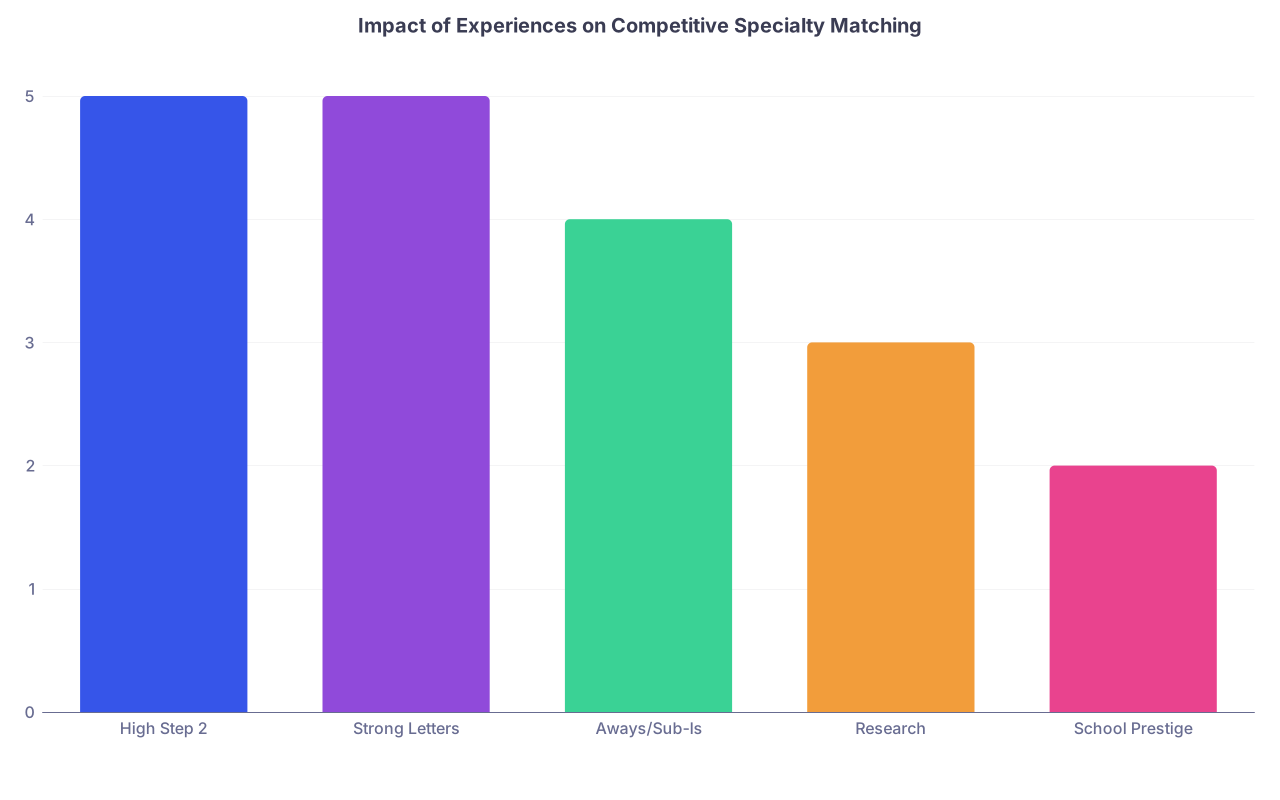
1. Lock in High‑Yield Experiences ASAP
You’re late in the game, but you can still:
- Add an away rotation or sub‑I in the specialty
- Get at least one letter from someone in that field who knows you well
- Get on 1–2 research projects that might not be published this year, but clearly show involvement and fit
| Category | Value |
|---|---|
| High Step 2 | 5 |
| Strong Letters | 5 |
| Aways/Sub-Is | 4 |
| Research | 3 |
| School Prestige | 2 |
(Rough “impact score” out of 5—letters and performance matter as much as raw numbers.)
2. Decide on Dual Application vs All‑In
Dual applying is not always the power move people think it is. Programs can smell a half‑heart application.
Dual application makes sense when:
- The two specialties have overlapping skill sets/residency structures (e.g., rads + DR prelim, neurology + prelim medicine, anesthesia + prelim medicine)
- You can write a coherent narrative for both without sounding disingenuous
- You’d genuinely be OK ending up in either specialty
Dual application is dangerous when:
- Your “backup” is something you would resent for the rest of your life
- Your application is diluted, with weaker letters and a muddled personal statement for both fields
If you dual apply, do it intelligently: a clear primary specialty (where your strongest letters and narrative live) and a realistic secondary with an honest explanation.
3. Manage Your Program List Like It’s a Portfolio
Competitive specialty? Then your program list should have:
- A few “reach” academic programs (fine, dream a bit)
- A lot of mid‑tier and community or hybrid programs
- Geographic ties highlighted clearly in your application wherever they exist
- Avoid overloading in cities where everyone applies “just because” (Boston, SF, NYC) unless you have big anchors there
Most people under‑apply to the middle and over‑apply to the top.
Step 7: Protect Your Head While You’re Taking This Risk
This part gets neglected. But it’s where students quietly implode.
Here’s what happens: your advisor says “don’t do it,” you apply anyway, and then every non‑invite feels like they were right and you were stupid.
So be proactive:
- Set a realistic expectation: “This will probably be a grind. I may get fewer invites than my friends. That doesn’t automatically mean I made the wrong call.”
- Define fail conditions before you submit: “If I get zero interview invites in [specialty] by X date, I will: [intensify backup specialty apps / pursue SOAP / plan for re‑application].”
- Have 1–2 people in your life (mentor, resident, friend) who actually believe this is at least possible and will remind you of that when you spiral.
You can’t outsource your emotional resilience to your advisor. They already told you what they think. Now it’s on you.
Step 8: If You End Up Unmatched or in Your Backup – Then What?
Real talk: you might not match your dream specialty, especially if you’re on the edge. That’s not failure; that’s odds.
If you go unmatched in the competitive specialty:
Use SOAP strategically. Don’t panic‑apply to random prelims you’d hate. Apply to spots that either:
- Are a genuine backup you can live with, or
- Offer a plausible path to reapplying (prelim surgery for rads/anesthesia, etc., though this is harder than people pretend)
Meet with mentors in the field immediately after match week and ask:
- “If I want to reapply, what would you have me do over the next 12 months?”
- “Does anyone honestly believe I can upgrade my application enough to be competitive next cycle?”
Sometimes the correct call is to move on, fully, to your backup specialty and build a life there. I’ve seen people fall in love with careers they initially saw as “settling.” Hospitalist IM, anesthesia, EM (in the right system), radiation oncology—there are many good lives in medicine that aren’t derm or ortho.
You’re allowed to grieve the dream. But staying stuck in “I was supposed to be X” is how you stay miserable.
Step 9: When You Should Actually Listen and Pivot
Here’s where I stop cheerleading and get blunt.
You should seriously consider pivoting away from a hyper‑competitive specialty if:
- You’re more drawn to the perceived lifestyle/pay/prestige than the actual work
- Multiple mentors in that specialty have tactfully said, “I don’t think this is the best fit”
- Your application has patterned professionalism or reliability issues (chronic lateness, bad eval comments, documented concerns)
- You want to “fight the odds” but you absolutely refuse to take extra time, do a research year, or make trade‑offs
People who actually succeed in derm/ortho/plastics/ENT when they’re not obvious superstars are usually the ones who say:
“I’ll take the research year, I’ll move cities, I’ll grind for 2 more years to give myself a real chance.”
If that sounds miserable to you, that’s a sign about your true level of commitment.
Quick Mermaid View: Your Decision Flow

| Step | Description |
|---|---|
| Step 1 | Love Competitive Specialty |
| Step 2 | Get Honest Feedback |
| Step 3 | Apply Mainly to Specialty |
| Step 4 | Apply With Backup |
| Step 5 | Research Year or Extra Time |
| Step 6 | Choose Different Specialty |
| Step 7 | Adjust List and Strategy |
| Step 8 | Commit to New Path |
| Step 9 | Within Typical Range? |
| Step 10 | Willing to Delay? |
FAQ (Exactly 3 Questions)
1. My advisor says I have “no chance” at my dream specialty. Should I even bother applying?
Maybe. “No chance” is almost never literally true. The real question is whether your probability is so low that the time, money, and risk of going unmatched are not worth it. If your metrics are only slightly below average and you’re willing to apply broadly, strengthen your letters, and accept a reasonable backup, applying can make sense. If you’re far below benchmarks with no realistic way to improve before applications, a Hail Mary all‑in strategy is usually a bad plan.
2. Is it smart to hide my competitive interest and tell programs I’m focused on the backup specialty?
No. Programs can smell that, and you’ll end up sounding generic to both sides. You don’t need to announce dual interest on day one, but your application to each specialty should stand alone as if it’s your primary. If you can’t write a convincing statement for the backup specialty where you sound honestly committed, that backup is probably not the right choice.
3. How do I know if it’s worth taking a research year to strengthen my application?
It’s worth it only if three things are true:
- Faculty in that specialty believe you have a realistic shot after the research year;
- You’re willing to treat that year like a full‑time job, not a vacation—posters, manuscripts, networking, away rotations, all of it; and
- You can tolerate the financial and personal cost of delaying training. If those conditions aren’t met, stretching school by an extra year often just delays the same outcome you’d have had now.
Key Takeaways
- Your advisor’s discouragement is data, not destiny. Extract specifics, then get second opinions from people in the specialty.
- Match your strategy to your actual profile: all‑in, dual apply, delay and strengthen, or genuinely pivot—don’t pretend you’re doing one while emotionally committed to another.
- If you’re going to fight for a competitive specialty, commit to the work and accept the risk. If you’re not willing to do that, choose a path you can actually live with and build a good life there.