What if the “backup” community program you barely skimmed on FREIDA ends up being your only interview in a hyper‑competitive specialty?
Let me be direct: underestimating community programs in competitive fields is one of the fastest ways to sabotage your match. Especially in things like dermatology, orthopedic surgery, plastics, ENT, anesthesia, EM, even GI and cardiology fellowships later on.
I’ve watched this play out more times than I like:
- Applicant wants ortho/derm/ENT/anesthesia.
- Only takes “seriously” the big-name university programs.
- Treats community programs as beneath them, or “safety” options that don’t need effort.
- January comes. Interview calendar is almost empty.
- Panic. Regret. Frantic emails that never get answered.
You think you won’t be that person. Most people who end up there thought the same.
Let’s prevent that.
The Core Mistake: Assuming “Community = Easier”
The biggest mental error: equating “community” with “less competitive” or “easier to get into.”
In some specialties, that assumption is flat-out wrong.
Here’s what people think the landscape looks like:
- University programs: hyper‑competitive, for the top applicants
- Community programs: backup, for weaker or average applicants
Reality is uglier and more nuanced:
- Some community programs in competitive fields are just as selective as mid-tier academic programs.
- Many have tiny class sizes (2–4 residents per year), which means:
- Fewer spots
- Less tolerance for risk in rank lists
- Strong emphasis on “fit” and work ethic
- They may not have name recognition, but they know everyone treats them as backup—so they bias toward applicants who actually seem to want to be there.
You underestimate them → they feel it → you don’t get ranked.
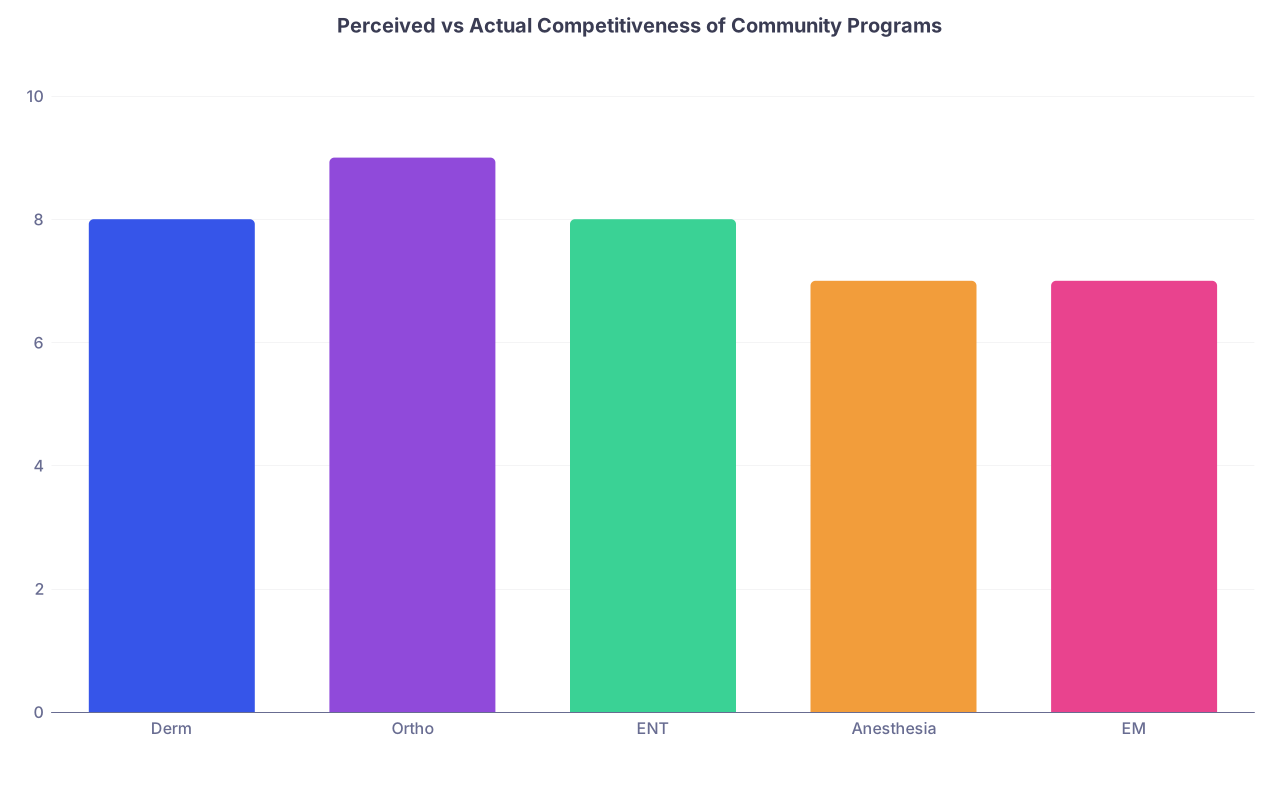
| Category | Value |
|---|---|
| Derm | 8 |
| Ortho | 9 |
| ENT | 8 |
| Anesthesia | 7 |
| EM | 7 |
(Scale 1–10 where 10 = “top academic name-brand program.” The gap between perception and reality is what burns people.)
How Underestimating Community Programs Wrecks Your Match
Here are the concrete ways this mistake shows up. If you recognize yourself in more than one of these, you’re playing with fire.
1. Applying to Too Few Community Programs
You’d be surprised how often I hear something like:
“I’m applying to 45 ortho programs, but only 5 are community. I don’t really see myself there.”
Translation: “I don’t understand the current match climate.”
In competitive fields, community programs are often:
- Where borderline applicants actually match
- Where IMGs/non‑traditional candidates have a shot
- Where geographic flexibility can be leveraged
By limiting community applications, you:
- Shrink your interview pool
- Rely on academic programs that are flooded with 260+ scores, AOA, PhDs
- Lose out on places that might love your workhorse energy and clinical skills
2. Writing Lazy, Generic Emails and PS for Community Programs
This one is painfully common.
Applicants put 80% of effort into:
- Personal statement geared toward prestige academic departments
- Emails to PDs at big names
- Letters of interest to “top 10” lists
Then they reuse that same generic stuff for community programs.
Programs notice when they are clearly your afterthought. Phrases like:
- “I am very excited about your strong research environment” (for a program that barely does research)
- “Your affiliation with [big academic center] is very appealing” (when that affiliation is mostly symbolic)
- “I am committed to an academic career” (for a program that’s proud of training community clinicians)
Instant turn‑off. They do not want to be your 3-year layover while you dream of better.
3. Weak Interview Preparation “Because It’s Just a Community Program”
This is where people tank themselves on interview day.
I’ve seen applicants:
- Show up late because “traffic was worse than I expected”—but somehow that never happened for the university interview
- Clearly not read the website beyond the first page
- Ask zero program-specific questions
- Ask only “How do residents match into fellowships?” in a place that serves primarily as a clinical training center
Community faculty have egos too. They work hard, take pride in their training environment, and they can absolutely tell when you’re “slumming it” through the day.
Programs remember:
- Who was actually excited about the patient population
- Who asked thoughtful questions about operative volume, autonomy, mentorship
- Who bothered to understand the program culture
Guess who gets ranked higher? Not the person who said, “This is my backup, but I think I’ll be fine.”
The Quiet Reality: Many Community Programs Are More Intense Than Universities
If you think community means “chill work and easy lifestyle,” you’re setting yourself up for a nasty surprise.
In many competitive fields, community programs often have:
- Higher operative volume per resident (especially in ortho, ENT, gen surg, OB/GYN, anesthesia)
- More autonomy earlier in training
- Less resident competition for cases because there are no fellows
- Heavier service load with less ancillary support
You know what that means for selection?
They want:
- People who can grind
- Reliable, not glamorous
- Less precious about “protected” research time, more focused on getting good clinically
You stroll in acting like you’re interviewing for a chill backup spot? You just told them you might crumble when the work hits.

Red Flags That You’re Undervaluing Community Programs
Here’s a quick self-check. If these sound familiar, fix it now.
Application Strategy Red Flags
- You applied to <10 community programs in a hyper‑competitive specialty.
- Your entire list is built around reputation and city desirability, not where you’re actually competitive.
- You didn’t bother to learn which community programs:
- Have strong fellowship placement
- Have high procedure volumes
- Have PDs who actually reply to emails
Personal Branding Red Flags
- Your personal statement screams “I’m destined for an academic career in NIH-funded research” when your CV does not.
- Every interview answer about your future is some version of “I want to be a physician-scientist” but you’re applying to heavily clinical community places.
- You don’t have a version of your personal statement that emphasizes:
- Clinical excellence
- Ownership of patient care
- Interest in high-volume bread-and-butter cases
- Teaching and community engagement
Behavior Red Flags
- You rank community programs based primarily on city desirability: “Well, at least it’s in [fun city].”
- You plan to “save money” by canceling some community interviews because you got 2–3 academic invites and “that should be enough.”
- You talk about community programs with subtle condescension around classmates. (You think PDs and faculty never hear about that? Cute.)
Why Community Programs Might Actually Be Your Best Bet
Let’s talk upside. Because there is a lot of it, if you’re not too arrogant to see it.
1. Match Probability
In competitive specialties, survival comes first. You can’t specialize if you never match.
Community programs can be:
- More open to:
- Non‑AOA
- Lower Step 2 scores (within reason)
- Non‑traditional backgrounds
- US-IMGs/FMGS (depending on specialty and location)
- Less obsessed with:
- Ivy undergrad
- Famous letter writers
- First‑author NEJM papers
They often care more about:
- Strong clinical performance
- Work ethic
- Local ties
- Fit with their culture
2. Training Quality
A lot of residents quietly admit later:
“My community program had insane volume and autonomy. I’d do it again in a heartbeat.”
You might get:
- More hands-on experience
- Earlier responsibility
- Closer relationships with attendings
- Faster development of real clinical judgment
Are you going to be a world-famous researcher? Probably not. Are you going to be a competent, confident clinician? Very likely.
3. Fellowship Potential
Here’s another wrong assumption: “If I go to a community program, I’ll never get a competitive fellowship.”
Not true in many fields.
Some community programs have:
- Strong connections with specific fellowships (because their grads succeed there)
- Attendings who did top-tier fellowships and still have contacts
- A track record of sending 1–2 residents per year to solid fellowships in:
- Cardiology
- GI
- Critical Care
- Pain
- Sports
- Heme/Onc
- ICU, etc.
| Feature | Community Program A | University Program B |
|---|---|---|
| Yearly resident spots | 3 | 6 |
| Average weekly cases (senior) | High | Moderate |
| Fellows present | None | Multiple services |
| Research requirement | Optional | Strongly expected |
| Recent fellowship matches | Regional strong | National top-tier |
Is the fellowship list identical to the top 5 academic giants? No. But it’s a path. A real one. For you.
How to Stop Making This Mistake (Before It Hurts You)
Here’s how to treat community programs with the respect that will actually help you match.
1. Build a Realistic Program List
For competitive specialties, include:
- A solid core of academic programs (if that’s your dream)
- A meaningful number of community programs, not 3–5 thrown in to make yourself feel better
As a rough, not-perfect guideline for highly competitive fields:
- Strong applicant (high scores, research, honors):
- Maybe 60–70% academic, 30–40% community
- Mid applicant:
- Closer to 50–50
- Borderline applicant:
- Heavier community focus (and possibly a backup specialty entirely)
This isn’t exact, but if you’re at “95% academic, 5% community” and you’re not a unicorn, you’re in denial.
2. Do Actual Homework on Community Programs
Pick 10–20 community programs and learn:
- Case volume (for surgical/procedural fields)
- Resident autonomy and responsibilities
- Fellowship outcomes
- What they emphasize on their website (clinical work? community service? teaching?)
- Any regional or local ties you can honestly highlight
Then:
- Tailor a short section of your personal statement for them
- Prepare 2–3 specific questions per program you can use on interview day
- Be ready to say, convincingly, why you’d thrive there, not just “in your specialty”
3. Craft a Community‑Compatible Story
You need a version of your “why this specialty” that makes sense for community training:
Emphasize things like:
- “I enjoy managing the bread-and-butter and complex cases that make up the bulk of real-world practice.”
- “I’m drawn to programs where residents take true ownership of patient care and are pushed clinically.”
- “I want to be the person attendings and nurses rely on at 2 a.m. when something is going wrong.”
De‑emphasize (or calibrate) things like:
- “My long-term goal is to run a basic science lab”
- “I’m primarily motivated by a career in academic medicine and high-level research” (when your CV doesn’t support that)
You can still be honest about enjoying teaching or doing some research. Just do not present yourself as someone who clearly views community training as Plan B to your fantasy R01 lifestyle.
4. Treat Every Interview Like It Could Be Your Only One
Because in some years, that’s exactly how it plays out.
For every community program interview:
- Read the website thoroughly (faculty list, curriculum, hospitals covered)
- Know:
- How many residents per year
- Call structure basics
- Any unique features they highlight
- Have program-specific questions ready that are not:
- “How competitive is your fellowship match?” as your first or only question
- “Do you plan to become more academic?” (literal question I’ve heard; it went badly)
And please, do not:
- Cancel community interviews early in the season “because I already have 4–5 invites” in a competitive field
- Assume invitations mean you’re “safe”
- Brag publicly about canceling “safety” interviews; word travels
The Match List Disaster: When Arrogance Becomes Unemployment
Final way this mistake nukes people: the rank list.
Common trap:
- You interviewed at 4 academic and 6 community programs.
- Ego says: “I’ll rank all the academic places above every community, even the one where I actually felt happiest.”
- You convince yourself: “I’d rather scramble/SOAP than go there.”
Then you don’t match.
Community programs are not your enemy. Your pride is.
If you felt:
- Respected
- Supported
- Comfortable with the resident culture
- Confident about the training
You do not push that program down your list just because the name doesn’t impress your classmates.
The match algorithm favors your preferences. But it cannot save you from bad ones.

| Step | Description |
|---|---|
| Step 1 | Competitive Specialty Applicant |
| Step 2 | Applies Mainly to Academic Programs |
| Step 3 | Few Interviews |
| Step 4 | Short Rank List |
| Step 5 | High Risk of Not Matching |
| Step 6 | Balanced Academic and Community List |
| Step 7 | More Interviews |
| Step 8 | Stronger, Longer Rank List |
| Step 9 | Much Higher Match Chance |
| Step 10 | Values Prestige Over Reality |
FAQ (Exactly 3 Questions)
1. If I really want an academic career, should I even consider community programs?
Yes. You’re not signing a blood oath to stay community forever. Many people train at community programs, then do fellowships at academic centers and end up in academic jobs. If your record doesn’t scream “obvious academic star,” it’s smarter to secure strong clinical training at a community program than to roll the dice and not match.
2. Are community programs actually harder than academic ones?
Sometimes, yes—especially for workload and autonomy. You may have less ancillary support, fewer fellows, and more direct responsibility. The name on the badge may be smaller, but the expectations often are not. That’s exactly why these programs are picky about who they take, and why underestimating them is so dangerous.
3. How many community programs should I apply to in a competitive specialty?
There’s no magic number, but if you’re in a competitive field and applying to 40+ places with fewer than 10–15 community programs, you’re probably overestimating your chances at academic centers. The weaker your scores/grades/research compared with the field, the more you should lean into community programs—and treat them like real targets, not afterthoughts.
Key points to remember:
- “Community” does not mean “easy” in competitive fields; many of these programs are brutally selective and intense.
- Treating community programs as backups—half-hearted PS, weak prep, minimal applications—is how strong candidates end up unmatched.
- A balanced, realistic strategy that genuinely respects community programs dramatically increases your odds of matching and becoming the kind of clinician you say you want to be.