
It is late February. Your friends are casually talking about their rank lists over lukewarm lecture hall coffee. One says, “I just ranked all my derm programs, then threw in a couple prelim medicine spots at the end. I mean, I have to try, right?”
You nod. You have maybe 8 interviews in a highly competitive specialty, plus a single “backup” in a less competitive field you are not even sure you like. You keep telling yourself: “People match with fewer. I know someone who matched ortho with 5 interviews. I will be fine.”
This is exactly how people walk into Match Week and end up staring at the “You did not match” screen.
Let me be blunt: over-ranking competitive specialties without a realistic strategy is one of the most quietly destructive mistakes I see every year. It is not dramatic when you submit. It feels “optimistic.” It feels “go big or go home.” The “home” part shows up in March, and it is brutal.
You are here because you are smart enough to sense the risk. Good. Let us dissect the fatal errors before they dissect your match.
The Core Problem: Misjudging Your Actual Competitiveness
The most dangerous applicants are not weak. They are “borderline competitive” and overconfident.
- Strong-ish scores
- Decent letters
- A couple of nice research lines
- And a wildly inflated sense of where they sit in the national pool
I keep seeing the same pattern.
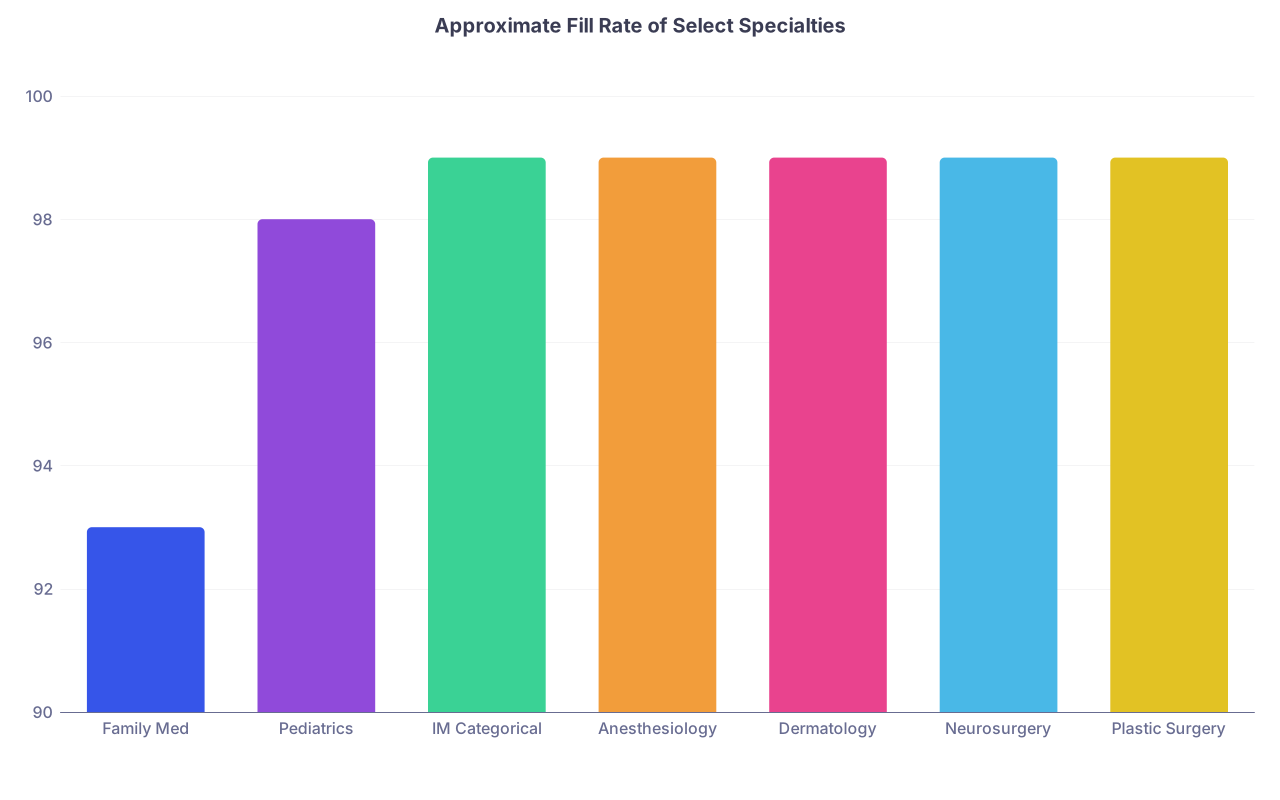
| Category | Value |
|---|---|
| Family Med | 93 |
| Pediatrics | 98 |
| IM Categorical | 99 |
| Anesthesiology | 99 |
| Dermatology | 99 |
| Neurosurgery | 99 |
| Plastic Surgery | 99 |
Those 99% fill rates? That means almost no slack in the system. Programs in derm, ortho, neurosurgery, plastics, ENT, integrated vascular, etc. are not scrambling to find warm bodies. They are choosing among piles of strong applications.
Common self-deception phrases you should treat as red flags:
- “My Step is below the median, but they liked me on interview.”
- “I did not get many invites, but the ones I got are legit programs.”
- “My advisor said it would be tough, but they did not say impossible.”
- “I know someone who matched with similar stats.”
I have watched people hang their entire match outcome on 4–6 interviews in a hypercompetitive field…with zero genuine backup. Or with a “backup” so badly ranked it might as well not be there.
Do not be that person.
Fatal Error #1: Confusing “I Got Interviews” With “I Am Likely To Match”
Once you get interviews, you are in the game, right? Yes. But you might be the 14th ranked applicant for 3 spots at each program. Being “interviewed” is not the same as being “competitive enough that ranking only this specialty is safe.”
Here is the mental trap:
“NRMP says most people match within their top 3. So if I rank all 7 derm programs first, I am probably matching derm.”
Wrong. “Most people” is a population-level statistic which includes primary care, prelim-only lists, couples match distortions, and internal candidates. It does not mean you, with 7 interviews in a 99% fill-rate specialty, have a 90% chance of matching derm.
I have seen:
- Applicant with 5 ortho interviews, Step 1 225 (when it still had scores), decent research, confident as hell → Unmatched. SOAP into prelim surgery.
- Applicant with 4 ENT interviews, average scores, no real backup → Unmatched, forced SOAP into TY; delayed career by a full year reapplying.
- Applicant with 8 derm interviews, but all from weaker programs, plus a couple of IM backups ranked very low → matched IM at choice #15 after a painful Monday of thinking they had totally failed.
Key reality: number of interviews in ultra-competitive specialties is not linear with match probability. Going from 2 to 6 helps, but it does not suddenly make it “safe” to skip a real backup.
Fatal Error #2: Using “Backup” Specialties Incorrectly
The word “backup” gets abused. People pretend they have one when they actually do not.
Common fake backups:
- Ranking a single prelim medicine or surgery year after 10 competitive programs and calling it “backup.”
- Applying to a less competitive specialty but ranking all those programs below every single competitive program, even the weak ones or ones you hated.
- Choosing a specialty you would never actually want to practice as your supposed safety net (e.g., “I will just match prelim then figure it out”).
Here is how weak backups typically show up on rank lists:
- Derm programs 1–10
- One random IM categorical you barely researched
- One prelim medicine spot
- Done
This rank list says:
“I would rather be unmatched than seriously consider a non-derm career path.”
If that is genuinely true, fine, you are consciously accepting the risk. For many students, it is not. They just could not emotionally face ranking other specialties higher than their dream. So they played pretend with a backup.
You want a real backup? That means:
- Sufficient number of interviews in that specialty (not 1–2).
- Ranking many of those programs above low-quality / low-interest competitive programs.
- Being emotionally prepared to actually do that specialty for a career if you match it.
If you would be devastated matching into your “backup” field, that is not a backup. That is denial.
Fatal Error #3: Ignoring Objective Data and Advisor Warnings
This one frustrates me the most, because it is preventable.
Your school gives you data. NRMP gives you data. Specialty societies publish data. Yet many applicants listen to:
- Rando on Reddit: “Matched ortho with 3 interviews, low Step, no research, AMA.”
- Classmate: “My mentor said they loved me. I am sure I am high on their list.”
- Family: “You have always been top of your class. Just go for it.”
And then ignore:
- Your home program director quietly saying, “You are borderline; you need a parallel plan.”
- The fact you got 3 interviews when average matched applicants had 12–15 in that specialty.
- Your dean suggesting adding a less competitive specialty you would also be content with.
Here is how you should be thinking, not feeling.
| Area | Concerning Sign |
|---|---|
| Interview Count | <6 in a very competitive field |
| Score Profile | Below specialty median or multiple fails |
| Research | Little/no specialty-related work |
| Advisor Feedback | Any version of “it will be tough” |
| Home Support | No home program or lukewarm support |
You do not need all five red flags. One or two can be enough to justify building a serious parallel rank strategy. Ignoring them because it “feels negative” is how people end up in the SOAP, scrambling for prelims they never wanted.
Fatal Error #4: Rigid “Dream or Nothing” Rank Philosophy
I have heard some version of this regularly around February:
- “If I do not match plastics, I will just reapply next year.”
- “I would rather SOAP into a prelim than match family or IM.”
- “I will do a research year. That will fix everything.”
Here is the problem: you are planning your life based on the assumption that future you will have:
- Unlimited emotional resilience
- Financial stability for an extra year (or two)
- Programs magically more interested in you after you went unmatched
Reality is uglier.
An unmatched year:
- Raises questions for future PDs: “Why did no one pick this person last time?”
- Adds stress, debt, and usually at least one geographic move
- Can actually make you less competitive if you do not fill the gap with strong, specialty-specific research or a relevant position
And no, a generic “research year” at some random institution does not automatically convert you into a superstar applicant. Sometimes it just delays the same problem.
Ask yourself honestly:
- Would you rather:
- Match right now into a solid, respected field you like 80–90%, or
- Roll the dice and potentially be unmatched, doing a prelim or non-training job, hoping next year looks better?
For some, the specialty passion is that strong. For many? They tell themselves it is, but break down during SOAP when reality hits.
I would rather see you rank:
- Competitive specialty programs you truly want
- Then a string of realistic, acceptable non-competitive specialty programs
- Then maybe a few prelims at the end
Than a list that screams “derm or bust” when your file clearly is not derm-level competitive.
Fatal Error #5: Not Understanding How NRMP Actually Works
If you do not understand the algorithm, you are gambling blindly.
Very short version: the algorithm is applicant favorable. It tries to give you the most preferred program that also ranks you high enough. But it can only choose among specialties you actually ranked.
If you rank:
- Ortho #1–10
- A single prelim spot #11
- Done
The algorithm cannot magically put you into a perfectly good categorical internal medicine program that did rank you but which you never listed. It is trapped by your rank list.
Common myths that get people into trouble:
“If I list it, I will match there.”
No. Ranking a backup does not make it your destiny. It only makes it possible.“If I include a less competitive specialty, the algorithm might give me that instead of my dream.”
Also no. It always tries to match you at the highest program on your list that also wants you. Ranking internal medicine at #15 will not “block” a program at #3 from taking you.“More ranks hurt my chances at top choices.”
Complete nonsense. Rank every program where you would accept training. Order them by genuine preference. That is it.
If you are not crystal clear on this, stop and learn. You are risking your career on an algorithm you might not fully understand.
Fatal Error #6: Letting Ego or Shame Control Your Backup Strategy
A very real, very ugly emotion in all this: shame.
Students tell me:
- “My family expects me to be a surgeon.”
- “Everyone knows I am going for derm. What will they think if I rank IM high?”
- “My school sends 5 people to ortho every year. I do not want to be the one who did not make it.”
So instead of building a rational, diversified rank list, they build a performance. Something they can show to others and say, “See? I went all in.” Then, if they go unmatched, they mentally shift: “Well, I took my shot. The system is unfair anyway.”
Let me be brutally direct: your ego does not deserve that level of power over the next 40 years of your life.
Nobody cares as much as you think. Your classmates are consumed with their own rank lists. Your program directors see failed matches every year. The only person who lives with the consequences long-term is you.
Ask yourself this before locking your list:
“If no one ever saw my rank list, and there were no bragging rights or shame, how would I order these programs and specialties?”
That answer is usually more rational. And safer.
How To Avoid These Errors: A Sanity-Check Framework
You want a checklist? Fine. Use this before you certify your rank list if you are applying to a competitive specialty (derm, plastics, neurosurgery, ENT, ortho, urology, integrated vascular, etc.).
1. Interview Count Reality Check
For your competitive specialty:
- <4 interviews: you need a serious backup.
- 4–7 interviews: you are in the gray zone. Backups strongly recommended.
- 8–12 interviews: still not “guaranteed.” A parallel plan is wise unless your file is truly stellar.
- 13+ interviews: now we are in the “likely” territory, but nothing is 100%.
And do not lie to yourself. If half those interviews are at super reach programs and you have no home support, the number looks better than it is.
2. Objective Competitiveness Check
Compare yourself honestly to recent matched data for that specialty:
- Scores (or pass/fail + Step 2)
- Research quantity and quality
- Presence/absence of a home program
- Letters from recognizable names in the field
- Red flags (leaves, failures, professionalism concerns)
If you are below average on more than one dimension, you should be actively building a backup plan, not just “keeping options open.”
3. Backup Specialty Integrity Check
If you claim to have a backup:
- Do you have at least 8–10 interviews in that specialty (for less competitive fields)?
- Are there at least 5+ backup programs ranked above your least-desired competitive programs?
- Could you look yourself in the mirror and say, “I would be okay practicing this field”?
If the answer to any of these is “no,” you do not really have a backup.
4. Emotional Honesty Check
Sit alone. No parents. No classmates. No attendings.
Write down:
- Specialty A (competitive)
- Specialty B (backup)
Then answer, in writing:
“If I match B instead of A, will I absolutely hate my life, or will I be a little disappointed for a while but fundamentally okay?”
If you are fundamentally okay, then you are being reckless if you do not rank B realistically. If you would absolutely hate B, then maybe you should not waste time on that backup and instead plan for research/reapplication with open eyes.
A Visual of What a Dangerous vs Safer Strategy Looks Like

| Step | Description |
|---|---|
| Step 1 | Competitive specialty only |
| Step 2 | High risk of unmatched |
| Step 3 | Competitive plus weak backup |
| Step 4 | Moderate risk & limited options |
| Step 5 | Competitive plus robust backup |
| Step 6 | Lower risk & more stable path |
You do not have to love the backup more than the dream. You just have to respect risk enough to give yourself a landing zone that is not a free fall.
FAQs
1. If I rank a less competitive specialty, will that hurt my chances of matching my dream specialty?
No. The algorithm always tries to match you to the highest-ranked program on your list that also ranks you high enough. Ranking internal medicine at #15 does not reduce your odds for a derm program at #3. It just gives you a safety net if none of the top options work out.
2. How many interviews in a competitive specialty are “enough” to skip a backup?
There is no magic number, but in highly competitive fields, fewer than about 8–10 interviews should make you very nervous if you have no real backup. Even with more, if your scores, research, or letters are below average for the field, banking exclusively on that specialty is still risky. A parallel plan almost never harms you and often saves you.
3. What if I am genuinely willing to go unmatched and reapply rather than match a backup specialty?
Then you need to be honest and intentional. Do not pretend you have a backup. Acknowledge that you are accepting a significant risk: extra debt, delayed training, possible future stigma as an unmatched applicant, and no guarantee that next year will be better. If, after fully understanding that, you still choose “dream or nothing,” fine. Just do not drift into that position by denial and wishful thinking.
Remember:
- Interviews in a competitive specialty do not equal safety.
- A “backup” that you rank too low or too thin is not a backup.
- Your ego and other people’s expectations are terrible guides for building a rank list.