The idea that “competitive specialties all feel the same” is wrong. Ophthalmology and urology prove it. Same ballpark of competitiveness. Completely different timelines and pressures.
Let me break this down specifically, because students screw this up every single year and pay for it with rushed apps, weak letters, or leaving a door closed that did not have to be.
We are talking about two early matches, two different centralized systems, and two distinct psychological pressures:
- Ophthalmology: SF Match, very early, front‑loaded anxiety, heavy research prestige culture.
- Urology: AUA/ERAS hybrid, earlier than NRMP but later than ophtho, more longitudinal evaluation pressure.
If you are even half‑seriously considering either of these, you cannot afford to “figure it out later.” Later is already too late for these two.
Big‑Picture: How Ophtho and Urology Match Systems Actually Differ
| Feature | Ophthalmology | Urology |
|---|---|---|
| Match system | SF Match | AUA Match (via ERAS) |
| Match date (relative to NRMP) | About 2–3 months earlier | About 1–2 months earlier |
| App opens | SF Match portal late spring/early summer | ERAS with other specialties (late spring) |
| Common interview season | Sept–Dec | Oct–Jan |
| Typical PGY start structure | Separate PGY-1 transitional/prelim + PGY-2 ophtho | Integrated categorical 5–6 year program |
That table is the skeleton. The lived reality is more brutal.
Ophthalmology compresses everything earlier. Your personal statement, letters, Step 2 score, and research story need to be mature by late summer of MS4 at the latest. Weak planning here means you are scrambling in June while your psych and IM classmates are still trying to remember their ERAS password.
Urology still feels early compared to categorical IM or FM, but the timeline is less compressed. You get a bit more space for late MS3 rotations, Step 2 improvement, and one last meaningful urology experience before programs rank you.
Timelines: Month‑by‑Month Reality
Let us walk through this the way I would with a serious MS3 trying to decide.
Rough Annual Timeline Comparison
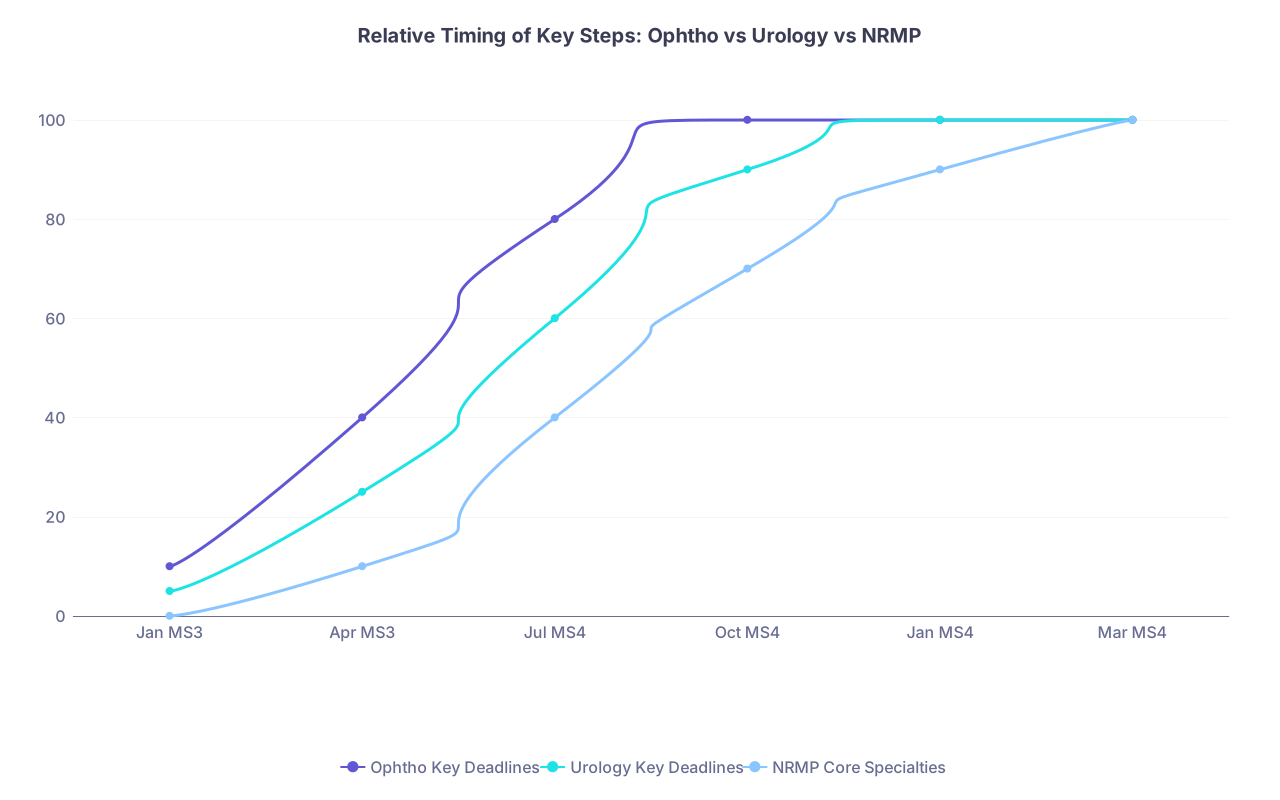
| Category | Ophtho Key Deadlines | Urology Key Deadlines | NRMP Core Specialties |
|---|---|---|---|
| Jan MS3 | 10 | 5 | 0 |
| Apr MS3 | 40 | 25 | 10 |
| Jul MS4 | 80 | 60 | 40 |
| Oct MS4 | 100 | 90 | 70 |
| Jan MS4 | 100 | 100 | 90 |
| Mar MS4 | 100 | 100 | 100 |
This is conceptual: higher “value” = more critical events happening.
Ophthalmology Timeline
Approximate; exact dates shift year to year. But the pattern stays the same.
- MS3 Winter (Jan–Mar)
You should already be:- Shadowing or doing a short ophtho experience.
- Identifying at least one potential ophtho research mentor.
- Thinking seriously: Is this my lane or just a flirtation?
If you “decide ophtho” in May of MS3, you are late but salvageable. If you decide in August of MS4, you are essentially applying blind.
MS3 Spring (Apr–Jun)
Ideal time for:- Dedicated ophtho elective at home.
- Getting involved in a project that has at least a chance to submit/accept an abstract by fall.
- Securing your first letter writer (and making sure they actually know you).
Early MS4 (Jun–Aug)
SF Match opens, programs set deadlines, and:- You finalize your program list (no, you cannot wait until October).
- You polish your personal statement, CV, upload Step 1 (if available) and Step 2 scores.
- Letters must be requested aggressively early. Ophtho attendings are notorious for slow letter turnaround.
Most ophtho applications are in by August / early September. That means your MS3 performance + Step scores + early exposure do almost all the work.
Interviews: Sept–Dec
Heavy clustering in October and November.
You will be:- Traveling earlier than almost any other specialty.
- Balancing away rotations (if you do them) with interview days.
- Spending money before your classmates even hit “submit” on ERAS.
Match: January (approx.)
SF Match results drop months before NRMP.
If you do not match, you have a very narrow window to pivot to another specialty or scramble into a prelim year.
Urology Timeline
More aligned with the traditional ERAS schedule but the actual match comes earlier through the AUA.
MS3 Winter–Spring
Ideally:- One urology elective or at least exposure.
- Initial relationship with one or two attendings.
- Exploring whether the OR + clinic mix and lifestyle are realistic for you.
Late MS3 / Early MS4 (Apr–Jun)
ERAS opens; urology applicants:- Prepare ERAS just like other specialties: CV, personal statement, etc.
- Usually aim for at least one “home” urology rotation plus possibly one away at a strong program.
MS4 Summer (Jul–Sep)
You:- Finalize ERAS.
- Take Step 2/Level 2 if you want that higher score in your file (strongly recommended for competitive urology).
- Lock in letters: at least one strong urology letter, usually more.
Most urology applicants are submitting around the same time as other early‑submitting specialties (September), but programs may start reviewing earlier, and the interview scheduling tends to run on an earlier rhythm.
Interviews: ~Oct–Jan
Urology interviews overlap with but slightly front‑load compared to core NRMP specialties.
You will see:- Some programs heavily interviewing in November.
- Compressed schedules to accommodate their earlier rank/match timeline.
Match: January (around the same month as ophtho, via AUA)
Again, earlier than NRMP.
The critical difference: many urology programs are categorical (intern year + all urology years), so your “backup” conversation feels different. There is no separate intern‑year scramble in most cases.
Distinct Academic and Application Pressures
This is where the anxiety profiles diverge.
Board Scores and Academics
Historically, both fields liked high Step 1 scores. That landscape is mutating with Step 1 pass/fail, but the culture is still there.
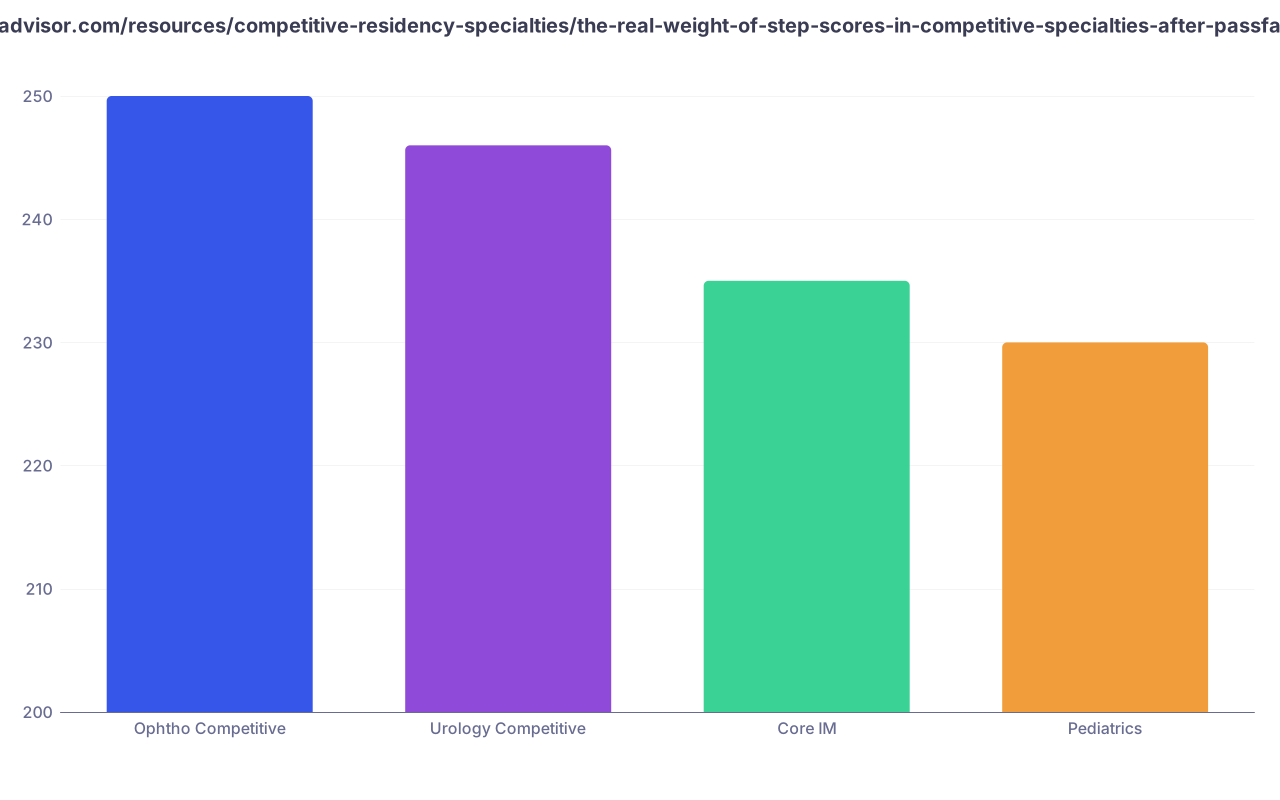
| Category | Value |
|---|---|
| Ophtho Competitive | 250 |
| Urology Competitive | 246 |
| Core IM | 235 |
| Pediatrics | 230 |
Numbers are rough, based on recent cycles, program talks, and who I see actually matching:
- Ophthalmology
Very sensitive to:- Strong Step 2 CK (now the only numerical Step metric). Think mid‑240s and above at competitive academic places.
- Class rank / AOA.
- Honors in medicine, surgery, and ophtho electives.
Ophtho has a research‑heavy culture. They care that you can handle highly technical, microsurgical details and digest literature. That tends to select for strong test‑takers and academically obsessive personalities.
- Urology
Also cares about:- Strong Step 2 CK, mid‑240s competitive at good programs, higher for top‑tier academic names.
- Solid performance on surgery rotation.
- Consistent third‑year clerkship evaluations more than hyper‑prestige research output in many cases.
The pressure profile:
- Ophtho: “Am I academically elite enough?”
- Urology: “Am I surgically capable and reliable enough?”
Research and Scholarly Work
Here is where students underestimate ophtho routinely.
- Ophthalmology
At competitive academic programs (Bascom, Wills, Wilmer, Mass Eye and Ear, UCLA, etc.), I have seen:- Multiple ophtho publications, sometimes first‑author.
- Conference posters at ARVO, AAO.
- Dedicated research years increasingly common for people gunning for the top 10.
If you are at a mid‑tier med school with no home ophtho department and minimal research, you are under real pressure. Not impossible, but you cannot coast.
- Urology
Research is valued but less dogmatic.- One or two urology‑related projects, or at least some surgical/relevant outcomes research, is very common.
- A full research year is more optional outside of the super‑competitive academic programs.
Pressure profile:
- Ophtho: “If my research portfolio is thin, am I dead on arrival?”
- Urology: “I need some scholarly work, but being a hard‑working, known quantity on rotation can compensate more.”
Letters, Rotations, and Away Strategy
Here is where the timelines smack you in the face.
Ophthalmology Letters and Rotations
The SF Match timeline compresses your ability to build a late‑bloomer narrative.
- You usually want:
- 2+ ophtho letters (1 from your home institution, 1 from an away or research mentor).
- 1 core clinical letter (medicine or surgery) if possible.
The pressure:
Your home elective often occurs in late MS3 or very early MS4. That means:
- If your med school schedules your ophtho elective in, say, August of MS4, you are in trouble. Letters may not be ready by the time you need to apply.
- Away rotations need to be smartly placed: many students aim for a May–July away to turn that experience into a letter before apps finalize.
I have seen students do:
- Home ophtho in March–April of MS3.
- Away #1 in June.
- Away #2 in July.
By August, they have three ophtho letters. Exhausting but strategic.
Urology Letters and Rotations
Urology gives you a bit more breathing room and more emphasis on longitudinal performance.
- You usually want:
- 2 urology letters (home faculty, away faculty).
- 1 medicine or surgery letter.
Rotations often look like:
- Home urology rotation late MS3 or early MS4.
- One away rotation mid‑MS4 (Jul–Sep).
- That away’s letter can still realistically make it in before heavy interview offers.
The psychological difference:
Urology lets you “peak” a little later. If you discover urology in January of MS3 and turn it on, you still have a real shot.
Match Mechanics: SF Match vs AUA vs NRMP
Let us clarify the plumbing, because this confuses people every application season.
Ophtho – SF Match
- Uses its own portal (not ERAS).
- You upload your documents, select programs, and rank within SF Match.
- Match outcome arrives earlier than NRMP.
Consequence:
- If you match ophtho, you then apply separately for a PGY‑1 prelim or transitional year (through NRMP).
- You essentially know your PGY‑2+ destination before you know your PGY‑1.
This fracture adds pressure:
- You must simultaneously manage two application cycles:
- Ophtho (SF Match)
- Internship (NRMP)
- And you must signal to prelim/TY programs that you are an ophtho‑bound applicant, which some medicine programs love and some quietly dislike.
Urology – AUA Match using ERAS
- Application: via ERAS (same platform as other specialties).
- Match algorithm and result: via AUA match, earlier than NRMP.
Consequence:
- Most urology spots are categorical. You match into a program that covers PGY1–PGY5/6.
- You typically do not separately apply to a prelim year (unless you are in some odd hybrid structure).
This consolidates the process slightly and reduces the multi‑match‑system headache.
Backup Plans: The Elephant in the Room
Everybody pretends they are “all‑in” on a competitive specialty. That is not a plan. That is a vibe.
The timelines force specific backup strategies.
Ophthalmology Backup Pressure
Because the ophtho match is so early:
- If you do not match, you:
- Still have time to apply in the main NRMP cycle to something else.
- But your ERAS for that other specialty will be a rush job, and your letters may be weak or generic.
Typical ophto backup paths:
- Internal medicine with a plan for ocular‑related subspecialty or research track.
- Neurology (neuro‑ophthalmology interest).
- Preliminary surgery or transitional year plus reapply ophtho later.
The psychological grind:
- You watch classmates relax into their one main application cycle.
- You are doing a high‑stakes, all‑or‑nothing early match, knowing you may have to pivot fast to a different identity as a physician.
Urology Backup Pressure
Urology matches early, but because the applications run through ERAS, people often:
- Submit both:
- Urology applications through ERAS (AUA match).
- A backup specialty through ERAS (IM, gen surg, etc.).
That sounds clever. Programs see through this, by the way. If your personal statement screams “I love the OR and the microsurgical elegance of urology,” and your internal medicine application has a copy‑pasted generic PS, good IM programs will notice.
Still, structurally:
- Urology lets you hedge more gracefully.
- You can rank urology in the AUA match, and if you fail to match, your backup ERAS apps for NRMP may still be reasonably strong.
But you must actually commit time to that backup. That is the trap.
Day‑to‑Day Training and Long‑Term Culture Pressures
This is less about timelines and more about the type of person who tends to end up content in each field.
Ophthalmology Culture
Recurring themes I have seen:
- Strong academic and subspecialty culture (retina, cornea, glaucoma, oculoplastics).
- Very tech‑heavy field: lasers, imaging, microsurgery.
- Many residents are perfectionistic, detail‑oriented, often with multiple research products before residency.
Residency structure (PGY‑2 to PGY‑4 generally) is front‑loaded with:
- High volume of cataracts and intraocular surgery.
- Pressure to be extremely precise—few things punish sloppy technique like eye surgery.
Psychological profile under pressure:
- Fear of early failure: “If I do not match now, this career path is gone.”
- Impostor syndrome among very high‑achieving peers.
- Long training pipeline followed by often excellent lifestyle, but you endure a compressed, brutal entry period.
Urology Culture
Different flavor.
- OR + clinic balance: endoscopic procedures, open/robotic surgery, some office‑based procedures.
- Strong camaraderie; many urology departments have reputations for being more “chill” culturally, even though the work is demanding.
- Residents often appreciate hands‑on procedures and longitudinal relationships with patients (stones, BPH, cancer follow‑up).
Training pressures:
- 5–6 years, usually integrated categorical.
- High operative volume, emergencies (torsion, obstructing stones, trauma).
- Night call can be intense, especially at high‑volume centers.
Psychological profile under pressure:
- Juggling surgical responsibilities with early specialization in a field many med students barely understand.
- Pressure not just to match, but to prove intraoperatively that you belong in a high‑skill surgical subspecialty.
Who Feels More Pressure, Honestly?
If we are brutally honest:
Ophtho applicants face more acute, early, research‑academic‑prestige pressure.
You feel like you are running a race that started before you even knew the race existed. The fear is: “If I do not line up a research‑heavy, polished app by late MS3, doors close permanently.”Urology applicants face more longitudinal, surgical‑performance pressure.
Your personality on the team, your hands in the OR, your Step 2 score, and your letters all integrate over time. The fear is: “Am I convincing people who operate with me that I am worth training for 5–6 years?”
Neither is “worse.” They are simply distinct.
If you love ophtho but hate tight deadlines, you will suffer during the application year but may be thrilled for the next 30 years.
If you love urology but are unsure about surgical culture, the match process may be the least of your worries.
Strategy: If You Are On the Fence Between Ophtho and Urology
Some people genuinely like both. Similar board score profiles, both procedure‑heavy, both relatively small, tight‑knit specialties. But the timelines force you to commit.

| Step | Description |
|---|---|
| Step 1 | MS3 Early |
| Step 2 | Prioritize ophtho research and SF Match |
| Step 3 | Explore urology electives and mentors |
| Step 4 | Reassess competitiveness specialties |
| Step 5 | Commit to ophtho timeline |
| Step 6 | Commit to urology timeline |
| Step 7 | Strong early ophtho exposure |
| Step 8 | Enjoy OR and endoscopy cases |
| Step 9 | Still unsure by late MS3 |
If you are in genuine indecision:
By Jan–Mar of MS3, you must:
- Arrange at least one ophtho and one urology experience.
- Talk honestly with attendings in both fields about your profile (scores, research, demeanor).
By May–Jun of MS3, you should:
- Pick one to pursue as a primary path.
- That means building letters, research, and rotations strategically for that field.
Dual‑applying ophtho and urology in a serious, competitive way is almost impossible without looking unfocused to both sides. I have seen a tiny number of people pull it off. It is not a plan I would design from scratch.
FAQ (Exactly 4 Questions)
1. Can I realistically switch from urology to ophtho or vice versa after starting residency?
Rare, but not impossible. You would need:
- A very strong reason (geography alone will not cut it).
- Support from your current program director.
- An open spot in the specialty you want to switch into.
The bigger barrier is cultural and timeline‑based. Ophtho spots are few, and most programs fill entirely through SF Match. Urology is similar. Switching tends to happen more between core specialties (IM, gen surg, anesthesia) than between two already‑competitive, small fields.
2. How badly does not having a home department hurt in ophtho or urology?
For ophthalmology, lack of a home department is a significant disadvantage but not a death sentence. You must:
- Actively seek away rotations at programs used to “outside” students.
- Get involved in research remotely or through associated institutions.
- Secure strong letters from those external mentors.
For urology, no home program is still a challenge, but the culture tends to be a bit more open to strong away‑rotation performance as proof. Either way, you must plan earlier and hustle harder for exposure and letters.
3. Do I need a dedicated research year for ophtho or urology?
For ophtho, a dedicated research year is increasingly common at the top‑tier academic programs if your baseline scores or pedigree are not already stellar. It can rescue a mediocre early trajectory. For urology, a research year is useful but less universally expected. It is most impactful if you want an academic urology career or to compensate for weaker boards or school reputation.
4. If I am a late‑decider (end of MS3), which is more forgiving: ophtho or urology?
Urology is more forgiving for late‑deciders. You still have:
- Time for a solid home rotation early MS4.
- A well‑timed away rotation before letters are due.
- Space to take Step 2 and show improvement.
Ophtho punishes late decisions. Without early MS3 planning, you will often have weaker research, limited ophtho exposure, and rushed letters. You can still apply, but your competitiveness will likely be tiered down unless your baseline metrics are exceptional.
You now understand why “ophtho vs urology” is not just about which organ system you like. It is about which timeline, which culture, and which type of pressure you are willing to live under during the most pivotal year of your training. Once you pick your lane and commit to its calendar, the next step is sharpening your actual application—school list, letters, personal statement, and interview strategy. That is the next stage of the journey, and it deserves just as much precision.