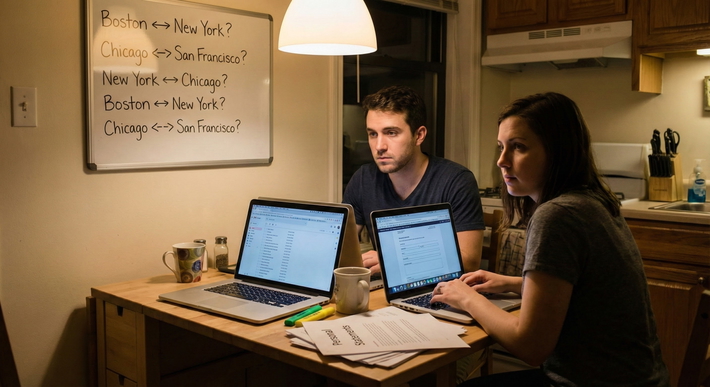
You're in it. Your partner already said yes, rank list locked, Match Day basically decided for them. Then your phone lights up with a late interview offer from a program you actually wanted. Or maybe one you never expected. Either way, the ground shifts.
This isn't the solo applicant scramble. This is the couples version: one future fixed, the other suddenly in play. Here's exactly what to do when that happens.
The 'Yes, But...' Scenario: Why Late Offers Hit Different When You're Coupled
Here's the exact mess: Partner A matched (or is locked into a program they love). Partner B gets a late interview invite, sometimes weeks after most interviews wrapped. You've already built a shared plan around Partner A's location. Now you're staring at a calendar conflict, a plane ticket you didn't budget for, and a quiet voice asking whether this changes everything.
Solo applicants feel FOMO. You feel something sharper. Your partner's future is set. Yours is suddenly fluid again. That creates a weird power imbalance in the relationship, even if neither of you wants it. One of you has certainty. The other has options and guilt.
I've watched couples freeze here. They treat the late offer like a moral test instead of data. They either leap without talking or shut it down instantly to "protect the plan." Both moves create regret later.
The hidden timeline stress is real. You know where your partner will be living, training, building friendships. Every day you delay a decision on this late offer, the gap between your two timelines widens. That's the pressure no one names out loud at the pre-interview dinners.
(See also: when one partner gets interviews 2 months before the other and what the data says about invite timing gaps for more.)
The Program Director's Perspective: What They Actually Think About Late Offers
Programs don't send late offers because you're their leftover. They send them because people withdraw, funding drops into place, or a couples-match candidate they loved suddenly can't make the geography work. Waitlists move. Spots open. That's logistics, not a ranking of your worth.
The unspoken hierarchy is mostly in your head. A late offer is often a strong candidate who became available late, not a scrap. PDs know couples matching is messy. Many of them have lived it or watched it wreck good applicants. What they wish you'd understand: most programs have more flexibility than their websites scream. They can sometimes work with staggered start dates, away electives, or creative scheduling if they want you badly enough. They just won't advertise it until you ask the right way.
From their side, couples matching is a two-body problem they already factor into ranking. They're not shocked when you mention a partner. They're calculating whether you're a flight risk or a committed pair who will both stay and contribute. Honesty about your situation usually helps more than it hurts, if you keep it professional and brief.
(See also: how program directors really view couples match applications for insider perspective.)
The 72-Hour Decision Framework for Couples
Panic is the enemy. Here's the clock you run when the email lands.
Hour 1-6: Process alone first. Don't text your partner the second you open it. Don't reply to the program. Sit with it. Feel the spike. Write down your gut reaction in one sentence: "This excites me because..." or "This terrifies me because..." That private note keeps you honest later when the conversation gets loaded.
Hour 6-24: Gather hard data. Look up the program's actual reputation in your specialty, not the marketing. Check location against your partner's locked city. How many hours by car or cheap flight? What's your realistic rank-list position if you interview? Pull any recent fellows or residents who did long-distance for a year. Get concrete, not vibes.
Hour 24-48: Have the hard talk. This is the "what if we end up apart" conversation. No soft-pedaling. You need to know each other's real thresholds before you spend money and emotional capital on an interview.
Hour 48-72: Decide and communicate. Tell your partner the plan. Then tell the program yes or no to the interview. Update anything that needs updating. Move.
Partner proximity sits at the top for most couples in this spot, and it should. That doesn't mean you ignore everything else. It means you weigh the rest against that 95.
The Conversation You're Avoiding: Having the 'What If' Talk
You know the one. The one where you say you want to explore the late offer and your partner hears "I might leave you." Here's how you actually do it without torching the weekend.
Start with ownership, not defense: "I got a late invite from X. I want to talk about whether I should go, because our plan matters more than my ego." Then shut up and let them react.
Use this framing when you feel the tension rise: "I want us to have complete information before Match Day locks everything. Exploring this doesn't mean ranking it above you. It means I don't want either of us living with 'what if' for three years."
Script that works: "I love that you matched at [their place]. And I want to understand what this late offer could mean for our long-term options. What's your real dealbreaker on distance or time apart?"
Ask curious questions instead of stating positions. "What would feel like too much risk?" beats "I think we should consider long-distance."
Boundaries matter. Exploring one or two late interviews is due diligence. Ghosting your shared plan while you chase every shiny invite is stringing them along. If you're still "thinking about it" two weeks later with no new data, you're not exploring, you're avoiding.
Long-distance in residency is brutal. Call schedules don't align. Holidays get ugly. But I've seen couples do one year apart and come out stronger because they treated it like a temporary tactical choice, not a referendum on the relationship. The ones who pretend it will be easy usually crack. The ones who name the cost upfront usually manage it.
Logistics of Playing the Game: Timeline Hacks and Communication Tactics
You need time. Programs want a fast yes. Here's how you buy 48-72 hours without looking flaky.
Reply same day with enthusiasm plus a concrete constraint: "Thank you so much for the invitation, I'm very interested. I'm currently on a heavy clinical stretch / finalizing travel for another commitment and need to confirm dates by [specific day]. Would it be possible to hold the spot until then?"
That works. Vague "I need to think" does not.
What you never say: "I have to check with my partner who already matched elsewhere." That frames you as a flight risk before you've even interviewed. What you can say later, if asked about couples status: "My partner is in the Match as well; we're coordinating geography carefully."
Email template that actually gets extensions:
Subject: Interview Invitation, [Your Name], Brief Scheduling Request Body: Dear [Coordinator/PD name], Thank you for the invitation to interview at [Program]. I'm excited about the opportunity. I have a fixed clinical obligation / travel constraint through [date] and would be grateful if I could confirm my interview date by [48 hours out]. Please let me know if that works on your end. Best, [You]
Short. Grateful. Specific. No novels.
Even if you decide not to go, the late offer can still move your rank list. Sometimes just knowing another program wanted you late recalibrates how you feel about the places you already interviewed. Use that information. Don't pretend it didn't happen.
When to Pull the Plug: Knowing You've Made the Right Call
You've overthought it when you're still spinning the same three arguments on day four with no new facts. You need more time only if a critical piece of data is genuinely missing (visa details, exact call schedule, partner's real emotional capacity).
Confidence in "yes, I'm pursuing" looks like this: you both can picture the worst-case (one year apart, lots of flying) and still feel the interview is worth the cost. Confidence in "no, I'm staying put" looks like this: the program is interesting but the geography or fit doesn't beat the shared life you're already building. Either way, the peace comes from deciding, not from guaranteeing the perfect outcome.
After you decide:
- Update your rank list if the interview changed anything.
- Send a clean decline if you're out, programs remember courtesy.
- Support your partner. They just watched you wrestle with a choice that could have pulled you away. Acknowledge that.
The right call is the one you both can live with on a random Tuesday in February when the Match is still weeks away and the what-ifs are loud.
Key Takeaways
Late offers aren't second-tier, they're often pure program logistics. Run the 72-hour framework so you neither panic nor freeze. Have the honest "what if we're apart" talk early; curiosity beats defensiveness every time. Professional, specific communication buys you time and keeps doors open. And the decision that works is the one that respects both of your futures, not the fantasy of a perfect single city.
You're not failing the couples match by considering a late offer. You're doing the adult version of it, gathering data, talking straight, and choosing on purpose.