

The couples match at top programs isn’t romantic. It’s political. Quiet, back-channel, spreadsheet-driven politics that no one explains to you because it makes people uncomfortable to admit how this really works.
You’re told, “Just rank what you love, the algorithm will take care of the rest.” At a mid-tier community program, maybe that’s almost true. At highly competitive programs—Mayo, MGH, UCSF, Penn, Columbia, Stanford, the big-name departments in NYC and Boston and big academic centers—you’re walking into a negotiation, not a fairy tale.
I’ve watched program directors go from “We’d love to have both of you” in the pre-interview glow to “We can probably only justify one” when the rank meeting turns brutal. I’ve heard chiefs say, “I like her a lot, but we can’t give up two spots for this couple when we have five 270+ Step 2 scores on the table.” This is the part your dean’s office doesn’t spell out.
You want to couples match into highly competitive programs? You have to understand the politics you’re stepping into.
What Couples Match Really Looks Like From the Program Side
Most applicants imagine couples match as this magical paired list that programs “just deal with.” That’s not what happens in real rooms.
Here’s the truth: programs do not run some special “couples algorithm” of their own. They make a list. A normal rank list. Then they sit in a room and argue about whether you, as a couple, are worth sacrificing flexibility for.
At a top program, the internal conversation sounds roughly like this:
- “Individually, they’re both solid, but we’d only take one if they weren’t coupled.”
- “If we rank them both high, and NRMP pulls them together, that’s two of our X PGY-1 spots locked into one relationship. Are they worth that risk?”
- “If they break up, we’re stuck with the weaker half for four years.”
- “If one is outstanding and the other is borderline, do we tank our class quality to satisfy a couple?”
No one says this on interview day. On interview day you hear: “We’re very couples-match friendly.” Translation? “We like couples, up to the point it costs us too much.”
At very competitive programs, every single slot has multiple strong contenders. When you come in as a couple, you’re not asking for two independent evaluations. You’re asking for a package deal in a system that wasn’t built to reward packages.
And that’s the core political problem: your value as a couple is never just the sum of two applications. It’s your perceived “total class impact” versus the flexibility those two slots could provide.
The Power Imbalance: One Star, One Anchoring Weight
Let me be blunt: the worst position in a couples match at a top program is being the weaker half of a pair where the other person is significantly stronger and aiming very high.
I’ve seen this play out more times than I can count:
- One partner: 260+ Step 2, AOA, first-author paper in NEJM or JAMA, honored all cores, great letters. Targeting MGH/Brigham/UCSF IM or top derm/anesthesia/rads.
- Other partner: Step 2 in the 230s, mixed clerkship evals, maybe one poster, targeting mid-tier IM/OB/peds.
Individually? Stronger applicant is ultra-competitive almost anywhere. Weaker partner is viable at many good programs.
As a couple? The dynamic changes completely.
The ranking meeting discussion goes like this:
“We love him. He’s easily in the top third of our list.” “But if we rank them both high, we’re committing to her too. She’s fine, but she’s borderline for our usual profile.” “If we take both, that means we drop someone else with a stronger file to make numbers work. Is he worth dragging her in?”
That sounds harsh, but that’s how it’s talked about. Cold, comparative, unromantic. No one wants to say it out loud to you, but they say it to each other.
And there’s a second layer: resentment.
Faculty won’t say it on Zoom, but in the closed-door rank meeting you’ll hear:
“We’re not bending our whole list around one couple. If they want to be together, there are plenty of mid-tier programs that will take them both.”
At top programs, your star partner doesn’t always “lift” you. Sometimes, you limit them. And program directors know it. They calculate it.
They also worry about optics. If they pull in a weaker applicant clearly tied to a star, people on the committee know what happened. Residents know. Other applicants know. There’s a subtle undercurrent of “Oh, that’s X’s partner, that’s why they’re here.”
Is it fair? No. Is it real? Absolutely.
The Unspoken Tiers of Couples in Competitive Programs
Programs at the top tier mentally sort couples into categories. No one says this publicly. I’ve watched it in rank meetings and side conversations.

Here’s the rough internal map:
| Couple Type | Program Attitude |
|---|---|
| Both superstars | Actively pursued |
| One star, one strong | Usually accommodated |
| One star, one borderline | Reluctant, very case-dependent |
| Both above average | Neutral to favorable at mid/high tiers, tougher at ultra-elite |
| Both borderline | Ignored at top, considered lower down |
Programs don’t see all couples as equal.
1. Both superstars
This is the dream scenario for the department.
Two AOA, multiple publications, high Step scores, glowing letters. They’re often both already known from aways, research, or networking. The internal discussion:
“If we can land them both, that’s a huge win for our program.”
This couple can reshape a rank list. Program directors will actually call each other (IM PD calling Anesthesia PD, for example) to align ranks and try to make it happen.
2. One star, one strong
For example: one 255+, research-heavy, the other 240–250 with solid evaluations and letters. Both clearly above the program’s “soft floor.”
These couples are usually ranked together without much angst. Programs feel like they’re not making a real sacrifice.
3. One star, one borderline
This is where politics, fear, and quiet tension show up.
The star would clearly be a top 10–20 name on the list. The partner sits at or just below the usual program profile. Someone will say:
“If they weren’t coupled, we’d probably put her in the maybe pile or rank her low-middle. Are we okay spending a top-20 slot on her just to secure him?”
Some committees say yes. Others say absolutely not. The star may still end up high, but the partner can get pushed down just enough that the pair never lines up where you want.
4. Both above average
At mid and upper-mid academic programs, this couple may do just fine. At the 10–20ish ranked programs, maybe also fine. But at the ultra-elite places, “above average” doesn’t move the needle.
You get ranked. But not aggressively. You become a set the program is okay with getting if the stars align, not one they’re trying to attract.
5. Both borderline
At highly competitive programs, this couple is basically a non-factor. They get ranked low or not at all, and the couples match status is irrelevant. It just doesn’t rise high enough in the list to matter.
Nobody will tell you which category they’ve slotted you into. But they absolutely do think this way.
The Algorithm vs. The Room: Where Power Really Lies
You’ll hear people say, “The Match algorithm favors applicants.” That line is technically true and practically misleading when you’re a couple aiming high.
The NRMP couples algorithm is deterministic and neutral. The human rank list that feeds into it is not.
Here’s the sequence that actually matters:

| Step | Description |
|---|---|
| Step 1 | Interview Day |
| Step 2 | Faculty Scoring & Notes |
| Step 3 | Initial Draft Rank List |
| Step 4 | Fine Tune Order |
| Step 5 | Discuss Package Impact |
| Step 6 | Adjust Both Up/Down Together |
| Step 7 | Final Rank List Submitted |
| Step 8 | Couple Identified? |
Faculty evaluation doesn’t care about the algorithm. The rank meeting doesn’t care about “favoring applicants.” They care about building the class they want, within the constraints of politics and department needs.
What couples match does, in practice, is force the committee to confront this:
“If we put Applicant A at #8 and Applicant B at #60, we may never get either of them as a couple. Do we move B up? Move A down? Leave it and risk losing them entirely?”
Those adjustments—those quiet nudges on the list—are where your fate is decided. not during some magical couples pass by the mainframe in Philly.
Sometimes you get bumped up because you’re a couple and both are strong, and the program wants you. Sometimes the weaker partner gets slid down because someone on the committee refuses to “waste” a high slot. I’ve seen PDs say:
“Do not move her into the top 30. If they really want to be together, there are plenty of other cities where that’s possible.”
You don’t feel that shift from your side. All you see in March is a line: “You have matched.” Or not.
Hidden Politics Between Departments and Across Institutions
The couples match at elite places is not just about you and one program. It’s about power between departments and even between hospitals in the same city.
This is the part almost no student ever hears about.
Internal department horse-trading
At big institutions with multiple residencies—say, IM, Surgery, Anesthesia, EM, Neuro, Psych all under the same system—here’s what happens:
- An IM PD loves you.
- Your partner is applying to Anesthesia.
- IM PD emails or calls Anesthesia PD: “We really want this candidate. Any chance you can help us bring in their partner?”
Now the anesthesia PD has to decide if their rank list gets distorted to satisfy medicine’s priorities.
If Anesthesia also likes your partner, this works beautifully. If they see your partner as “fine but replaceable,” tensions start.
I’ve literally heard:
“I am not dragging a mediocre anesthesia candidate into our top 15 just because medicine really wants her boyfriend.”
On the flip side, some departments are more politically powerful. Big-name IM or surgery departments at prestige institutions can lean harder on smaller programs and get compliance.
Cross-institution alliances and non-aggression pacts
In certain cities—Boston, NYC, Philly, Chicago—PDs across institutions know each other very well. They share fellowship applicants, research, conferences. Some of them trained together.
Do they coordinate couples match lists between hospitals? Officially: no. Unofficially: there’s chatting.
Sometimes it’s benign: “Hey, both of us are high on this couple; let’s see how it plays out.” Sometimes it’s more pointed:
“We’re pushing both of them up. If you’re not going to take the partner, don’t over-rank the star and blow up their chance at ending up in the same city.”
It’s not common, but it happens. Especially for high-profile couples who’ve made a personal impression on multiple faculty.
You will never see any of this in writing. But I’ve watched the emails go by.
Awkward Truths Programs Won’t Say to Your Face
Let me lay out a few things I’ve heard behind closed doors that no one says on your interview day.

“We prefer couples whose trajectories match.”
If both partners are roughly in the same competitiveness tier for their specialties, programs relax. They’re not being asked to make a major sacrifice. When there’s a big mismatch, anxiety goes way up.“We don’t want to be the backup plan that accidentally becomes Plan A.”
If faculty sense that you really want a different city or “dream program,” they may rank you lower as a couple. No one wants the resentful pair who clearly wished they were somewhere else.“We’re wary of drama.”
There’s a low-level fear that couples will bring personal conflict into the residency culture: breakups, favoritism, scheduling battles. This is especially true in smaller programs where two residents make up a large fraction of a class.“We don’t want to be used for leverage.”
PDs know you might threaten to rank another institution higher unless both of you are pulled up. But they also know they have a deep applicant pool. At the highest tiers, they will not be strong-armed by an MS4.
No one phrases it this bluntly, but it absolutely colors how they look at couples.
Strategy That Actually Works When You’re Aiming High
You can’t control the quiet wars in rank meetings. You can control how much leverage you walk in with and how much risk you’re asking programs to take.
Let me give you the unvarnished playbook.
1. Be brutally honest about your competitiveness gap
If one of you is clearly stronger, stop pretending otherwise. Sit down with real data: Step 2, clerkship grades, research, letters, away rotations.
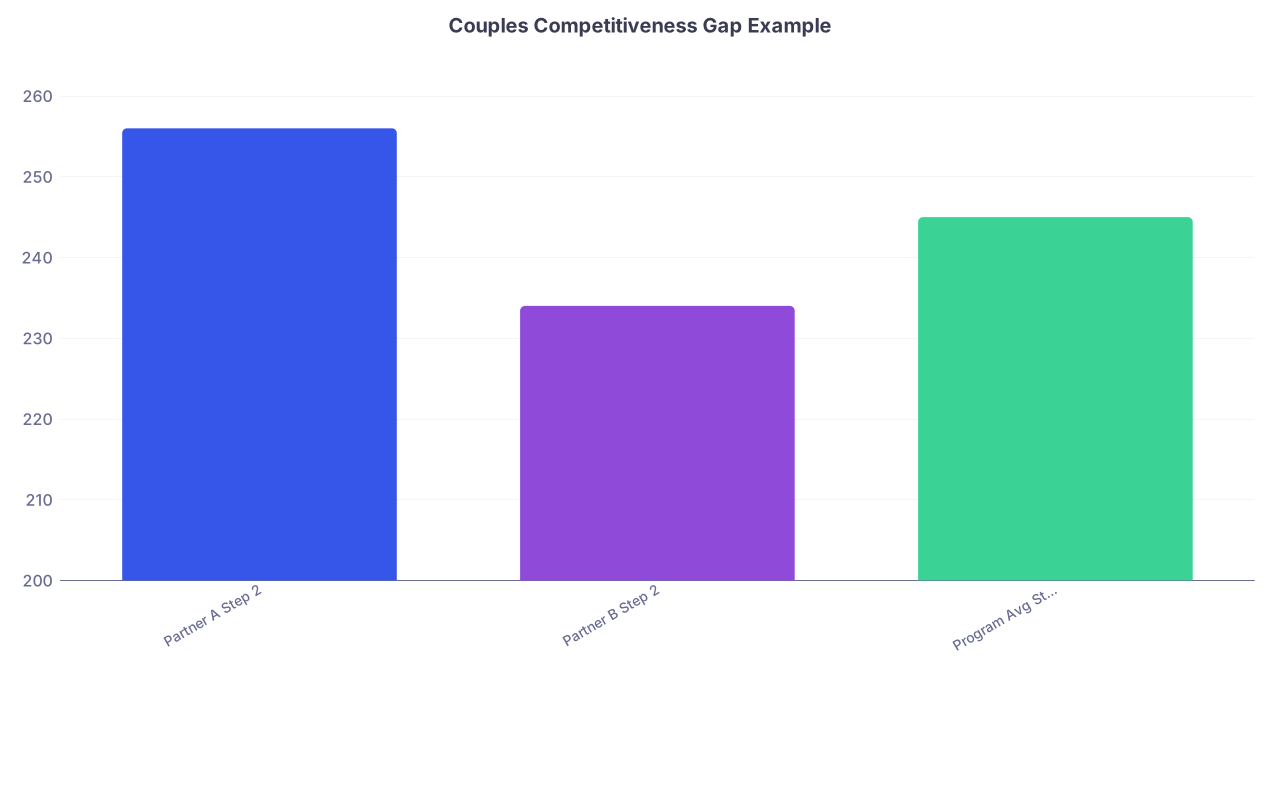
| Category | Value |
|---|---|
| Partner A Step 2 | 256 |
| Partner B Step 2 | 234 |
| Program Avg Step 2 | 245 |
If Partner A is at or above the target program’s usual profile and Partner B is below it, you have three real options:
- Aim slightly below the star’s ceiling so the weaker partner clears the floor. The star gives up some prestige to increase the odds of landing together. This is the most reliable couples match strategy. Many don’t have the ego control to do it.
- Apply broadly with a wide geographic spread, including excellent but not ultra-elite programs where both are above the floor. Stop aiming at the absolute top 5 in each specialty if one partner is marginal there.
- If the gap is extreme, consider same-city, different-tier pairings. One at a top-10 university program, the other at a solid mid-tier or community affiliate in the same metro. This is much more common (and politically easier) than two top-10s bending over backwards to sync for you.
What doesn’t work? Both partners blindly shooting for “MGH or bust” when only one is a realistic fit.
2. Use away rotations and faculty champions strategically
In a couples match to top programs, an away rotation isn’t “extra interviewing.” It’s political capital.
For the stronger partner, the away can secure a top-10 spot on the list. For the weaker partner, the only real hope at some elite places is a powerful internal advocate.
I’ve watched this play out at a major West Coast program:
- She was the star, rotating in their IM department.
- He was applying to their anesthesia program, slightly under their usual stats.
- She crushed the month. Multiple faculty went to their IM PD saying, “We need her. She fits here.”
- IM PD called Anesthesia PD and said, “If there’s any way to make space for her partner, we’d really like both.”
- Anesthesia moved him from “mid-list” to “upper-middle.” That was enough.
Without her away rotation performance, he never gets that bump. The anesthesia PD frankly admitted it afterward.

So if you’re serious about the couples match at a high-level institution, think this way:
- Who will have the strongest away impact?
- Which department’s PD carries more internal weight?
- Which partner can realistically become “indispensable” enough that the other service feels pressure to accommodate?
That’s the game. Pretending otherwise is how couples get burned.
3. Communicate clearly—but don’t beg
You should tell programs you’re couples matching. Hiding it hurts you. But how you talk about it matters.
Programs respond better to:
- “We’re very interested in your institution and the city, and we’d be thrilled if things worked out here for both of us.”
than to:
- “We need you to take both of us or we’ll go somewhere else.”
The latter works maybe at mid-tier places desperate for talent. At elite places, it just annoys people. They have more applicants than positions, and they know it.
Strong move: at the end of an interview, if you genuinely like a program, say something like:
“I wanted to mention we’re couples matching—my partner is applying in [specialty] and also interviewing at [this institution/other local programs]. This institution is one of our top choices, and if it works out for both of us, we’d be excited to build our lives here.”
You’re signaling interest without trying to extract a promise. PDs hate feeling manipulated. But they appreciate clarity.
When to Adjust Your Dreams—and When Not To
The hardest part of the couples match at top programs is ego management. Knowing when “We’re shooting for the stars” is admirable and when it’s delusional.
There are two traps couples fall into.
Trap 1: Sacrificing both careers to chase one brand-name
I’ve seen couples both end up at mediocre programs in undesirable locations because one partner fixated on a single prestige name and built an irrational list around it. They over-ranked one or two “dream bundles,” under-ranked perfectly good pairings elsewhere, and got burned.
Ask yourself this honestly: would you rather both be at strong, but less famous programs in a livable city—or have one of you at the shiny name and the other at a program you resent for three years?
There’s no universally right answer. But you must have that conversation before you certify your list. Not after Match Day.
Trap 2: One partner silently giving up too much
It’s not always the weaker partner who sacrifices. Sometimes the stronger partner quietly tanks their own ceiling because they’re afraid of looking selfish. They agree to only rank mid-tier joints when they clearly could have matched much higher alone and still landed in the same city.
If you’re the higher-trajectory partner, you’re allowed to say:
- “I want us together. But I also don’t want to completely under-train for my long-term career. Let’s look seriously at cities where we can both thrive, even if we’re not at the exact same prestige level.”
Sometimes that means splitting between a top academic place and a strong community affiliate. Same city. Different brands. Both careers alive.
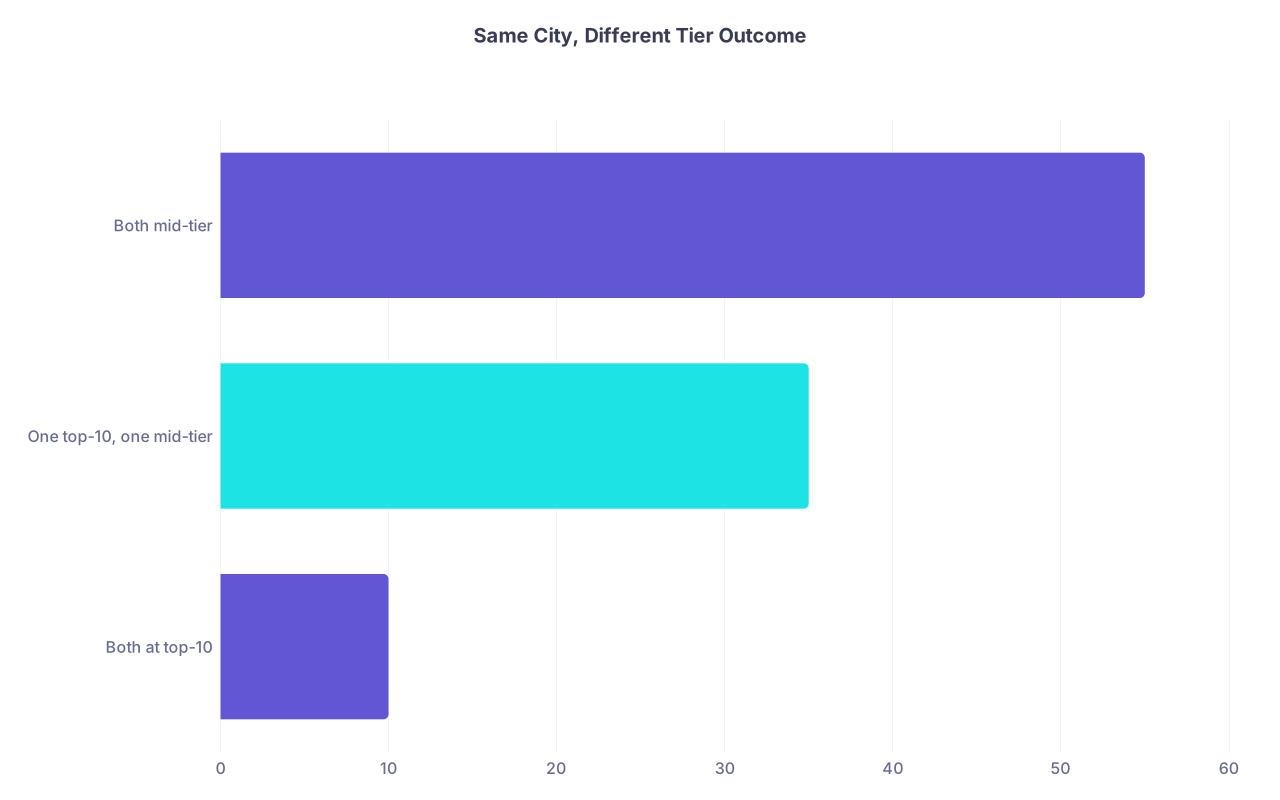
| Category | Value |
|---|---|
| Both at top-10 | 10 |
| One top-10, one mid-tier | 35 |
| Both mid-tier | 55 |
Quietly, this “same city, different tier” outcome is how a lot of very successful couples end up doing it. No one posts about it on Instagram. But it works.
The Bottom Line
The couples match at highly competitive programs isn’t random and it isn’t purely algorithmic. It’s shaped by politics in rank meetings, department power balances, risk tolerance, and your own willingness to be realistic.
If you remember nothing else, keep these three points:
- Programs do not evaluate you just as two individuals; they evaluate the package and the tradeoffs it forces on their rank list. If one of you is significantly weaker for that tier, stop pretending that doesn’t matter.
- The strongest leverage you have isn’t begging or hinting—it’s being the kind of couple that’s easy to say yes to: matched trajectories, strong away rotation performance, and clear but non-needy communication of genuine interest.
- The smartest couples stop trying to force a fairy tale “both at the #1 program” scenario and instead build rank lists that maximize both careers over the next decade, not both egos on Match Day.


