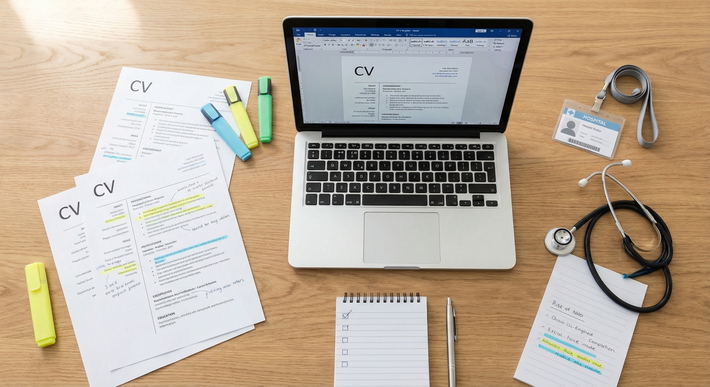
It's 2:07 AM. You've opened ERAS for the fifth time tonight. You tell yourself you're just "checking formatting," but that's a lie and you know it. What you're really doing is staring at your CV and mentally comparing it to that classmate who somehow has three first-author papers, two podium presentations, and a headshot that looks like they were born to be chief resident.
And then the thoughts start. Fast. Mean. Familiar.
What if I'm not smart enough? What if I wasted med school? What if every academic program looks at my application, sees zero first-author papers, and quietly throws me into the "nice kid, not academic" pile? What if I'm doomed to a community program forever?
I know that spiral. I've heard it from applicants every year, and honestly, I've lived some version of it too. The blank-publication panic is real. But here's the truth you need to hear before your brain runs off a cliff: having zero first-author papers is common. Very common. More common than the loudest people in your class would have you believe.
A lot of students confuse "I don't have a first-author paper" with "I have nothing." That's just wrong. Brutal, distorted, anxiety-brain wrong. A missing paper is not an empty application. It means one part of your file is thinner than you want. That's it.
So let's reframe this properly. Not "I have nothing." "I have time to build something." Even if that something is small. Even if it's not glamorous. Even if it's a case report in a journal nobody brags about at lunch.
Because no, your career is not over because you don't have a first-author paper.
This article is for educational purposes only. It is not financial advice, not legal advice, and not tax advice. Figures vary by individual circumstances, so consult a qualified professional before acting.
The Truth About "Academic" Programs: Do You Really Need a Paper?
A lot of applicants hear "academic program" and immediately translate it into: must have publication history or perish. That's not how this works.
Academic programs are not just research factories. They are training programs that need residents who can take care of sick patients, communicate clearly, work hard, teach juniors, and not fall apart every time the census spikes. Research helps. Of course it helps. But it is not the sole admission ticket.
The myth is dumb, and it persists because applicants love simple rules. "Academic = papers." Clean. Easy. Wrong.
What academic programs actually want is someone who fits the environment:
- strong clinical judgment
- evidence of discipline
- curiosity
- teachability
- reliability
- potential to contribute to scholarship, education, or systems improvement
Notice that last phrase. Potential to contribute. Not "already published in NEJM by age 26."
A resident is not hired as a finished product. They are recruited as a future colleague. That matters.
For most specialties, your baseline still starts with the boring-but-decisive stuff:
- board scores or equivalent exam performance
- clinical grades
- sub-I performance
- letters of recommendation
- interview presence
- professionalism
If those are weak, a random paper won't save you. I need applicants to understand this because too many people fetishize research while quietly underperforming on the wards. Bad strategy. Academic programs do not want a mediocre clinician who can format citations.
And the "zero to one" reality is much less dramatic than people think. Most residents do not enter training with a polished academic portfolio. They start with little or nothing, then build during residency. That's normal. That's the pipeline.
That chart captures the broad truth even if exact numbers vary by specialty: the majority of applicants are not walking around with stacks of first-author publications. There's a long tail. The loud overachievers live in that tail. They are real, but they are not the whole applicant pool.
There's another piece people miss: academic programs also love teachers.
If you're the student who shows up prepared, asks sharp questions, gives good mini-presentations on rounds, helps your interns, tutors pre-clinical students, or builds practical educational resources, that matters. A lot. Programs notice who elevates the learning environment. Scholarship isn't only bench work and manuscripts. Teaching is academic medicine too.
So no, you do not need a paper just because the website says "academic." You need a coherent story that says: I belong here. I work hard. I think clearly. I can grow into the kind of resident who contributes.
That story can include research. It doesn't have to start there.
The "Zero to Hero" Strategy: What to Do If You Have 0 Months Left
Let's say the panic is justified. Applications are coming. You have no first-author papers. No giant mentor network. No magical summer research block to rescue you. Fine. Then you need realism, not fantasy.
Do not start trying to launch a randomized trial. That is delusional applicant behavior. You do not have the time, infrastructure, or emotional stability for that mess right now.
Go after low-hanging fruit:
- case reports
- retrospective chart reviews
- quality improvement projects
- poster abstracts
- educational projects that can become presentations or brief reports
These are not consolation prizes. They are the practical first rung.
The sick-patient strategy
You know what often turns into a publication? A weird, complicated, memorable patient. The zebras. The near-miss. The unusual imaging finding. The treatment complication nobody expected.
If you see a case like that, tell the attending plainly: "This was a really instructive case. Do you think it could become a case report? I'd be happy to draft it."
That last sentence matters. "I'd be happy to draft it." Not "Can someone help me get published?" Nobody wants to adopt a vague, needy applicant project. People respond to labor. Offer to do the writing.
A lot of students miss opportunities because they assume every publication needs to emerge from some formal research lab. Wrong. Some of the fastest first-author wins come from clinical cases sitting right in front of you.
The retrospective hack
If a case report isn't available, look for a small retrospective project. Existing data is your friend because the patients already exist, the charts already exist, and no one is waiting two years for enrollment.
Examples:
- outcomes of patients with a specific diagnosis at your hospital
- trends in consult timing
- readmission patterns
- procedure complications
- adherence to guideline-based care
Is this glamorous? Not usually. Is it efficient? Yes. And efficiency wins when the clock is ugly.
You'll still need IRB guidance and a mentor, obviously. But compared with prospective work, retrospective projects are much more realistic on a student timeline.
QI is not fake research
I need to say this aggressively because applicants keep underrating it. Quality Improvement is real. It counts. If you identify a systems problem, implement a small intervention, and measure a result, that is valuable academic work.
Academic medicine is not just asking obscure questions in elegant prose. It's also fixing dumb broken processes that hurt patients and frustrate staff.
Examples of workable QI:
- improving discharge summary completion
- increasing vaccination screening
- reducing delayed antibiotic administration
- standardizing sign-out elements
- improving follow-up after abnormal test results
If your institution has a QI office, resident council, or departmental education lead, start there.
The urgency factor
Starting now, even if the result is modest, is better than doing nothing while doom-scrolling Reddit threads written by anonymous catastrophizers.
Maybe the paper won't be accepted before ERAS. Fine. You can still list:
- submitted manuscript
- under review
- abstract accepted
- poster presented
- QI project completed
That is movement. That is evidence you didn't freeze.
And yes, a tiny, imperfect project is better than an imaginary masterpiece that never leaves your Notes app.
Leveraging Your "Secret Weapons" When You Can't Publish
If you have no papers, then other parts of your application need to hit harder. That's not unfair. That's strategy.
Letters are your life raft
A strong letter can do more for you than a mediocre publication ever will. I've seen this happen repeatedly. A detailed letter from an attending who truly knows your work can change how a file feels.
You want letters that say things like:
- this student functions above level
- I would recruit them to my own residency
- they are dependable under pressure
- they teach peers naturally
- patients trust them
- they respond well to feedback
You do not want generic fluff. "Pleasant student, showed interest." That letter is wallpaper.
To get a strong letter:
- show up early
- know your patients cold
- volunteer for the unglamorous tasks
- follow through
- ask for feedback before the rotation ends
- ask directly if they can write you a strong letter
That last word matters. Strong. Use it.
Be unmistakably good clinically
If you aren't a researcher, then be the applicant who makes everyone say, "I'd want this person taking care of my family."
That means:
- efficient presentations
- thoughtful plans
- solid fund of knowledge
- calm bedside manner
- procedural initiative where appropriate
- ownership
Academic programs still train doctors. Don't let the publication panic distract you from becoming one.
Leadership and service still count
Tutoring first-years. Running a student clinic workflow. Organizing a specialty interest conference. Building patient education materials. Mentoring. These things show the spirit of academic medicine: teaching, service, systems thinking.
No, they are not the same as a publication. But they are not filler either. They show you contribute beyond your own transcript.
Networking without being weird
A lot of students hear "networking" and imagine fake-smiling at conferences while collecting business cards like Pokémon. Relax.
Real networking in medicine is simpler:
- ask attendings about their career path
- follow up after a rotation
- ask one specific question about a project or topic
- offer help with something concrete
- keep the relationship warm, not needy
You don't need a powerful mentor who adopts you on sight. You need a few faculty who can say, "Yes, I know this student. They're serious, reliable, and worth backing."
That's enough.
The IMG Perspective: Is It Even Possible for Me?
If you're an IMG, I know the panic can feel even uglier.
You might be thinking: I don't have home-institution research, I don't have easy access to US attendings, everyone keeps saying I need connections, and now I also need publications? Great. I'm cooked.
You're not cooked. But you do need to be brutally strategic.
For many IMGs, the primary drivers of success are still:
- strong USMLE performance
- meaningful US clinical experience
- letters from US physicians
- clear communication skills
- professionalism
- a believable specialty story
That stuff moves the needle. A lot.
Research can help, yes. But plenty of IMGs overestimate the value of a weak publication and underestimate the value of excellent clinical performance during US rotations. If a supervising physician in the US can say you worked like a future resident, that is powerful.
Clinical exposure is often your advantage because it proves adaptability. It answers the unspoken program question: Can this applicant function in the US system?
If you lack local research options, try these moves:
- email faculty after reading one of their recent papers
- attend virtual conferences and ask smart questions
- connect with alumni from your school who trained in the US
- ask US rotation supervisors about case reports or QI opportunities
- join specialty societies with student or international sections
Be normal in your outreach. Short email. Specific interest. Clear ask. No autobiography in paragraph form.
And if nothing research-related materializes? Then don't waste months feeling insulted by reality. Double down on scores, rotations, communication, and letters. That path is still real. I've seen IMGs match into strong academic environments without shiny publication lists because the rest of the application was disciplined and convincing.
Stop Panic-Applying and Start Building
Maybe you did waste some time in MS1 and MS2. Honestly? A lot of people do. They're trying to survive anatomy, figure out who they are, and keep their heads above water. Regret is common. It's also useless after about five minutes.
So here's the move now: pick one small project this month. One. A case report. A QI idea. A chart review. An educational poster. Something real and finishable.
Then protect your clinical performance like your future depends on it. Because it does.
You are not disqualified from academic programs because you have zero first-author papers. Thin in one area is not dead on arrival. What academic programs want most is someone who can learn fast, care deeply, teach others, and keep building.
That can still be you.
Start small. Start now. Stop worshipping the perfect CV and build the actual one.