Understanding the CV Landscape for Non‑US Citizen IMGs in Psychiatry
For a non-US citizen IMG trying to match into psychiatry, your CV is more than a list of experiences—it is your narrative in a single document. Programs will quickly scan it to answer three questions:
- Can you handle residency training in the US?
- Are you truly committed to psychiatry?
- Are you worth the investment of a visa?
Psychiatry programs receive hundreds (sometimes thousands) of applications. A strong, strategically crafted CV can move you from “generic foreign national medical graduate” to “promising psychiatry candidate we should interview.”
This article will walk you through:
- How a psychiatry residency CV differs from a generic medical student CV
- What program directors look for in non‑US citizen IMGs
- How to build each section of your CV for maximum impact
- Concrete examples tailored to psychiatry
- Common mistakes and how to avoid them
Throughout, we’ll focus on how to build a CV for residency specifically as a non-US citizen IMG applying to psychiatry.
What Makes a Strong Psychiatry Residency CV for Non‑US Citizen IMGs?
A residency CV is different from a job CV in other fields. For psychiatry, programs are especially sensitive to:
- Evidence of long-term interest in mental health
- Communication skills, empathy, and professionalism
- Understanding of US healthcare culture (especially for IMGs)
- Stability and reliability (important when visa sponsorship is required)
For a non-US citizen IMG, the CV has an extra job: reducing perceived risk. Program directors may worry about:
- Visa complexity and delays
- Whether you can adapt to US clinical and cultural norms
- Whether your psychiatry interest is genuine or a fallback option
Your CV must demonstrate:
- Consistent psychiatry engagement over time
- Clear US experience or orientation (observerships, electives, telehealth, research with US collaborators, etc.)
- Professional maturity—someone safe to supervise and easy to work with
Think of your CV as your evidence file for these three points.

Section-by-Section: How to Build Your Psychiatry Residency CV
Below is a structured template with residency CV tips tailored to psychiatry and non-US citizen IMGs. You’ll adapt the content for ERAS formatting, but the principles remain the same.
1. Contact Information & Personal Details
Keep this clean and professional:
- Full name (as it appears on official documents)
- Professional email (e.g., first.last@gmail.com)
- Phone number with country code
- Current address (US address if you are in the US; otherwise, home country)
- Optional: LinkedIn URL (if professional and updated)
Avoid:
- Including marital status, age, photo, religion, or national ID numbers.
US programs do not require or want this.
2. Education
List in reverse chronological order:
- Medical school name, city, country
- Degree (e.g., MBBS, MD equivalent)
- Dates (month/year – month/year)
- Honors or distinctions (if significant and understandable to US readers)
Example:
MBBS, XYZ Medical College, Mumbai, India
2015 – 2021
Graduated with Distinction in Psychiatry and Internal Medicine
If you completed any:
- US clinical electives
- Visiting student rotations in psychiatry
- Exchange programs
You may list these under Clinical Training or Additional Education, but highlight the psychiatry and US connection.
3. USMLE and Other Exams
While ERAS captures scores, a line on your CV or personal notes is helpful:
- USMLE Step 1: Pass (include score if strong and not pass/fail only)
- USMLE Step 2 CK: 2xx/3xx, month/year
- OET/IELTS/TOEFL (if relevant for language proof)
As a foreign national medical graduate, strong, timely exam performance suggests you can handle the cognitive load and adapt to the US system.
4. Clinical Experience: Make Psychiatry Visible and Credible
For a psych match, your Clinical Experience section is critical. Divide it clearly:
- Psychiatry Clinical Experience
- Other Clinical Experience (Internal Medicine, Neurology, etc.)
- US Clinical Experience (if not already obvious)
For each entry, include:
- Position (e.g., “Psychiatry Observership,” “Clinical Elective Student,” “House Officer, Psychiatry”)
- Institution, city, country
- Dates
- 2–4 focused bullet points emphasizing what you did and what you learned
Example 1 – US Psychiatry Observership
Psychiatry Observership, Department of Psychiatry
ABC University Hospital, Chicago, IL, USA | 09/2023 – 10/2023
- Observed inpatient and outpatient psychiatric care, including mood disorders, psychosis, and substance use disorders.
- Participated in daily rounds, case discussions, and multidisciplinary treatment planning conferences.
- Presented a mini-case conference on cultural factors influencing depression in South Asian patients.
- Gained exposure to electronic medical records, US documentation standards, and interprofessional communication.
Example 2 – Home Country Psychiatry Internship
Rotating Intern – Psychiatry
DEF Teaching Hospital, Lagos, Nigeria | 02/2022 – 05/2022
- Conducted initial psychiatric evaluations under supervision in emergency and outpatient settings.
- Assisted in managing patients with schizophrenia, bipolar disorder, and alcohol use disorder.
- Led psychoeducation sessions for families regarding medication adherence and relapse prevention.
- Collaborated with psychology and social work teams in discharge planning.
Key advice for non-US citizen IMGs:
- Prioritize psychiatry experience at the top of this section, even if more limited.
- Do not hide non-psychiatry rotations, but frame them in a way that shows transferable skills (e.g., communication, complex medical-psychiatric comorbidities).
- If you lack US experience, consider virtual US-based psychiatry electives, telepsychiatry shadowing, or remote case conferences—and list them appropriately.
Building a Psychiatry-Focused Profile: Research, Leadership, and Activities
Program directors often look at Research and Experience sections to judge your genuine interest in psychiatry and your potential as an academic clinician.
5. Research Experience: Even Small Projects Count
You do not need a PhD or dozens of papers. But one to three meaningful psychiatry-related research experiences can significantly strengthen your profile.
Include:
- Role (Research Assistant, Student Investigator, Co-investigator)
- Project title or topic
- Institution
- Supervisor (optional but useful if well-known)
- Dates
- 2–4 bullet points about your contributions
Example – Psychiatry Research for an IMG
Student Research Assistant – Depression and Diabetes Comorbidity Study
Department of Psychiatry, GHI Medical College, Karachi, Pakistan | 01/2021 – 12/2021
- Collected and managed clinical data on patients with comorbid type 2 diabetes and major depressive disorder.
- Conducted structured interviews using PHQ-9 and assisted with data entry and quality checks.
- Contributed to statistical analysis using SPSS and preparation of a conference abstract.
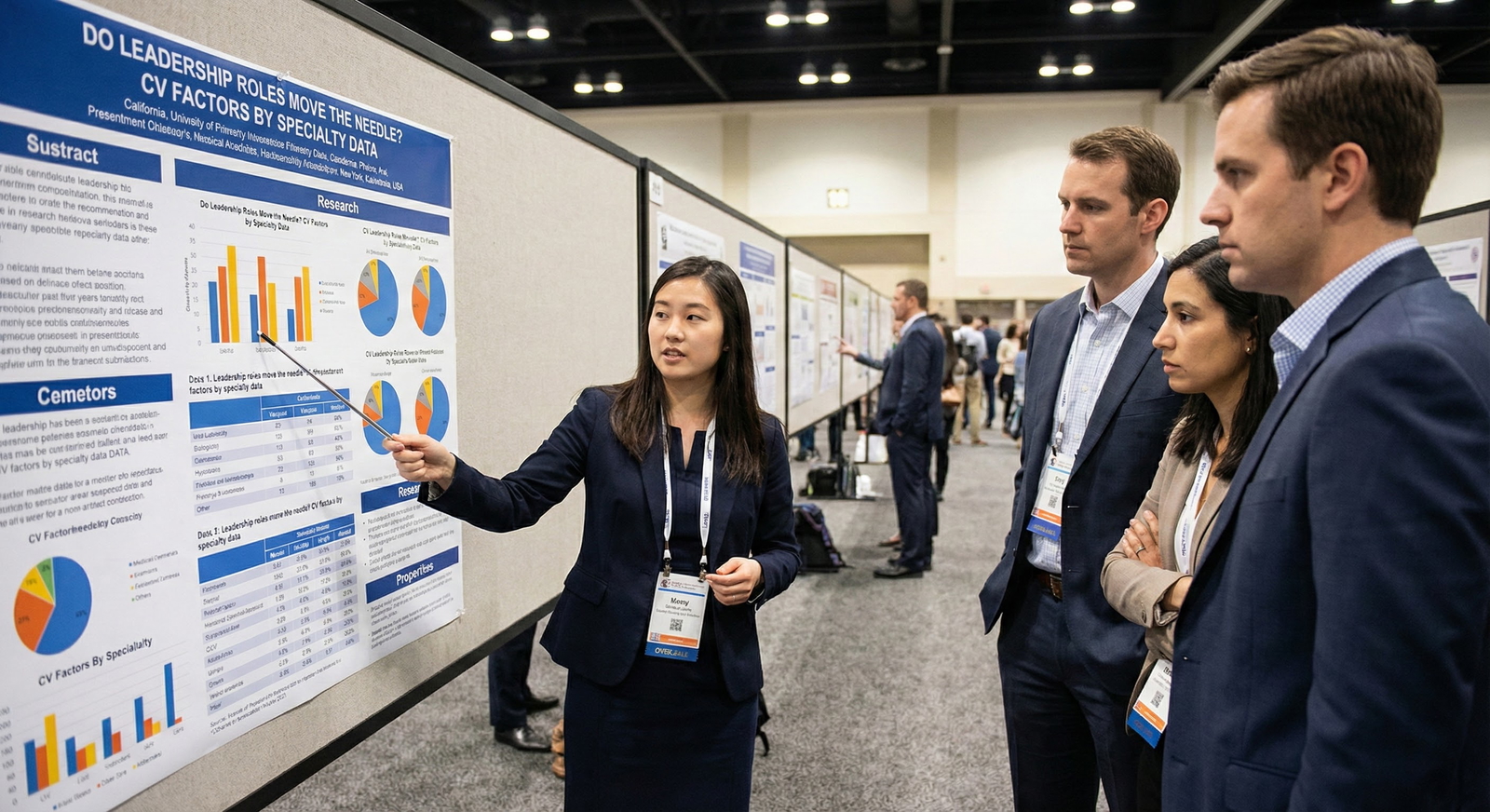
- Co-authored one poster presented at the National Psychiatric Society Conference (2022).
If you have non-psychiatry research, include it but interpret its relevance:
- Gained experience with study design, ethical approvals, and handling sensitive patient data—skills directly applicable to psychiatric research.
If you have no research yet:
- Seek a small retrospective chart review with a psychiatrist
- Join an ongoing project as a data collector or literature reviewer
- Work with remote supervisors (including in the US) on scoping reviews or systematic reviews
Even a simple quality improvement (QI) project in a psychiatry setting can be valuable.
6. Publications and Presentations
For publications, use standard citation format and separate them clearly:
- Peer-reviewed journal articles
- Book chapters (if any)
- Abstracts
- Posters and oral presentations
Psychiatry-related items should appear first, regardless of date, if possible.
Example – Poster Presentation
Kumar A, Lee S, et al. “Barriers to Mental Health Help-Seeking Among International Medical Students.” Poster presented at the Annual Meeting of the American Psychiatric Association, 2024 (virtual).
If you have no formal publications:
- You can still list:
- Educational blog posts on mental health (if professional)
- Articles in student journals
- Local conference presentations
- Just label them honestly (e.g., “Local Student Research Day Presentation”).

7. Teaching and Leadership: Signal Maturity and Communication Skills
Psychiatry values communication, teaching, and team leadership. These are areas where a non-US citizen IMG can stand out.
Teaching Experience
Include:
- Small group teaching (junior medical students, nurses, community health workers)
- Peer-tutoring in psychiatry or behavioral sciences
- Leading journal clubs or case conferences
Example:
Peer Tutor – Behavioral Sciences
XYZ Medical College, Cairo, Egypt | 09/2019 – 03/2020
- Taught weekly small group sessions on basic psychiatry concepts and psychiatric interviewing for second-year medical students.
- Received positive anonymous feedback highlighting clarity and empathy in teaching style.
Leadership and Organizational Roles
List:
- Class representative
- Mental health awareness campaign organizer
- Leadership roles in student psychiatric societies or wellness committees
Example:
President – Medical Student Psychiatry Interest Group
ABC University, Manila, Philippines | 08/2020 – 06/2021
- Organized monthly seminars on depression, suicide prevention, and addiction with local psychiatrists.
- Implemented a peer-support initiative for stressed medical students, increasing participation in wellness activities by 40%.
- Coordinated an online mental health awareness week during COVID-19, attended by 300+ students.
These experiences demonstrate you are:
- Comfortable with psychosocial topics
- Able to work with teams
- A potential future leader in psychiatry
Personalizing Your CV to Psychiatry as a Non‑US Citizen IMG
Beyond listing experiences, how you frame them matters.
8. Tailoring Descriptions to Highlight Psychiatric Skills
Even non-psychiatry experiences can emphasize skills valued in psychiatry:
- Active listening
- Cultural sensitivity
- Handling emotionally intense situations
- Collaborative care with multi-disciplinary teams
Example – Internal Medicine Rotation (Psych-relevant framing):
- Frequently managed patients with comorbid depression and anxiety; collaborated with consultation-liaison psychiatry for complex cases.
- Learned to recognize delirium, adjust medications accordingly, and communicate with families about cognitive changes.
9. Addressing Gaps and Non-Linear Paths
Many non-US citizen IMGs have:
- Gaps between graduation and applications
- Years spent preparing for exams or working in non-clinical roles
Use your CV and application to normalize and explain these gaps through meaningful activities:
- Mental health volunteering
- Online psychiatry courses (e.g., Coursera, edX)
- Narrative medicine or reflective writing activities
- Research involvement
You can include these under:
- “Relevant Courses and Certifications”
- “Volunteer and Community Service”
- “Professional Development”
10. Volunteer Work and Community Service: Showcasing Compassion
Psychiatry programs care deeply about empathy and social awareness.
Examples:
Volunteer Listener – Mental Health Helpline (Remote)
01/2023 – Present
- Provided emotional support and active listening via online chat to individuals experiencing stress, anxiety, and loneliness under trained supervision.
- Followed protocols for crisis escalation and referral while maintaining strict confidentiality and boundaries.
Community Outreach Volunteer – Substance Use Awareness Campaign
NGO XYZ, Mexico City, Mexico | 06/2021 – 09/2021
- Helped conduct psychoeducation sessions on substance use and stigma in local communities.
- Collaborated with a multidisciplinary team to adapt educational materials to local cultural contexts and language.
These roles reinforce your psychiatric interest and humanistic qualities—crucial elements for a psych match.
Formatting, Style, and Common Mistakes to Avoid
Even strong content can be undermined by poor presentation. A polished CV subtly signals that you can practice organized, professional documentation—essential in US training.
11. Formatting and Style Tips
- Length: 2–4 pages is typical for a residency CV (more if significant research). Quality over quantity.
- Font: Professional and simple (e.g., Times New Roman, Arial, Calibri; 10–12 pt).
- Consistency: Uniform date formats, bullet style, and spacing.
- Language:
- Use clear, concise, action-oriented verbs (e.g., “conducted,” “collaborated,” “organized”).
- Avoid excessive jargon and non-standard abbreviations.
- Order of Sections: For a psychiatry-focused non-US citizen IMG, a common effective order is:
- Education
- Clinical Experience (psych first, then others)
- Research Experience (psych-related emphasized)
- Publications & Presentations
- Teaching Experience
- Leadership & Volunteer Work
- Awards & Honors
- Professional Memberships
- Skills & Languages
12. Common Errors by Non‑US Citizen IMGs
Overloading the CV with unrelated details.
- 12-page CVs with every workshop since high school are counterproductive.
- Focus on last 5–7 years and clinical/research relevance.
Under-representing psychiatry when applying for psychiatry residency.
- If psychiatry appears only once in your CV, programs may doubt your commitment.
Leaving unexplained gaps in training.
- Convert “years studying for USMLE” into “USMLE preparation plus part-time mental health volunteering, online psychiatry coursework, or research assistance.”
Inconsistencies between CV and ERAS.
- Make sure dates, titles, and roles match exactly.
Unprofessional email address or strange formatting.
- Correct these simple, high-impact issues first.
Omitting visa-related clarity when relevant in other documents.
- You won’t put your visa needs directly on the CV, but ensure your personal statement or program communication clarifies your visa category and feasibility.
Strategic Planning: How to Build Your CV for Psychiatry Over 6–24 Months
If you are early in the process, you can intentionally shape your CV toward psychiatry. Here is a phased approach for a foreign national medical graduate:
Within 6–12 Months Before Applying
- Secure at least one solid psychiatry rotation (preferably US-based, but home country is okay).
- Join or start a small psychiatry research or QI project.
- Obtain 1–2 psychiatry mentors who can later write LORs.
- Engage in mental health volunteering or community outreach.
- Present at one poster session (local, national, or international).
Within 12–24 Months Before Applying
- Aim for continued psychiatry exposure (longitudinal involvement looks better than a single short rotation).
- Take part in teaching activities related to mental health or communication skills.
- Consider online or certificate courses in psychiatry, addiction, global mental health, or psychotherapy basics.
- Document everything in a living CV version so you don’t forget dates and details.
This intentional planning makes your final residency CV look like a coherent journey into psychiatry, not a last-minute decision.
FAQs: CV Building for Non‑US Citizen IMGs in Psychiatry
1. How is a psychiatry residency CV different from a general medical student CV?
A psychiatry residency CV highlights:
- Persistent and genuine interest in mental health
- Evidence of strong communication and interpersonal skills
- Activities showing empathy, cultural sensitivity, and insight into human behavior
Compared to a general medical student CV, more weight is placed on:
- Psychiatry rotations, electives, and observerships
- Mental health research or advocacy work
- Teaching, leadership, and community outreach related to psychological well-being
2. I’m a non‑US citizen IMG with no US clinical experience. How can I still build a competitive psychiatry CV?
You can still strengthen your CV by:
- Maximizing psychiatry exposure in your home country (inpatient, outpatient, community psychiatry)
- Joining psychiatry-related research or QI projects, even small ones
- Participating in virtual US-based psychiatry electives, webinars, or conferences
- Taking online mental health courses from reputable institutions (Coursera, edX, WHO, etc.)
- Doing mental health volunteering (helplines, school programs, NGOs)
Then, clearly describe these experiences on your CV with a focus on psychiatric skills and insights.
3. How many pages should my psychiatry residency CV be?
For most non-US citizen IMGs:
- 2–4 pages is appropriate
- If you have extensive publications/research, it may be longer, but ensure it is well organized
Program directors value clarity and relevance over length. Cut out outdated, redundant, or marginally relevant items.
4. Do I need psychiatry research to match into psychiatry as an IMG?
Strictly speaking, no, it is not mandatory, but:
- Having some psychiatry-related research (even a small project or poster) significantly strengthens your application.
- It shows you can think critically about psychiatric topics and contribute academically.
If you lack research, focus even more on:
- Strong psychiatry clinical experiences
- Compelling mental health advocacy or volunteer work
- Excellent letters of recommendation from psychiatrists
By thoughtfully structuring your experiences and intentionally building your profile, your CV can present you not just as a non-US citizen IMG, but as a well-prepared future psychiatrist who brings valuable international perspective, resilience, and commitment to the field.