
Your CV probably looks ‘average’ because you’re comparing it to ghosts and screenshots, not reality.
Let me say the thing no one says out loud: almost every normal applicant feels like their CV is embarrassingly basic. You see that one classmate with 14 publications, an MPH, and a startup and your brain quietly whispers, “Cool, so I’m screwed.”
You’re not. But I know that doesn’t feel true at 1:30 a.m. when you’re rewriting your “Honors & Awards” section for the tenth time and still only have… two lines.
So let’s do something different. Instead of platitudes like “everyone has their own journey,” I’m going to walk through specific, concrete signs your “average” CV is actually stronger than you think—and where you’re actually vulnerable.
I’m assuming you’re like me: you want receipts. You want to know, “Am I completely delusional or am I quietly competitive and just catastrophizing?”
First: The Lie Your Brain Keeps Repeating About CVs
Your brain is probably running this script:
- “Top programs only want people with 10+ pubs.”
- “I don’t have a 260+ and 12 leadership roles, so my CV is forgettable.”
- “Everyone else used med school better than I did. I wasted my chances.”
I’ve watched people with:
- 0 publications
- 1 poster
- Decent-but-not-flashy Step scores
- One real leadership role
…match into solid programs because the overall story on their CV was clear, consistent, and aligned with the specialty.
Meanwhile I’ve seen:
- 8 publications
- Random scattered experiences
- No depth, no continuity
…and those people struggled. Because their CV wasn’t a story. It was just noise.
So here’s the uncomfortable truth: you might not have as little as you think. You might just be terrible at recognizing what actually matters to PDs and what’s just LinkedIn fluff.
Sign #1: You Have Continuity, Not Just Chaos
If you’ve stuck with one or two things for more than a year, that’s already a quiet flex programs care about.
For example:
- Tutored anatomy MS1–MS3
- Volunteered at the same free clinic every month for 2+ years
- Stayed with one research mentor across multiple small projects
- Held a role in SNMA, AMSA, interest group, or student government for >1 year
Programs don’t just care about the flashy title. They’re looking for proof you can show up consistently without someone holding your hand.
If you can draw a straight(ish) line from M1 to M4 in at least one area—teaching, community work, research, advocacy—that’s not “average.” That’s exactly what many PDs quietly hope to see.
If your CV has:
- a lot of “1 month,” “2 month,” “brief volunteer” entries
and almost nothing that lasted…
That’s where it starts to look weaker. But even then, if you have one thing you stuck with? That’s something you can lean on.
Sign #2: Your Clinical Experiences Actually Match Your Specialty
You don’t need some hyper-curated, perfect specialty-specific CV. But if you’re applying to IM and the only specialty-related thing on your CV is a single IM rotation… yeah, that’s thin.
But here’s where people underestimate themselves.
If you’re going into, say, internal medicine, and you have:
- IM sub-I or acting internship
- A few case reports or QI projects in general medicine
- Volunteering in chronic disease management (diabetes clinic, hypertension outreach, etc.)
- Tutoring or mentoring with a slant toward adult medicine
That’s already coherent.
Same pattern for other specialties. Ask yourself:
“Can a program director look at my CV and, in 5 seconds, understand why I’m applying to this specialty?”
If the answer is yes—even roughly—your CV is not as “random” as you think.
If the answer is no, that’s not the end of the world. You can still:
- Emphasize the most relevant experiences
- Rephrase descriptions to highlight the parts that fit your specialty
- Use your personal statement and letters to connect the dots
But if you’re already at the “yeah, it kind of fits” stage? That’s an underrated green flag.
Sign #3: You Have At Least One Area of Depth
Programs are not expecting you to be a mini-attending in everything. They’re scanning for one area where you actually leaned in.
Depth can look like:
Research depth
Not 15 publications. More like: 1–3 projects with the same mentor, maybe 1 poster, 1 manuscript (even if submitted or “in progress” but real).Teaching depth
Repeated small group tutoring, anatomy TA, problem-based learning facilitator, peer mentor, longitudinal teaching elective.Service depth
Long-term involvement in a clinic, community organization, pipeline program, health equity work.Leadership depth
Not 7 titles. One role where you actually did things: coordinated events, organized a conference, started a new initiative, managed a team.
If you have one of these with real continuity and actual work behind it, that’s stronger than 10 line items where you just showed up once.
Here’s the trap: because it’s “just what you do,” you don’t give yourself credit. You list it in two bland bullet points and move on.
If you can point to one thing and say, “Yeah, that took a lot of time and I actually made something happen,” your CV is not basic. You’re just under-selling it.
Sign #4: Your CV Doesn’t Have Red Flags (And That Matters)
There’s this weird silence around the fact that for a lot of programs, the bar is:
- Don’t be unprofessional
- Don’t be unreliable
- Don’t be a nightmare to work with
If your CV:
- Has no giant unexplained gaps
- Doesn’t show weird job-hopping every few months
- Doesn’t contain obviously fabricated nonsense
- Isn’t riddled with typos and chaotic formatting
…you’re already clearing a surprisingly important bar.
Is that enough for derm at MGH? Obviously not. But for many solid programs in most specialties, they’re not expecting every applicant to come in with a research empire. They just want someone who works hard, shows up, learns, and doesn’t blow up the team.
If your biggest “flaw” is “only 1 publication” or “not a lot of leadership,” that’s stress-worthy in your head, not necessarily in theirs—especially at mid-tier or community programs.
Here’s a quick comparison just to be brutally clear:
| Aspect | Quietly Strong CV | Actually Weak CV |
|---|---|---|
| Continuity | 1–2 multi-year experiences | Many 1–2 month activities |
| Specialty Fit | Clear-ish pattern | No connection to target specialty |
| Depth | One real area of focus | Spread thin, no depth anywhere |
| Professional | Clean, honest, consistent | Gaps, errors, sketchy entries |
| Growth | Increasing responsibility | Same-level roles, no progression |
If you’re mostly in the left column, your CV is not “average.” It’s just not Instagram-brag-ready.
Sign #5: You’re Underestimating ‘Small’ Things That Programs Actually Like
You know those things you almost didn’t list because they felt too small?
- Being a peer mentor to M1s
- Helping coordinate interview day or orientation
- Serving on a curriculum committee
- Doing QI projects that never got published but actually fixed something on the ward
- Consistent local volunteering not tied to a big national name
These are gold when described correctly.
PDs are not robots scanning for “NEJM or bust.” They’re asking:
- Does this person help teams run smoother?
- Does this person care about patients beyond the bare minimum?
- Does this person have evidence of reliability and effort?
I’ve seen applicants match with CVs that were basically: a couple of posters, one clinic, one teaching role, one or two leadership roles. No crazy prestige. But each thing was real.
If you’re looking at your CV and seeing “just little stuff,” stop and ask: “Did this require responsibility, initiative, or consistent effort?” If yes, it’s not little. You’re just minimizing it because it’s yours.
Sign #6: Your CV Shows Growth, Not Just Static Boxes
One of the strongest signs your CV is better than you think: there’s a clear arc.
Something like:
- M1: Volunteer at free clinic
- M2: Become clinic coordinator
- M3: Start QI project in that same clinic
- M4: Present that project as a poster
That’s a narrative. That screams, “Give me a system and I’ll make it better.”
Same idea in research:
- M1: Data entry on a project
- M2: Help with analysis, second or third author
- M3: First author poster or manuscript
Or teaching:
- M1/M2: Anatomy tutor
- M3: Lead tutor / design review sessions / run workshops
If you can trace even a small progression in one area, your CV already looks more intentional than you think. PDs care more about that upward trajectory than having a million unrelated lines.
If your experiences feel scattered, you can still retroactively show growth by:
- Rewording bullets to highlight increased responsibility
- Grouping related experiences together under themes
- Emphasizing the “next step” each experience led to
Okay, But What If My CV Really Is Thin? What Can I Still Fix?
Let’s say you’ve been brutally honest and your CV is actually pretty bare. That doesn’t mean “game over.” It means you need strategy, not panic.
Two real levers you still have, even late in the game:
Strengthen how you present what you already have.
Half of CV weakness is in the wording. “Helped with a project” sounds like fluff.
“Collected and managed data for a retrospective study on X; contributed to abstract for regional conference” sounds like substance, even if you only did 10% of it.Add focused, high-yield experiences now.
You’re not going to add three publications in 3 months. But you can:- Join a small QI or case report project related to your specialty
- Take on a concrete role in a clinic or student group (scheduling, coordinating, teaching)
- Help faculty organize a teaching session or OSCE and actually list it
Here’s roughly how short efforts can still change the picture:
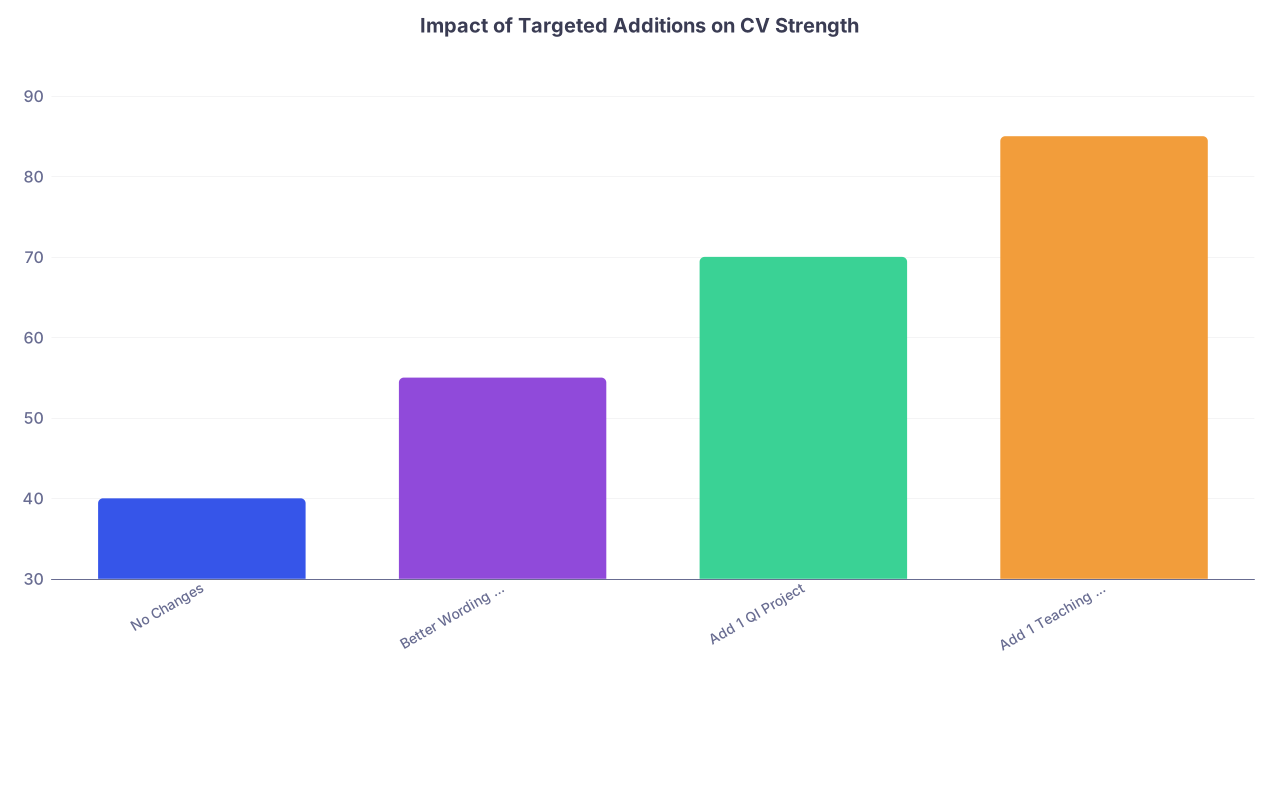
| Category | Value |
|---|---|
| No Changes | 40 |
| Better Wording Only | 55 |
| Add 1 QI Project | 70 |
| Add 1 Teaching Role + 1 QI | 85 |
That’s not scientific. But it’s realistic. Two or three smart additions + better descriptions can move you from “worryingly weak” to “solid, competitive for many programs.”
The Stuff You’re Overrating (That’s Feeding Your Anxiety)
Let me be blunt about a few things applicants obsess over that don’t matter as much as your 3 a.m. brain thinks:
Having leadership in 8 different clubs
Looks scattered. One or two meaningful roles > grabbing every title.Publications in huge journals vs smaller/regional
Yes, big journals impress. But most programs are satisfied with any evidence you can complete a project.Prestige of every single experience
Fancy names help. But community clinics, smaller conferences, local work? Still counts. A lot.No “national” positions
Most applicants don’t have them. PDs know this.
What they do care about much more than you think:
- Are you going to show up for patients?
- Are you going to work hard on call?
- Are you going to make their lives easier, not harder?
Your CV is just one piece of that picture. And if you’ve been reliably involved, teachable, and not a chaos machine, that does come through—even if you feel mediocre on paper.
Here’s a quick visual that might calm part of your brain:
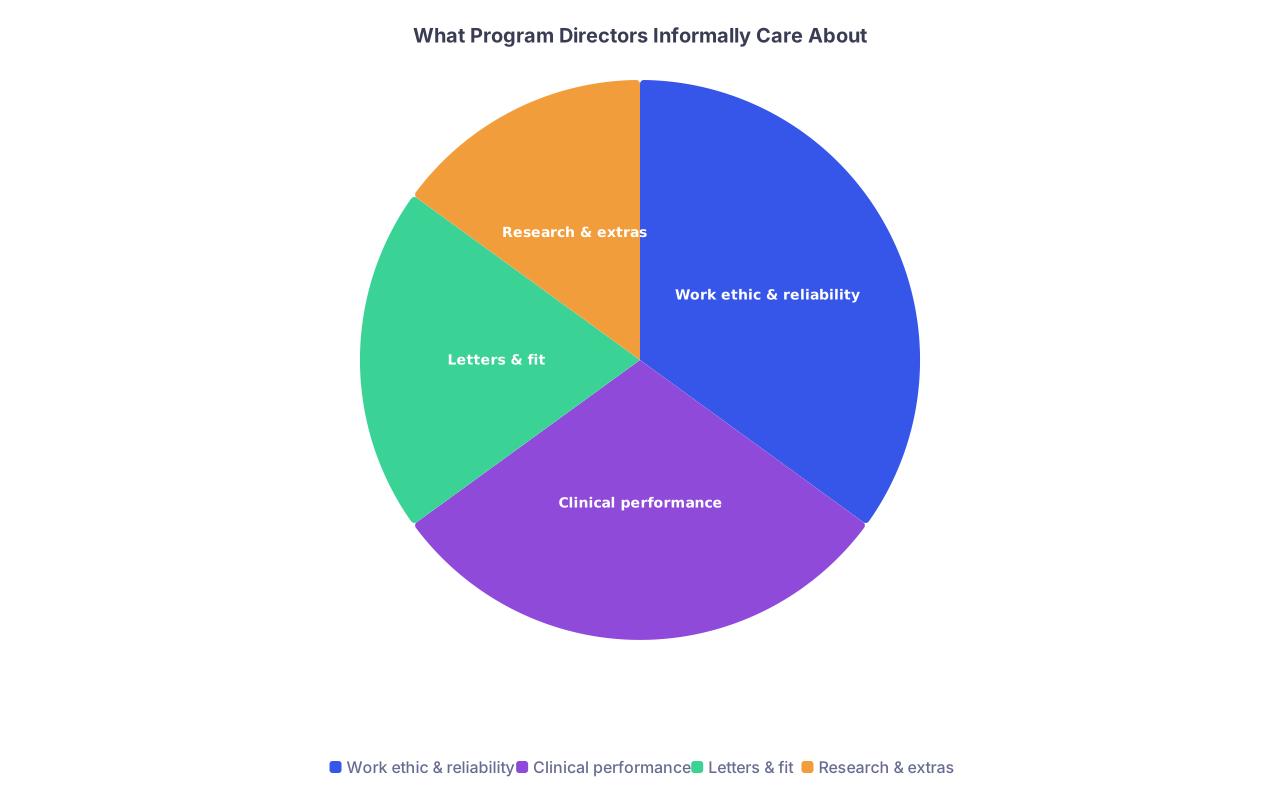
| Category | Value |
|---|---|
| Work ethic & reliability | 35 |
| Clinical performance | 30 |
| Letters & fit | 20 |
| Research & extras | 15 |
Is this an exact breakdown? No. But it’s closer to reality than the “research is 80% of my fate” story your anxiety is pushing.
How to Know If Your CV Is Quietly Strong: A Simple 5-Minute Test
Do this honestly:
- Print your CV or open it on screen.
- Take a pen (or mentally) and mark:
- One area of continuity (something you did for >1 year).
- One area of depth (where you took on more responsibility or produced something).
- One area that points clearly toward your chosen specialty.
If you can circle at least:
- 1 continuity
- 1 depth
- 1 specialty-aligned thing
…your CV is almost certainly stronger than it feels at 2 a.m.
If you can’t? Then your next step isn’t “panic” but “surgically add or upgrade one thing in each of those buckets over the next 1–3 months.”
FAQ (You’re Not the Only One Thinking These)
1. I have zero publications. Am I screwed for residency?
No, unless you’re going for the ultra-competitive, research-heavy top programs in super competitive specialties. Plenty of applicants match every year with no publications, especially in IM, FM, peds, psych, and many community or mid-tier academic programs. In that case, your letters, clinical evals, and consistency in other areas matter even more. One small, fast QI project or case report can help, but no pubs ≠ automatic rejection.
2. My classmates have way more leadership than I do. Does that kill my chances?
Not by itself. Programs like to see leadership, but they care much more about substance than titles. One legit role where you actually did things—organized events, improved a process, mentored others—is better than 6 “co-chair” roles where you just showed up. If you have nothing, take on one real responsibility now (clinic committee, teaching, QI coordination) and do it well.
3. I feel like my CV is super generic. How do I make it stand out without lying?
You don’t need to make it “stand out” with drama. You need to make it clear. Make sure the bullets under each item show: what you did, who it impacted, and any outcome (even small). “Helped in clinic” is generic. “Coordinated follow-up calls for 20–30 high-risk patients weekly to address medication and appointment barriers” is specific and real. Same activity, different impact on the reader.
4. I lost time due to personal/health/family issues and my CV feels thin compared to my peers. Am I doomed?
No. But you have to be smart about it. Briefly addressing legit disruptions in your MSPE/personal statement can contextualize thinner activity sections. Programs don’t expect productivity machines; they do appreciate resilience and honesty. Focus on showing continuity and effort in the time you did have. One or two well-chosen, meaningful experiences can still carry weight.
5. What’s one thing I can do this month to meaningfully strengthen my CV?
Pick one:
- Ask a faculty in your specialty if you can help with a small QI project or case report.
- Take on a concrete, named responsibility in a clinic, student group, or teaching setting.
- Rewrite your CV bullets to be specific, outcome-focused, and specialty-aligned.
Any of those can move your CV from “meh” to “respectable” faster than doom-scrolling Reddit stats.
Open your CV document today and force yourself to highlight three things: one long-term commitment, one area of depth, and one experience tied to your specialty—then rewrite those bullets so they actually sound as strong as the work you put in.