
The myth that “Step scores fix everything” is dangerous. And a thin CV hurts more than programs admit publicly.
Let me just say the part you’re probably afraid to say out loud: you’re scared that your entire future comes down to one or two test scores… and you’re not even sure those are enough to cover what feels like a pretty bare application everywhere else.
You look at your CV and it’s… short. A couple of things. Nothing that screams “wow.” Meanwhile, your classmates list five research projects, three posters, leadership in five orgs, global health trips, and a startup on the side. And you’re sitting there with, “Volunteer at free clinic, tutor, some small project that never got published.”
But your Step scores? Strong. Maybe very strong.
So now your brain is doing that thing:
What if programs think I’m lazy?
What if they assume I peaked at exams and did nothing else?
What if they just see an empty ERAS and auto-reject me?
Let’s unpack this without sugarcoating it—but also without the catastrophizing your 3 a.m. brain is doing.
How Much Do Strong Step Scores Really Cover for a Thin CV?
Short answer: they help a lot. They don’t fix everything. And they don’t work the same for every specialty or program.
Here’s the uncomfortable hierarchy most people won’t say directly: scores are a filter, not a guarantee. Your CV is the story they read after you pass that filter.
If your Step 2 is, say, 255–265, programs notice. It buys you credibility. It tells them: “This person can handle the test-heavy parts of residency, can pass boards, won’t become a remediation problem.” That’s huge. Program directors lose sleep over board pass rates.
But a thin CV + strong scores gets interpreted differently depending on context.
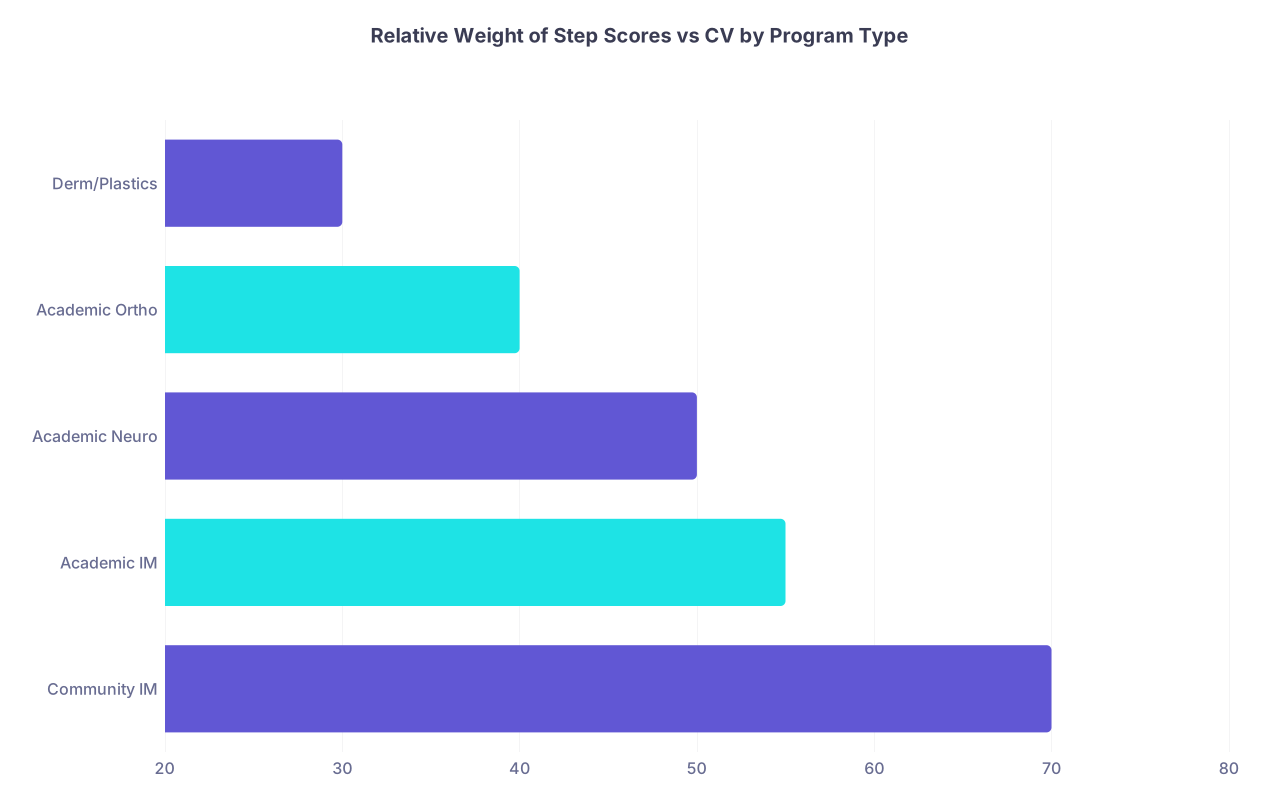
| Category | Value |
|---|---|
| Community IM | 70 |
| Academic IM | 55 |
| Academic Neuro | 50 |
| Academic Ortho | 40 |
| Derm/Plastics | 30 |
Think of it like this (rough, but directionally true):
- Community programs, especially in IM/FM/psych/peds: scores matter a ton, CV can be simpler and you’re still fine.
- Academic, research-heavy places: scores open the door, but they expect some evidence of scholarship or leadership.
- Competitive surgical subspecialties (ortho, ENT, derm, plastics, ophtho): thin CV is a real problem unless other parts are very strong (away rotations, home program advocates, strong letters).
So if you’re aiming for, say, categorical internal medicine at a mix of university and solid community programs and you’ve got a 250+ Step 2, a thinner CV is not an automatic death sentence. Not even close.
But if you’re dreaming Duke neurosurgery with “no research, no home mentor, no leadership,” the scores alone won’t save it. Harsh but true.
What Programs See When They Look at a Thin CV
This is where the anxiety really kicks in. You’re imagining program directors scrolling through your ERAS saying, “That’s it? That’s all?”
Most of them are not that dramatic. They’re busy. They’re triaging hundreds (or thousands) of apps in a weekend while also running an actual residency.
What they’re really asking is much more basic:
- Did this person do something outside class and exams?
- Are they reliable? Do they show up repeatedly anywhere?
- Do they have any depth—sticking with one thing over time?
- Is there any evidence they can function on a team / with patients / in a stressful system?
If your CV is “thin but coherent,” that’s different from “thin and chaotic.” Example:
Thin but coherent:
- 2 years consistent free clinic volunteering
- Tutor for first- and second-years
- Small QI project on clinic workflow, poster at a regional conference
Is that flashy? No.
Is that enough for a lot of programs, especially plus good scores? Yes.
Thin and chaotic:
- One-off weekend health fair
- Shadowed a random specialist for 10 hours
- Joined a research project, dropped after 3 months, nothing to show
Programs see that and wonder if you lose steam, lack follow-through, or only do resume-padding.
So your job now isn’t “become a different person with 10 publications in 3 months.” It’s “turn your thin CV into a clear, believable story that matches your scores and your stated goals.”
And yes, that’s still possible even late in the game.
Reality Check: Where a Thin CV Really Hurts
You don’t need a monster CV for every decent match. But there are scenarios where a sparse application sharply limits you. Let’s be blunt about those.

A thin CV hurts most when:
You’re applying to research-heavy academic programs
If you’re saying in your personal statement: “I’m passionate about academic medicine, research, and becoming a physician-scientist” and your CV has zero posters, zero abstracts, zero anything—there’s a mismatch. They don’t expect you to be an R01-funded fellow as an MS4, but they do look for some attempt at scholarship.You’re gunning for super competitive subspecialties
Ortho, ENT, neurosurgery, derm, plastics, ophtho. These are stacked with people who’ve been on 3–5 projects, have multiple letters from big names, did away rotations, and actually showed up in the OR or lab consistently. You can’t “score” your way out of low engagement there, not easily.Your school isn’t well-known or you’re an IMG with no US research/experience
In those scenarios, the CV is how you prove you’re not just “strong exam taker, unknown clinical entity.” If that part is also bare, programs feel like they’re gambling on someone they don’t know with no outside verification.Your letters are generic
If your CV is thin and your letters read like “hardworking, punctual, pleasant to work with” with zero specific examples, they add up to… nothing compelling. Good, safe, but not someone they’ll fight for on the rank list.
You’re probably reading this and thinking, “Okay, perfect, so I’m doomed.” No. It just means you need to be strategic, not magical.
How Much Can You Actually Fix Late? More Than You Think
If you’re in the middle of MS3 or early MS4 and staring at a depressing ERAS draft, all is not lost. You can’t rewrite the past 3 years, but you can add a surprising amount of substance in 6–9 months if you’re focused.
Here’s the thing people underestimate: programs aren’t counting lines on your CV. They’re evaluating patterns. Depth. Trajectory.
So if you add two or three real things in one year, that can shift their whole read on you.

| Step | Description |
|---|---|
| Step 1 | Realize CV is thin |
| Step 2 | Pick one main lane |
| Step 3 | Find quick-win project or role |
| Step 4 | Show up consistently 3-6 months |
| Step 5 | Ask for letter or presentation |
| Step 6 | Highlight story on ERAS and PS |
The playbook, if you want it spelled out:
Pick ONE main “lane” for growth
Research lane. Teaching/education lane. QI/leadership lane. Don’t try to do all three suddenly; it’ll look fake and scattered. For example:
- “I care about medical education” → take on a structured teaching role, help write a workshop, or assist with a curriculum tweak.
- “I care about QI and patient care systems” → join or start a simple QI project on a rotation site (clinic no-show reduction, discharge instructions clarity, etc.).
- “I care about research but I’m late” → find a retrospective or chart-review project that can realistically become a poster/abstract in 4–6 months.
Find something that produces an outcome, not just “showed up”
You don’t need a NEJM paper. A poster at a local conference, a short presentation at M&M, a curriculum session you helped design—that’s all CV gold when your application is otherwise light.
Show continuity
If you’ve been volunteering somewhere for a year but never had a “title,” talk to the coordinator. Can your role be made more formal? Can you become shift lead, training person, data tracker? You’re already doing the work—convert it into something that reads as leadership or initiative.
Ask for one or two strong, detailed letters
If your CV is thin, your letters matter even more. You want at least one writer who can say, “This student may not have 10 research lines, but they show up, follow through, and function like an intern.”
How Programs Actually Compare You to Others
The comparison game in your head is brutal and usually inaccurate. You’re comparing the highlight reel of your classmates to the worst version of your own story.
Programs aren’t reading you next to “perfect human with 6 first-author papers and 270 Step 2” in a side-by-side spreadsheet. They’re doing pattern recognition at scale.
| Feature | Applicant A: Thin CV | Applicant B: Stronger CV |
|---|---|---|
| Step 2 CK | 255 | 255 |
| Research | None | 1 poster, 1 abstract |
| Volunteering | 1 clinic, 1 year | 2 activities, 3+ years |
| Leadership | None | Org treasurer, 1 year |
You look at that and think, “They’ll always take B.” But that’s not how it always plays out.
What if:
- Applicant A has a phenomenal letter from an inpatient attending saying, “Functions like a PGY-1, top 5% of students I’ve worked with.”
- Applicant B has average letters and comes across disinterested during interview day.
Now it’s not so obvious, is it?
Programs will absolutely rank a “thin CV, strong scores, excellent human” above “stacked CV, weird vibes, mediocre team player.”
So yes, your CV is lighter. But if your clinical performance is strong, you’re normal and kind on interview day, and your scores clear their internal cutoffs, you’re still in the fight at a lot of places.
Concrete Moves to Improve Your CV Right Now
This is the part everyone wants: “Tell me exactly what to do so I don’t ruin my life.” Okay.
Here are realistic, high-yield moves you can still make, even late:
Turn existing activities into stronger entries
Don’t just write “Volunteer at free clinic.” Flesh it out: “Served as primary student for X patients per session, coordinated follow-up calls, helped launch a medication access tracking sheet.” That’s not lying—that’s describing.Add a small research or QI project with a clear end point
Ask on your current or next rotation: “Is there any data we’ve already collected that needs to be turned into a poster or abstract?” You’d be shocked how many half-baked projects just need a student with time and Excel.Grab a defined teaching role
Sign up to be an MS1/MS2 small group facilitator, OSCE rater, anatomy TA, or Step 1 tutor through your school. Programs love teaching—it signals communication skills and patience.Fix your personal statement and ERAS descriptions
If your CV is thin, your writing needs to carry more weight. Tell a coherent story: why this specialty, what you’ve actually done, what kind of resident you’ll be. Avoid vague “I love helping people” nonsense. Use specifics.Interview prep like your life depends on it
Because it kind of does. If your paper app is “fine but not dazzling,” your in-person impression is a huge lever. Be someone they want to work 12-hour shifts with. That matters more than another bullet point ever will.
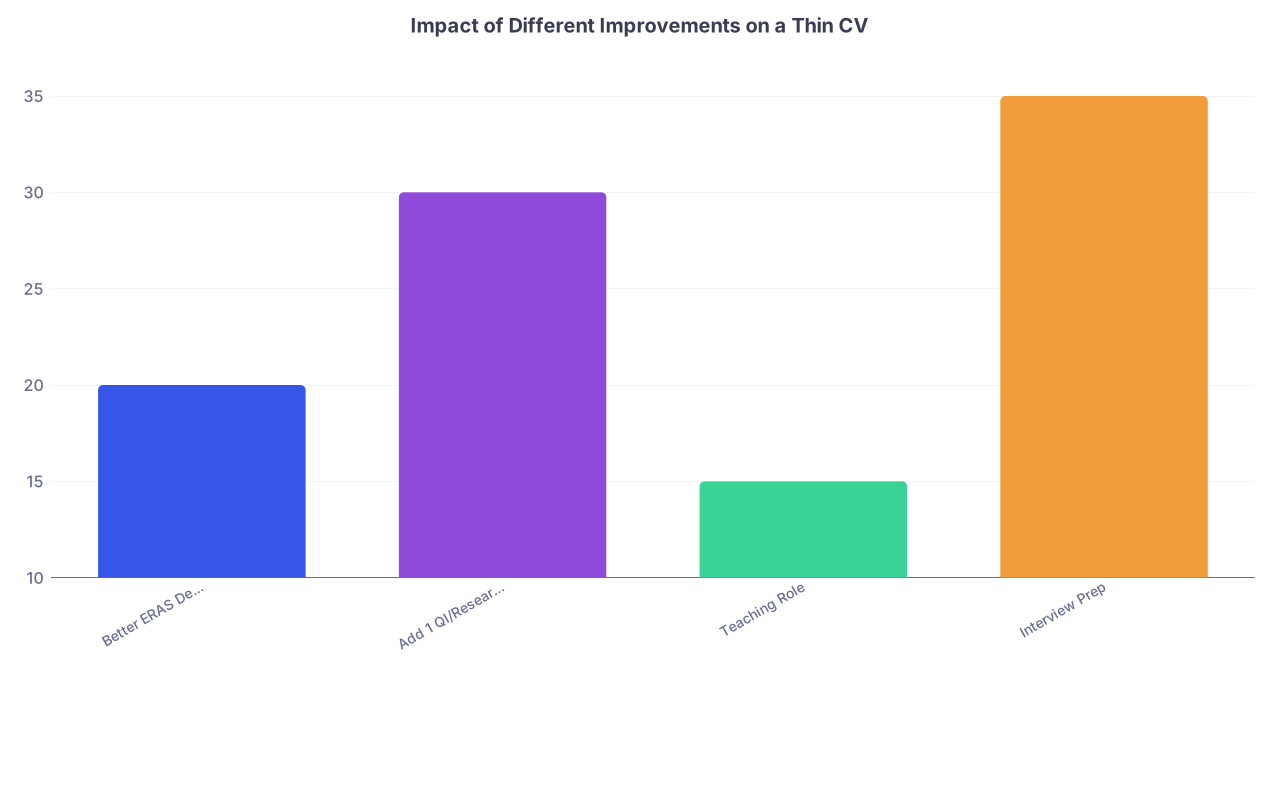
| Category | Value |
|---|---|
| Better ERAS Descriptions | 20 |
| Add 1 QI/Research Project | 30 |
| Teaching Role | 15 |
| Interview Prep | 35 |
And yeah, those percentages are made up—but directionally? That’s how I’ve seen it play out: one decent project + strong interviewing moves the needle way more than obsessively padding minor roles.
What If I Really Can’t Add Much Before Applications?
Then we shift strategy from “add content” to “aim smart and present well.”
If time is almost out:
- Apply broadly. More than you think. Especially if your school isn’t a powerhouse or your specialty is even moderately competitive.
- Include a healthy chunk of community or less research-heavy academic programs where a 250+ Step 2 and solid clinical evals are huge.
- Lean on geography where you have ties. Programs love “likely to stay” people.
- Get your mentors/letter writers to explicitly address any perceived gaps: “May not have extensive research, but on the wards they already function at the intern level.” That line is gold.
And internally, accept this: your first job out of residency will not hinge on whether you matched “top 10” or “mid-tier solid program.” It will hinge on: did you train well, did you pass your boards, and are you competent.
I’ve seen people from mid-tier IM programs match GI and cards. I’ve seen derm residents from not-top-10 places land great jobs. The prestige dread is real, but it’s exaggerated.
Battling the 3 a.m. Panic Voice
Let’s be honest. None of this fully shuts up the internal noise that says: “You didn’t do enough. You wasted time. Everyone else is ahead.” That voice doesn’t care about reason. It feeds on comparisons.
Here’s what I remind people—and myself—when that spiral starts:
You’re not being evaluated on whether you did everything. You’re being evaluated on whether you did enough to suggest you’ll be a safe, growing, workable resident.
Most residents, even at good programs, are not superstars with glittering CVs. They’re regular students who did okay-to-good and then learned like crazy on the job.
Programs are under pressure to fill spots with people who can function, not with CV trophies who burn out or can’t work in a team. If you can show you’re reliable, decent, and teachable, that matters more than you think.

You’re probably harsher on yourself than any PD will be.
So… Is Thin CV + Strong Step Enough to Match Well?
Here’s my honest take:
For most core specialties (IM, FM, peds, psych, prelim medicine, many EM programs):
Thin but coherent CV + strong Step 2 + good letters + solid interview = very reasonable chance to match well, especially if you’re flexible on geography and prestige.For mid-competitive fields (neuro, anesthesiology, OB/GYN, some EM, some surgical prelims):
You’re still in the game. The thinner the CV, the more you need strong letters and a convincing, specific story about why that specialty.For hyper-competitive subspecialties:
A thin CV is a bigger problem, and strong Steps alone usually aren’t enough for “dream” programs. But you may still match somewhere if you play it very smart and have good mentorship and away rotations.
Your job now isn’t to become a different person. It’s to:
- Strengthen the story your existing experiences tell.
- Add one or two high-yield, outcome-based activities if you still have time.
- Aim at programs where your profile—scores-heavy, CV-light—is still very much acceptable.
You’re not as behind as your brain insists you are.
Key Takeaways
- Strong Step scores don’t erase a thin CV, but they absolutely keep you in the running for many solid programs—especially in core specialties.
- You can’t rebuild your entire CV late, but you can add 1–2 meaningful, outcome-focused activities and sharpen how you present what you’ve already done.
- Matching “well” is less about impressing everyone and more about aligning your real profile with programs that value what you actually bring—reliability, teachability, and the ability to function on day one.