Introduction: Why CV Tailoring Matters in Residency Applications
Your residency CV is more than a list of activities—it is a strategic document that tells programs, “I understand your specialty, I understand your needs, and I fit here.”
Residency Applications are increasingly competitive across all Medical Specialties. Programs may review hundreds (or thousands) of applications in a short time. A generic, one-size-fits-all CV can easily blend into the background, even if you have strong experiences. Thoughtful CV Tailoring helps you:
- Highlight your most relevant clinical and research experience
- Demonstrate insight into the specialty’s culture and priorities
- Signal intentional Career Development and clear motivation
- Make it easier for program directors to see you as a strong match
This roadmap will walk you through how to tailor your CV for different specialties while keeping a strong, consistent foundation. You’ll learn how to structure your document, what to emphasize for major Medical Specialties, and how to align your Medical Education journey with your target field.
Understanding Your Audience: How Specialties Evaluate Your CV
Before changing a single line on your CV, step back and ask: “Who will read this, and what are they looking for?” CV Tailoring starts with understanding your audience.
Researching Each Medical Specialty
Every specialty has different core values and daily realities. Start with:
Official resources
- ACGME program requirements for the specialty
- Specialty society websites (e.g., ACP for Internal Medicine, AAP for Pediatrics, ACEP for Emergency Medicine)
- NRMP’s Charting Outcomes in the Match to understand what successful applicants commonly have
Program-level resources
- Residency program websites: mission statements, values, patient populations
- Sample resident profiles and alumni outcomes
- Descriptions of tracks (e.g., clinician-educator, global health, research-heavy)
Key Competencies and Culture
As you research, list the core competencies each specialty tends to value. For example:
Surgery
- Technical and manual dexterity
- Comfort with high-acuity, high-pressure situations
- Strong work ethic, resilience, and stamina
- Teamwork in hierarchical but collaborative environments
Psychiatry
- Excellent communication and listening skills
- Empathy and emotional insight
- Interest in behavioral sciences, mental health advocacy
- Longitudinal care and patient relationships
Emergency Medicine
- Rapid decision-making and triage
- Multitasking in chaotic environments
- Procedural skills (lines, airway management, wound care)
- Comfort with shift work and variable hours
Map your own experiences to these competencies and identify what to highlight.
Identifying and Using Program-Level Keywords
CV Tailoring also includes wording choices. Many programs scan ERAS experiences quickly and may focus on keywords that match their priorities.
To find keywords:
- Review program websites and note repeated phrases:
- “Underserved populations,” “health equity,” “community-oriented”
- “Academic research,” “QI initiatives,” “evidence-based practice”
- “Procedural training,” “simulation,” “operative experience”
- Review individual program goals or tracks, such as:
- Global health
- Medical education
- Health services research
- Advocacy
Incorporate these phrases organically into your activity descriptions when accurate. For example:
- Instead of: “Volunteered at free clinic.”
- Use: “Provided longitudinal primary care to underserved patients at a student-run free clinic, focusing on chronic disease management and health equity.”
Programs quickly recognize when your CV “speaks their language.”
Structuring Your Residency CV: Core Framework + Tailoring Strategy
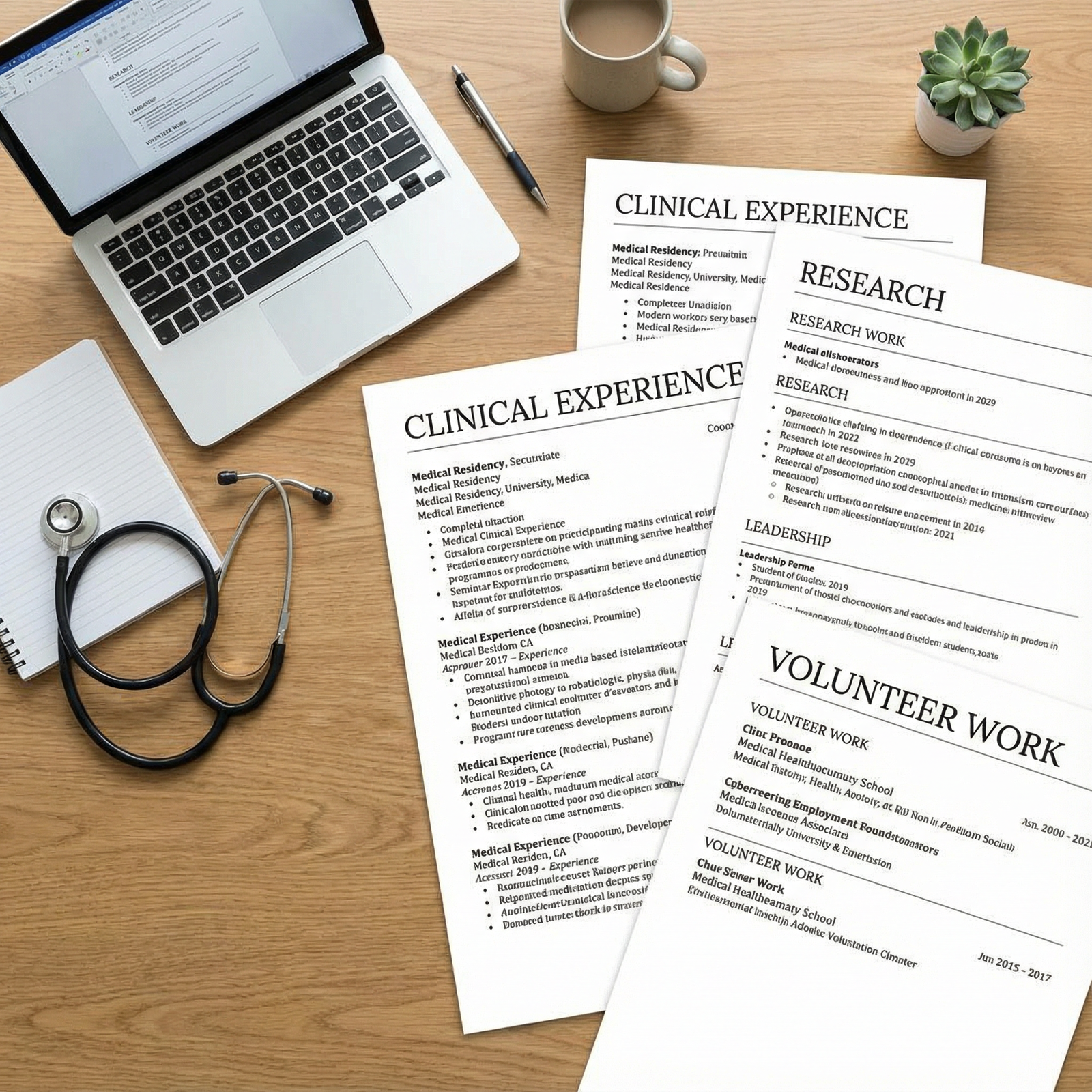
The basic framework of your CV will remain fairly consistent across all Residency Applications. What changes is emphasis, ordering, and detail.
Core Sections of a Strong Residency CV
1. Contact Information
Keep it professional and minimal:
- Full name
- Phone number
- Professional email address
- City/State (optional)
- LinkedIn or professional website (optional, but helpful if well-developed)
Avoid including:
- Personal photo (unless required by a specific system or country)
- Unprofessional email addresses or social media links
2. Education
List all degrees in reverse chronological order:
- Medical school: name, location, degree, expected or actual graduation date
- Prior degrees: bachelor’s, master’s, PhD (include majors/minors if relevant)
- Key honors: AOA, Gold Humanism, scholarships, Dean’s List
Tailoring Tip:
For academically rigorous specialties (e.g., Dermatology, Radiation Oncology, Radiology, some Internal Medicine programs):
- Bold or otherwise emphasize:
- Honors designations
- Distinction in research or medical education
- Dual degrees (MD/PhD, MD/MPH, MD/MBA)
- Briefly mention thesis titles or capstone projects if they align with the specialty.
3. Clinical Experience and Clerkships
This is the backbone of your CV. Include:
- Core and sub-internship rotations (especially in your target specialty)
- Electives relevant to your field
- Away rotations / audition rotations
For each, list:
- Institution and department
- Dates
- Role (e.g., “Sub-intern in Internal Medicine”)
- 2–4 bullet points describing responsibilities and impact
Tailoring Strategy:
- Reorder rotations: List your target specialty rotations and sub-internships higher within the clinical section when possible.
- Adjust bullet points: Highlight skills most valued by that specialty.
- For Dermatology: skin exams, dermatoscopy, biopsies, inpatient consults
- For Anesthesiology: pre-op assessments, airway management exposure, intra-op monitoring
- For Family Medicine: continuity clinics, preventive care, chronic disease management, obstetrics exposure
4. Research and Scholarly Activity
Include:
- Research projects (clinical, basic science, QI, education, health services)
- Presentations (oral, poster)
- Publications (peer-reviewed, abstracts, book chapters)
- Works in progress (clearly labeled)
List your role clearly (e.g., “Principal investigator,” “Co-author,” “Data analyst”).
Tailoring Strategy:
- Highlight topic alignment: If applying to Psychiatry, move your mental health research above unrelated lab work.
- Emphasize methodology match: For specialties heavy on outcomes research (Internal Medicine subspecialties, Radiation Oncology), highlight:
- Study design
- Data analysis skills
- Use of statistics or specific software (R, SPSS, Stata)
- Quantify when possible:
- “Enrolled 150 patients in a prospective observational study of sepsis management.”
5. Volunteer Work, Leadership, and Service
Programs want evidence of professionalism, responsibility, and values. Include:
- Student organization leadership roles
- Community service, clinics, advocacy work
- Teaching and mentoring roles
Tailoring Strategy:
- For Family Medicine & Pediatrics: emphasize community health, education, advocacy, and work with underserved or vulnerable populations.
- For Academic/Research-focused IM or Neurology: prioritize leadership in scholarly organizations, journal clubs, or research committees.
- For Surgery or EM: highlight roles that show decisiveness, team coordination, or performance under pressure (e.g., EMS volunteering, disaster response teams).
6. Professional Skills, Certifications, and Additional Training
Include:
- BLS, ACLS, PALS, NRP, ATLS (as applicable)
- Languages and proficiency level
- Technical/clinical skills (e.g., ultrasound-guided IV placement, suturing)
- Teaching certificates, QI training, simulation instructor courses
Tailoring Strategy by Specialty:
- Anesthesiology / EM / Critical Care: airway management exposure, ACLS, PALS, simulation training.
- Pathology / Lab-based specialties: lab techniques, histology, microscopy, handling of specimens, prior bench research.
- Radiology: familiarity with imaging modalities, basic radiology electives, anatomy teaching.
7. Interests and Hobbies
This section is brief but powerful. Programs use it to identify fit, well-being, and potential talking points for interviews.
- Aim for 3–5 concise, authentic entries.
- Avoid generic one-word hobbies (“reading,” “travel”).
- Use short descriptive phrases:
- “Trail running and organizing resident wellness hikes”
- “Teaching chess to middle school students in underserved communities”
Tailoring Strategy:
Adjust the focus, not the truth. For a program emphasizing community engagement, you might phrase:
- “Volunteering in community health fairs and organizing blood pressure screening events.”
For a program in a region with strong outdoor culture:
- “Backpacking and trail running; interested in exploring national parks near [Program Region].”
Specialty-Specific CV Tailoring: How to Stand Out in Different Fields
Below are practical examples of tailoring your CV for commonly applied specialties. Use these as models, then customize for your own Career Development goals.
Surgery
Surgery programs look for evidence of technical ability, grit, and commitment.
What to Emphasize:
- Operative exposure and procedural skills
- List sub-internships in general surgery and subspecialties early.
- Highlight:
- Assisting in OR procedures
- Competence in suturing, wound management, drains, basic laparoscopic skills (if applicable)
- Teamwork in high-stakes environments
- Leadership in surgical interest groups or simulation labs
- Experiences in trauma centers, ICU rotations, EMT work
- Research
- Surgical outcomes, quality improvement, perioperative medicine
- Case reports or case series of surgical patients
Example Bullet Revisions:
- Generic: “Assisted in patient care on surgical wards.”
- Tailored: “Managed pre- and post-operative care for 15–20 inpatients daily, including fluid management, wound care, and early recognition of surgical complications.”
Internal Medicine
Internal Medicine values clinical reasoning, communication, and scholarly engagement.
What to Emphasize:
- Complex case management
- Internal medicine sub-internship and ward experience
- Bullet points focusing on:
- Diagnostic reasoning
- Management of multiple comorbidities
- Chronic disease follow-up
- Academic and QI engagement
- Research in chronic diseases (diabetes, hypertension, heart failure)
- QI projects (reducing readmissions, improving transitions of care)
- Teaching
- Peer tutoring, leading case conferences, mentoring junior students
Example Bullet Revisions:
- Generic: “Participated in patient rounds.”
- Tailored: “Led daily presentations on complex inpatient cases, synthesizing history, labs, imaging, and evidence-based guidelines to propose diagnostic and management plans.”
Pediatrics
Pediatrics focuses on communication, family-centered care, and child advocacy.
What to Emphasize:
- Child and family interactions
- Pediatric rotations, pediatric emergency, NICU/PICU exposure
- Work in schools, summer camps, tutoring, youth mentorship
- Advocacy and community work
- Child health fairs, immunization drives
- Involvement with organizations addressing child poverty, nutrition, or education
- Developmental understanding
- Any experiences where you adapted communication to different developmental stages
Example Bullet Revisions:
- Generic: “Volunteered at a community clinic.”
- Tailored: “Coordinated a pediatric literacy initiative at a community clinic, counseling caregivers on early childhood development and reading practices.”
Psychiatry
Psychiatry programs emphasize interpersonal skills, reflection, and an interest in mental health.
What to Emphasize:
- Mental health–related experiences
- Psychiatry rotations, consult-liaison experience, addiction medicine, behavioral health clinics
- Crisis hotline work, peer counseling, community mental health volunteering
- Longitudinal interactions and empathy
- Activities where you supported vulnerable populations over time
- Scholarly interest in psychiatry
- Psych-related research, neuroscience, psychotherapy workshops
- Attendance at psychiatry conferences, journal clubs
Example Bullet Revisions:
- Generic: “Shadowed in psychiatry clinic.”
- Tailored: “Observed and documented diagnostic interviews and psychotherapy sessions in an outpatient psychiatry clinic, focusing on building rapport, motivational interviewing, and safety assessments.”
Emergency Medicine
Emergency Medicine seeks applicants comfortable with fast-paced, unpredictable environments.
What to Emphasize:
- High-acuity environments
- EM clerkships, away rotations, urgent care experiences
- EMS/EMT roles, disaster response volunteering
- Procedural and resuscitation skills
- IV lines, suturing, splinting, basic airway management (where applicable)
- Certifications (ACLS, PALS, ATLS if completed)
- Teamwork under pressure
- Roles in simulation labs, code teams, rapid response teams
Example Bullet Revisions:
- Generic: “Worked in emergency department.”
- Tailored: “Participated in the initial assessment and stabilization of acutely ill patients in a Level I trauma center, including trauma surveys, splinting, and assisting with code blue resuscitations.”
Advanced Strategies for Effective CV Tailoring
Beyond content, how you present your experiences can significantly strengthen your application.
Prioritizing and Reordering Sections
You can subtly adjust the order of sections (where allowed by the application system):
- Applying to a research-heavy academic IM program:
- Consider placing Research before Volunteer/Leadership if your scholarly output is a major strength.
- Applying to Family Medicine or Pediatrics with strong community involvement:
- Emphasize Volunteer/Service earlier, particularly if it aligns with primary care and underserved populations.
Within sections, list the most relevant experiences first, even if they are not strictly chronological (if your CV format allows; within ERAS experience entries must remain chronological, but your CV for supplemental use may be more flexible).
Using Metrics and Outcomes
Where possible, quantify your work:
- “Screened 120+ patients for depression and anxiety using validated tools.”
- “Co-led QI project that improved vaccination rates from 62% to 81% over 12 months.”
- “Taught weekly physical exam skills sessions to a cohort of 15 first-year students.”
Numbers help program directors quickly grasp your impact.
Aligning Your CV With Your Personal Statement and Letters
CV Tailoring should align with your overall application narrative:
- If your personal statement emphasizes a commitment to underserved care, ensure your CV clearly shows longitudinal service and relevant clinical experiences.
- Share your CV with letter writers and discuss which experiences you are emphasizing for a given specialty so they can reinforce those themes in their letters.
Consistency across CV, personal statement, and letters creates a coherent and compelling story.
Practical Tips: Editing, Reviewing, and Avoiding Common Pitfalls
Common Mistakes in Residency CVs
Being too generic
- Same bullet points for all specialties
- No specialty-specific language or examples
Overcrowded, hard-to-read format
- Long paragraphs instead of concise bullets
- Inconsistent dates, fonts, or spacing
Exaggeration or misrepresentation
- Programs often verify experiences; integrity is non-negotiable.
Irrelevant or outdated content
- High school activities usually unnecessary unless exceptional and clearly relevant.
Step-by-Step CV Tailoring Workflow
Start with a “master CV”
- Include everything: all experiences, roles, details.
- Keep this stored and updated for future Career Development and Medical Education milestones.
Create specialty-specific versions
- Copy the master CV and title it by specialty (e.g., “Residency CV – Internal Medicine”).
- Reorder and refine experiences to match the specialty’s competencies.
Adjust wording and emphasis
- Insert specialty-appropriate keywords naturally.
- Rewrite bullet points to highlight skills your target specialty values most.
Seek targeted feedback
- Ask mentors and residents in that specialty to review:
- “Does this CV reflect what your program values?”
- “What’s missing that would strengthen my fit?”
- Ask mentors and residents in that specialty to review:
Proofread meticulously
- Check for spelling, grammar, date consistency, and formatting.
- Read out loud to catch awkward phrasing.
FAQ: Tailoring Your CV for Different Residency Specialties
1. What are the most important sections to include in a residency CV?
At minimum, include:
- Contact Information
- Education
- Clinical Experience / Clerkships
- Research and Scholarly Activity
- Volunteer Work and Leadership
- Professional Skills and Certifications
- Interests and Hobbies
Depending on your background, you may also add sections such as “Teaching Experience,” “Quality Improvement Projects,” or “Awards and Honors” to highlight specific strengths.
2. How do I decide which experiences are most relevant to a specialty?
Ask yourself:
- Does this experience demonstrate a competency my target specialty cares about (e.g., procedural skill, communication, advocacy, research)?
- Does it align with the populations or settings emphasized in that field (e.g., children for Pediatrics, underserved communities for Family Medicine, acute care for EM)?
- Could a program director easily see how this experience predicts my success in their training environment?
Use residency websites, mentors, and talking with current residents to refine your judgment. When in doubt, include the experience but adjust the emphasis and phrasing.
3. Do I really need separate CV versions for different specialties?
If you are applying to more than one specialty—or even different types of programs within the same specialty (e.g., community vs. research-heavy academic Internal Medicine)—having tailored versions is very helpful. Small changes in ordering, bullet point emphasis, and language can meaningfully improve how well your application aligns with a program’s priorities.
You do not need to reinvent the entire CV each time, but fine-tuning is worth the effort in a competitive Match environment.
4. How long should my residency CV be, and how detailed?
Most residency-focused CVs are 1–3 pages, depending on your level of experience:
- For most graduating medical students: 2 pages is common and appropriate.
- Focus on clarity, relevance, and readability rather than hitting a specific page number.
Include enough detail for each major role to show what you actually did and what skills you gained (2–4 bullets per role is typical). If you find your CV exceeding 3 pages, consider trimming older, less relevant activities or consolidating similar entries.
5. Should I include hobbies and personal interests on my residency CV?
Yes. Thoughtfully chosen hobbies:
- Humanize you beyond your test scores and grades
- Provide easy conversation starters during interviews
- Offer insight into your teamwork, resilience, leadership, or wellness strategies
Keep them genuine and specific. Avoid controversial topics and ensure anything listed is something you would be comfortable discussing in detail. Tailor the way you describe them to align with the tone of the specialty or program culture when appropriate, without misrepresenting your true interests.
By treating your CV as a dynamic, strategic document—and by aligning it with the expectations of different Medical Specialties—you transform it from a static list into a powerful tool for your Residency Applications. Used well, it will not only summarize your Medical Education journey but also clearly articulate why you are an excellent fit for your chosen field.