
The way faculty judge the “Research” section of your residency CV is harsher and more systematic than anyone tells you.
You think they’re counting lines. They’re not. They’re running a mental algorithm in under thirty seconds that boils down to: “Is this real academic work or decorative fluff?” And they’ve been doing it for years.
Let me walk you through what actually happens in that room when your ERAS application is on the screen, and how faculty quietly rank your research compared to everyone else’s.
What Really Happens When Your CV Is On the Screen
Here’s the part students never see.
It’s 7:30 pm in some conference room or Zoom call. There’s stale coffee, half-eaten cookies from noon conference, and a few tired faculty plus 1–2 program directors scrolling through ERAS.
Nobody is lovingly reading every line of your CV.
They open your application. One of three things happens with your research section:
- They scan and immediately think: “Serious academic track.” You just moved into a different mental tier.
- They scan and think: “Good, solid, expected level.” You meet the bar, no more, no less.
- They scan and think: “CV gardening.” That’s the kiss of death phrase for research credibility.
They don’t say this to you. They say it to each other.
You’ll hear muttered lines like:
- “Lot of case reports.”
- “Poster machine.”
- “Oh, this one actually writes.”
- “Name on a bunch of things but nothing first-author.”
I’ve sat in those meetings. I’ve watched applicants with “12 publications” get ranked below someone with two excellent, clearly real projects.
The volume is not the primary filter. The signal is: depth, role, and coherence.
The Hidden Hierarchy: How Research Is Actually Ranked
There’s an unspoken tier system most faculty use. Nobody writes this down, but they apply it relentlessly.
Think of it as a quiet pecking order.
| Tier | Perceived Level | Typical Reaction |
|---|---|---|
| 1 | First-author paper in solid journal | "Serious" |
| 2 | Middle-author in good work, clear role | "Legit contributor" |
| 3 | Abstracts/posters from real projects | "Normal/expected" |
| 4 | Case reports, one-off posters | "OK, minor" |
| 5 | Questionable, padded, vague entries | "CV gardening" |
Now I’ll translate that into how we actually think about each type.
Tier 1: First-Author, Original Research (Real Work)
This is the top of the food chain for most non-PhD, non-MSTP applicants.
A faculty member sees:
- Your name first
- A real study/question
- In a journal they’ve at least vaguely heard of
- With a coherent topic that matches your “story”
This is when people say things like:
- “This one actually did work.”
- “They can probably finish what they start.”
- “We can groom them for fellowship.”
We’re not obsessing about impact factor unless you’re applying to physician-scientist tracks. But first-author original research in a halfway decent journal? That’s gold. Especially if it matches your stated interests.
Tier 2: Middle-Author, But On Real Projects
This is very underrated. Students obsess about being first author. Faculty mostly want to know: did you actually contribute to something that required more than a week of effort?
Good signals here:
- You’re second or third author on a paper clearly coming from your home department.
- The topic aligns with your other activities.
- The project has a methods section that doesn’t look like a book report.
You get credit for being on a real team, not just wandering around presenting 5 unrelated posters at regional meetings.
If you’re not applying as a hardcore research person, this tier is usually “good enough” to check the research box strongly.
Tier 3: Posters and Abstracts From Real Work
This is the middle zone. Where most applicants live.
Faculty scroll down and see:
- A poster at your specialty’s national or major regional meeting.
- An abstract in the conference proceedings.
- Maybe a couple of institutional research days.
If at least some of these are clearly tied to one real project (same topic, same mentor), this reads as: “Student participated in legitimate research, probably understands basic process, did some work.”
This is absolutely acceptable for the majority of programs and applicants. The problem is when this is all you have and it’s disorganized, random, and looks like you wandered from project to project without investing in any of them.
Tier 4: Case Reports and Random One-Off Stuff
Let me be blunt: case reports are CV seasoning. Not the main course.
Faculty know exactly how much work goes into most case reports:
- You saw something interesting.
- Your resident or attending asked you to help write it up.
- You wrote a chunk, edited some text, maybe made a figure.
That’s fine. It shows some initiative. But it does not scream “I understand research design, data, or critical thinking.” It screams: “I can help produce something when someone else drives.”
We don’t throw it out. But we don’t overvalue it either.
What we do notice:
- If your ENTIRE research section is 6 case reports and zero studies, we rank you as having “no real research experience.”
- If you have 1–2 case reports plus one ongoing real project or a poster from a study, that looks normal.
Tier 5: Fluff and CV Gardening
This is where people quietly roll their eyes.
Patterns that trigger this reaction:
- Overly vague entries: “Participated in several quality improvement projects” with no specifics.
- Listing “manuscript in preparation” for half a dozen things that will never see daylight.
- Four different “Institutional poster day” presentations of what looks like the same trivial project, reworded to look like more volume.
- “Submitted to [fancy journal]” as if that’s an accomplishment. It’s not.
The internal monologue from faculty: “This student thinks we can’t tell the difference between real work and padding.”
You never want that thought associated with your name.
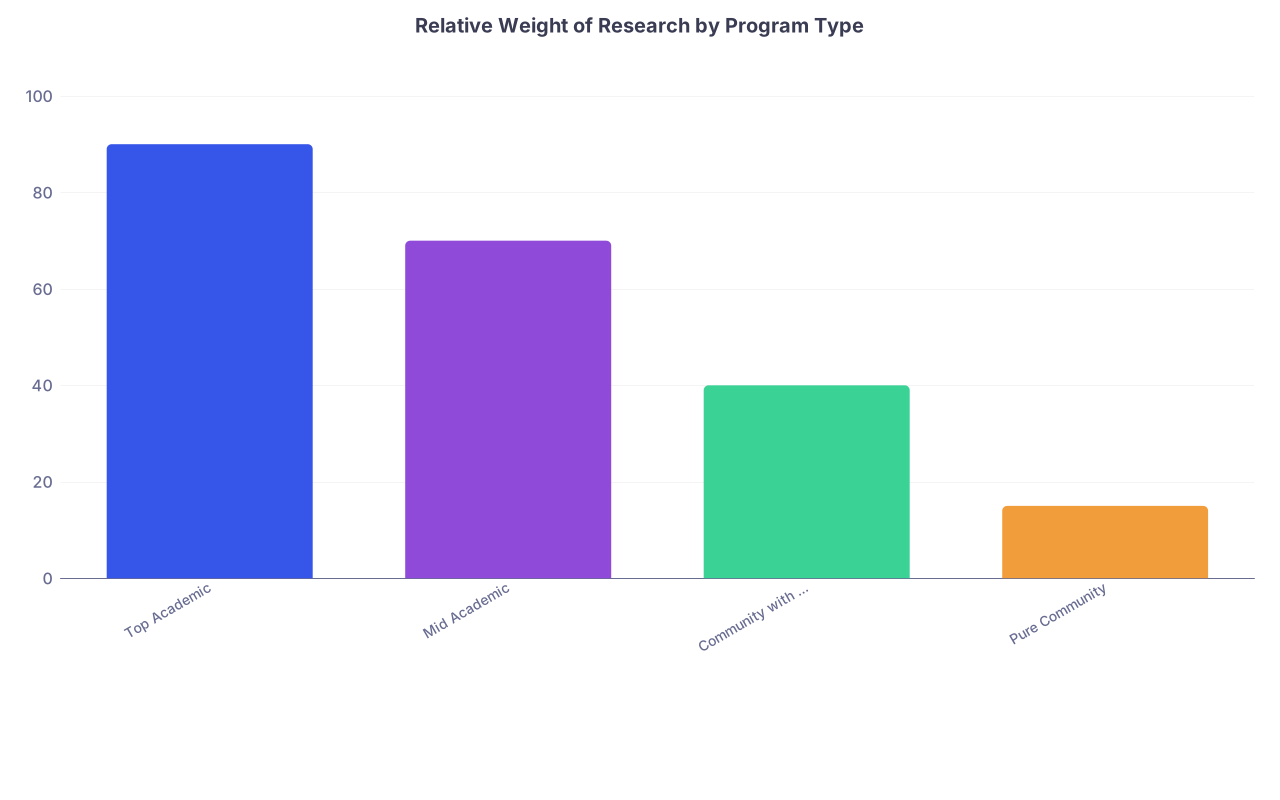
How Program Type Changes How Your Research Is Judged
Not every program cares equally. But the way they judge what you have is surprisingly consistent.
| Category | Value |
|---|---|
| Top Academic | 90 |
| Mid Academic | 70 |
| Community with Academic Affiliation | 40 |
| Pure Community | 15 |
Those numbers aren’t from a paper. They’re from years of sitting in rank meetings and hearing what directors actually argue about.
At Top Academic Programs
Think big-name IM programs, competitive surgical residencies, derm, rad onc, neurosurgery, etc.
Here’s what happens:
- Research is a sorting tool.
- It compensates for minor score deficits and magnifies strengths.
- It identifies “future faculty” and “future fellowship stars” early.
Applicants get mentally slotted:
- “Gonna be a K-award person.”
- “Strong clinically, OK research.”
- “Excellent on paper but zero academic trajectory.”
If you’ve got high-volume, high-quality research (especially with a consistent theme), you get air cover for weaker pieces elsewhere.
If you have nothing? You’d better be in the absolute top tier on scores, letters, and clinical comments.
At Mid-Tier Academic or University-Affiliated Programs
Here research is more of a tiebreaker and a “this person will represent us well” marker.
They’re asking:
- Can this person produce at least one poster or publication as a resident?
- Will they embarrass us or help us match more students into fellowships?
Having solid, Tier 2–3 research is a big plus. Top-tier research makes you stand out. No research at all doesn’t kill you, but it drops you behind similar applicants who have something.
At Community Programs
Research rarely dominates the conversation. But it still sends a signal.
The quiet truth:
- Too much hardcore research (especially basic science) sometimes makes community programs nervous. They worry you’ll be miserable or leave.
- A moderate amount of clinical or QI research reads as “motivated, probably organized, can finish projects.”
So for community programs, the goal is not “pile up as much as possible.” It’s “show I can be productive and am not gaming the system.”
The Three Questions Faculty Ask Themselves About Your Research
They are not consciously counting your entries. They’re subconsciously answering three questions.
1. Is This Real?
Translation: Are these projects with actual design, data, timelines, and teams—or just decorative case reports and flimsy QI?
Signals that say “real”:
- Longitudinal involvement (dates spanning more than a summer).
- One or two main topics that show up multiple times.
- Named mentors who faculty actually know.
- Clear roles: “Designed survey,” “Performed data collection,” “Conducted analysis.”
Signals that say “maybe not”:
- Everything happened in one 8-week summer.
- Ten different topics with no main line.
- Vague phrases like “assisted with project.”
2. Did You Actually Do Anything?
This is where role matters more than raw count.
Faculty look for clues:
- First or second author? Strong plus.
- Descriptions that show ownership: “Led data extraction,” “Performed chart review,” “Wrote introduction and discussion.”
- Continuity: you followed a project from start to presentation or publication.
Red flags:
- Your name is 8th on a poster with 10 authors.
- Every description is “assisted” or “helped with.”
- You claim huge contributions to five different manuscripts all “in preparation.”
We’ve all supervised students. We know what’s realistic.
3. Does It Fit Your Story?
This one’s subtle but powerful.
If your personal statement says you’re passionate about health disparities, but all your research is bench immunology with a PI you barely know? That disconnect stands out.
Strong match:
- You say you want cardiology, and you have echo outcomes research with your cardiology department.
- You write about surgical education, and you worked on resident education projects.
- You show interest in critical care, and you’ve done ICU outcomes or sepsis-related work.
Faculty love coherence. It reads as maturity and intentionality, not random opportunism.
How They Treat “In Progress,” “Submitted,” and “In Preparation”
You think adding “manuscript in preparation” makes your CV look active. Faculty think very differently.
Here’s the unspoken ranking of credibility:
| Status on CV | How Faculty Read It |
|---|---|
| Published | 100% real |
| In press / Accepted | 95% real |
| Submitted | 50–70% real |
| In preparation | 10–20% real |
“Published” is done. Safe. Solid.
“Accepted” or “In press” is nearly as good.
“Submitted” is a coin toss. Could be real, could be overly optimistic. Faculty mentally discount it but do not ignore it.
“In preparation” is almost white noise. People have “in preparation” manuscripts that stayed that way from M2 to PGY3. We know this.
If you must list “in preparation,” keep it to a very small number and only for things that are genuinely in late drafting, with a plan and a committed team. Two is plenty.
Behind the Scenes: How It Comes Up in Rank Meetings
Nobody goes down your CV line by line in a rank meeting. That’s not how it works.
Usually it goes like this:
Program director: “Next is Patel, internal medicine applicant. Strong letters, 250s on Step 2, two medicine sub-Is, couples matching. Thoughts?”
Faculty 1: “Good on wards. Solid team player. We liked him.”
Faculty 2 (who actually looked at your research): “He has a first-author cardiology paper and presented at ACC. Definitely research-capable.”
Program director, summarizing: “OK, strong student, some real research. Academic trajectory. Where compared to the prior one?”
Or:
Program director: “Next is Nguyen. Step 240, good letters. A lot of ‘research’ listed.”
Faculty 1: “Yeah, I saw that—mostly case reports and local QI posters. Nothing wrong with it, but I wouldn’t call this a research-heavy applicant.”
Faculty 2: “Agreed. I don’t see anything first-author or original.”
Program director: “So, clinically strong, average research. Probably below the last applicant who had real projects.”
That’s how research actually moves you up or down.
Not “12 vs 5 pubs.” But “real vs noise” and “consistent vs scattered.”
How to Present Your Research So Faculty Quietly Rank You Higher
You can’t magically generate a randomized trial out of nowhere. But you can absolutely control how your existing work reads to a tired faculty member in 20 seconds.
1. Collapse the Fluff, Highlight the Real
If you did five mini-posters on essentially the same QI project, emphasize the project, not the count.
Instead of:
- “Poster, Hospital QI Day 2023 – Improved Discharge Summaries”
- “Poster, GME Poster Night 2023 – Improving Discharge Summaries”
- “Poster, Medicine Resident Day – Discharge Summary Initiative”
You’re better off making the project itself the star in the description, and letting the multiple presentations be secondary details. That shows depth, not inflation.
2. Use Descriptions That Scream “I Did Work”
The short text under each entry is where you can rescue a middling-looking project.
Bad: “Assisted with data collection and literature review.”
Better: “Performed chart review of 220 patients, created study database, and drafted introduction and discussion.”
We know what those words mean. “Performed,” “created,” “drafted” signal active contribution, not passive observation.
3. Show Continuity, Not Chaos
If you’ve done projects in multiple areas, you can still impose a narrative.
Example:
- M1–M2: General outcomes project in internal medicine.
- M3–M4: ICU-related research.
You can frame that as: “Early exposure to clinical research methods” leading to “focused interest in critically ill patients.” Same data, different framing.
What you’re trying to avoid is the sense that you mindlessly collected lines without intention.
The Quiet Penalty for Dishonesty and Overreach
Faculty do not expect you to have a Nature paper. They do expect your story to be internally consistent.
Here’s where people get burned:
You list:
- “First author manuscript in preparation”
- “Manuscript in preparation”
- “Manuscript in preparation”
Then on interview day you can’t clearly explain:
- What question you were asking
- What the main result was
- What your specific role was
- Why it hasn’t actually been submitted yet
That disconnect is deadly.
Afterwards, the interviewer notes:
- “Unclear role in research, may be overstating contributions.”
- “Could not describe project details.”
Program directors trust those comments more than your CV word choices.
Where Research Actually Matters Most in the Process
It’s not during the first screen as much as you think. It’s at three critical choke points.

| Step | Description |
|---|---|
| Step 1 | Application Submitted |
| Step 2 | Initial Screen |
| Step 3 | Interview Offer |
| Step 4 | Interview Day |
| Step 5 | Post Interview Discussion |
| Step 6 | Rank List Creation |
| Step 7 | Research As Tiebreaker |
| Step 8 | Higher Rank Tier |
| Step 9 | Scores and Red Flags |
Borderline screen decisions
If your scores are slightly below a program’s usual band, solid research can push you into “invite” instead of “reject.”Interview day differentiation
When everyone looks strong clinically, the person who can clearly and confidently talk through one meaningful project stands out.Rank list arguments
In faculty debates, phrases like “He’s done serious research and will match into a good fellowship from here” win you higher positions.
If You’re Late in the Game and Light on Research
If you’re already at the application phase and your research is thin, here’s the uncomfortable truth: you can’t fix volume. You can fix presentation and story.
Do this:
- Ruthlessly condense fluff. Drop anything that’s duplicative, trivial, or barely real.
- Emphasize whatever shows the most ownership, even if it’s small.
- Prepare to talk one project through from start to finish like it was a serious learning experience, focusing on what you learned (methods, statistics, bias, limitations).
- Align your personal statement and interviews with whatever research you do have so it looks coherent, not random.
Faculty do not expect miracles. They expect honesty, insight, and a realistic level of productivity for your situation.
The Bottom Line: How Faculty Quietly Rank Your Research
Here’s what really decides how your “Research” section lands when your CV flashes on the screen:
- Real work beats long lists. A couple of genuine, clearly described projects outrank ten low-effort, padded entries every single time.
- Role and coherence matter more than raw count. First/second author, continuity of topic, and clear descriptions of your contributions are what move you up the mental tiers.
- Your research must match your story and survive conversation. If you can walk an attending through one project like a grown-up, your stock rises. If your CV looks bigger than your understanding, it quietly drops.
You can’t control how tired the faculty are when they read your ERAS. You can control whether your research section looks like noise—or a clear signal that you’re someone worth betting on.