
It’s 10:45 p.m. Your ERAS CV is open on your laptop. You’re tweaking verbs, rearranging sections, wondering if “Co-founder, Wellness Initiative” sounds impressive enough to catch a program director’s eye.
Let me tell you what’s actually happening on the other side of that upload button.
Down the hall, a PD is scrolling through 60 applications in an hour. They are not reading your bullets the way you think they are. They’re not admiring your phrasing. They’re scanning every line as a signal of a backstory. A story they’re going to test when you sit in front of them on interview day.
Faculty don’t see bullets. They see implied narratives:
- “This person did this because…”
- “This probably means they’re the type who…”
- “If I ask about this, they’d better have a real story, not marketing fluff.”
If the backstory they expect doesn’t match the one you actually have? That’s where people get exposed, and that’s where applicants lose spots they were otherwise competitive for.
Let’s walk through what PDs and faculty assume is behind each major category of your CV, what they silently judge, and how to fix your bullets so the “expected backstory” and your real story line up.
How PDs Actually Read Your CV
Here’s the truth you don’t hear at dean’s meetings: PDs are not trying to be fair. They’re trying to be efficient.
Most PDs I know run through ERAS like this:
- First pass: filter by exam scores / class rank / red flags.
- Second pass: scan CV for “signals of residency success.”
- Third pass: read personal statement only for borderline or special cases.
The CV is the workhorse. But not every section carries equal weight.
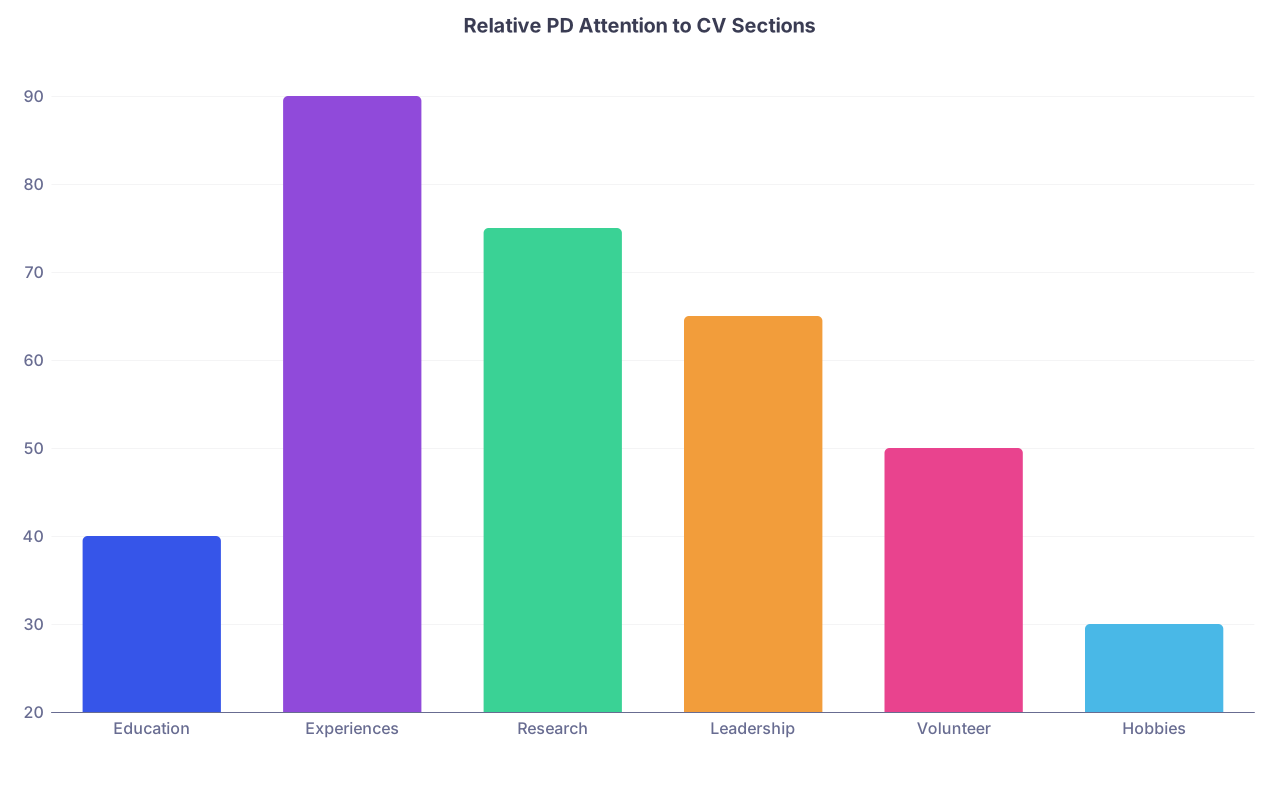
| Category | Value |
|---|---|
| Education | 40 |
| Experiences | 90 |
| Research | 75 |
| Leadership | 65 |
| Volunteer | 50 |
| Hobbies | 30 |
No one sits there consciously assigning percentages like this. But functionally, this is what’s happening.
They’re asking themselves three questions as they skim:
- Can this person do the work? (work ethic, follow-through, reliability)
- Can this person function on our team? (professional, not a problem, teachable)
- Does this person fit our culture and needs? (research-heavy vs community, diverse backgrounds, language skills, etc.)
Every bullet they read is being reverse-engineered into those three buckets.
So let’s break down what they think your backstory is when they see each type of bullet — and how you can write (or rewrite) your bullets and experiences so the right story lands.
Clinical Experiences: What Your “Role” Really Signals
Your clinical bullets are not about tasks. Everyone “rounded with attendings” and “presented patients.” PDs know that. They’re looking for evidence of responsibility, initiative, and trajectory.
When they see:
“Sub-internship, Internal Medicine – [Hospital Name]”
The expected backstory in their head is:
- You carried patients semi-independently.
- You wrote notes someone actually used.
- An attending or senior can vouch that you didn’t crumble at 4 p.m. when three admissions hit.
If underneath that you only:
- Pre-rounded slowly
- Wrote shadow notes
- Left at noon every day
Then the bullet is over-selling your story, and if you get pushed on it in an interview (“Tell me about a time as a sub-I when you had to manage a sick patient”), you’re going to sound hollow.
You fix this by narrowing the claim and sharpening the function.
Instead of:
- “Acted as primary provider for internal medicine patients, completed full H&P and daily notes.”
Write what you actually did but in a residency-relevant frame:
- “Independently pre-rounded and drafted H&Ps/daily notes on 4–6 medicine patients, then adjusted plans in real time based on senior/attending feedback.”
The subtext PDs look for:
- Volume: 4–6 patients reads like “real service,” not a tourist rotation.
- Independence with supervision: “drafted, then adjusted” says you can be taught.
- Time pressure and adaptability: “in real time” hints at functioning when things change.
They don’t expect you to have run a code. They expect you to have owned something, even if small.
Same for: “Clinical assistant, free clinic”
Faculty expectation:
- You showed up regularly.
- Someone relied on you.
- You didn’t treat it as a one-off school requirement.
If your reality is you went three times in two years, do not write this as if it was longitudinal. Either:
- Own the short-term but explain impact, or
- Drop it and put energy into stronger, more honest experiences.
Research: What Your Abstracts and Posters Are Quietly Telling Them
This one is brutal because applicants lie to themselves here constantly.
PDs are not dumb. They see: “Co-author, 3 abstracts, 2 posters, 1 manuscript in progress”
What they actually think is:
- “Okay, this school clearly has a big research machine.”
- “Did this person just show up for data entry, or did they really drive a project?”
- “If I ask them any reasonable question about the study design, will they crumble?”
I’ve watched faculty deliberately ask the same research question three different ways just to see when the applicant runs out of things to say. I’ve also seen a candidate sink a top-tier interview because they couldn’t explain the primary outcome of “their” study.
The expected backstory behind a solid research bullet is:
- You know the central question of the study in one sentence.
- You understand the basic design (retrospective cohort, RCT, survey, etc.).
- You can explain your role without sounding like a passive extra.
- You have at least one challenging moment you overcame (IRB hold-up, messy data, changing endpoints).
So if your bullet currently says:
- “Involved in data collection and analysis for retrospective study on outcomes in sepsis patients.”
But your real involvement was “I filled out a spreadsheet from the chart for a month,” you’re setting yourself up to be exposed.
Better:
- “Abstracted chart data for retrospective study of sepsis outcomes (n≈350) and assisted with preliminary data cleaning under supervision of [PI name].”
That sounds smaller, sure. But it’s real. And now, if someone asks:
- “What types of errors came up during data cleaning?”
- “How did your group handle missing data?”
You have room to talk about what you actually saw.
For anything you list as “manuscript in preparation” or “submitted,” PDs expect:
- You can name the journal target (even if it was ultimately rejected).
- You know where in the pipeline it is — or why it died.
- You didn’t just “ghost” after your name went on the abstract.
If you can’t answer “So what’s the status of that manuscript?” in a grounded way, either update it accurately or take the bullet off.
Leadership & Titles: The Most Overinflated Section on ERAS
This is where CVs go to die.
Every PD I know rolls their eyes at:
- “Co-founder”
- “President”
- “CEO of student-run initiative”
- “Director of outreach”
They assume 70% of those are inflated to sound impressive. So for every leadership title, they’re mentally asking: “Okay, but what did you actually do that affected other humans?”
For example:
Bullet: “Co-founder, Medical Student Mentoring Organization”
What they expect the backstory to include:
- You started something from zero, not inherited an existing project.
- You recruited people.
- You created a system or process that lasted beyond you.
- You had at least one real obstacle (no funding, low turnout, faculty pushback).
If reality is:
- You and a friend made a GroupMe, held one Zoom event, and wrote up a constitution for your CV
Then you’ve broken the trust test. They will smell it.
Rewrite it to match what truly happened:
Instead of:
- “Co-founder and president of mentoring organization connecting 50+ pre-med students with mentors.”
Try:
- “Helped launch a peer-mentoring group by pairing 8–10 pre-clinical students with upperclass mentors and organizing two Q&A panels in the first year.”
Now if they ask, “What was hard about starting that?” you can talk about turnout, logistics, continuity. Real things.
Same for student government:
Bullet: “Class president, MS2 year”
The expected backstory:
- You were the interface between administration and students.
- You dealt with complaints, policy changes, maybe exam scheduling drama.
- You had at least one conflict where you had to choose between popularity and what was right.
If all you did was order T-shirts and send emails, dial the claim down and be precise:
- “Served as one of four student representatives for MS2 class, organizing class-wide communications and gathering feedback about block scheduling and exam timing.”
That still reads as leadership. But it won’t collapse if someone says, “Tell me about a time your position was unpopular.”
Volunteer & Service: The “Are You For Real?” Filter
This is the section where PDs try to distinguish:
- Real service orientation vs
- CV-padding box checking.
A few patterns PDs are looking for:
Longevity over quantity.
One sustained 2-year commitment beats six random weekend events. If you list a one-day health fair as a standalone experience, you’re telling them you care more about optics than substance.Proximity to real people.
They expect that “community outreach” means you actually interacted with actual humans, not just made flyers.
So, say your bullet is:
- “Volunteer, community health fair, 2019–2022.”
The expected backstory:
- You went more than once.
- You took on gradually more responsibility.
- You can remember a specific patient encounter or logistics headache.
If in reality, you went three times in four years, you either:
- Tighten and time-bound it correctly (“Summer 2020, 3 events”), or
- Fold it into a more general “One-time events” line instead of claiming a longitudinal role.
Better:
- “Volunteer, community health fairs (3 events) – Assisted with BP/glucose screenings and patient education in a primarily Spanish-speaking neighborhood under RN/attending supervision.”
Now the PD sees:
- Scope (3 events, not pretending to be 4 years).
- Role.
- Context (Spanish-speaking neighborhood, which could tie into language skills).
And you’re safe when they inevitably ask, “Tell me about a memorable patient you met at one of those fairs.”
Honors, Awards, and “Merit”: What They Infer About You
Here’s the uncomfortable part: most awards sections look identical. So when you list:
- “AOA”
- “Gold Humanism Honor Society”
- “Departmental award for excellence in pediatrics”
The backstory they expect isn’t just “smart and nice.” They expect:
- Every attending who worked with you would be relieved to see your name on their sign-out list.
- You were consistent, not just on your favorite rotation.
- You weren’t a problem behind the scenes (no professionalism issues, no chronic lateness, no toxic behavior).
If they see big awards and then lukewarm or vague letters, it sets off alarms. The thinking becomes: “So you convinced your school, but people who worked closely with you were not that impressed?”
Same for small micro-awards. If you list:
- “Certificate of appreciation – health fair volunteer.”
- “Participation award – case competition.”
You’re filling space with noise. PDs see that as insecurity. They expect a mature applicant to curate, not dump every scrap of recognition they ever received.
Rule of thumb I’ve heard bluntly stated in selection meetings: “If I wouldn’t care that my own kid got this, I don’t want to read it on an ERAS.”
Strong awards backstory:
- There is at least one faculty member who would say, “Yes, that award actually mattered, and they deserved it.”
- You can explain how you received it without sounding rehearsed or arrogant.
Hobbies & Interests: The Trap You Don’t Realize You’re Setting
Programs use hobbies for two reasons:
- Fit/culture.
- BS detection.
That “Running, travel, cooking, reading” line you copied from your friend’s CV? PDs have seen that exact cluster thousands of times. When they see:
- “Travel”
- “Fitness”
- “Music”
- “Cooking”
They expect a backstory that’s very specific.
If you say:
- “Long-distance running”
They’re going to ask:
- “What’s your favorite race?”
- “What’s your PR?”
- “How many miles a week do you run when you’re not on a busy rotation?”
If the truth is:
- You jogged 3 miles twice a week… last year…
You’ve now been flagged as someone who inflates. And once they catch one inflation, they assume there are more.
Same for:
- “Travel” → they expect at least one real story, not “I went to Cancun once.”
- “Cooking” → they expect you to have a go-to dish or cuisine, not “I meal prep chicken and rice.”
- “Reading” → they expect a recent book, not “I used to like Harry Potter.”
So write hobbies that have concrete handles:
Instead of:
- “Travel, fitness, music”
Try:
- “Trail running (local 10Ks, half-marathon goals), learning regional Mexican recipes (esp. Oaxacan), and playing guitar in an informal med school band.”
Now, if they ask, “So what’s your favorite trail near campus?” you’re ready. And more importantly, the backstory they imagine (“This person actually does these things, and I can talk to them like a human”) will match reality.
How PDs Use Your CV in the Interview Room
You need to understand this dynamic, because it’s where backstory really gets tested.
Picture a pre-interview huddle. I’ve been in these.
The PD walks in with a stack of printouts or a shared screen and says something like:
- “Okay, I’ve got four today. One AOA from [X], strong research. One non-trad with a previous career. One IMG with a huge volunteer record. And a local student with strong letters. Pick one or two things you want to ask them about.”
Faculty flip through your CV in 30 seconds and circle bullets that don’t feel self-explanatory. That’s what they’re going after.
If you wrote:
- “Led quality improvement initiative that reduced ED wait times by 15%.”
The expected backstory:
- You know how that number was calculated.
- You know what the baseline was.
- You can outline what you did step-by-step.
- You remember at least one thing that did not work.
If instead, the truth is:
- You joined a pre-existing team midstream.
- Your name got added to a poster.
- You don’t really know the metrics.
You’ve publicly overclaimed. And interview rooms are unforgiving to overclaimers.
You want the opposite experience: they circle your bullet, ask, and then realize you’re actually more substantive than you sounded.
For example, bullet:
- “Helped redesign sign-out template on surgery service.”
Expected: “probably helped with wording.”
Your story, if you really did the work:
- You noticed dropped tasks.
- You proposed specific fields.
- You piloted it, solicited feedback, revised.
- Nurses or other services commented it was clearer.
That’s the narrative you want ready. Not fluff. A straightforward, concrete backstory.
Rewriting Your CV So the Backstory and Bullets Match
Here’s the practical checklist I give people when I sit down with their ERAS for 45 brutal minutes:
| Area | Question PD Is Asking |
|---|---|
| Clinical | What did you actually *own*? |
| Research | Can you explain the study in 2–3 lines? |
| Leadership | Who would notice if you disappeared? |
| Volunteer | Did real people rely on you? |
| Awards | Would a faculty defend this mattered? |
| Hobbies | Could you talk about this for 5 minutes? |
For every bullet, do this:
- Say the bullet out loud as if a PD just read it to you and asked, “Tell me about that.”
- Time yourself talking naturally about it. Can you go 60–90 seconds with specifics and no fluff?
- If you can’t, the bullet is either:
- Overstated → you need to shrink it.
- Vague → you need to specify scope, role, and context.
- Not important enough → you should delete it.
Then ask yourself the harsher question: “If an attending who knows this experience read this bullet, would they nod or roll their eyes?”
If it’s the latter, fix it. Before a PD sees it.
The Hidden Game: Consistency of Story
One last thing most applicants do not appreciate.
PDs are not just checking your individual bullets. They’re mapping your pattern.
They look at:
- Your clinical choices
- Your research focus
- Your service activities
- Your hobbies
And they ask: “Does this form a coherent human being, or is this random CV confetti?”
That doesn’t mean you need some grand brand. You’re not a tech startup. But if you say you’re deeply passionate about underserved medicine… and your entire portfolio is lab research with zero community engagement… the backstory doesn’t line up.
Same with the “I love surgery” applicant whose activities scream dermatology from two years ago. PDs have seen this a hundred times. They do not like chameleons.
Programs want to believe that the person in front of them is the same person who did those things on paper. The more your bullets tell a consistent, grounded story — and the more your real backstory matches that — the safer you are.

FAQs
1. Should I remove experiences that make me look “less impressive” if I didn’t do that much?
If you can’t talk about an experience for a solid minute with specific details, and if there’s any inflation in how you’ve written it, yes — either rewrite it to match reality or cut it. PDs prefer a slightly shorter, honest CV over a padded one that crumbles under questioning. The goal isn’t maximum line count; it’s maximum credibility.
2. How many research projects do I need for competitive specialties?
There’s no magic number, but PDs care a lot more about depth than raw count. One or two projects where you truly understand the design, your role, the results, and the challenges is worth more than five poster-presentations you barely remember. If you’re listing more than 3–4 research items, you should be ready to discuss any of them at an attending level of detail.
3. Can I keep hobbies that I haven’t done regularly during clinical years?
Yes, if they were a real part of your life and you can still talk about them concretely. You don’t need to be at peak marathon training right now. But don’t list something that’s essentially dead. If you haven’t touched the guitar in 4 years, drop “guitar” and keep something you’re actually still connected to. PDs use hobbies as an authenticity check; if you fake that, they’ll assume you’re faking more important things too.
In the end, remember three things:
- PDs are always reading past your bullets, into the story they assume is behind them.
- You control whether that assumed story matches reality by how precise, honest, and concrete your bullets are.
- The safest, strongest CV is not the one with the most lines; it’s the one where every line you’ve written you could defend — calmly, specifically, and without flinching — in front of a room full of attendings.