
The volunteer section of your CV can quietly destroy your credibility.
Not because you did not do enough. Because what you chose to list looks fake, inflated, or strategically convenient.
Let me be blunt: program directors are not impressed by long volunteer lists. They are impressed by believable, consistent engagement that matches what you claim to care about. Everything else triggers suspicion.
This is where applicants make avoidable, reputation-killing mistakes.
The Biggest Volunteer Red Flags That Program Directors Notice
Residency programs read thousands of CVs. Patterns jump out. Some patterns scream “This is padding” or “This person is not honest.”
Here are the worst offenders.
1. The Sudden Explosion of Volunteering Before ERAS
You did almost nothing for two or three years. Then, magically, starting January of application year:
- Free clinic
- Homeless shelter
- Telehealth outreach
- Fundraising committee
- “Leadership role” at a student-run clinic
All starting within the same 3–6 month period.
That does not read as “commitment.” It reads as “someone told me I needed volunteering, so I panic-signed up for everything.”
The trap:
- Believing quantity of entries outweighs timeline coherence
- Assuming nobody will look at the dates closely
- Thinking “at least it is something” is enough
What programs think:
- “So this person only started caring when applications were coming.”
- “Is this genuine, or are they checking a box?”
- “Will they also only care about patients when it affects their evaluations?”
If 80% of your volunteering starts during MS3/MS4 right before ERAS, expect skepticism.
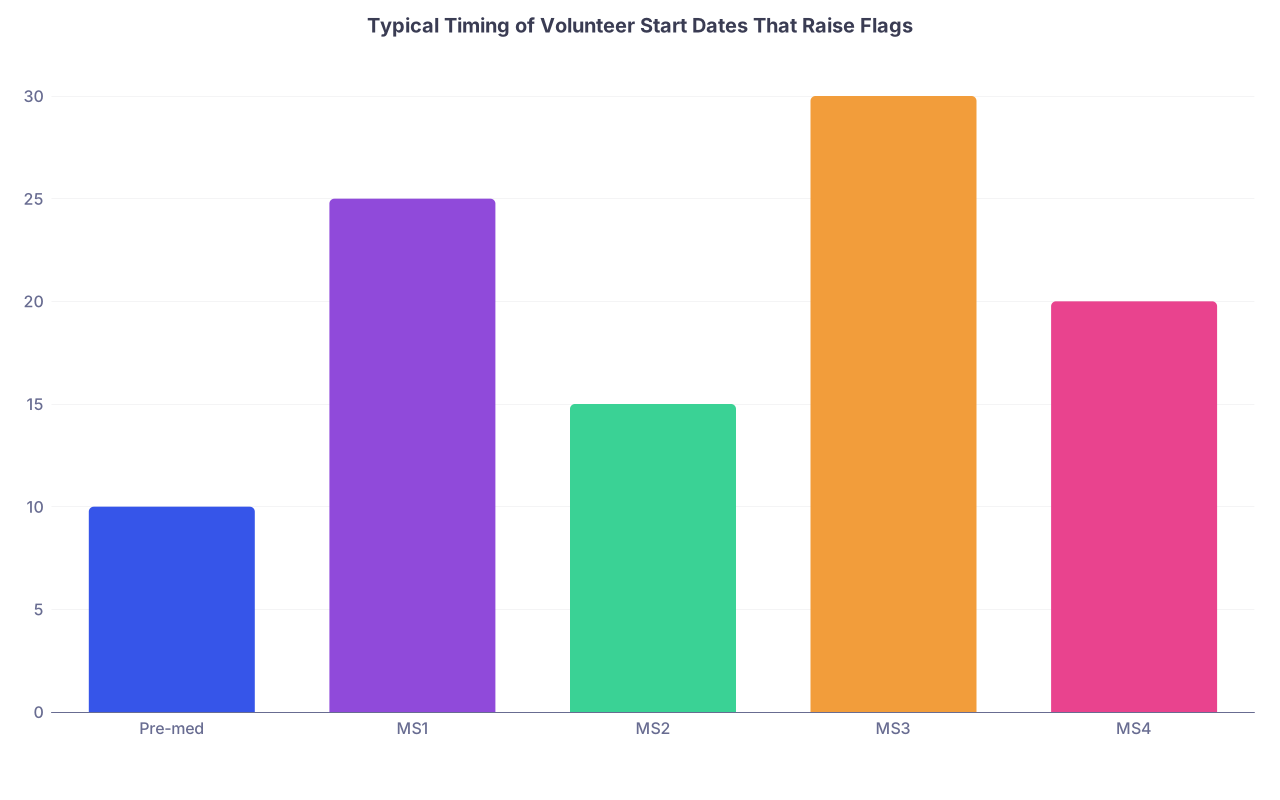
| Category | Value |
|---|---|
| Pre-med | 10 |
| MS1 | 25 |
| MS2 | 15 |
| MS3 | 30 |
| MS4 | 20 |
What to do instead:
- One or two long-term commitments that start early (MS1/MS2)
- Occasional additional short-term projects that make sense given your interests
- If you started late, own it in your personal statement or interview: explain why, do not pretend otherwise
The mistake to avoid: stacking brand-new activities to look “impressive.” You look reactive, not committed.
2. “One-Day Wonders” Listed as Major Commitments
Another credibility-killer: listing single events as if they were ongoing roles.
Typical examples:
- “Volunteer, Community Health Fair” – Hours: 4
- “Participant, 5K for Cancer Awareness” – Hours: 3
- “Shadowing, 1 day in clinic” – Hours: 6
Then those appear as full entries, sometimes even with bullet points and “Responsibilities.”
One-off things belong in a brief “Additional Activities” area, or grouped, not as standalone pillars of your CV.
Why this backfires:
- It makes you look desperate to fill space
- Inflates trivial engagement into “volunteering”
- Signals poor judgment about what is meaningful
If I see five separate 3–5-hour events each listed like major commitments, I assume:
- You did not actually volunteer consistently
- You are trying to hide that by listing every small thing you ever did
Better approach:
Group short-term events into one entry:
“Community Health Events Volunteer (Various), 2022–2024
– Participated in 6 single-day events: BP screenings, flu shot clinics, health fairs (~24 total hours).”
Now it looks honest and proportional.
The mistake to avoid: treating every 3-hour event as a CV headline.
3. Suspiciously Rounded or Inflated Hours
Yes, people exaggerate hours. And yes, programs notice patterns.
The classic offenders:
- “Free Clinic Volunteer – 200 hours”
- “Hospital Volunteer – 300 hours”
- “Homeless Shelter – 100 hours”
All perfectly rounded. No range. No explanation.
Even worse:
- 500+ hours at one place with zero tangible roles or outcomes described
- Massive volunteer hours that overlap implausibly with full-time clinical rotations and research
Programs rarely have time to audit, but they absolutely have time to discount you mentally as “numbers-padding.”
Here is what triggers suspicion:
- More hours than is feasible given your med school schedule
- All numbers conveniently rounded (100, 150, 200, 300)
- Huge hours for things described vaguely as “helping” or “assisting”
| Entry Description | Hours Listed | Credibility Flag |
|---|---|---|
| Free clinic, 4 years, weekly | 40 | Underreported / odd |
| Single summer, vague role, “helped” | 300 | Likely inflated |
| 2 years, monthly shifts, specific task | 60–80 | Credible range |
| Multiple roles, exact 500 hours total | 500 | Rounded, suspicious |
Better practice:
- Use ranges when appropriate: “60–80 hours”
- Do a quick calculation: weekly hours × weeks ≈ total; do not pretend you remember precise numbers
- If you must estimate, be conservative, not ambitious
The mistake to avoid: using hours as a flex. The more you push the numbers, the less believable your entire CV becomes.
4. “Leadership” That Is Clearly Just a Title
Programs are tired of fake leadership.
Examples I see all the time:
- “Vice President, Community Service Club” – but no described responsibilities
- “Director of Outreach, Student Clinic” – but started the role 3 months before ERAS and mentions only “sending emails”
- “Founder and President, X Initiative” – which has one event and three members
If your leadership is:
- Short-lived
- Light on described actions
- Heavy on titles
- And obviously timed around application cycles
It looks fabricated, even if technically true.
Questions reviewers ask themselves:
- “Would this group even notice if this person disappeared?”
- “Did they run anything, or just attend meetings?”
- “Is this a resume title, or did they actually lead people?”
Common trap:
You think “Any leadership title is better than none.” No. Fake or flimsy leadership is worse than no leadership. It suggests insecurity and performative ambition.
To avoid that:
- Only list leadership where you actually made decisions, organized people, or changed something
- In the description, write specific actions: “Recruited 8 volunteers,” “Coordinated 6 health fairs,” “Implemented new scheduling system”
- Do not inflate committee membership into leadership
The mistake to avoid: chasing leadership labels instead of doing real work.
5. Activities That Do Not Fit Your Story (And Look Like Pandering)
If your entire application screams “I love inpatient cardiology research,” then suddenly you have:
- Short-term “Pediatrics literacy volunteer”
- “Arts and crafts with children in oncology ward”
- “Pediatrics mobile clinic – 1 month before ERAS”
It looks less like commitment and more like strategic pandering to pediatrics programs.
Same problem for:
- Applying to surgery but suddenly stacking end-of-school global health trips
- Applying to psychiatry but adding last-minute “neuroscience outreach” that has no depth
Programs are pretty good at sniffing out:
- Activities chosen just because they sound “good for this specialty”
- One-off, unrelated, last-minute experiences
Does this mean you cannot change your mind or explore? Of course not. But if the volunteering is clearly last-second and disconnected, do not pretend it is the core of your identity.
Fix it by:
- Being honest about exploration: “Initially explored pediatrics through brief volunteer experiences, but found a better fit in X.”
- Not overselling brief specialty-related volunteering as proof of deep passion
The mistake to avoid: curating a fake narrative instead of owning a real one.
6. “Mission Trips” and Global Health That Look Like Medical Tourism
This one gets harsh scrutiny now.
Red flags:
- One-week trip abroad, first time out of the country, marketed in CV as “global health experience”
- Descriptions like “treated patients” or “performed procedures” as a preclinical or early clinical student
- Trip was clearly organized by a third-party company that sells “shadowing abroad”
Programs see giant ethical issues here:
- Scope of practice concerns
- Exploiting underserved populations for personal gain
- No continuity, no follow-up, no sustainability
If you describe a 7–10 day trip like you were staff:
- “Provided care to 200 patients”
- “Managed medications”
- “Performed minor procedures”
Expect some faculty to roll their eyes or be actively turned off.
The only somewhat safe way to list these:
- Emphasize observation, education, and cultural humility, not “providing care”
- Honestly describe length and your role: “7-day educational trip; role: assisted with logistics and observed physicians.”
- Reflect on what you learned about health systems, not how many patients you “helped”
The mistake to avoid: turning ethically fraught, short trips into heroic narratives.
7. Overlapping Commitments That Make No Sense Logistically
I sometimes see CVs like this:
- Research: 20 hours/week
- Volunteering: 10 hours/week
- Tutoring: 8 hours/week
- Student government: 5 hours/week
- Rotations: full-time
All during the same calendar period.
On paper, that is 40+ extra hours every week. During clinical clerkships. Impossible in any real medical school environment.
Programs are not dumb. They know:
- How many hours clinical rotations usually take
- How much time serious research consumes
- That “20 hours/week” almost never means “20 hours in addition to full-time clerkships”
When your listed commitments do not align with real human capacity, reviewers do not carefully recalc your schedule. They just think: “This is exaggerated.” And once that thought creeps in, it stains the rest of the CV.
Better strategy:
- Use realistic hour estimates
- Allow for some months when activities paused during intense rotations or exams
- You can write “5–10 hours/week during preclinical years; reduced to 2–3 hours/week during clerkships”
The mistake to avoid: building a superhero schedule that no sane adult believes.
8. Vague Descriptions That Could Mean Anything (Or Nothing)
Another sign of embellished or meaningless volunteering: the language.
Examples:
- “Helped in the clinic.”
- “Assisted patients.”
- “Participated in various duties as needed.”
- “Was involved in community engagement.”
This tells the reader exactly nothing. And when I see very vague language paired with long timeframes and big hour counts, I immediately question how real the involvement was.
Programs read this kind of fluff constantly. It is a defensive maneuver when there is not much to describe.
Fix it with specifics:
- What exactly did you do?
- With whom?
- How often?
- What changed because you were there?
For instance:
- Weak: “Helped at free clinic.”
- Stronger: “Checked in patients, took vitals, updated EMR, and coordinated follow-up appointments for ~10–15 patients per shift.”
You do not need to sound grand. You do need to sound concrete.
The mistake to avoid: hiding weak involvement behind jargon or generic verbs.
What Strong, Non-Suspicious Volunteer Experience Actually Looks Like
Let us flip this around. Programs trust volunteer experiences that are:
- Longitudinal
- Logically timed
- Modestly described
- Integrated with your broader story
Here are three patterns that rarely raise red flags.
Pattern 1: One Anchor Activity + Smaller Side Roles
For example:
- 2.5 years with a student-run free clinic, regular monthly shifts
- Occasional one-off health fairs or screening events
- Maybe a small, clearly defined leadership role after a year of involvement
Key features:
- Dates show real continuity
- Hours are believable and not extreme
- Descriptions are specific but not theatrical
Pattern 2: Early Exploration, Later Focus
You might have:
- MS1–MS2: a few different volunteer settings (hospital, shelter, outreach)
- MS3–MS4: one or two that you stayed with because they fit you best
This shows:
- You tested environments
- You made choices
- You did not cling to activities purely to “fill the CV”
Pattern 3: Modest but Real Commitment
Not everyone will have dozens of entries. That is fine.
Something like:
- 18 months of 2–3 hours/week at a food pantry
- 12 months with a phone-support line or hospice visits
- A realistic 50–100 total hours described accurately
If you are worried “That is not enough,” remember: programs compare authenticity more than raw volume.
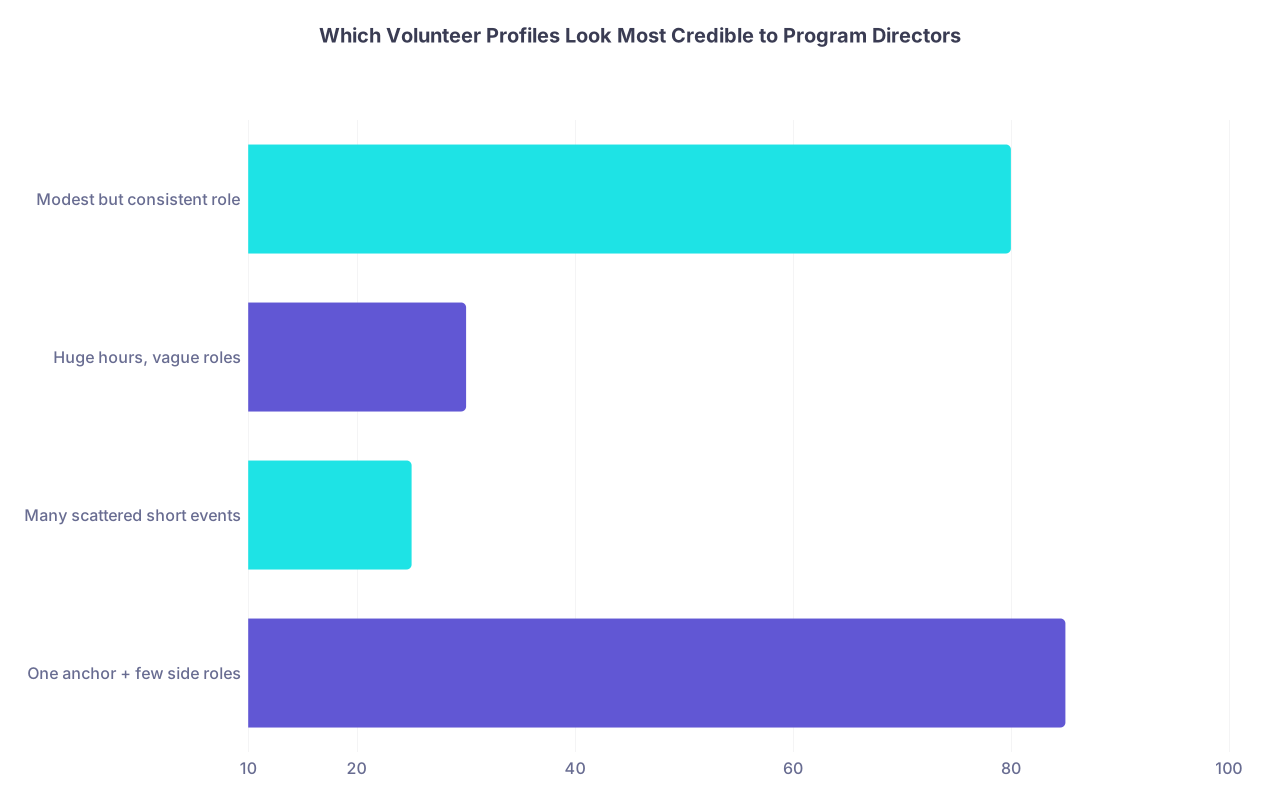
| Category | Value |
|---|---|
| One anchor + few side roles | 85 |
| Many scattered short events | 25 |
| Huge hours, vague roles | 30 |
| Modest but consistent role | 80 |
How to Audit Your Own Volunteer Section Before ERAS
You should assume someone skeptical and tired is reading your application. Because they are.
Use this checklist and be brutally honest:
Timeline check
- Do most activities start right before ERAS?
- Do you have at least one thing that lasts >1 year?
Hour sanity check
- Are any numbers absurd, overly rounded, or incompatible with your schedule?
- Can you explain how you got to those numbers if someone asked?
Role clarity check
- Can you write 1–2 specific sentences about what you actually did in each role?
- If not, maybe it should not be there or should be grouped with other minor events.
Narrative consistency check
- Do the experiences line up with who you say you are and what specialty you want?
- If not, are you being honest about them as exploration instead of pretending they prove “lifelong passion”?
Ethics and optics check
- Any global health/mission trips described in a way that implies practicing beyond your training? Fix that.
- Any activities that might feel exploitative or performative? Rethink how (or if) you include them.
If something feels shaky while you are reading your own CV, assume it will look worse to a stranger.
Key Takeaways: Do Not Let Volunteering Sabotage Your Application
Strip it down:
- Authenticity beats volume. A few consistent, believable activities always look better than a scattered list of questionable entries.
- Timeline and hours must make sense. If your commitments magically appear right before ERAS or your hours look superhuman, reviewers will not trust your numbers—or you.
- Titles and trips do not impress if they look fake. Inflated leadership, medical tourism, and vague “helping” roles are traps. Avoid them or describe them honestly and modestly.
Treat your volunteer section as a credibility test, not a scoreboard. If it fails that test, fix it now, before a program quietly moves your application into the “no” pile.