
The biggest mistakes on residency CVs happen after you match—when you think the game is over.
Let me tell you what really happens: once you’re in residency, your CV quietly determines who gets chief, who lands the competitive fellowships, who is “the star resident,” and who is just background noise. Nobody says it out loud. But faculty, PDs, and fellowship directors are constantly reading between the lines of what you choose to include, how you write it, and what you leave suspiciously vague.
You matched. Good. Now the real CV rules start.
Rule #1: Residents Are Sorted Into Tiers By Their CVs—Fast
During intern orientation, your program director is not just learning your name. They skim your ERAS application and the “update” CV you send HR and leadership. They start a mental spreadsheet:
- “Future academic—protect time”
- “Solid clinician—reliable”
- “Probably chief material”
- “Won’t be a problem, won’t be a star”
No one tells you that's what's happening. But I’ve watched PDs and APDs do it over coffee the week before you arrive.
Your CV at the start of residency does 3 things:
- Signals trajectory
- Signals reliability
- Signals teachability
Not perfection. Trajectory.
A resident with a 225 Step 1 but three concrete QI projects and a couple of poster presentations? That looks like someone already moving. A resident with a 260 and absolutely nothing new since M3 year? That looks like someone who peaked on test day.
Then six months in, your updated CV starts showing up in more places than you realize:
- Award nominations (“Send me their current CV, please.”)
- Fellowship recommendation letters (“Attach your updated CV and personal statement.”)
- Research grant or travel funding
- Chief resident selection meetings
- Moonlighting approval at some places
Your co-residents are being judged off the same raw material you have: ward months, QI projects, a handful of presentations. The difference is how cleanly, concretely, and strategically they present it.
That’s the first unwritten rule: the CV is still very much alive after Match. You either manage it, or it manages you.
Rule #2: The “Resident CV Format” Is Not The Med Student Format
Most residents keep using the ERAS-style layout they used as MS4. That’s amateur hour.
Faculty reading your resident CV are not thinking like an admissions committee anymore. They’re thinking: Can I trust this person with a project, a title, a letter?
Your CV needs to evolve. By PGY2, your structure should look more like a junior faculty CV than a premed document.
Here’s the rough architecture most academic PDs subconsciously expect from a resident:
| Section Order | Section Name |
|---|---|
| 1 | Contact & Current Position |
| 2 | Education & Training |
| 3 | Licensure & Certifications |
| 4 | Honors & Awards |
| 5 | Publications |
| 6 | Presentations |
| 7 | Research & QI Projects |
| 8 | Teaching Experience |
| 9 | Leadership & Service |
Notice what’s quietly gone?
- Detailed pre-med shadowing
- High school awards
- Random volunteer hours that never matured into anything
Med student fluff has to die. By the end of PGY1, if you’re still listing “Volunteer, free clinic, 2015-2017” as a major bullet point, it reads as: “I did more before medical school than I’ve done in residency.”
Program directors won’t say it. They think it.
You want your CV to scream: “I’m now functioning as a physician. I’ve grown.” That means:
- Leading with current training level and institution
- Making residency-based activities the star of the show
- Pushing med school content down or off the document unless it’s genuinely major (a first-author paper in a good journal, a major scholarship, national leadership role)
The moment you match, you’ve entered a new league. Dress your CV accordingly.
Rule #3: Bullets That Win You Fellowships All Have The Same DNA
Faculty skim. They do not carefully parse your CV line by line. At best, you get 20–40 seconds on first pass.
The bullets that survive that skim have three traits:
- They start with a strong action verb
- They show scope or scale
- They show outcome or impact
A weak resident bullet looks like this:
- “Participated in quality improvement project on sepsis bundles.”
That text might as well be invisible. Here’s how the residents who get pulled for opportunities write the same thing:
- “Co-led multidisciplinary QI project to improve sepsis bundle compliance on two inpatient medicine units, increasing timely antibiotic administration from 63% to 88% over 9 months.”
See the difference? There’s leadership, scope, and a number.
And the part PDs love most: a timeframe. It shows you can sustain effort.
For anything you want to matter—teaching, QI, research—add at least one of these:
- A number (patients, sessions, percentage change, size of team)
- A time frame (months, academic year)
- A result (accepted, implemented, awarded, published, presented)
You’d be shocked how many “hardworking, involved” residents have CVs filled with vague, neutered language that hides everything they’ve actually done.
The content is there. The bullets bury it.
Rule #4: Your “Dead” Projects Aren’t Dead—They’re Vulnerabilities Or Assets
This is something residents don't realize until fellowship applications blow up their inbox.
Faculty read your “Works in Progress” section like a diagnostic test. They look for:
- Pattern of starting and not finishing
- Wildly inflated descriptions early on, followed by no final product
- Or the opposite: a quiet, humble description followed later by a complete paper or poster
I’ve watched fellowship committees do this:
They’ll scan:
- Publications
- Presentations
- Then go back to “Works in Progress” and ask, “Did this ever go anywhere?”
If they see three similar-sounding projects listed over three years, none of which resulted in at least a poster, they don’t say, “Wow, so busy.” They say, “This person doesn’t close loops.”
Here’s the move you should be making every 6–12 months:
Take every “Works in Progress” item and force it into one of three buckets:
- Completed → Update to publication, presentation, or finished QI program
- Actively in progress with clear next step and date
- Honestly dead → remove, or rewrite once as a “pilot” that informed something else
Do not let zombie projects accumulate. They make you look scattered or unreliable, even if the reality is your attending dropped the ball.
If something died for reasons out of your control, either:
- Let it quietly disappear from future versions, or
- Combine it into a broader bullet: “Contributed to multiple retrospective cohort projects on sepsis outcomes under Dr. X, leading to two poster presentations at [meeting].”
Tie it to what did happen.
Rule #5: Teaching Entries Are Secret Gold—If You Treat Them Like Real Work
Residents chronically undersell their teaching. Faculty quietly overvalue it.
Why? Because programs need people who can educate juniors, med students, and eventually lead curricular pieces. When I’ve sat in meetings about chief selection or national leadership opportunities, one of the first questions isn’t “How many papers?” but “Who actually teaches well and consistently?”
Here’s what most residents write:
- “Taught medical students on wards”
- “Lead morning report as senior resident”
That tells no story. It’s wallpaper.
Contrast that with what actually turns heads for APDs:
- “Created and delivered a recurring 30-minute weekly case-based teaching session for MS3/MS4 students on the inpatient medicine service, with informal feedback leading to adoption by other senior residents.”
- “Co-designed and led a simulation-based curriculum for interns on rapid response management over one academic year (8 sessions, ~40 residents).”
Faculty see concrete frequency, audience, and longevity. It looks like curriculum development, not just vibes.
If you ever:
- Built a teaching handout, pocket card, or slide deck
- Created a recurring teaching session (even if small)
- Ran a journal club with actual structure
- Led intern orientation teaching sessions
You can write that in a way that signals you’re more than just another person who talks in front of a whiteboard.
Teaching is a currency in residency. Stop treating it like a footnote.
Rule #6: Awards Are Not All Equal—And Faculty Know Exactly Which Ones Are Fluff
Here’s the part you’ll never hear in public: programs hand out some awards because someone deserves it, and some awards because someone had to get something.
Recognition on a CV stratifies into three unspoken tiers in faculty minds:
Top tier:
- Program-wide “Resident of the Year”
- Department-wide teaching awards voted on by students or junior residents
- Institution-level or national awards (ACP, AAP, ACOG, etc.)
Middle tier:
- Rotation-specific “best resident of the month” type recognitions
- Small scholarships tied to specific projects or diversity initiatives
- Local hospital awards with some application process
Bottom tier:
- Certificates for “participation” mis-labeled as awards
- Things every resident gets once (e.g., “Intern Excellence Award” when there are 20 “winners”)
- Med school awards that clearly just rewarded showing up
You can—and should—list all actual awards early in training. But as you accumulate real ones, start pushing the weaker or older ones down or off.
No faculty member has ever been impressed to see “Dean’s List, undergrad” still sitting on page 1 of a PGY3 CV. It reads as either insecure or unaware.
If you’re light on awards? Don’t fake heft by overformatting small things. It looks desperate. Better to have a lean but honest section than one bloated with “Certificates of Appreciation.”
Rule #7: Formatting Is A Professionalism Test You Didn’t Know You Were Taking
Here’s the dirty secret: PDs and fellowship directors use your CV as a proxy for how you’ll document in the chart, how you’ll write emails, how you’ll present your work publicly.
If your CV has:
- Inconsistent date formats (2019–20, 07/2021–06/22, etc.)
- Random font changes
- Typos in journal names or attending names
- Sections out of logical order
They don’t think, “Wow, they were busy.” They think, “Sloppy. This is how their notes probably look.”
On the other hand, the residents with clean, calm, consistent CVs? Those are the ones PDs forward to colleagues with, “Here’s the person I was telling you about.”
You want:
- One font, no circus
- Dates aligned and consistent
- Roles clearly labeled (Resident, Co-investigator, Presenter, First author)
- Two to three levels of hierarchy, max (section, entry, bullet)
And then the big one: PDF only. Sending a messy Word file that reformats on other systems is the fastest way to look like you’ve never dealt with a grant or job application in real life.
Create a “master CV” template and keep it updated every 3–4 months. Whenever you finish something even mildly CV-worthy, drop it in that week. You will not remember details a year later when you suddenly need a fellowship-ready document in 24 hours.
Rule #8: What You Leave Off Your CV Sends Its Own Signal
Faculty notice what’s missing.
An aspiring cardiology fellow with three years of residency and not a single cardiology-related anything documented? Okay, either they decided late or they aren’t very intentional. That’s not fatal, but it changes the story a letter writer has to tell.
An “education-focused” resident with no documented teaching, no workshop attendance, no MedEd projects or curricula? Same deal.
You don’t need 15 items. You need a coherent thread.
Pick 1–2 “lanes” by mid-PGY2 that your CV will emphasize:
- Research (even modest)
- Medical education
- Quality improvement / patient safety
- Leadership & advocacy
- Global health
Then start curating. When you choose which bullets to expand, which to condense, and which to quietly retire, keep that narrative in mind.
The PDs who advocate for you in closed rooms are essentially answering: “What is this resident about?” Your CV is the only concrete document they have to base that on.
Give them a clear answer.
Rule #9: Conference Abstracts, Posters, and “Minor” Output Matter More Than You Think
Lots of residents have this fantasy: “I’ll wait until I have a real publication before I clutter my CV with small stuff.”
Wrong move.
Inside the house, faculty view the ladder of academic output roughly like this:
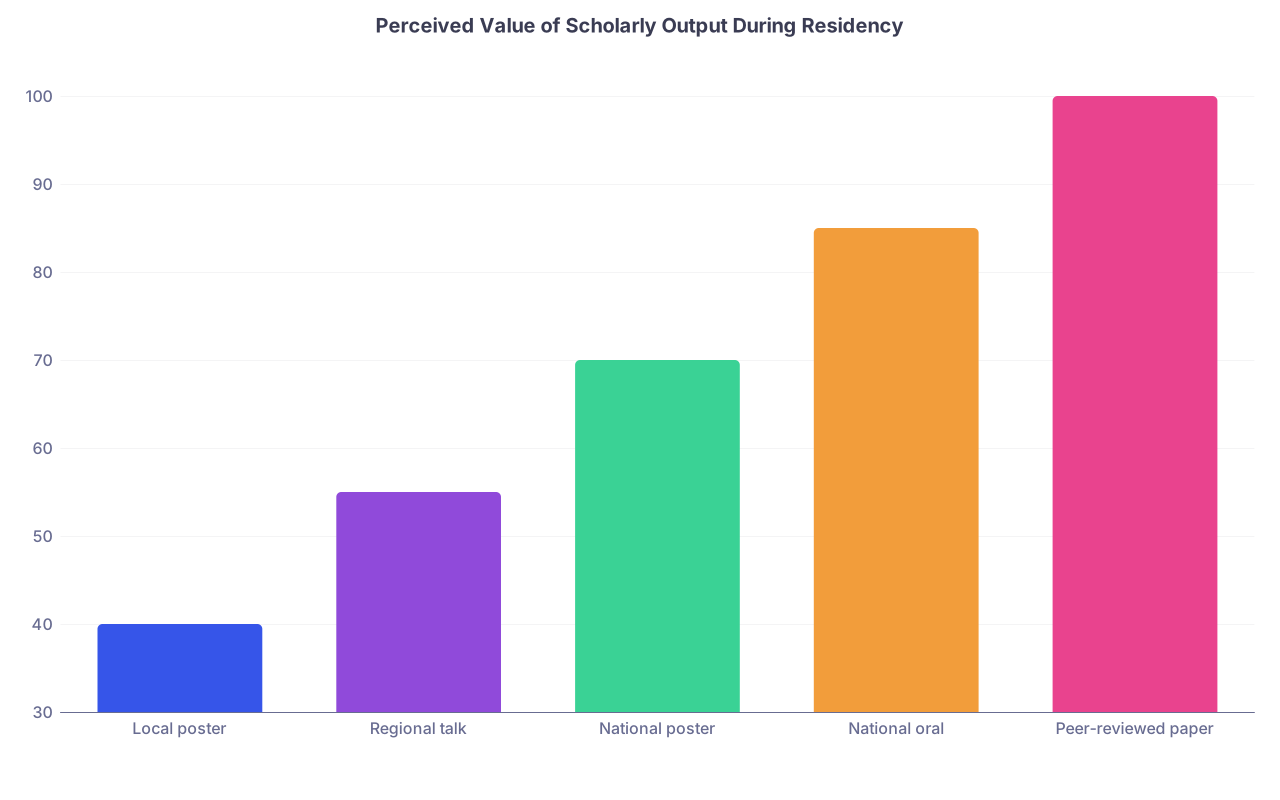
| Category | Value |
|---|---|
| Local poster | 40 |
| Regional talk | 55 |
| National poster | 70 |
| National oral | 85 |
| Peer-reviewed paper | 100 |
Will a national oral presentation beat a local poster? Sure. But the presence of anything on that ladder is better than nothing. It tells a story:
- You saw something interesting
- You worked it up
- You submitted on a deadline
- You stood in front of a board and talked about it
That’s productivity, communication, and follow-through in one package.
Don’t hide your smaller wins. Format them cleanly under “Presentations” with:
- Authors
- Title
- Conference name
- Location
- Date
- Type (poster, oral, workshop)
The only time it starts to look silly is when one resident spreads a single case report across five lines (“Submitted,” “Accepted,” “Presented,” “Published,” “Online ahead of print”) with no other output. That smells like CV inflation.
Be honest. Be thorough. But don’t play yourself by waiting for the NEJM paper that’s not coming.
Rule #10: The “CV You Show Your Co-Residents” Is Not The “CV You Send Outside”
You should have two versions of your CV once residency gets serious:
- Internal / working CV – everything you’ve ever done, full detail, messy notes even
- External / polished CV – 2–4 pages, tightened, coherent, with dead ends pruned
Residents often make one of two mistakes:
- They send the bloated internal CV for a faculty recommendation or fellowship, making themselves look unfocused and self-unaware.
- They send a stripped-down, under-detailed version that hides half their effort and gives letter writers nothing to work with.
The working CV is for you and for the one faculty mentor who cares about the full picture. The polished CV is for PDs, committees, and selection panels who have 30 seconds to understand you.
When an attending says, “Send me your CV, I’ll write you a letter,” send the polished version but attach the longer one as “full academic CV” if you truly have a lot of detail. Most will only open the polished one. A minority will dig into the full thing. Both types will appreciate that you’re not making them wade through 14 pages of fluff.
How Your CV Quietly Shapes Your Residency Trajectory
Let me pull back the curtain on how your CV concretely changes outcomes:
Chief selection: Near the end, the leadership will literally pull up 5–10 CVs side by side. If yours makes you look like “the one who just did their job,” you lose to the one with clean leadership bullets, teaching entries, and a couple of projects closed out.
Fellowship letters: Faculty will mine your CV for phrases they can use in letters. “Led a QI initiative…” “Organized a recurring teaching session…” If those phrases aren’t there, their letter becomes generic: “hardworking, compassionate, a pleasure to work with.” Death by faint praise.
External awards and nominations: When APDs forward names for “resident award at regional meeting,” they attach CVs. The ones that get picked are rarely the absolute best clinicians. They’re the ones with a CV that tells a crisp story of impact.
First jobs: Community hospitals and private groups may pretend they don’t care much about your CV. But when they’re choosing between two candidates, the one whose CV looks like a young professional instead of a disorganized student gets the offer.
None of this is about faking accomplishments. It’s about refusing to let your real work be erased by bad presentation.

A Simple 6-Month CV Maintenance Rhythm
You don’t need a 3-day retreat to overhaul your CV. But you do need a rhythm.
Every 6 months (January and July work well):
- Open your working CV
- Add anything you’ve done: talks, posters, QI, new responsibilities
- Clean up “works in progress” and either update, merge, or kill dead items
- Create an updated 2–4 page polished version
- Save both as PDFs with dates in the filename:
Lastname_CV_2026-01.pdf
If you want a simple sanity check, run through this quick mental filter for each section:
- Does this make me look current?
- Does it show growth since med school?
- Does it tell a coherent story about what I’m becoming?
If the answer is no, rephrase, move, or cut.

The Difference Between Residents Who “Have Potential” And Residents Who Get Picked
I’ve seen average-test-score residents with unremarkable med school applications walk out of residency with:
- Chief resident titles
- Competitive fellowships in oversubscribed fields
- Multiple local and regional awards
- Faculty positions at their home or a better institution
And I’ve watched USMLE rockstars disappear quietly into mid-tier jobs they never really wanted, wondering what happened.
Often, the difference was not ability. It was whether they learned the unwritten CV rules early enough:
- Capture real work as it happens
- Describe it in concrete, outcome-focused language
- Cut student-era fluff in favor of resident-era responsibility
- Shape a narrative instead of a list
- Present it all in a format that says “junior colleague,” not “still a student”
You matched. The door opened. But who gets invited further inside—that’s where your post-Match CV does more work than you realize.
Years from now, you will not remember which bullet point you agonized over. You will remember which doors quietly opened because, on paper, you looked exactly like the person they were hoping to find.