The fantasy that PDs “carefully read every CV” is exactly that—a fantasy. Most of you get 10 seconds. Maybe less. And in those 10 seconds, they make more assumptions about you than you’d ever be comfortable knowing.
Let me walk you through what actually happens in that first brutal scan—and how to rig it in your favor.
What 10 Seconds Really Looks Like From the PD’s Side
I’ve sat in offices where an associate program director flipped through ERAS applications like they were Instagram stories. Click. Click. Click. “Nope.” “Nope.” “Maybe.” “Interview.” All within seconds.
You think: “But my experiences are so nuanced…”
They think: “Do I have any reason to stop scrolling?”
Here’s the ugly truth: in that 10-second glance, they’re not “evaluating” you. They’re running a mental triage.
Roughly, that scan follows this sequence:
- Name / School
- Exam signals (Step 1/2, or if not visible, any clue of risk)
- Education timeline (any weird gaps or red flags)
- Section density and structure (is this a mess or clean?)
- Quick pattern recognition: research? leadership? service? red flags?
- Gut bucket: Interview / Maybe / Hard Pass
No one is thinking, “Let me appreciate the depth of their volunteerism.” They’re thinking, “Does anything jump out that makes this person safe, interesting, or dangerous?”
That’s it.
So your CV is not a biography. It’s a visual and content signal system. You either trigger the right assumptions quickly—or you get scrolled past.
The Silent Assumptions PDs Make in 10 Seconds
Let me spell out the specific snap judgments that fire in their heads as they glance at your CV. Because once you know what they’re assuming, you can start to control it.
1. School and Timeline: “Can this person survive my program?”
First thing many PDs do: look at your medical school and timeline. Not because they’re obsessed with pedigree. Because it’s a shortcut.
The unspoken logic usually goes like this:
Recognized US MD / DO school with normal progression:
Assumption: “Baseline safe. Probably can function.”Caribbean / international grad with any irregularities:
Assumption: “Higher risk. Need compensating strengths.”Extended timeline, LOA, remediation, late graduation:
Assumption: “Possible performance, personal, or health issues. Do I want to dig?”
They’re asking one question: “Is there anything here that suggests this trainee might struggle to keep up, fail boards, or require a lot of remediation?”
If your timeline looks nonstandard and you don’t contextualize it somewhere else in your application, you get mentally bucketed as “riskier” in three seconds flat, even if the reason was perfectly legitimate.
2. Exam Signals: “Are you going to be a board problem?”
Even with Step 1 pass/fail, board risk still dominates PD thinking. They live and die by board pass rates.
In 10 seconds, they’re not calculating; they’re pattern-checking:
- Step 2 CK score (if visible), timing, and whether it’s missing
- Any mention of failed attempts
- Words like “extended”, “remediated”, “probation” elsewhere in the file
The thought process is brutally simple:
Solid Step 2 CK (for that specialty):
“Okay, not worried about boards. Next filter.”Borderline or low for that specialty:
“Possible issue. Need offsetting strengths or we pass.”Missing Step 2 CK late in season:
“Question mark. Extra risk. Why risk it with so many applicants?”
You cannot “hide” exam performance with extra fluff. For many PDs, exams are the first hard gate: if you don’t clear it, nothing else gets read.
3. Experience Layout: “Is this person organized or chaotic?”
PDs are not just reading what you did. They’re reading how you present what you did.
In those 10 seconds, they subconsciously evaluate:
- Is the CV clean and logically structured?
- Are entries consistent in formatting?
- Do dates, locations, and roles look coherent?
- Are there random, minor, or irrelevant items cluttering the page?
When they see a chaotic, inconsistent, overstuffed experience section, the internal monologue sounds like this:
“I’m not going to teach this person how to write a note. They can’t even write a CV.”
Harsh, but real.
By contrast, a CV that is:
- Clean, with clear headings
- Prioritized (most relevant and recent first)
- Light on filler, heavy on substance
creates an immediate assumption: “Professional. Efficient. Probably easy to work with.”
They’re extrapolating from a piece of paper to your behavior on rounds. And they do it instantly.
4. Research and Scholarly Activity: “How serious are you about this field?”
Different specialties read research very differently. But in all of them, research on your CV sends one of three signals:
- “This person is serious about academics / this specialty.”
- “This person is fine clinically but not academic-focused.”
- “This person padded their CV and hopes we don’t notice.”
In the scan, they’re not reading titles. They’re skimming for:
- Number of entries
- Type of output (pubs, posters, QI, nothing)
- Any specialty alignment with their field
If they see three lines of legit-sounding projects roughly in the right domain, that’s usually enough to file you under “did something reasonable.” You don’t need 20 publications for most programs. You do need enough to avoid the “never engaged with the field” assumption if you’re targeting an academic program or a research-heavy specialty.
What kills you is sloppy or obviously inflated entries:
- Ten “submitted” manuscripts from the same group with no publication or presentation history
- Vague project titles with no role or outcome
- Obvious attempts to convert every tiny task into “research”
PDs have been reading this stuff for years. They smell CV inflation in seconds.
5. Leadership and Longitudinal Engagement: “Is this person a passenger or a driver?”
Most PDs won’t consciously say this out loud, but they’re looking for evidence that:
- You’ve taken responsibility for something bigger than yourself
- You’ve stuck with something for more than a month
- You’re capable of initiative, not just checking boxes
In the quick scan, they’re searching for:
- Longitudinal roles: class rep, committee member, project lead, clinic coordinator
- Leadership in something that actually matters (not “social media chair for the ping-pong club,” unless you did something real with it)
- Continuity: years of involvement vs. one-off “events”
Here’s the quiet assumption:
A CV full of single-day or single-month activities spells “dabbler.”
A CV with a few activities stretched over years spells “reliable, finishes what they start.”
They’d rather see three things you did well and consistently than fifteen things you touched once.
6. Service, Character, and “Would I want them on my team?”
There’s a softer side to the 10-second scan. PDs are human. They’re looking for some hint of who you are beyond the stats.
They’re glancing for:
- Clinical volunteering that looks real, not photo-op level
- Patterns of service that match the program’s values (safety-net hospitals love to see underserved work, for instance)
- Any glaring mismatch: applicant to primary care program with CV entirely about private practice plastic surgery shadowing and zero primary care content
They’re making quick character assumptions:
- Consistent service in one setting → “Probably grounded, team-oriented.”
- All activities clearly about self-advancement → “Probably transactional.”
- Nothing at all in service or teaching → “Unknown. Maybe fine, maybe not.”
Will they reject you outright for weak service? Not usually. But it can shift you from “meh” to “this one seems like a good fit” very quickly.
7. Red Flags and Weirdness: “Am I going to regret this?”
PDs develop a sixth sense for “weird.”
In a 10-second glance, things that catch their eye:
- Large unexplained gaps in training
- Multiple school changes
- Overly long education (lots of extra years with no clear explanation)
- Inconsistent or contradictory dates
- Overly dramatic descriptions in experiences
Their inner voice: “If something feels off now, it’ll be worse when they’re my resident.”
They’re looking for reasons not to invite you. That’s the part applicants never fully appreciate. With 1,500 applications, they’re not searching for reasons to love you first. They’re hunting for reasons to say no quickly.
Your CV’s first job is to give them no easy reason to say no.
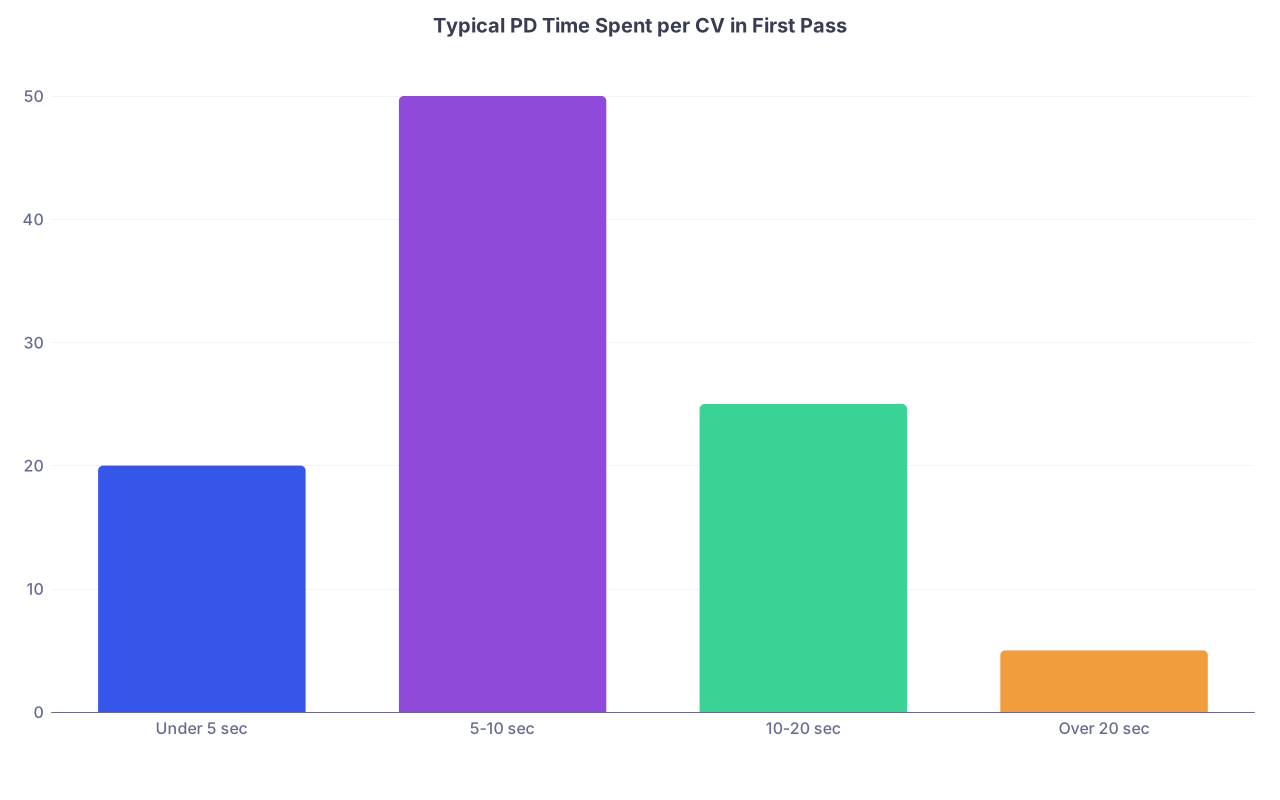
| Category | Value |
|---|---|
| Under 5 sec | 20 |
| 5-10 sec | 50 |
| 10-20 sec | 25 |
| Over 20 sec | 5 |
How to Reshape Your CV So Those Assumptions Work For You
Now let’s talk about what you can actually do. Not in some vague “be authentic” way. Concrete restructuring moves and content choices that change what PDs assume in that first glance.
Make Your CV Visually “Legible” to a Tired PD
You want the PD to feel, instantly: “This is easy to read. This applicant respects my time.”
Do this:
- Use clear, conventional section headings: Education, USMLE/COMLEX, Experience, Research, Leadership, Volunteer, Honors. Don’t reinvent the wheel.
- Keep formatting consistent: same date style; same order (Role, Organization, Location, Dates) for each entry.
- Don’t bold everything. Reserve bold for roles or headings, not full sentences.
If they open your CV and it looks like a well-edited document, you’re starting from “professional” rather than “chaotic.”
Ruthlessly Prioritize the Top Half
On many PDs’ screens, they barely scroll. The top half of your CV is prime real estate. That’s where their eyes land first.
You want the top zone to communicate:
- Stable education
- Reasonable exam performance
- Coherent identity
So:
- Place Education and Exam sections near the top, clearly and cleanly.
- Put the most relevant experience category next (for many, that’s Clinical Experience or Research, depending on specialty and program type).
- Don’t let random shadowing or minor jobs sit above your best experiences just because they’re older.
The first major section after education should tell a story: “I am a [future internist / surgeon / pediatrician] who has actually done things aligned with that identity.”
Convert “Laundry List” Entries into Tight, High-Yield Signals
PDs don’t read paragraphs in CVs. They scan structure and keywords.
Your entries should:
- Be 1–3 bullet points at most (or short lines)
- Highlight responsibility, scope, and outcome, not fluff
- Avoid clichés like “enhanced communication skills” and “worked well in a team”
Compare these two:
Weak: “Participated in weekly clinic for underserved patients, working with physicians and staff to provide care and improve my communication skills.”
Strong: “Coordinated weekly intake for student-run free clinic serving ~40 uninsured patients per session; led onboarding for 10 new volunteers.”
The second one gives them immediate assumptions:
- Takes initiative
- Handles real responsibility
- Understands volume and systems
Write every entry like you’re trying to prove you weren’t just standing in the back of the room.
Show Longitudinal Commitment, Not Random Tourism
If your CV looks like you “toured” 30 things briefly, PDs assume you’re a sampler, not a finisher.
Where you can, structure your CV to emphasize:
- Multi-year involvement in select activities
- Progression: volunteer → coordinator → director; member → officer
- Consistent themes (global health, QI, med ed, underserved, etc.)
If you did an activity over 3 years but only highlight it once in your head, you’re under-selling yourself. Make the duration obvious:
“Volunteer, then clinic coordinator, Student-Run Free Clinic, 2019–2023.”
That one line tells them:
Committed. Trusted. Grew over time.
Make Research Look Real, Not Aspirational
Your research section is not your hopes and dreams. It’s a record of what you actually did.
PDs instantly downgrade you if they see:
- Ten “Manuscript in preparation” entries
- Every project “submitted” but none accepted
- A flood of research items with no clear role attached
You’re much better off with:
- 2–4 solid projects
- 1–2 posters or pubs
- Clear roles: “Data analysis, protocol design, manuscript drafting”
If a project didn’t produce output, you can still list it—if it was real work. But write it honestly:
“Contributed to data collection and preliminary analysis for retrospective cohort study on [topic]. Manuscript in progress.”
One such line? Fine. Ten of them in a row? They assume you piggybacked and slapped your name everywhere you could.
Use Service and Leadership to Defuse “Robot” Assumptions
Some of you have killer scores and a tidy CV—and still get passed over. Why? You look like a robot. No humanity, no service, no teaching, nothing that suggests you’d be a good colleague when the pager doesn’t stop.
You don’t need a saint’s CV. You do need something that says:
“I care about more than my own metrics.”
Good moves:
- Emphasize any consistent teaching (tutoring, TA, near-peer teaching)
- Highlight real community or patient-facing service with continuity
- Pick 2–3 activities that show you as an actual person with values
A PD once told me outright: “When I see nothing but research and zero service, I assume they’re not going to want to do the scut, and my seniors will hate working with them.”
Is that always fair? No. Does it affect who gets an interview? Absolutely.
| CV Feature | Common PD Assumption |
|---|---|
| Clean, consistent formatting | Professional, organized |
| Many brief, unrelated activities | Dabbler, checkbox behavior |
| Longitudinal roles with progression | Reliable, leadership potential |
| Overcrowded research with no output | Inflated, chasing lines |
| Service + teaching + clinical mix | Team-oriented, well-rounded |
Quietly Address or Soften Red Flags
If your CV has potential landmines—gaps, extended timelines, repeated years—you can’t fix them in the CV itself, but you can make them less alarming.
Tactics:
- Make dates accurate and consistent. Sloppy or conflicting dates scream “hiding something.”
- Avoid unnecessary clutter that draws attention away from your strengths. If your CV is busy and confusing, the weird stuff stands out more, not less.
- Use your personal statement or a short explanation in ERAS (if appropriate) to give context in a mature, non-defensive way.
What you’re trying to do is move yourself from “unknown risk” to “known, contained issue with clear recovery.”
A PD can work with, “Took a leave for health reasons, received appropriate care, returned, and completed the curriculum successfully.” They do not want, “This timeline makes no sense and I don’t have time to figure it out.”

| Step | Description |
|---|---|
| Step 1 | Open CV |
| Step 2 | Higher risk bucket |
| Step 3 | Board risk concern |
| Step 4 | Chaotic impression |
| Step 5 | Interview or Maybe |
| Step 6 | Neutral or Pass |
| Step 7 | School and timeline normal |
| Step 8 | Exam signals okay |
| Step 9 | CV clean and focused |
| Step 10 | Any strong positives |
Stop Cluttering With Irrelevant or Weak Filler
That “shadowed Dr. X for 4 hours” entry? It’s not helping you. Nor is “Member, Random Student Interest Group (attended 2 meetings).”
Every weak line dilutes the impact of your strong ones. And in a 10-second scan, volume doesn’t equal value. It just makes you look unfocused.
Ask yourself, for every entry:
“If a PD saw only this line, would they think better of me, the same, or worse?”
If the answer is “same” or “worse,” cut it.
Focus your CV on:
- Things with real responsibility
- Things with real duration
- Things that clearly connect to your specialty interest, skills, or character
More is not more. Stronger is more.
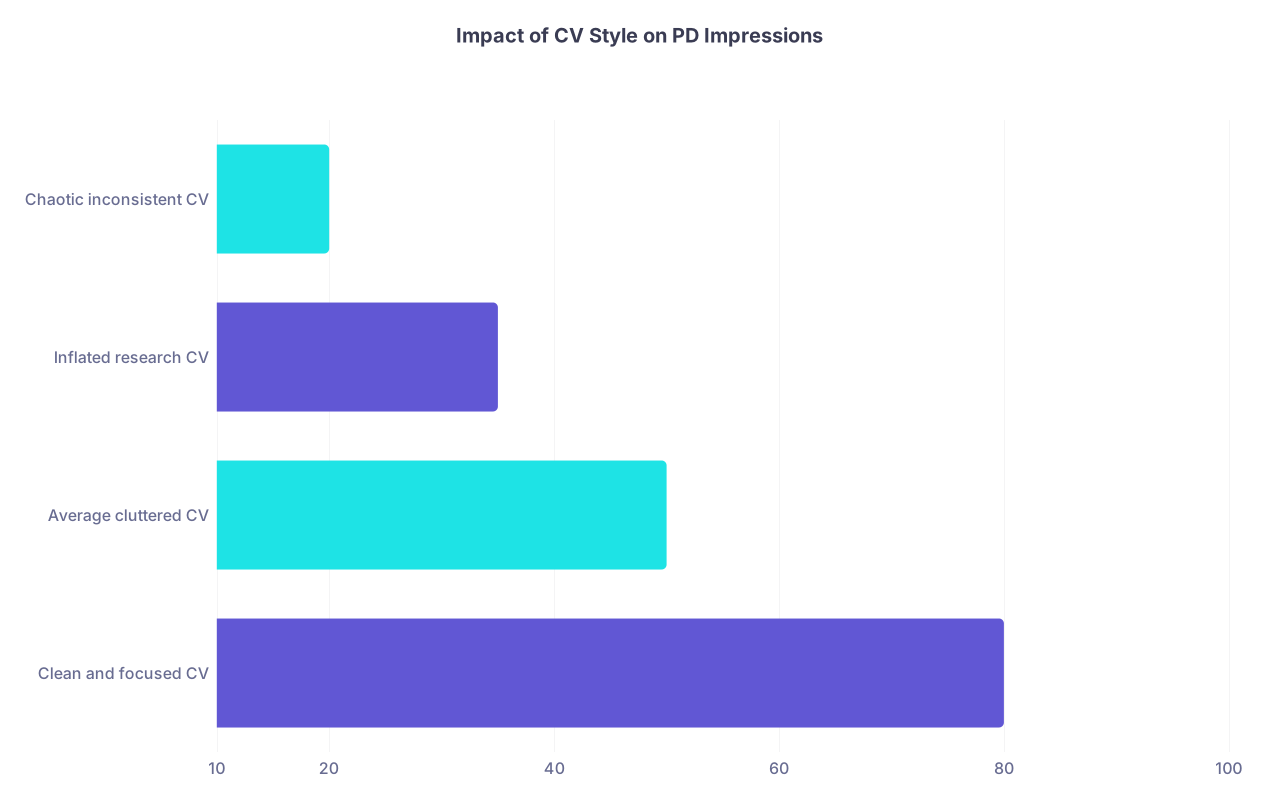
| Category | Value |
|---|---|
| Clean and focused CV | 80 |
| Average cluttered CV | 50 |
| Inflated research CV | 35 |
| Chaotic inconsistent CV | 20 |
How To Improve Your CV Now (Even Late in the Game)
If you’re close to application time and panicking, don’t. You can’t rewrite your entire history in three months. But you can dramatically change how it reads.
Concrete moves:
- Reformat for clarity and consistency in one weekend. This alone changes how PDs feel about you.
- Merge trivial shadowing/short roles into a single line or cut them.
- Strengthen descriptions for your best 5–10 experiences—leadership, clinics, research, teaching.
- Re-order sections so your best, most relevant content hits the PD’s eyes first.
- Make your research section honest, lean, and clearly labeled by outcome type (pub, poster, ongoing project).
If you’ve got a bit more runway, prioritize:
- Taking on a meaningful, defined role in one ongoing clinic, project, or committee instead of adding random new activities.
- Getting at least one tangible scholarly output out of existing work: a poster, presentation, or QI report.
- Adding a small but real teaching or mentorship activity and doing it well.
You’re not trying to become a different person. You’re trying to present the strongest, clearest version of who you already are—fast.
FAQ: 5 Common Questions About PD Assumptions and Your CV
1. Do PDs actually read beyond the CV if they like what they see?
Yes—once you pass the first scan. The CV is the gateway. If it feels solid and aligned, they’ll look at your personal statement, letters, and MSPE. But if the CV fails that initial 10-second triage, most never get curious enough to dig deeper. That’s why presentation and prioritization matter so much.
2. Should I list every research project, even if there was no publication?
List the projects where you contributed meaningfully. Be explicit about your role and honest about the outcome. A few serious, well-described projects beat a padded list of half-baked “manuscripts in progress” every time. PDs assume inflated research = inflated ego or lack of integrity.
3. How bad does a non-traditional or extended timeline look?
By itself, less bad than you think—if everything else signals stability and competence. PDs mainly worry about ongoing instability or hidden issues. If you’ve got an extended path but strong recent performance, clean formatting, good Step 2, and coherent involvement, many will view your path as “nontraditional but solid” instead of “risk.”
4. Do hobbies and interests matter on the CV?
They matter only if they’re real and specific. A vague line like “Enjoys travel and reading” is static noise. Specific, sustained interests—“Completed 10 marathons,” “Lead guitarist in a band that plays monthly gigs,” “Fluent in three languages, volunteer medical interpreter”—make you memorable and human. PDs have told me more than once that a strong hobby section helped them remember and rank someone higher.
5. Is it better to have a short, tight CV or a long, detailed one?
For residency, tight wins. PDs prefer a CV that respects their time. Two focused pages with strong, curated entries beat four pages of marginal, repetitive, or trivial content. You want them to finish that 10-second scan thinking, “Clean, capable, fits our world,” not, “Why is this so long and cluttered?”
Years from now, you won’t remember every line you agonized over in your CV. You’ll remember whether you told your story clearly enough that a tired PD, in a 10-second window, could see the kind of resident you’d become—and decided you were worth a closer look.