It’s late. You’ve got ERAS open, a “draft CV” in one window, and a mess of experiences in your head: volunteering in the ED, that cardiology shadowing you did MS1 summer, a year as a medical assistant before school. Now you’re staring at the “Experience” section wondering:
Do I list shadowing separately?
Do I call it “clinical experience”?
Will I look like I’m padding my app if I separate everything?
Here’s the direct answer and how to not screw this up.
The Short Answer: Shadowing ≠ Clinical Experience
If you remember nothing else from this, remember this:
Shadowing is observation.
Clinical experience is participation.
On your CV (and in ERAS), you should:
- Treat shadowing as its own type of experience, clearly labeled “Shadowing”
- Not inflate shadowing into “clinical work” or “direct patient care”
- Keep true clinical roles (MA, scribe, EMT, CNA, nurse, etc.) clearly separate
Programs can spot the difference in about three seconds. If you blur the line to make your app “look more clinical,” it usually backfires.
How Programs Actually View Shadowing vs Clinical Experience
Let me be blunt: programs don’t care how many dozens of hours you stood in the corner of an OR watching surgery and saying nothing.
They care about:
- Responsibility
- Reliability
- Team integration
- Judgment
- Ownership of tasks
Shadowing gives them almost none of that. It tells them you’re mildly interested and showed up. That’s it.
Clinical experience, on the other hand—working as an MA in a busy IM clinic, a scribe in the ED, hospice volunteer actually sitting with patients—shows:
- You can work with patients or families
- You can handle charting, communication, logistics
- You’ve seen how medicine functions when you’re not just “the observer”
So yes, both matter. But not equally. And that’s exactly why you keep them distinct.
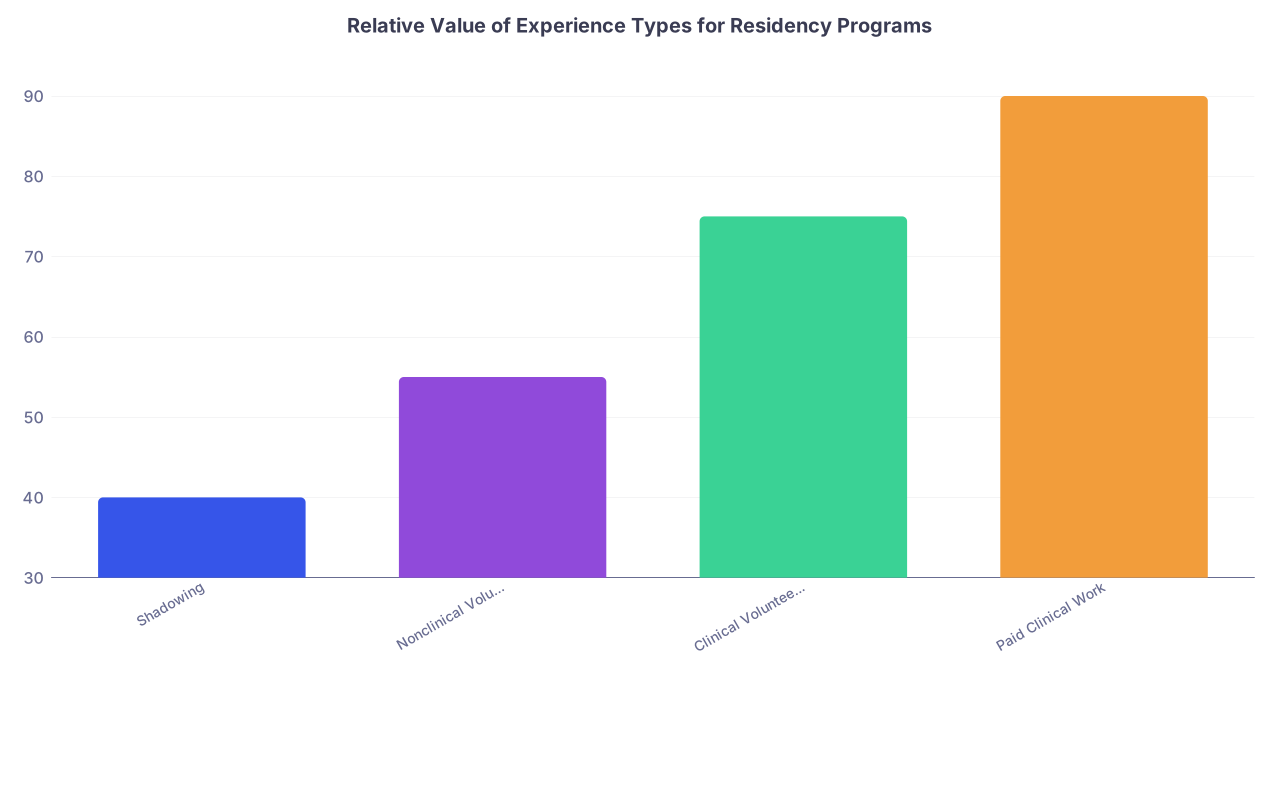
| Category | Value |
|---|---|
| Shadowing | 40 |
| Nonclinical Volunteering | 55 |
| Clinical Volunteering | 75 |
| Paid Clinical Work | 90 |
(Think of those numbers as “approximate value” out of 100, not literal scores.)
Where Shadowing Actually Belongs on a Residency CV
Let’s get concrete.
You’ve got two main situations:
- ERAS Application
- Standalone CV you upload or send directly
1. In ERAS
ERAS doesn’t have a “Shadowing” checkbox. You have to classify.
For shadowing experiences in ERAS, do this:
Put them under “Work, Volunteer, Research” section
Set Role/Position as “Shadowing Student” or “Observer”
Use “Volunteer” (unpaid) or “Other” if nothing fits better
Make the title honest and obvious:
- “Shadowing – Cardiology (Dr Smith)”
- “Pediatric Emergency Medicine Shadowing”
- “Orthopedic Surgery Observer”
Don’t call it “Clinical Assistant” if you never touched a chart or a patient. That’s how you lose credibility.
2. On a Traditional CV
On a Word/PDF CV, you have more control. You should separate categories clearly.
The cleanest approach:
- One section for Clinical Experience
- One section for Shadowing Experience or Physician Shadowing
Like this:
CLINICAL EXPERIENCE
Medical Assistant, Internal Medicine Clinic
City Health System, City, State | 2018–2019
- Roomed patients, took vitals, documented in EMR, assisted with procedures…
SHADOWING EXPERIENCE
Shadowing Student – Cardiology
University Hospital, City, State | Summer 2021 (40 hours)
- Observed outpatient and inpatient cardiology visits, case discussions…
You’re not hurting yourself by admitting something is “only” shadowing. You’re helping the reader quickly understand what level of responsibility you had.
When Does It Make Sense to Combine vs Separate?
Now the nuance. Because some of you have this situation:
“I volunteered in a clinic and sometimes also shadowed the attendings. Do I split that?”
Use this rule:
If your primary role was active (volunteer/worker) with occasional shadowing:
List it as clinical experience and mention the shadowing in the description.
Example:
Clinical Volunteer – Free Clinic
- Checked patients in, took vitals, managed flow between waiting room and exam rooms
- Occasionally shadowed attending physicians during complex visits to better understand decision making
If it was 95% shadowing with a tiny bit of helping (handing out clipboards, maybe):
Call it Shadowing. Don’t stretch.
Multiple Shadowing Experiences: One Entry or Many?
If you shadowed:
- 10 hours IM
- 15 hours pediatrics
- 20 hours surgery
and all at the same hospital, no leadership, no projects, no nothing… you do not need 3 separate CV entries.
Shadowing Experience – Multiple Specialties
City Hospital, City, State | 2019–2021 (45 hours)
- Observed inpatient and outpatient care in internal medicine, pediatrics, and general surgery
- Attended rounds and case discussions to understand different care models
When to separate?
- When the specialty is directly relevant to what you’re applying to
- When one experience is much deeper (e.g., 120 hrs in EM + 10 hrs in derm)
- When you had meaningful extra work: QI project, poster, or some quasi-research
Example: You’re going into EM. Make that EM shadowing its own, stronger entry. Fold the random 10 hr derm into a combined/misc entry or skip it.
How Detailed Should Shadowing Entries Be?
Rule of thumb: 2–4 bullets. Max. Don’t write a novel about how watching CABGs changed your life.
Focus on:
- What settings (clinic vs hospital, outpatient vs inpatient)
- What you actually did beyond standing there (if anything)
- What you learned that’s relevant to residency or your specialty
Good:
- Observed ED workflow including triage, resuscitation, and handoffs
- Discussed diagnostic reasoning and disposition decisions with attending physicians
Bad:
- Gained a deep appreciation for the sacrifices of physicians and their families
- Realized my lifelong calling to become an emergency physician
Programs hate those vague, sentimental lines. Everyone “realized their calling.” It says nothing.
Common Mistakes That Make You Look Less Credible
I see these all the time:
Calling shadowing “clinical experience” to pad hours
If you list 500 “clinical hours” and it’s all shadowing, most reviewers roll their eyes and move on.Mixing paid work and shadowing in one bullet list
Don’t write: “Worked as scribe and also shadowed multiple specialties” under one heading. Split them or clearly demote the shadowing to a minor thing.Making shadowing your strongest “clinical” activity
If the only patient-related thing you’ve ever done is shadow, you have a gap. You don’t fix that by re-labeling shadowing. You fix it by getting real clinical experience, even late.Padding the description with fluff
“Worked with patients from diverse socio-economic backgrounds” after 10 hours of watching clinic visits? Weak. Don’t oversell.
How Much Shadowing Is “Enough” To List?
You don’t need to list every 4-hour afternoon. Ask:
- Did this significantly shape my specialty choice?
- Did I accumulate a meaningful number of hours (usually ≥20–30)?
- Does this add something not already obvious from my clinical rotations?
Good thresholds:
- <10 hours: usually skip, unless it’s unique (e.g., prison medicine, rare subspecialty)
- 20–40 hours: fine to list as one entry
- 100+ hours in one specialty: strong single entry, especially if aligned with your chosen field
Remember: once you’re a 4th year, your core clerkships already show prolonged exposure to patient care. Shadowing matters most when:
- It fills gaps (e.g., you’re applying to EM at a school without an EM core)
- It shows early, consistent interest in a specialty
- It predates med school and led you there (then it belongs in pre-med history)

| Step | Description |
|---|---|
| Step 1 | Shadowing Experience |
| Step 2 | Consider listing as entry |
| Step 3 | Probably omit |
| Step 4 | Combine into one entry |
| Step 5 | Separate entries ok |
| Step 6 | Hours 20 or more |
| Step 7 | Unique or specialty critical |
| Step 8 | Same site as other shadowing |
How This Plays With Specialty Choice
Programs in different specialties care differently.
- Primary care (FM, IM, Peds) – They care more about longitudinal, real-world clinical exposure. Shadowing is fine, but working in a clinic or community setting carries way more weight.
- Highly competitive fields (Derm, Ortho, ENT, Plastics) – Shadowing with well-known faculty can matter for connections and letters. But again, be honest and label as shadowing or observer.
- EM – Shadowing EM is quite common and worth listing, especially if your school has weak EM exposure. But scribes and techs will always beat pure observers in value.
The pattern is the same: shadowing is supplementary. It’s the seasoning, not the main dish.
| Experience Type | Typical Impact Level | How To Label On CV |
|---|---|---|
| Paid clinical work | Very high | Clinical Experience |
| Clinical volunteering | High | Clinical Experience |
| Research with patients | Moderate–High | Research Experience |
| Shadowing | Low–Moderate | Shadowing / Physician Shadowing |
| Nonclinical volunteering | Moderate | Volunteer / Community Service |
Putting It All Together: A Clean Structure
Here’s a simple structure you can steal for your CV (non-ERAS):
- Education
- USMLE/COMLEX (optional on CV, but nice)
- Clinical Experience
- Shadowing Experience
- Research
- Teaching / Leadership
- Volunteer / Community Service
- Presentations / Publications / Honors
Under “Clinical Experience,” put anything where you actually did work with or for patients.
Under “Shadowing Experience,” group all physician observation with clear labels and approximate hours.

FAQ: Shadowing vs Clinical Experience on a Residency CV
1. Should I ever mix shadowing and clinical experience in the same section?
You can keep them under the broad umbrella of “Clinical and Shadowing Experience” if space is tight, but the individual entries must be clearly labeled. So:
- “Medical Assistant – Internal Medicine Clinic”
- “Shadowing – Cardiology”
Don’t bury “shadowing” inside a clinical title. The reviewer should be able to tell at a glance which ones involved responsibility and which were observational.
2. Do residency programs expect to see shadowing at all?
No one’s rejecting you for “not enough shadowing.” By the time you apply to residency, clerkships and sub-Is matter far more. Shadowing is nice to have if:
- It predates med school and explains your path
- It’s in your target specialty
- Your home institution has limited exposure in that field
But if you never shadowed formally and you did solid rotations and sub-Is, you’re fine.
3. How do I list shadowing that happened before medical school?
Two options:
- If you’re including pre-med experiences, make a section like “Pre-Medical Clinical and Shadowing Experience” and list them there.
- If they’re old, short, and not directly relevant, you can cut them. Once you’re 4th year, a random 8-hour shadowing from 6 years ago usually doesn’t move the needle.
Be especially careful not to make pre-med shadowing look like medical school clinical training.
4. Should I include exact hours for shadowing?
You don’t need exact to-the-minute logs, but approximate hours help the reader scale it. Something like:
- “Summer 2021 (≈40 hours)”
That’s plenty. Don’t list “37.5 hours” like you’re invoicing someone. Round reasonably and be honest. If your “200 hours of shadowing” were really four afternoons, someone will notice.
5. What if my only “clinical” thing is shadowing? How do I avoid looking weak?
You can’t fix a lack of active clinical experience just by formatting. You need real clinical exposure. That might mean:
- Late clinical volunteering (free clinic, hospice, ED volunteer)
- Short-term paid roles if feasible (scribe, MA, technician)
- Extra time on sub-Is where you take real responsibility
On your CV, be transparent: clearly mark shadowing as such, and highlight any part of it where you interacted with patients or staff beyond pure observation—without exaggerating.
6. Is it bad if my shadowing doesn’t match the specialty I’m applying into?
Not at all. Many people pivot. A CV that shows:
- Shadowing in surgery and ortho
- Then strong clinical rotations and sub-I in internal medicine
- Then you apply IM
That’s totally fine. Use your personal statement and interviews to explain the evolution. Shadowing in other fields just shows you explored and then chose. Programs actually like that story.
Key takeaways:
- Shadowing and clinical experience are not the same thing; label them separately and honestly.
- Group shadowing under its own heading or clearly tagged entries, and don’t inflate it into “clinical work.”
- Use shadowing as a supplement to real clinical roles and rotations, not a substitute for them.