
The way program directors actually read your CV is brutally fast, brutally selective, and nothing like what your school told you.
I’ve watched PDs go through 200+ applications in an afternoon. I’ve seen them reject people with gorgeous CVs in under ten seconds. I’ve heard the comments they’d never say to your face. You’re building this thing like it’s a portfolio. They’re using it like a triage tool.
Let me walk you through how your CV really gets read—line by line—on the other side of ERAS.
How Your CV Is Really Screened In the First 30 Seconds
Here’s the unromantic truth: for most programs, your “CV” is not a separate PDF. It’s the ERAS-generated experience and education sections, plus some quick glances elsewhere. And the first pass is not holistic. It’s mechanical.
For most PDs and selection committee members, the first 30 seconds look something like this:
- Filtered list already applied: Step scores, YOG, visa status, maybe home state/region.
- Open application.
- Eyes jump to: education → current year → any gaps.
- Quick scan of experiences: looking for a pattern (not volume).
- Quick sniff test for red flags: club spam, fake leadership, obvious fluff.
- Decision bucket: “Interview,” “Maybe,” or “No.”
That’s it. Nobody is reading every bullet on the first pass. They’re scanning for signal.
You improve your chances not by adding more lines, but by making the right lines impossible to miss.
Education: What PDs Notice in 3 Seconds
This section is deceptively simple. It’s not where you win the game, but you can absolutely lose it here.
What PDs actually look for:
- Are you a US MD, US DO, or IMG?
- Year of graduation and any unexplained gaps.
- School reputation / known relationships.
- Advanced degrees that actually matter (MPH, PhD, MS with real work behind it).
If you’re an IMG, they’re also quietly clocking: “Is this a school where we’ve matched from before?” They won’t say that out loud. But they scroll slower when they see a familiar place.
Here’s how this plays out:
- A US MD 4th-year from a solid mid-tier school with no gaps? They glance, nod mentally, move on.
- A 2018 graduate with two years of “personal leave” and no concrete explanation anywhere? That starts a mental red-flag list instantly.
- MD/PhD or MD/MPH? They look for whether that story shows up later in the CV. Big degree with no follow-through in experiences = posturing.
You can’t change your school or grad year. But you can:
- Make sure dates are tight and consistent. No mysterious partial years unless there’s a clear explanation in your application.
- Use any dual degree or unique pathway to set up a coherent story with what follows. If you have an MPH, but zero public health projects in your experiences, it just looks like credential collecting.
Clinical Experiences: Where PDs Decide if You’re Real
This is where PDs decide if you’re someone they can drop into a hospital at 3 a.m. and not worry.
They do not care that you “rounded on 10 patients per day.” Everyone did. That’s the floor, not the flex.
They’re looking for three things:
- Responsibility
- Continuity
- Specialty fit (or at least a believable interest)
Let’s talk about structure. Most of your “Work/Experience” entries fall into three big buckets:
- Clinical employment (scribe, MA, EMT, RN prior to med school)
- Longitudinal medical school roles (clinic coordinator, QI project lead, student-run clinic)
- Observerships / externships (especially for IMGs)
PD mindset when scanning these:
- “Has this person done anything that suggests they’re dependable over time?”
- “Did anyone ever trust them with something non-trivial?”
- “Does this role actually tell me anything about how they’ll function as a resident?”
If you have a scribe job buried with a weak description like:
- Shadowed physicians and assisted with documentation.
That tells them nothing. Every premed says that.
But if it says:
- Independently documented HPI, ROS, and physical exam for 15–20 ED patients per shift, allowing physicians to focus on acute management.
- Escalated abnormal results directly to attending when urgent findings were identified.
Now the PD can see you in the workflow. They see responsibility. Escalation. Real stakes.
The Hidden Red Flags in Clinical Entries
Things that quietly hurt you:
- Ten different short-term roles with 2–3 month durations. Screams non-committal or difficult to work with.
- “Shadowing” listed as work. That’s premed behavior. By residency, it looks childish unless it’s something very unique.
- Obvious padding: three separate entries that are clearly the same job sliced into micro-roles just to fill space.
If you’re an IMG with observerships, here’s the harsh truth: PDs have been burned by people listing “externships” that were glorified hallway loitering. So they read your descriptions with suspicion.
They’re asking: “Did you actually do anything clinical, or just watch?”
You fix that by being explicit:
Bad:
- Completed internal medicine observership at X Hospital.
Better:
- Participated in bedside rounds, presented daily assessments and plans to attending and team.
- Wrote draft notes and orders under supervision, receiving feedback on clinical reasoning and documentation.
That language—presented, drafted notes, feedback—sounds like real participation. That’s what keeps you out of the “fake observership” bucket.
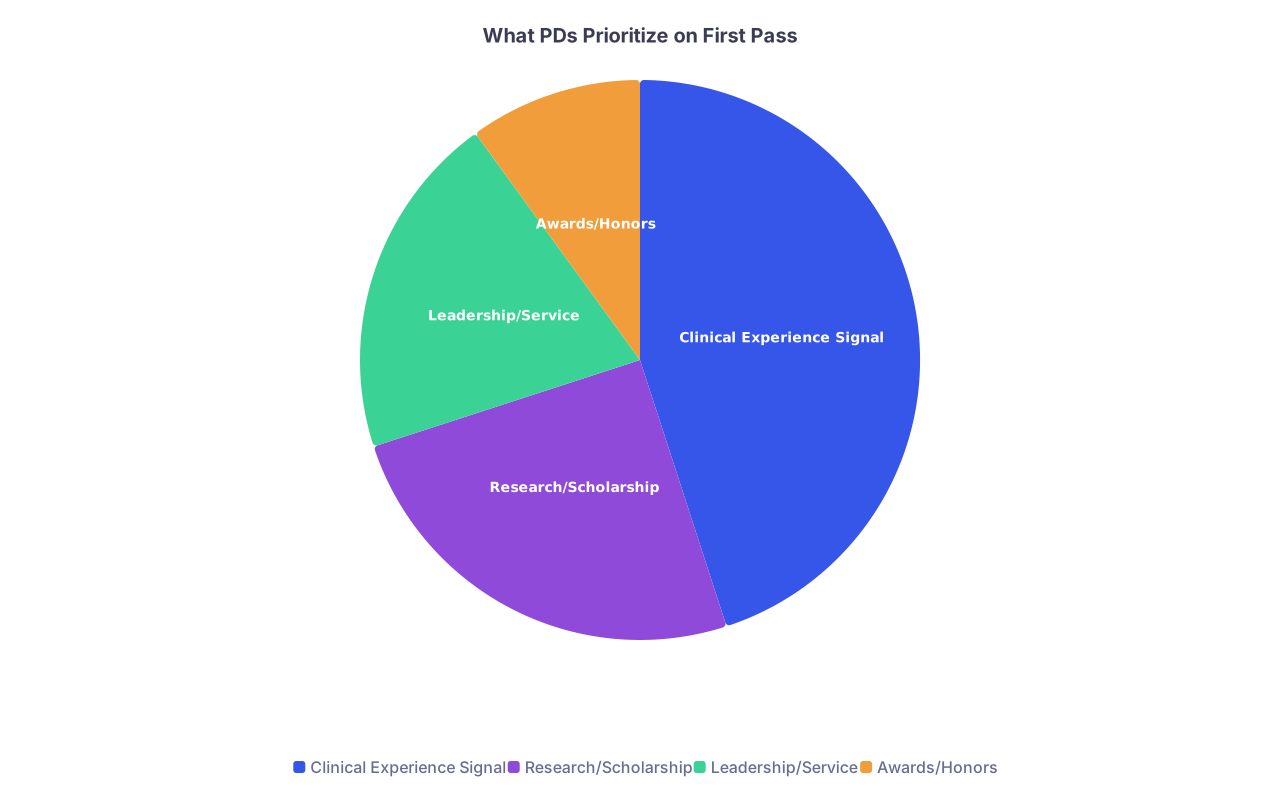
| Category | Value |
|---|---|
| Clinical Experience Signal | 45 |
| Research/Scholarship | 25 |
| Leadership/Service | 20 |
| Awards/Honors | 10 |
Research: How It Helps You (and When It Actually Hurts)
Here’s the part no one tells you: PDs are sick of “research” that’s just resume theater.
They can smell it in two seconds.
When a PD scrolls the research section, they’re not counting lines. They’re asking a simple question:
“Did this person actually do real work on something, or did they just put their name on projects?”
The difference is always in the verbs and the continuity.
A superficial, unimpressive research entry looks like this:
Title: “Outcomes in X…”
Role: Research Assistant
- Collected data.
- Helped with analysis.
- Participated in manuscript preparation.
That tells them nothing. Everyone “helped.”
A serious entry:
Title: “Outcomes in X…”
Role: Primary student investigator
- Designed data collection protocol and coordinated IRB submission for a 200-patient retrospective chart review.
- Performed data extraction and cleaned dataset of >10,000 data points using Excel and R.
- Presented preliminary results at regional ACP meeting; manuscript in revision for submission.
Now they see ownership. Process. Output. They can picture you doing the work.
And yes, they absolutely notice if your “research interest” claims don’t match the specialty. An application for anesthesia with five Derm and plastics projects and zero perioperative anything? That disconnect sits in the back of their mind.
The Quiet Credibility Killers
These are the things faculty talk about behind closed doors:
- Twenty “in progress” projects, zero publications or posters. Massive overcompensation flag.
- Mismatched author order versus your claimed role. If you brag like you led it but you’re author #8, they notice.
- Copy-paste project descriptions that are so generic they could apply to any disease.
If your research is modest, own that. One well-described QI project with a clear impact can beat ten vague “data collector” entries.
| Aspect | Weak Entry | Strong Entry |
|---|---|---|
| Role description | “Assisted with project” | “Led data collection and analysis” |
| Output | None listed | Poster, talk, or manuscript mentioned |
| Time frame | 1–2 months | 6–24 months |
| Specialty alignment | Unrelated to chosen specialty | Clearly connected to specialty |
Leadership & Volunteering: Where PDs Judge Your Professional Maturity
This is where a lot of otherwise strong CVs fall apart. Because this is where PDs see who you are when nobody’s grading you.
There’s a hierarchy in how they value these entries, even if they’ll never put it that bluntly:
- Longitudinal leadership with real responsibility (clinic director, curriculum chair, committee rep).
- Service that involves logistics and people management (organizing free clinics, leading tutoring programs).
- Short-term, one-off volunteering and feel-good events.
- “Member” of six different student interest groups with no defined role.
Let me be very clear: being “Member, Internal Medicine Interest Group” means nothing. It just tells them you can click “join” on a listserv.
What they want to see:
- Did someone trust you with something that could fail?
- Did you stick with anything for more than a semester?
- Did you move anything from A to B in the real world?
If you list “Clinic Coordinator,” but your description is:
- Helped organize clinic days.
- Assisted with patient flow.
That’s fluff. They’ve seen it a thousand times.
If instead:
- Scheduled and supervised 10–15 student volunteers per clinic session, ensuring full staffing and on-time patient flow.
- Implemented new triage protocol that reduced average patient wait time from 90 to 45 minutes over 3 months.
Now you sound like someone who could run a team on nights. That’s the mental leap they make.

Awards & Honors: The Section They Read Faster Than You Think
You know how much time PDs actually spend on your awards?
If they’re skimming: maybe five seconds.
They glance for:
- AOA / Gold Humanism / top-decile mentions.
- School-specific honors they recognize (distinction in research, clinical honors).
- Any big red-flag absence if your transcript/HMS narrative suggests you should have them.
Nobody cares that you were “Employee of the Month” at a coffee shop in 2014. That belongs under work, if at all.
What impresses them:
- Selective, competitive awards with clear criteria.
- Consistency: a couple of meaningful honors over multiple years.
- Alignment: awards that match your story (teaching award if you say you love education, research award if you lean academic).
What annoys them more than they’ll admit:
- Inflated language (calling something a “scholarship” that was just general aid).
- Participation certificates disguised as awards.
- Vague entries with no institution or year.
A clean, honest awards section is short and sharp. Quality over volume.
How PDs Read “Hobbies & Interests” (Yes, This Matters More Than You Think)
This is the section they read when they’re on the fence or tired. I’ve seen jaded PDs scroll past everything else and slow down here.
They’re looking for one thing: “Can I stand being in the workroom with this person for three years?”
If your hobbies list looks like it was written by ChatGPT in 2020:
- Traveling
- Reading
- Cooking
- Fitness
You’ve told them nothing. You sound replaceable.
They remember:
- “Competitive powerlifter, deadlift 450 lbs; coach novice lifters at local gym.”
- “Baking sourdough bread; maintain three starters and supply loaves weekly to call room.”
- “Host a film podcast with 2k monthly downloads focused on Asian American cinema.”
Specifics make you real.
And they absolutely talk about it. “Oh, this is the rock climber.” “This is the guy who restores old motorcycles.” That’s how you get remembered at ranking meetings.

| Step | Description |
|---|---|
| Step 1 | Open Application |
| Step 2 | Check Education and YOG |
| Step 3 | Scan USMLE and Transcript |
| Step 4 | Quick Look at Experiences |
| Step 5 | Read Details of Key Entries |
| Step 6 | Close and Move On |
| Step 7 | Glance at Research and Leadership |
| Step 8 | Check Hobbies if On Fence |
| Step 9 | Assign Interview or Rank |
| Step 10 | Signal Present |
Line-by-Line Fixes: How to Rewrite Your CV Like a PD Is Sitting Next to You
Now we get to the part you control: how each line actually reads.
PDs are pattern recognizers. They’ve looked at thousands of entries. They see through filler fast.
A strong CV line, in their eyes, does three things:
- Names a concrete role and time frame.
- Uses active, specific verbs tied to real tasks.
- Shows scale, responsibility, or impact.
Here’s how to transform typical weak lines into something that survives a 10-second skim.
Common Weak Patterns PDs Dislike
Fluff verbs: “helped,” “assisted,” “exposed to,” “was involved in,” “participated in.”
Vague outcomes: “improved patient care,” “enhanced communication,” “gained skills.”
No scale: no numbers, no frequency, no duration.
Fix them like this:
Weak:
- Helped residents with patient care.
Strong:
- Pre-rounded and presented on 3–5 inpatients daily to senior resident, contributing to problem lists and daily plans.
Weak:
- Participated in quality improvement project to reduce readmissions.
Strong:
- Collected and analyzed data for QI project targeting 30-day readmissions on a 24-bed medicine unit; helped implement discharge checklist that decreased readmission rate from 18% to 13% over 6 months.
Even if you don’t have exact numbers, you can still be concrete:
- Coordinated weekly student-run clinic, ensuring full staffing and supply readiness for 15–20 uninsured patients per evening.
Do that across your CV and your entire application reads differently.
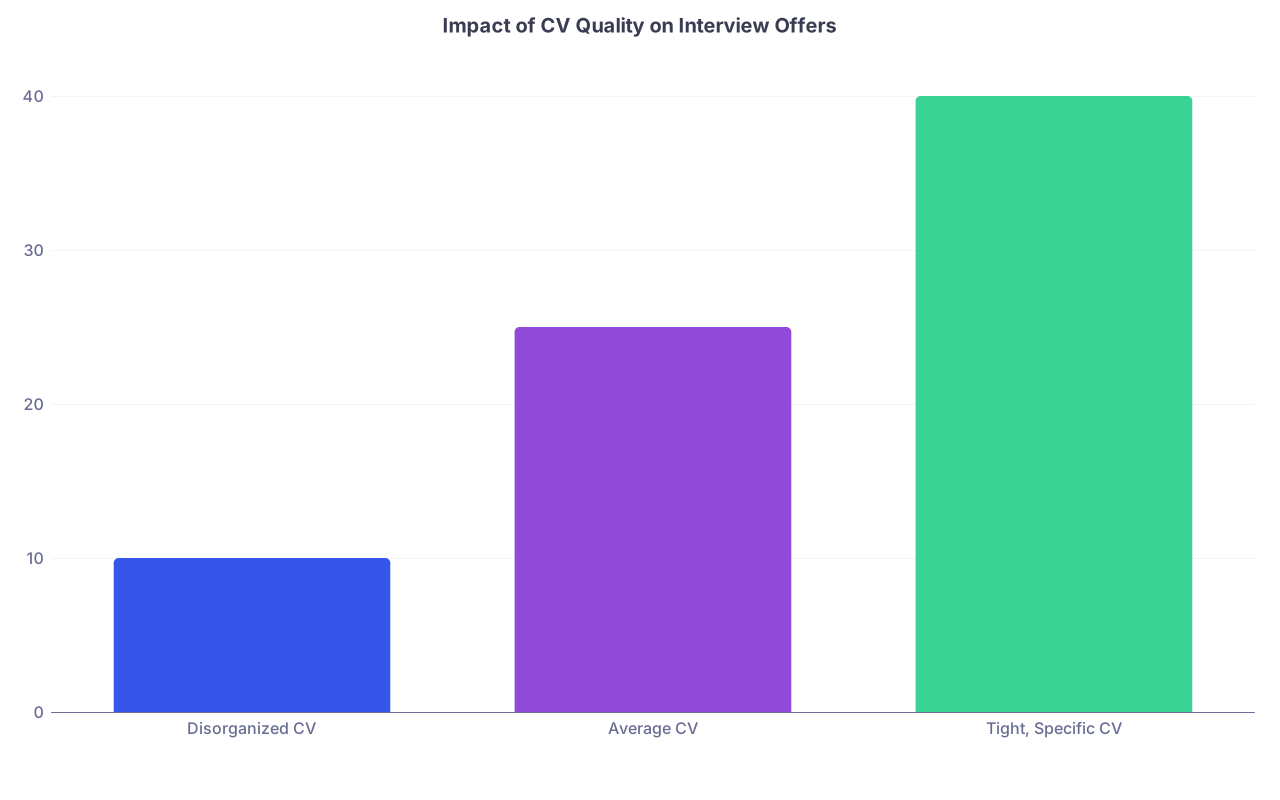
| Category | Value |
|---|---|
| Disorganized CV | 10 |
| Average CV | 25 |
| Tight, Specific CV | 40 |
What PDs Say After You Leave the Room (And How Your CV Plays Into It)
Here’s the part that really matters.
The CV doesn’t just get you an interview. It shapes what they think of you after you leave.
In ranking meetings, I’ve heard versions of:
- “She actually ran that student clinic for two years. You can tell from her CV she sticks with things.”
- “His research entries are all fluff. Three ‘in progress’ manuscripts and no posters. I don’t buy it.”
- “Look at his work history—EMT, then ED tech, then scribe. This guy knows how hospitals work.”
- “All their leadership is 3–4 months long. I’m worried they won’t stay engaged.”
You know what they’re scrolling through on the screen while saying this? Your CV entries. Not your personal statement. Not your LORs. Those help, but the CV is the backbone.
Your goal is simple: give them undeniable, specific lines they can reference when they’re arguing to rank you higher.
“I want this person” is always easier to say when there’s a concrete sentence backing it up.
Practical Rewrite Strategy: How to Audit Your Own CV Like a PD
Here’s how I tell students to do it when I’m being blunt:
- Print your ERAS experience list or open it on a laptop.
- Give yourself 15 seconds per entry with a timer. That’s generous compared to how PDs read.
- For each entry, ask: “Would a stranger understand what I actually did and why it matters?”
- If the answer is no, rewrite the bullets until a non-medical friend could roughly picture you in the role.
Specific fixes to implement across the entire CV:
- Replace every “helped” or “assisted” with a more specific verb and explicit task.
- Add scale to at least half your bullets: numbers, frequency, duration.
- Unify your story: if you say you’re passionate about X specialty, at least some clinical, research, or leadership entries need to point in that direction.
- Kill redundancy: merging 2–3 similar low-impact roles into one cleaner entry is better than padding.
And stop trying to win by volume. A PD looking at 60 applications today will be much more impressed by:
- 8–12 well-written, substantial experiences
than by:
- 25 copy-paste, repetitive, vague entries that all look and sound the same.