
You’re staring at your CV, cursor blinking on the “Leadership & Activities” section.
You’ve got a few titles on there — Treasurer of some interest group, maybe an orientation leader, a research team “co-lead” you sort of invented because you did a lot of work but weren’t the PI. And in the back of your mind is this constant question:
“Do these leadership roles actually matter to residency committees, or are they just filler between Step scores and publications?”
Let me tell you exactly how they get scored. Because they do get scored — just not the way your school’s career office tells you.
How Program Committees Actually Look at Your CV
Here’s the unpolished truth: most programs do not have time for a nuanced, soulful reading of your leadership “journey.”
A typical file review for mid-tier programs? 2–4 minutes per applicant on the first pass. At some places, less. At some of the hyper-competitive spots, it’s literally closer to 60–90 seconds for the initial screen.
So what happens to your leadership titles in that slice of time?
They get run through two mental filters:
- “Is this real leadership or fluff?”
- “Does this predict how this person will behave as a resident in my program?”
That’s it. There’s no spreadsheet where “President” is 5 points and “Member” is 1. But there is pattern recognition. And most faculty have been doing this for years. They know the difference between signal and decoration.
I’ve sat in those rooms when we go through 40 files before lunch. I’ve watched PDs skim your CV with one finger sliding down the page, pausing on very specific things. Let me walk you through what actually makes them stop — and what they ignore without even realizing it.
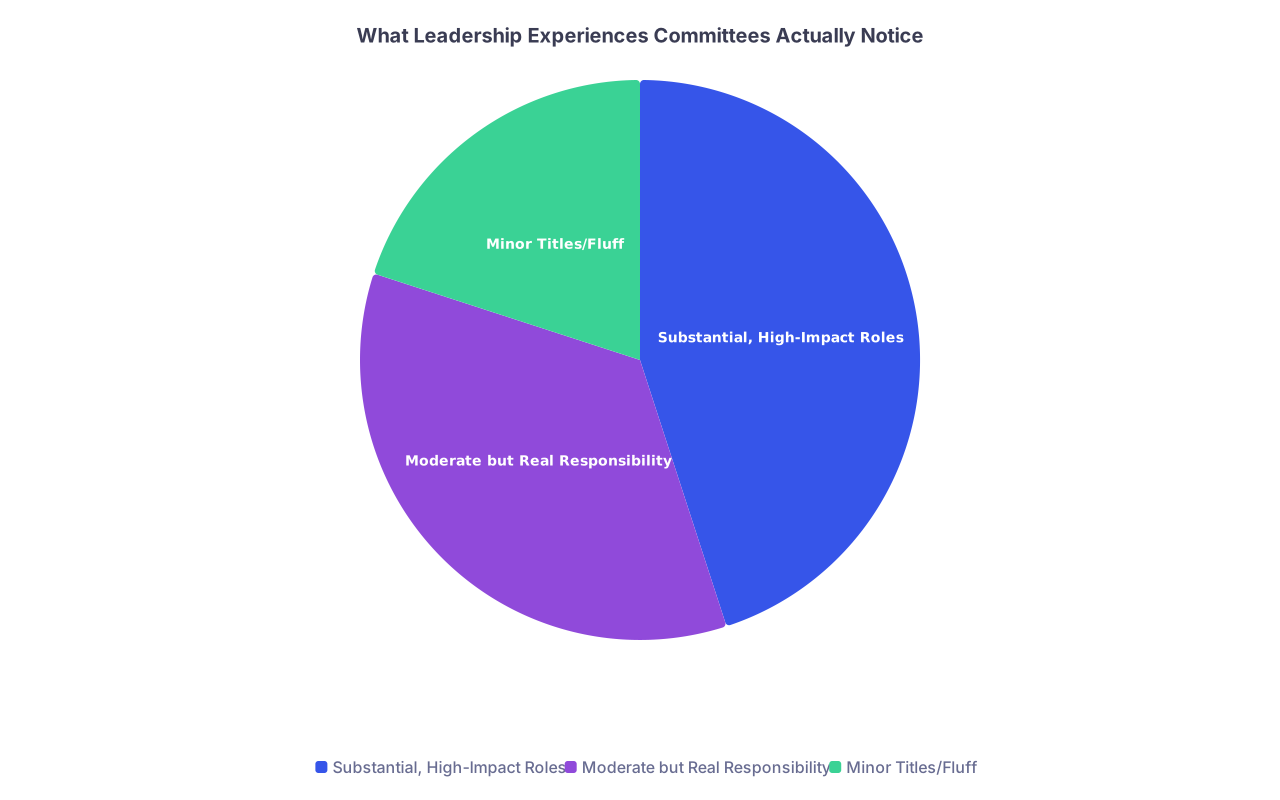
| Category | Value |
|---|---|
| Substantial, High-Impact Roles | 45 |
| Moderate but Real Responsibility | 35 |
| Minor Titles/Fluff | 20 |
The Hierarchy: Not All Leadership Titles Are Scored Equally
There’s an unwritten hierarchy of leadership in the minds of reviewers. Nobody publishes it. But everyone uses it.
Top-tier leadership that always gets noticed
These are the ones that make reviewers lean forward a bit:
- Chief Resident (for prelim/TY apps or advanced applicants)
- Class president or major class-wide position (e.g., Student Government Exec)
- Significant national or regional leadership (AMA, specialty organizations, national committees)
- Founder of a major, enduring initiative (free clinic, new course, robust service project)
- PI or lead coordinator of a large research project or QI initiative that produced real outcomes
Those are the “okay, this person actually runs things” roles.
You’d be surprised how fast an associate program director will say “oh, they were class president” and immediately file you into the “likely solid teammate, probably reliable, probably can herd cats” mental box.
Mid-tier leadership that can be powerful (or totally invisible)
This is where most applicants live:
- President/VP of a student interest group
- Orientation leader / peer mentor / house leader
- Committee roles (curriculum committee, diversity council, wellness task force)
- Coordinator of tutoring programs, USMLE prep groups, or peer-teaching initiatives
- Team captain (sports, intramurals) or club officer roles
- Research or QI “co-lead” or project manager
These can look strong or completely meaningless depending on two things:
- Scope — how many people or moving parts did you actually manage?
- Outcomes — what changed or happened because you did the role?
If those aren’t obvious in 1–2 lines, the title usually gets mentally downgraded to “generic med student leadership.”
Low-tier or “filler” leadership
You know these:
- Any title with “member” in it
- Temporary committee attendance with no clear work
- “Co-founder” of tiny, short-lived things that clearly just padded a CV
- Generic volunteer with a fancy name slapped on it
- Titles where the description screams “I did this for ERAS”
Those aren’t scored. They occupy space. At best they soften a weak CV with “at least they showed up to something,” but in competitive piles, they don’t move the needle.

What Reviewers Are Actually Asking Themselves
Let me translate how your leadership titles are subconsciously “scored” in the heads of PDs and faculty.
They’re not thinking, “Oh wow, 3 leadership positions, that’s impressive.”
They’re thinking:
- “Can I trust this person with responsibility at 3 a.m. when a nurse calls?”
- “Have they ever had to manage other humans?”
- “Have they done anything that suggests they won’t crumble when they’re overwhelmed?”
- “If I make them a chief in four years, will they be a disaster or an asset?”
Strong leadership roles shortcut those questions. Weak ones don’t touch them at all.
Red flags hidden in leadership sections
This part nobody tells you.
Certain patterns quietly hurt you:
- Twenty micro-roles, none held for more than a few months → “dabbler, likes titles, poor follow-through.”
- Huge leadership title, zero outcomes listed → “possible resume inflation.”
- Multiple “founder of X” roles that look like clones of existing groups → “ERAS entrepreneur, might be image-focused.”
- Leadership in toxic or controversial groups at your school that faculty talk about behind closed doors → “we know what that actually means.”
I sit in meetings where someone will say, “Oh, they were on that committee? That group is useless. Nobody does work there,” and the whole room mentally discounts it.
That’s the stuff you never hear in your dean’s meeting.
How Different Specialties Weight Leadership
Here’s another internal truth: leadership doesn’t mean the same thing in every specialty.
| Specialty | How Much Leadership Matters | What Impresses Them Most |
|---|---|---|
| Internal Med | Moderate-High | Chief roles, QI leadership |
| Surgery | High | Team leadership, endurance roles |
| Emergency Med | Very High | Operations, event coordination |
| Pediatrics | High | Community programs, advocacy |
| Psych | Moderate | Peer support, wellness, teaching |
| Radiology | Moderate-Low | Research/tech project leadership |
This is broad, but it tracks with what I’ve heard in faculty rooms.
Surgery and EM eat up real leadership. They want people who have run things under pressure.
Radiology and pathology care more about intellectual leadership and project ownership than student council politics.
If you’re applying to EM with nothing but “preclinical interest group secretary” and “member, AMSA,” and you’re wondering why interview invites are thin — this is why.
How Committees “Score” Titles During File Review
Different programs use different systems, but here’s the pattern:
- Automatic screen – Scores, class rank, MSPE, red flags. Leadership doesn’t rescue you here unless you’re on the borderline.
- File review scoring rubric – Many programs have a “non-academic” or “experiential” domain. Leadership often lives here.
- Holistic impression – This is where a truly strong leadership narrative can bump you up or bump you down.
I’ve seen rubrics with 1–5 points for “Leadership & Service.” Here’s how those usually shake out in practice (not the written version they show accreditation):
- 1–2 points: No leadership or only trivial roles.
- 3 points: Typical med student stuff — one or two positions, mild responsibility.
- 4 points: A clear, sustained role with impact or multiple moderate roles with clear outcomes.
- 5 points: Major leadership with scope (class-wide, large initiatives, national leadership, chief).
Here’s the kicker: the difference between a 3 and a 4 in that domain can be the difference between “interview” and “no interview” at places that have too many borderline applicants.
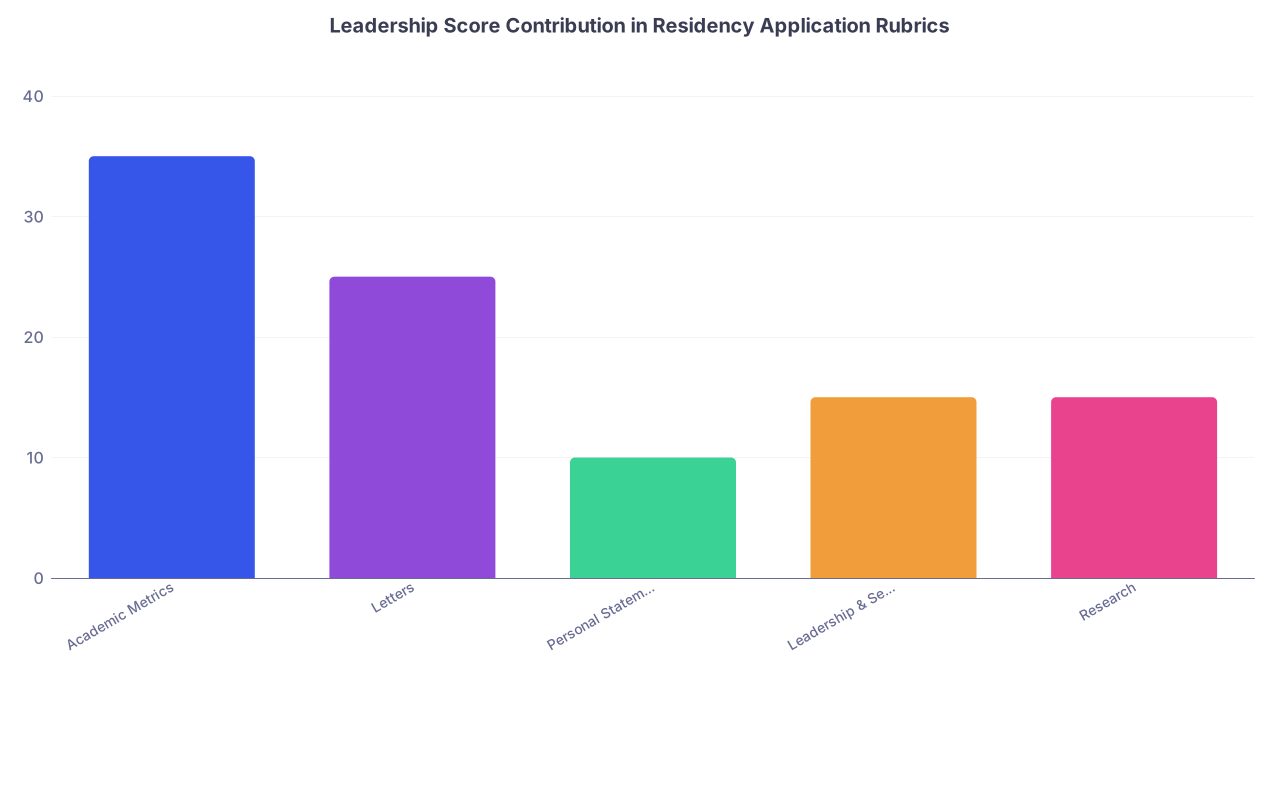
| Category | Value |
|---|---|
| Academic Metrics | 35 |
| Letters | 25 |
| Personal Statement | 10 |
| Leadership & Service | 15 |
| Research | 15 |
Is leadership the main thing? No.
Can it be the tiebreaker? Absolutely yes.
Why Some Titles Hurt You More Than They Help
You’ve been told “any leadership is good.” That’s not entirely true.
Reviewers are allergic to inflation.
If your CV reads like a LinkedIn influencer who just discovered the word “founder,” people get suspicious very fast.
The committee members around the table are thinking:
- “Did this actually require leadership, or did they just fill out a form and get a title?”
- “Does this person chase recognition more than real work?”
- “If they’re this grandiose on paper, what are they like in person?”
I’ve seen PDs literally roll their eyes at:
- “Founder and CEO of [two-person tutoring initiative that met twice]”
- “Executive Director of the [tiny student-run group that copied an existing service]”
- Ten separate “co-chair” roles all in the same year
They assume you’re doing what a lot of students do: stacking titles and hoping someone will be impressed by the volume.
They won’t. They’d rather see three solid roles than fifteen hollow ones.
How to Turn a Basic Title into a Strong Leadership Signal
Here’s the part you can control: the story that sits under the title on your CV.
Most students waste that space.
They write:
“President, Internal Medicine Interest Group
- Organized meetings and invited speakers
- Coordinated activities for members”
That tells a reviewer absolutely nothing. That’s the job description.
Here’s how a reviewer-friendly version looks:
“President, Internal Medicine Interest Group
- Increased active membership from 15 to 60 by restructuring events and introducing resident-led case nights
- Secured funding and coordinated 3 hands-on workshops with 40+ attendees each”
Now it says:
- You changed something.
- You dealt with logistics, recruitment, coordination.
- You got results you can quantify.
That’s the kind of thing that quietly bumps your “leadership” score from a 3 to a 4 in someone’s head.
Same role. Different framing. Very different impact.

The Hidden Gold: Leadership in Your Letters and MSPE
Here’s something your dean’s office usually doesn’t explain:
The most powerful leadership signal is not the title on your CV. It’s when a faculty member or PD writes something like:
- “She is the de facto leader on every team she joins.”
- “Residents consistently turn to him when things are chaotic; he has the presence of a chief.”
- “She single-handedly revived our student-run clinic operations during COVID disruptions.”
When that kind of line shows up in a letter, your modest “clinic coordinator” title suddenly looks a lot bigger. Because now we know what it meant.
And committees absolutely cross-reference. I’ve watched reviewers say:
“They were just vice president of the interest group, but listen to this line from the letter — clearly they were the driver.”
Your goal is to make your lived leadership so obvious that writers cannot avoid mentioning it. Titles alone won’t do that. Behavior on the wards, in clinic, on projects will.
Same with the MSPE “Noteworthy Characteristics” section. If one of those bullets is a leadership story — not a title — you get remembered.
How to Rehab a Mediocre Leadership Section
So what if you’re a late M4 or already in the application cycle and your leadership section is… underwhelming?
You’re not going to invent new roles now. And you shouldn’t.
What you can do:
- Upgrade descriptions from duties to outcomes and scope.
- Connect leadership with clinical work, QI, teaching — not just clubs.
- Make sure your strongest leadership story appears somewhere else too: in your personal statement, a letter, or the MSPE.
For example, if your best “leadership” was taking charge of a chaotic inpatient team and informally organizing sign-outs, you can’t list that as a title. But you can ask your attending or resident to highlight it in a letter.
And in your personal statement, one short paragraph about a time you coordinated a team during a heavy call shift can say more about your readiness than a dozen club presidencies.
This is what most students don’t understand: committees care vastly more about functional leadership than formal leadership. Titles are just a quick proxy. You want both to align.

| Step | Description |
|---|---|
| Step 1 | Leadership Titles on CV |
| Step 2 | Reviewer Skims Application |
| Step 3 | Minimal Impact |
| Step 4 | Read Description Carefully |
| Step 5 | Positive Leadership Impression |
| Step 6 | Influences Rubric Score |
| Step 7 | Borderline Applicant Bumped Up |
| Step 8 | Substantial Role? |
| Step 9 | Clear Outcomes? |
The Mistakes That Make Committees Roll Their Eyes
You want the unvarnished list? Here it is.
I’ve seen all of these in the wild:
- Listing “Team Leader – Anatomy Dissection Group” like it’s a major role
- Calling yourself a “CEO” of a two-person side project
- Adding “Informal” in front of made-up leadership titles
- Triple-counting the same activity in clinical, leadership, and research sections
- Writing four lines about some minor pre-med club and one line about a major QI project
- Claiming leadership for things clearly run by faculty or administration
This stuff doesn’t just fail to help you. It signals poor judgment.
Programs are trying to sniff out insecurity and ego under stress. Overblown leadership claims are a giant red flag.
If you’re not sure whether a role sounds inflated, imagine your own PD reading it in front of you and asking, “So tell me exactly what you did in that role.” If that thought makes your stomach drop, tone it down or cut it.
What Actually Impresses Committees (That You Don’t Realize Is Leadership)
Let me flip the script and tell you about the kinds of “quiet” leadership that make people in the room nod:
- Running an efficient, humane sign-out system that residents mention in their narrative comments.
- Creating a simple checklist that reduced errors or improved workflow on a rotation.
- Organizing a small but consistent peer-tutoring group that helps classmates pass.
- Being the M4 everyone goes to for advice on schedules, electives, or hard attendings — and doing it well.
- Taking on the unglamorous logistical work for a free clinic or QI project and actually making it function.
If even one attending writes a line like, “She is a natural leader without needing a title,” you’ve already won the leadership game. That carries more weight than half the fancy student government roles in your class.
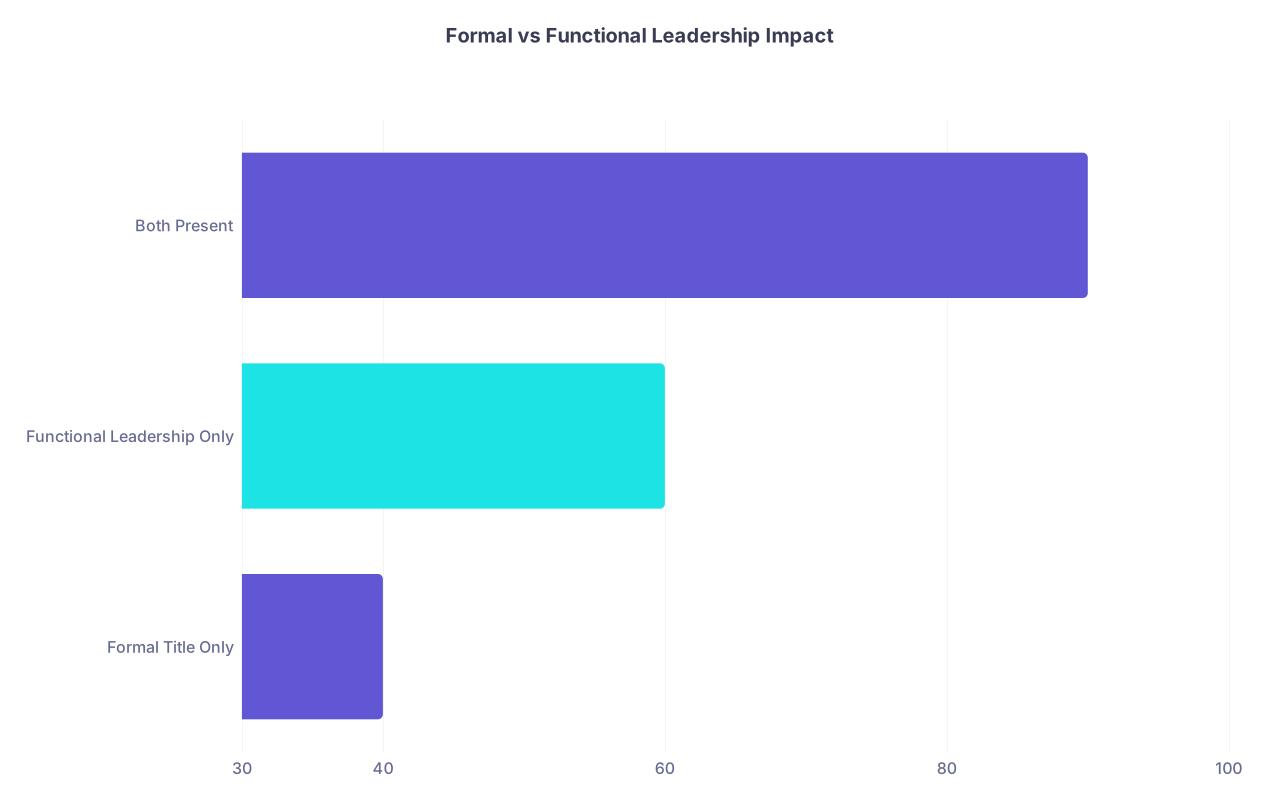
| Category | Value |
|---|---|
| Formal Title Only | 40 |
| Functional Leadership Only | 60 |
| Both Present | 90 |
Most applicants overestimate the value of formal titles and underestimate functional leadership. Committees lean the other way.
How to Fix This Before You Apply
If you’re not in the middle of submitting ERAS yet, you still have room to maneuver.
You don’t need to become president of everything. You need one or two real roles with:
- Duration (more than a semester of token participation)
- Responsibility (people, logistics, or outcomes depending on the role)
- Evidence of change (growth, improvements, new initiatives)
Pick things that intersect with your specialty if you can, but it’s not mandatory. An IM applicant who led a student-run free clinic and then talks about system-based practice? Gold. An EM applicant who organized large-scale simulation nights? Same.
Then do the boring, unsexy work really well. Show up. Take responsibility when things go wrong. Do the follow-through your classmates are too busy to do. That’s what gets you the kind of letters that turn mild titles into strong leadership signals.
Leadership titles on your CV don’t get scored the way your school’s brochure suggests. Nobody is counting positions. They’re scanning for evidence that you can be trusted with responsibility when things are messy, fast, and consequential.
If your leadership section is a pile of thin titles with vague bullet points, committees will treat it as wallpaper. If it’s a small set of concrete, outcome-focused roles backed up by letters and real stories, it quietly moves you up the stack.
You’ve got time — whether right now you’re rewriting bullets on your ERAS application or still choosing how to spend your M3 and early M4 year. Use it to trade fluff for substance. One real, demanding role done well is worth more than ten hollow presidencies that never left a mark.
With that foundation built, your next real task isn’t adding more titles. It’s making sure your personal statement and interview answers tell the same story: someone who doesn’t just collect positions, but actually leads. That’s where committees stop skimming and start remembering your name — but that’s a conversation for another day.