
Last week I was talking to a former EMT who spent five years doing corporate project management before medical school. She stared at her ERAS CV and said, “All anyone’s going to see is that I wasted time and couldn’t commit.”
That feeling—that your years outside medicine are a permanent stain on your residency application—sits in your chest like a rock. I know that exact panic: the timeline that doesn’t look “clean,” the gap you’re sure will be the first thing every PD whispers about behind closed doors.
Let’s walk through this, like two people sitting at 11:30 p.m. refreshing ERAS and catastrophizing together.
First: What Program Directors Actually Care About (Not the Fantasy Version in Your Head)
Let me just say it bluntly: they’re not sitting there with a ruler measuring how “pure” your medical path was.
They care about:
- Can you handle the workload and finish residency?
- Are you safe with patients?
- Are you reliable, not a headache?
- Do you fit their culture, roughly?
- Are there any red flags they’ll have to justify to their colleagues?
That’s it. Everything else—research, leadership, volunteering—is supporting evidence.
Years outside medicine only become a “problem” if they:
- Look like you’re running from responsibility, not holding it
- Are totally unexplained, like you disappeared into the wilderness
- Directly conflict with your “story” (e.g., “I’ve always known I wanted surgery since age 5” but you spent 7 years happily doing something else and never mention why that changed)
If your non‑medical work shows the opposite—responsibility, longevity, leadership, hard things done well—it’s not a liability. It’s ammunition. The real danger is you presenting it badly or apologizing for it.
How Working Outside Medicine Can Quietly Help You (Even if You Don’t Believe Me Yet)
You’re probably stuck in “I’m behind, I’m older, everyone else has 10 publications” mode. I get it. But look at what you actually bring that most straight-through applicants don’t.
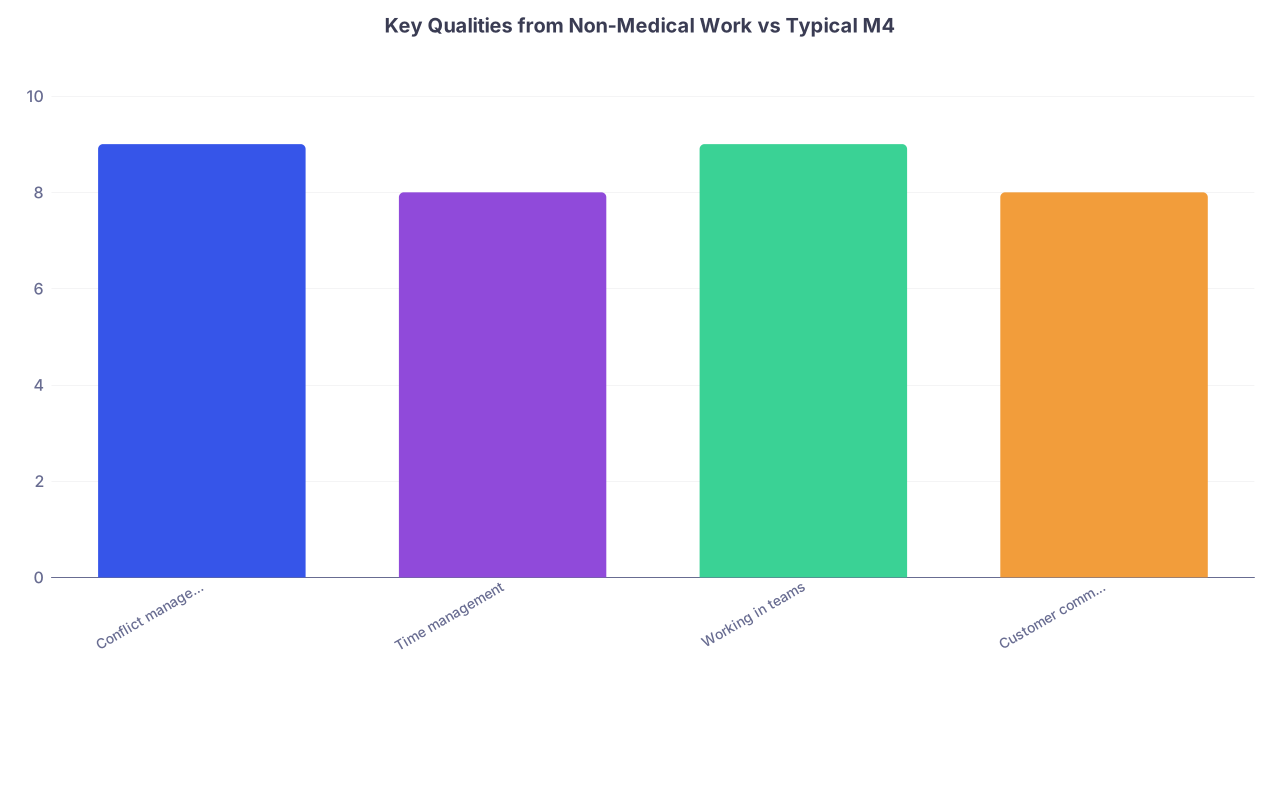
| Category | Value |
|---|---|
| Conflict management | 9 |
| Time management | 8 |
| Working in teams | 9 |
| Customer communication | 8 |
No, that’s not “scientific.” But it reflects reality. Non‑medical work—if you did it for years—usually gives you:
- Real accountability: You were fired if you didn’t show up or hit deadlines, not just “got a B.”
- Experience with angry people: Replace “customer” with “patient” or “family,” and suddenly your old job is weirdly relevant.
- Working with different personalities: You already know how to deal with a micromanager, an avoidant colleague, the disorganized boss. That’s residency.
- Time and task juggling: If you managed multiple clients, projects, or shifts, that’s PGY‑1 life in a different outfit.
Program directors are desperate for one thing: residents who don’t implode under stress and don’t make them regret ranking them. A long, stable work history—even outside medicine—screams, “You can trust me to show up.”
The trick is: you can’t just list the jobs. You have to translate them.
The Part That Actually Matters: How You Frame Those Years
If you throw your past jobs into ERAS like a sad LinkedIn dump, yeah, it’ll look random and irrelevant. That’s on us, not them.
Here’s how to frame non‑medical work so it helps rather than hurts.
1. Rewrite Your Mental Story First
If the story in your head is, “I wasted five years being lost,” that energy leaks all over your personal statement and interviews.
You need a cleaner, honest narrative like:
- “I worked as an engineer for four years, learned I loved problem-solving but missed meaningful human interaction, and that’s what pulled me to medicine.”
- “I supported my family by working retail management for six years; it taught me conflict resolution, scheduling, and how to stay calm under pressure—skills I now bring to clinical care.”
Not a fairy tale. Just a straight, non-defensive explanation that shows:
- There was a reason
- You grew from it
- You made a deliberate pivot to medicine
If you sound ashamed of your past, they’ll wonder if they should be suspicious of it. If you sound grounded and clear about it, most will move on.
2. Translate Job Duties into Residency-Relevant Skills
Don’t do this in a cheesy way. No “Excel wizard = surgical precision” nonsense. But you do need to show them how this matters.
Take a few examples.
Retail manager (3 years):
Bad: “Managed store operations and supervised staff.”
Better: “Led 12-person team, created schedules under variable staffing, handled daily customer complaints, resolved conflicts and escalations.”
Connect it to residency: leadership, time management, difficult conversations.
Corporate project manager (5 years):
Bad: “Coordinated projects across departments.”
Better: “Oversaw 10+ concurrent projects with hard deadlines, tracked progress, adjusted timelines when issues arose, and communicated expectations to stakeholders.”
Residency parallel: running a list, coordinating consultants, updating families and teams when plans change.
Truck driver, restaurant server, teacher, IT support, etc.—almost all of them have pieces you can realistically connect to patient care, teamwork, communication, reliability.
Where To Put This Stuff on ERAS (And What NOT to Do)
You don’t hide it. Please don’t try to bury five years of your life like no one will notice.
1. Work Experiences Section
This is exactly where long-term non-medical jobs go.
For each role:
- Use action verbs
- Mention measurable scope when possible (size of team, number of clients, volume, responsibility level)
- Add 1–2 lines tying skills to medicine without sounding like a motivational poster
Example:
“Customer Service Supervisor, XYZ Bank (2016–2020)
Supervised team of 8 representatives, handled escalated customer issues, and maintained performance metrics above company targets. Developed skills in de-escalating high-stress situations and delivering complex information in understandable terms—approach I now use with patients and families.”
That’s enough. You’re not writing a novel.
2. Personal Statement: Mention It Once, Cleanly
You don’t need three paragraphs about your “journey from marketing to medicine.” One tight moment is enough.
Something like:
“Before medical school, I spent four years as a high school teacher. I loved mentoring students, but I found myself increasingly drawn to the intersection of science and advocacy in my students’ lives. That tension led me to medicine, where I’ve been able to combine that same patience and communication with direct clinical care.”
Then move on. If you dwell on it like it’s a crime you’re confessing, it becomes weird.
3. CV Timeline Consistency
What freaks PDs out is unexplained gaps, not “different career.”
If you have:
2014–2018: Software engineer
2019–2023: Medical school
That’s honestly cleaner than:
2014–2015: shadowing
2016: random stuff
2017–2018: part-time jobs, “studying”
2019–2023: medical school
Long, consistent work history = stability. Just make sure dates line up between ERAS, your personal statement references, and any LORs that mention your background.
The Red Flag Question: When Can It Hurt You?
I’m not going to pretend there’s never a downside.
Years outside medicine can raise eyebrows when:
- There are frequent 3–6 month jobs with no explanation = looks like you can’t stick with anything
- You were fired or had professionalism issues you’re hiding = that will come out if someone calls references
- The story changes every time you tell it = suggests you’re not honest or haven’t processed it
- You still seem ambivalent about medicine = worst-case for a PD who’s terrified you’ll quit PGY‑2
The way you protect yourself:
- Be consistent in how you explain the shift across PS, interviews, and LORs
- Own it without drama: “I tried X seriously, realized it wasn’t the long-term fit I wanted, and chose medicine.”
- Show commitment now: strong clinical evals, good Step scores (if applicable), continuity in med-related experiences since you started this path
| Scenario | How It’s Seen |
|---|---|
| 4+ years in one role, promotion | Strong reliability, maturity |
| 6 jobs in 3 years, no clear reason | Instability, potential red flag |
| Clear explanation of career change | Thoughtful, deliberate choice |
| Vague or evasive about past | Concern about honesty |
| Ongoing clinical engagement now | Reassuring commitment |
| Minimal current involvement in medicine | Worry you’re still unsure |
If your situation is messy—lots of job changes, long unexplained breaks—then you need to be ready with a calm, non-defensive explanation. Not a monologue. One or two honest sentences.
How to Talk About It in Interviews Without Sounding Defensive or Desperate
This is where anxiety usually explodes. You sit down, the PD glances at your ERAS, and you know it’s coming:
“I see you worked in another field for several years before medicine. Tell me about that.”
Here’s how to not spiral.
1. Use a Simple 3-Part Structure
I’ve seen this work over and over:
- What you did
- What you learned
- Why you changed paths
Example:
“I worked as a mechanical engineer for five years. I enjoyed problem-solving and working with teams, and it taught me how to stay calm when things didn’t go as planned. Over time I realized the parts of my job I found most fulfilling were when I was directly helping people—mentoring junior engineers, explaining complex ideas—so I started volunteering in a clinic, and that’s when I realized I wanted a more hands-on role in people’s lives. That led me to medical school and ultimately to internal medicine.”
Short. Clear. No apology. No melodrama.
2. Don’t Overcompensate
You don’t have to insist, “I’ve always wanted to be a doctor” when your CV literally shows 8 years doing something else. That just makes you sound disconnected from your own life.
Better: “Medicine wasn’t my first career, but it’s the one that finally aligned my skills with what I care about long-term.”

| Step | Description |
|---|---|
| Step 1 | Describe prior job briefly |
| Step 2 | Name 1-2 key skills gained |
| Step 3 | Explain what felt missing |
| Step 4 | Describe how medicine filled that gap |
| Step 5 | Link to chosen specialty |
You can literally map your answer onto that in your head during an interview.
If You’re Still Panicking: What to Do This Year to Strengthen Your CV
If you’re in med school or in a research year and drowning in “I wasted too much time,” here’s how to calm your brain and give PDs something current to hang onto.
Do at least one of these (two is better):
Get a sustained clinical thing going
Weekly free clinic, longitudinal elective, year-long hospital volunteer gig, something. You want to show: “Yes, I’m here now. Consistently.”Attach your past to something concrete in medicine
Ex-teacher? Tutor or teach MS1s. Ex-program manager? Take on a QI project. Ex-IT? Help with EMR optimization project.Ask for at least one letter that mentions your prior career positively
“She brings maturity from her previous work in X, which shows up in how she handles feedback / teams / patients.”
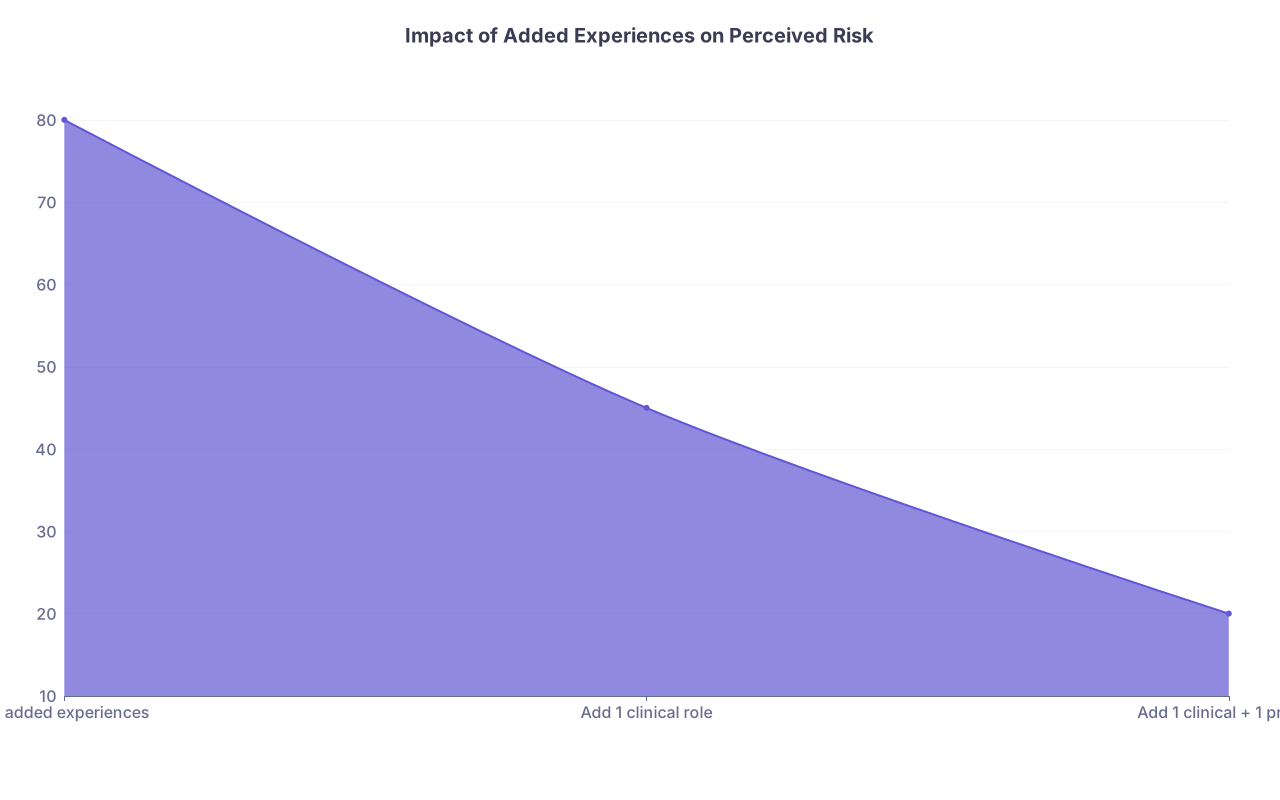
| Category | Value |
|---|---|
| No added experiences | 80 |
| Add 1 clinical role | 45 |
| Add 1 clinical + 1 project | 20 |
Again, not scientific. But I can tell you from what I’ve seen: once a file shows current performance and clear commitment, the anxiety about your old life fades fast in reviewers’ minds.
You’re Not the Only One (Even If It Feels Like It)
This is maybe the one thing I wish someone had drilled into my head.
There are:
- Former nurses applying to anesthesia and EM
- Ex-accountants going into internal medicine
- Ex-teachers in pediatrics
- People who did whole PhDs in unrelated fields and then switched
And plenty of them match. Into good programs.
The ones who struggle usually have one of three problems:
- They try to hide or minimize their past and come off vague
- They haven’t built enough current evidence of fit for their specialty
- Their scores or clinical performance are weak, and the prior career becomes an easy scapegoat
Your job isn’t to erase your past. It’s to make it make sense. To you first. Then to them.

FAQ: Six Questions I Know You’re Still Asking
1. Do programs secretly prefer “straight-through” students over people who worked first?
Some do. Some actually like older, nontraditional folks because they stabilize a class. You can’t control individual biases. What you can control is giving them no legitimate reason to see your past as a risk: strong clinical performance, clear explanation, consistent story. I’ve seen 30‑something ex-lawyers match at solid academic IM and EM programs. It’s possible.
2. Should I leave short, random pre-med jobs off my ERAS?
If they were brief (a month or two) and don’t meaningfully contribute to your story, it’s usually fine to leave them off. But anything substantial (a year+), especially if it fills a gap, should be on there. Leaving big chunks of time blank is worse than listing a not‑so‑glamorous job. Gaps scream “what happened?” far louder than “barista” or “assistant manager” ever will.
3. Will they think I’m less committed because I “found” medicine late?
Only if you talk about it like some vague random drift. If you can articulate why you changed paths and what makes medicine the right long-term fit, they’ll often see you as more committed. You tried something else, realized it wasn’t right, and still chose the brutal path of medicine. That’s not a casual decision.
4. Do I need to write my entire personal statement about my previous career?
No. Please don’t. One strong, specific paragraph is enough to anchor your story. The rest should be about why this specialty, what you’ve done in medical school, and who you are now. Overemphasizing your past can accidentally make it the main character, when it’s really just Act I.
5. Should I apply more broadly because of my non-medical background?
Apply broadly because the match is insane, not because you worked a different job before. But yes, if your scores or grades are average and you’re worried about being “nontraditional,” casting a wider net is smart. Community and mid-tier academic programs often value maturity more than hyper-elite research places that want 20 pubs. Know your profile. Don’t self-reject, but don’t be delusional either.
6. What if an interviewer clearly doesn’t respect my previous career?
Then that’s data. If someone sneers at your years of work or makes you feel small about supporting your family, they’re telling you what kind of culture they run. Answer calmly, stick to your story, and mentally mark that program as lower on your list. The whole point of all this suffering is to end up somewhere that sees your actual value, not just your test scores.
If you strip away the panic, you’re someone who’s already lived a real adult life, then chose medicine anyway. That’s not a weakness. The key is making your CV and your story reflect that clearly and consistently—without apology, without drama, just facts and growth.