
Last week, a classmate whispered to me in the library, “I still haven’t figured out how to explain my gap year on ERAS. Do you think PDs will think I’m lazy?” Then she laughed in that way that’s not really laughing at all—more like trying not to cry in public.
I nodded way too fast because… same. My brain has basically been running the same loop: I took a gap year. Program Directors are going to see it. They’re going to think I’m unreliable. Weak. Damaged goods. Right?
Let’s talk about that. Honestly. Not in the fake “it’s all fine, everything is a growth opportunity” way. In the “I’m terrified but I still need a plan” way.
What PDs Actually See When They See a Gap
Here’s the nightmare version playing in my head:
PD opens my ERAS, scrolls, sees a missing year, leans back in their chair, says to the coordinator, “Yeah, no. Pass.” And that’s it. One missing line on a timeline, and my entire future goes straight into the trash.
The reality is less dramatic. Annoyingly less dramatic.
Most PDs I’ve talked to or heard on panels care about three things with gaps:
- Is it explained?
- Does the story make sense with who you say you are now?
- Does it raise red flags about reliability or professionalism?
They’re not allergic to gaps. They’re allergic to mystery.
Unexplained gaps. Vague gaps. “Personal reasons” with zero context. Things that suggest you disappeared off the face of the earth and might do it again in residency when you’re on night float covering half the hospital.
The brutal truth: a gap in your CV isn’t automatically the problem.
An unexplained gap is.
A badly framed gap is.
A defensive or confusing explanation is.
So when my brain screams, “PDs will hate this,” the more accurate translation is: “If I don’t handle this carefully, I might make them nervous.” Which, honestly, is something we can work with.
The Big PD Question: “What Were You Doing and Why?”
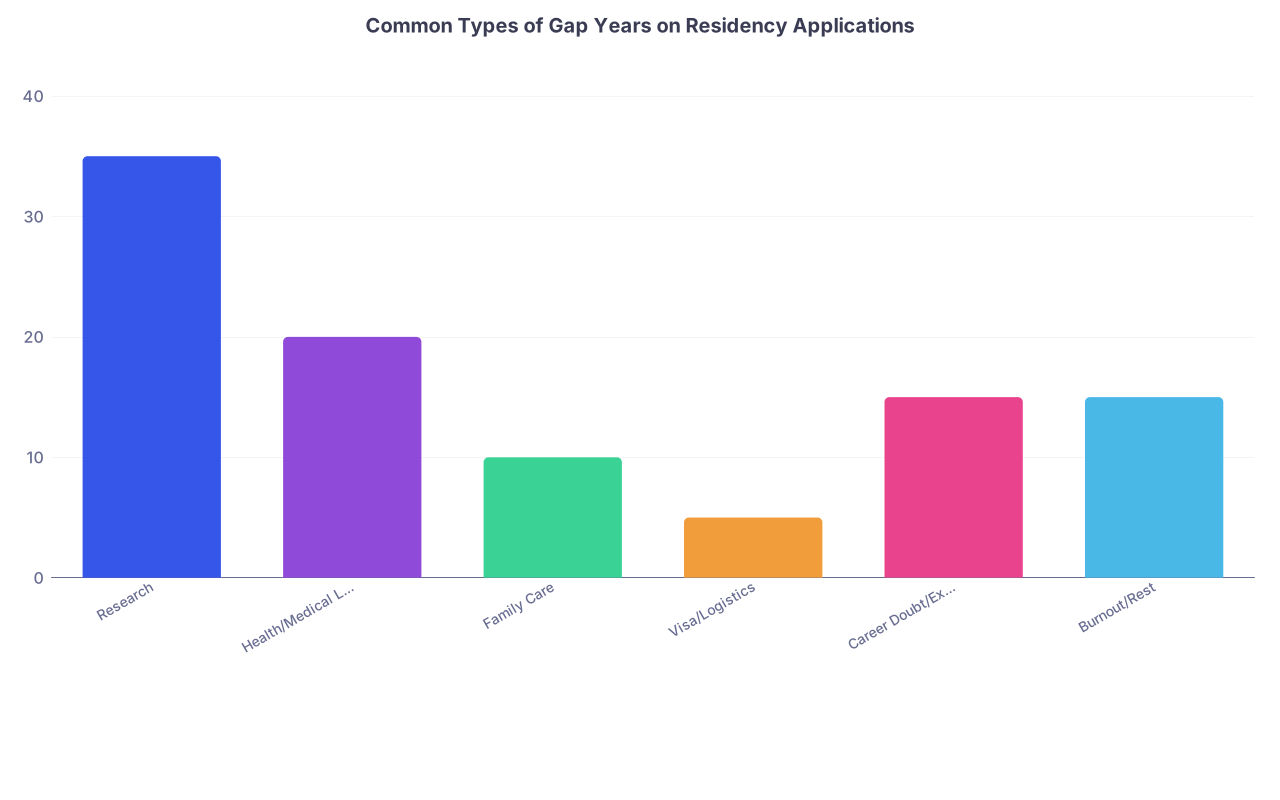
| Category | Value |
|---|---|
| Research | 35 |
| Health/Medical Leave | 20 |
| Family Care | 10 |
| Visa/Logistics | 5 |
| Career Doubt/Exploration | 15 |
| Burnout/Rest | 15 |
Every PD is basically scanning your application with one silent question in mind:
“Can I trust this person to show up, learn, and not implode halfway through PGY-2?”
Your gap year becomes one more piece of data toward that question.
What helps them feel okay?
You show:
- You were doing something specific.
- You have a clear, grounded reason for the gap.
- You’re not hiding it, you’re not ashamed of it, and you’re not spinning some weird fantasy.
They do not need you to have cured cancer or written three NEJM papers during that time. They just need to not feel uneasy.
I’ve seen people match with:
- A year out for severe depression and therapy.
- A year home taking care of a dying parent.
- A year doing full-time research in a totally different city.
- A year because they failed Step the first time and regrouped.
- A year because they realized mid-M4 that they hated their chosen specialty and had to regroup.
Those all matched. Not because PDs love “non-traditional journeys” as some inspirational poster. But because those stories were clean, honest, and didn’t scream chaos.
The Ugly Fear: “Will They Think I’m Weak?”
Here’s the thought that really keeps me up:
“If I admit I needed time off—mental health, burnout, family stuff—they’ll think I’m weak and unfit for this career.”
I hate how much that feels believable in medicine. We all see how residents are run into the ground. We absorb this unspoken rule: you’re allowed to be a burnt crisp of a human, but you’re not allowed to say you needed to stop for a second.
Here’s the thing I’ve heard over and over from attendings who actually sit on selection committees: they’re much more worried about people who don’t have insight into their limits.
PDs are not looking for superheroes. They are looking for people who will not:
- Impulsively quit mid-year
- Hide their struggles until they blow up into disaster
- Refuse to ask for help when actually drowning
A gap year framed as:
“I completely shut down, ignored my problems, vanished from med school, and still don’t really know what happened,”
is scary.
A gap year framed as:
“I hit a wall, recognized it, got help, used the time to get stable, learned how to recognize my early red flags, and I’ve been functioning reliably since,”
is not.
It’s not about being flawless. It’s about showing you’re not a walking time bomb.
How to Frame Different Kinds of Gaps (Without Lying)
This is the part my brain obsesses on: wording. That little 1020-character box on ERAS where you explain “leave of absence” or “gap” feels like a bomb. Use the wrong phrase and boom, right?
Here’s how I’d approach some of the common scenarios, and what PDs actually care about in each.
1. Research Year
Honestly? This is the least scary kind.
Most academic programs won’t even blink. In some specialties (derm, neurosurgery, ortho), they almost expect it.
The trap is when your “research year” looks like: 2 months of research, 10 months of Netflix.
You want:
- A clear research mentor and setting: “Full-time research fellow in the Department of Cardiology at X University.”
- A focused goal: “Outcomes research in heart failure readmissions” beats “Helped with some projects.”
- Concrete outputs or lessons: abstracts, posters, manuscripts—even if “in preparation” or “submitted.”
If you didn’t produce much (which happens more than anyone admits), don’t fabricate. Focus on skills: data analysis, IRB process, learning research methods, improving presentation skills.
The red flag is not low productivity. The red flag is pretending you changed the field and having nothing to show for it.
2. Health / Mental Health Leave
This one feels terrifying to even write down.
I’ve watched people agonize over how explicit to be. You don’t owe every PD your full psych history. You also shouldn’t hide behind a foggy “personal reasons” line if it was a formal leave.
A reasonable middle ground:
- Keep it focused and brief.
- Name the general category: “medical leave” or “health-related leave” is usually enough.
- Emphasize treatment + stability + successful return.
Something like:
“Took a medical leave of absence from Month/Year to Month/Year to address a health condition. During this time, I engaged in appropriate treatment and fully recovered. I returned to clinical rotations, completed them on-schedule, and have maintained stable functioning since.”
If it was mental health, you can decide how specific you want to be. Some say “medical leave.” Some say “mental health treatment.” The key: you show that the problem wasn’t ignored. It was addressed. There’s a track record of stability after the gap.
PDs are much more nervous about someone who pretends they never had issues than someone who says, “I dealt with this and here’s the proof that I’m okay now.”
3. Family Responsibilities / Caregiving
PDs are not robots. Many have taken care of dying parents or sick spouses themselves.
Being home for a year to help with a parent’s cancer treatment or a sibling’s crisis doesn’t make you weak. It makes you a person.
You don’t have to spill all the family trauma. Something like:
“From Month/Year to Month/Year, I took a leave from formal training to assist with a significant family medical situation. During this period, I provided logistical and emotional support and managed day-to-day responsibilities, while maintaining involvement in [online CME, virtual research meetings, self-directed study] as feasible. Once the situation stabilized, I returned to training with renewed focus.”
The key: you weren’t just passively floating. You were functioning. You came back. You’re not still on the edge of that same crisis.
4. Academic Struggles / Step Failure / Remediation
This is the one that feels like a flashing neon sign: “I STRUGGLED.”
PDs see this every year. The disaster is when applicants get defensive or vague.
They want:
- What went wrong (in plain language)
- What you did differently
- Evidence that the new system works
Something like:
“After initially struggling with standardized exams, I took a leave from Month/Year to Month/Year to focus on preparing for Step 1. I worked closely with academic support services, developed a structured study plan, and addressed test-taking anxiety. I returned to coursework with improved performance, successfully passed Step 1, and subsequently passed Step 2 on the first attempt.”
Notice the structure: problem → action → outcome. You’re not pretending it didn’t happen. You’re showing it changed you.
What If My Gap Really Was… Kind of Empty?
Here’s the horror scenario:
“What if I didn’t do anything impressive? I was just… home. Burnt out. Drifting. No job. No research. Just trying to function.”
Honestly? A lot of people have a year like that. They just don’t talk about it.
You cannot rewrite the past, but you can choose how you interpret it now.
Ask yourself:
- Did you take care of your own basic functioning (sleep, eating, therapy, exercise)? That’s still real work, even if med culture pretends it’s not.
- Did you help family? Work odd jobs? Volunteer occasionally? Tutor? Anything?
- Did that emptiness teach you something about how you want (or don’t want) to live?
You do need something—anything—structured to put in that space. It’s okay if it’s modest:
- Part-time work, even non-medical
- Volunteering
- Self-directed study (if you can describe it concretely)
- Language courses
- Caregiving
If your gap year is this year and you’re still in it: don’t let the rest of it stay empty. Start now adding structure, even if small.
If it’s in the past and you genuinely did very little, be honest but not self-sabotaging. Frame it:
“I took time away from formal training during Month/Year–Month/Year. Initially, I struggled with burnout and adjustment, and I used this time to focus on regaining stability, including [therapy, exercise, reconnecting with supportive communities]. As I recovered, I engaged in [part-time work, tutoring, online coursework]. I returned to medical training with improved coping strategies and sustained performance since.”
It’s vulnerable. But it has arc. It doesn’t sound like you’re still lost.
How to Show PDs You’re Not a Risk
This is what it all comes down to. They’re not deciding if past-you was flawless. They’re asking: “Is future-you safe to invest in?”
A gap stops being scary when your recent track record is clean and strong.
Three things help a ton:
Your last 12–18 months look stable.
Solid clerkship evaluations. No new leaves. Step 2 done and passed. No vague unexplained breaks.Letters that back up your story.
If you had a gap for health or academics, having an advisor or PD say, “They had a rough period, they addressed it, and they’ve been reliable and strong since,” carries more weight than anything you write about yourself.You talk about it calmly in interviews.
Not oversharing. Not crying mid-answer. Not launching into a 10-minute monologue. Just a clear, rehearsed, honest explanation and then… move on.
Concrete Ways to Make Your Gap Less Scary on Paper
| Strategy | What It Signals to PDs |
|---|---|
| Recent solid clinical performance | Current reliability and readiness |
| Step 2 taken early and passed | Academic stability now |
| At least one strong home institution letter | People who know you trust you |
| Any structured activity during gap | You weren't totally adrift |
| Clear, concise ERAS explanation | No hidden chaos |

| Step | Description |
|---|---|
| Step 1 | See CV Gap |
| Step 2 | Concern - Possible red flag |
| Step 3 | Uneasy - Inconsistent |
| Step 4 | Higher risk |
| Step 5 | Acceptable - Move on |
| Step 6 | Is it explained? |
| Step 7 | Does story fit rest of app? |
| Step 8 | Recent performance stable? |
So if you’re spinning out like I am, here’s what I’m doing to keep myself from completely melting:
- I’m writing a short, non-dramatic explanation and showing it to someone who’s sat on a selection committee, asking them bluntly: “Does this sound okay or terrifying?”
- I’m making sure my recent stuff is as strong as I can get it: Step 2 done, good evals, at least one attending who can genuinely vouch for my reliability.
- I’m accepting that I can’t erase the gap. I can only own it.
The Part None of Us Want to Admit
Some programs will see a gap and quietly move on. Especially the hyper-competitive, “we have a thousand perfect applicants” places. You could have the world’s best explanation and they just won’t bother engaging.
That sucks. It’s not fair. It’s also not personal. You are not your most fragile year.
But plenty of programs—especially ones that actually work with real humans in real life—will look at you as a whole picture. Gaps and all. They’ve had residents who had kids. Cancer. Divorces. Breakdowns. Recoveries.
They understand that sometimes the most resilient people are the ones who’ve already been broken once and rebuilt.
You’re not going to get to write “Gap year taught me resilience” in big heroic font and have everyone clap. But you can quietly prove it with how you’ve shown up since.
If You’re Still Panicking
Honestly? Same.
I still have nights where my brain jumps to, “What if every PD sees this and thinks I’m unstable?” Or, “What if this one year ruined everything I worked for the last decade?”
Then I remember:
- It happened.
- I’m still here.
- I’m better now than I was before it.
And PDs aren’t fortune tellers. They’re just people trying not to pick residents who will implode. Your job isn’t to convince them you’re perfect. Your job is to show them that when life hit hard, you didn’t stay down forever.
If you can do that—clearly, calmly, without drama—your gap year stops being a permanent stain and becomes just one chapter.
Not the whole story. Not the final verdict.
Just one hard year in a long career you’re still allowed to have.
Key points to hold onto:
- PDs don’t automatically reject you for a gap; they worry only when it’s unexplained, chaotic, or inconsistent with your current performance.
- A clear, honest, brief explanation plus strong recent performance and letters can neutralize a lot of the fear around that missing year.
- You can’t edit the past, but you can control the story you tell now—and how convincingly your current behavior proves you’re not the same person who went through that gap.